Category: Uncategorized

  • Remote Staffing vs BPO vs Employer of Record: Which Is Better for Your Business?

    Remote Staffing vs BPO vs Employer of Record: Which Is Better for Your Business?

    Hiring in the Philippines gives you access to a skilled, English-speaking workforce at competitive rates.

    However, before you bring someone on board, you need to choose the right hiring model.

    Your decision affects how much control you have, the ease or difficulty of compliance, and a good chunk of your daily operations, especially if you outsource a significant portion.

    Below is a clear guide comparing the three most common global team outsourcing options to choose from:

    Understanding the 3 Most Common Hiring Models in the Philippines

    Before choosing how to hire in the Philippines, it helps to understand how each model works.

    These three offshoring strategies differ in how much control the client has over the worker, the extent of legal responsibility, and how much control you keep over day-to-day operations on that side of the world:

    What Is Remote Staffing

    What Is Remote Staffing?

    Remote staffing lets you work with Filipino professionals in two ways: direct hire or through an agency like Remote Staff.

    Direct Hire

    You can hire talent directly as employees in the Philippines. This gives you full control over their tasks, schedule, and workflow.

    You are also responsible for payroll, benefits, and legal compliance, which requires understanding local labor laws and registration processes.

    However, handling legal compliance and taxes for a direct hire can be difficult without a legal entity in the Philippines.

    Through an Agency

    When hiring independent contractors through an agency (like Remote Staff), the provider recruits, screens, and matches candidates to your requirements.

    The contractor works directly with you on day-to-day tasks, while the agency supports onboarding, provides monitoring tools, and assists with administrative tasks.

    You manage performance and workflow, as you would with an internal team member, but without incurring the need for internal HR administration.

    What Is a Business Process Outsourcing (BPO) Company?

    Business process outsourcing (BPO) delivers a service using its own employees.

    You pay the BPO for the output based on agreed metrics or service levels, and they decide how the work is done internally.

    You don’t manage or control their staff. You don’t set their schedules, processes, or pay. The BPO oversees everything — hiring, training, supervision, and workflow — while you receive the final results.

    BPOs work best when you want a hands-off setup for standardized, high-volume tasks and prefer to focus on outcomes rather than managing individual workers.

    What Is an Employer-of-Record (EOR)?

    An Employer of record services (EOR) legally employs your Filipino worker on your behalf.

    You source and select the talent, and manage their tasks and day-to-day work, while the Employer-of-record handles all legal and administrative responsibilities.

    This includes:

    • Payroll and contracts
    • Taxes and statutory contributions
    • Compliance with DOLE and BIR regulations
    • Mandatory benefits and local labor documentation

    For example, Remote Staff offers two distinct services: supplying independent contractors or using an EOR for the talents you directly recruited.

    Using an EOR lets you directly recruit your team and control their workflow without setting up a Philippine company or worrying about legal compliance.

    It’s ideal if you want direct sourcing and management of talent while avoiding HR, administrative, and legal burdens.

    Key Differences Between remote staffing, BPO, and EOR

    Key Differences Between remote staffing, BPO, and EOR

    When deciding remote staffing solutions vs EOR vs BPO, comparison across key factors can help you choose the best model for your business:

    Cost Comparison

    • Remote Staffing: You can hire talent directly as employees or as independent contractors through an agency.

    Costs are generally lower than hiring full-time local employees directly, though pricing varies depending on skills and whether you manage HR/admin yourself or use the agency’s support.

    • BPO: You pay a flat service fee for output or metrics. Pricing can be higher for fully managed services since the BPO handles staff, training, and operations.
    • EOR: You cover salaries and benefits like a local employee, plus the EOR fee. Costs are slightly lower than remote staffing and it avoids the cost of setting up a local entity and ensures compliance.
    • Remote Staffing: If hiring directly, you are responsible for legal compliance, payroll, and benefits.

    If hiring through an agency, reputable providers like Remote Staff can help manage compliance, onboarding, and labor requirements.

    • BPO: The BPO handles employment compliance for their own staff. You’re only responsible for overseeing the results of the BPO contract.
    • EOR: The EOR assumes all legal employment responsibilities, including taxes, statutory benefits, and labor compliance. You focus solely on managing the work itself.

    Talent Control and Cultural Fit

    • Remote Staffing: High control — whether you hire directly or through an agency, you manage tasks, workflow, and communication, and can integrate them into your company culture.
    • BPO: Low control — you receive output but don’t direct how the staff arrive at them. Testing for cultural fit is limited.
    • EOR: Medium to high control — you manage daily tasks and team culture, but the EOR handles HR and compliance in the background.

    Setup Time and Scalability

    • Remote Staffing: Fast to set up, whether hiring direct employees or contractors through an agency.

    Scaling is easy, as you can add more team members as needed.

    • BPO: Moderate setup; scaling depends on the BPO’s capacity and processes. Adjusting team size or workflow can be slower.
    • EOR: Quick setup without a local entity; scaling is straightforward since you can still choose who you hire while the EOR manages legal employment.

    Which Model Is Best for Australian SMEs?

    Australian SMEs face unique challenges when hiring overseas: maintaining control, moving quickly, and supporting hybrid or remote teams. Choosing the right model depends on your priorities for compliance, management, and flexibility.

    Outsourcing Without a Local Entity

    If you want entity-free hiring and access to Filipino talent without registering a local company, Remote Staffing, BPO, and EOR can all be viable options:

    • Remote Staffing: You can hire talent directly as employees or through an agency as independent contractors.

    Hiring directly without a local entity gives you full control over tasks and workflow, but it can be risky. You are responsible for payroll, benefits, compliance with Philippine labor laws, and avoiding misclassification of workers.

    Hiring through a reputable agency reduces these risks. The agency handles sourcing, onboarding, and basic administrative support, while you retain control over day-to-day work.

    • BPO: Pay for services based on output or metrics. The BPO manages its own staff and operations, so you don’t deal with HR or employment compliance.
    • EOR: You source and manage the worker, while the EOR handles payroll, contracts, statutory compliance, and benefits — letting you oversee their work without legal risk.

    All three options allow quick access to talent, though direct hiring without a local entity carries legal and compliance risks.

    Using a reputable agency or an EOR helps you mitigate these risks while still gaining fast access to skilled workers.

    When You Need Flexibility + Compliance

    Australian SMEs that need control over daily work while staying compliant can choose:

    • Remote Staff contractors: Flexible for project-based or ongoing tasks without full employment obligations.
    • EOR services: Full-time talent can be integrated into your team, while the EOR ensures compliance with local labor laws.

    This approach is ideal for hybrid or distributed teams that require both oversight and legal security.

    Full-Time vs Project-Based Hiring

    • Remote Staffing and EOR: Whether hiring independent contractors (short-term or long-term) directly or through an agency, or engaging talent via an EOR, you retain control over workflow and can fully integrate them into your team.

    Using a reputable agency or EOR adds safeguards because both manage legal, payroll, and HR responsibilities, ensuring compliance and reducing risk.

    The main difference is an agency recruits for you, while you recruit your own in an EOR.

    • BPO: Suited for ongoing, standardized processes where results or output matter more than managing individual workers.
    Common Myths About BPOs and EORs

    Common Myths About BPOs and EORs

    Misconceptions about BPOs, EORs, and remote staffing can lead to costly errors in decision-making. Here are the most common myths — and the truth behind them.

    “BPOs Are Always Cheaper”

    Many assume BPOs cost less because they bundle services, but fully managed operations often come with higher fees.

    In some cases, other talent acquisition outsourcing like remote staffing and employer-of-record arrangements are more cost-effective, depending on the role/s and level of control you need.

    “Remote Teams Are Less Reliable”

    With proper vetting, monitoring tools, and structured workflows, remote professionals can match or even exceed the performance of in-office teams.

    Reliability depends on the remote workforce management systems and support you put in place, not the work setup.

    “EOR Gives You Full Control”

    An EOR lets you manage day-to-day work while taking care of the legal and administrative responsibilities behind the scenes.

    You control tasks, workflow, and team culture, while the EOR remains the official employer on paper in the Philippines, handling payroll, statutory benefits, taxes, contracts, and compliance in remote hiring laws.

    However, there are limitations within the employment framework itself.

    For example, you cannot skip statutory benefits, abruptly adjust employment contracts, or change payroll schedules to suit your preferences.

    It’s best to consult with the employer-of-record to ensure that adjustments comply with local laws while keeping your team protected and operations running smoothly.

    Remote Staff’s Hybrid Solution: The Best of All Worlds

    Remote Staff offers a flexible approach that combines compliance, control, and long-term relationship continuity.

    In addition to our standard remote staffing option, we provide a separate Contractor-on-Record (CoR) model and an EOR solution as well.

    If you already have remote staff, you can choose to start with a CoR setup or an EOR model, or transition from CoR to EOR later — giving you full oversight of work while minimizing legal and administrative risks.

    How Contractor-on-Record Works_

    How Contractor-on-Record Works

    The Contractor-on-Record (CoR) model is a hybrid setup where Remote Staff acts as the administrative employer for your contractor, while you retain full control over their day-to-day tasks and workflow.

    It is similar to an EOR, as Remote Staff handles contracts and payroll. The key difference is that under a CoR, your talents retain their independent contractor status.

    This means they are not reclassified as employees, so you are not required to pay statutory benefits.

    However, if you prefer, you can still provide statutory benefits voluntarily.

    When to Switch from CoR to EOR

    As your team grows, takes on more critical responsibilities, or becomes more integrated with your core operations, transitioning to an EOR setup can be a smart move.

    While the CoR model offers flexibility and administrative support, it has limitations for teams that are central to your business.

    Relying on contractors for key operations might be viewed by regulators in your country as misclassification, increasing legal and compliance risks.

    Switching to an EOR ensures your team has full employment rights, while you continue to retain control over their work.

    This provides a safer, legally compliant structure that supports long-term growth, stronger integration, and team stability.

    Full Transparency + Local Support

    Remote Staff ensures visibility into performance, hours, and workflow while providing local support for compliance and administrative matters.

    This combination allows businesses to manage their teams effectively, maintain culture, and reduce risk — all without setting up a local entity.

    How to Choose the Right Hiring Model for Your Business

    Choosing between a remote staffing, CoR, or EOR setup depends on the pace of your team’s growth, the roles you need to fill, and your comfort level with legal and compliance responsibilities.

    Unlike most agencies, Remote Staff can provide the talent you need for any team size — whether it’s a small group of contractors, a larger team, project-based, part-time, or full-time positions.

    So if you’re keen to avail a CoR and EOR service but need additional staff, Remote Staff can also find suitable talents for you.

    That said, here’s a look at the options if you want more control over recruitment or you already have remote talents in your team you want to transition to an EoR for compliance:

    Business Size and Growth Stage

    • Startups or small teams (1–3 hires): CoR through an agency is often enough if you need speed, flexibility, and low commitment.
    • Growing teams (4–10 hires): EOR is ideal when you need structure, payroll support, and smoother operations.
    • Scaling companies (10+ hires or long-term teams): EOR ensures statutory compliance, employee stability, and lower long-term risk.

    Type of Roles (Tech, Admin, Back Office)

    • Project-based or flexible roles: CoR through an agency works well for freelance-style work such as design, development sprints, or short-term admin.
    • Operational or ongoing roles: EOR fits back-office, admin, customer support, and roles that require consistent workflows.
    • Critical or core-business roles: EOR is the safest option for engineers, long-term tech talent, or staff managing sensitive processes where regulators may view contractor arrangements as misclassification.
    • Need to hire within days? CoR or Remote Staffing through an agency gives you the fastest onboarding.
    • Moderate urgency + moderate compliance needs? EOR provides payroll, government remittances, and a smoother structure.
    • Long-term hires with exposure to your internal systems? EOR reduces risks, especially if regulators in your home country might view contractors as de facto employees.

    Here are some questions you can answer to better decide:

    [wpforms id=”30797″ title=”false”]

    Frequently Asked Questions (FAQ)

    Below are quick answers to the most common questions when choosing between BPO, CoR, and EOR models.

    What’s the main difference between BPO and EOR?

    A BPO provides managed services where the provider controls the team, processes, and output.

    An EOR lets you manage the work directly while the provider handles local employment, payroll, taxes, government remittances, and statutory benefits.

    Is Remote Staff considered an EOR or a BPO?

    Remote Staff is neither a traditional BPO nor a pure EOR.

    We operate a hybrid model that offers:

    • COR for flexible arrangements
    • EOR for complete statutory compliance

    This gives you more control than a BPO and more flexibility than a standard EOR.

    Do I need a Philippine entity to use any of these models?

    No. You can hire in the Philippines through Remote Staff without setting up a local corporation.

    A CoR and EoR allow you to operate legally without forming a Philippine entity.

    How fast can I hire through Remote Staff’s hybrid model?

    You can typically hire within days, depending on the role.

    CoR is the fastest, while the EoR may take slightly longer because they include additional steps for compliance, but onboarding is still quick compared to forming your own entity.

    What’s more compliant: hiring a freelancer or using an EOR?

    An EOR is significantly more compliant, especially for long-term or integrated roles.

    Freelancer arrangements can raise misclassification risks—both in the Philippines and in your home country—if the contractor functions like an employee.

    An EOR structure protects you by ensuring statutory benefits, taxes, and labor regulations are properly managed.
    Need Help Choosing Between Remote Staffing, BPO, or EOR_

    Need Help Choosing Between Remote Staffing, BPO, or EOR?

    Hiring in the Philippines gives you access to skilled, English-speaking talent at competitive rates.

    However, before you bring someone on board, you need to choose the hiring model that fits your goals.

    Each option — Remote Staffing, BPO, or EOR — offers different levels of control, compliance, and involvement in daily operations.

    Choosing the right model is a crucial part of outsourcing partner selection, helping you stay compliant, manage your team effectively, and avoid unnecessary risks.

    So whether you’re exploring outsourcing models for SMEs, startup outsourcing solutions or other offshore team building strategies, Remote Staff can guide you through the options and recommend the best setup based on your business size, timeline, and legal risk appetite.

    Take the next step: schedule a call with Remote Staff today.
  • Planning to Outsource Work to the Philippines? A Guide to Independent Contractor vs. Employee

    Planning to Outsource Work to the Philippines? A Guide to Independent Contractor vs. Employee

    As more Australian SMEs turn to the Philippines for scalable remote talent, proper worker classification has become increasingly relevant—even critical.

    The stakes are high: the Australian Fair Work Commission (FWC) recently reaffirmed in Pascua v Doessel Group Pty Ltd (2024-2025) that overseas workers may still be considered employees, not contractors, if the employment relationship factors reflect employee-level control and integration.

    This case resulted in 15 weeks’ compensation for unfair dismissal, reinforcing how costly misclassification can be – even when the worker lives offshore.

    The Philippines also maintains certain enforcement standards under the Labour Code, DOLE, and BIR—each regulating benefits, taxes, and employment status.

    For Australian businesses, this means a worker engaged offshore must still be classified correctly under both jurisdictions to avoid liabilities.

    Let’s analyse how and why to truly determine whether your Filipino talent is an independent contractor or employee – and to avoid costly mistakes while still reaping the benefits of outsourcing global talent.

    IN THIS BLOG

    Why Worker Classification Matters – Even When You Hire From the Philippines

    Correct labour classification protects your business from penalties, backpay disputes, and compliance failures.

    It also determines whether the engagement is legally viewed as a contract for services (contractor) or a contract of service (employee).

    For Australian SMEs relying on Filipino talent, misclassification risks extend across both Australian and Philippine law.

    Misclassifying a Filipino worker who performs employee-like functions can expose Australian businesses to compliance issues, disputes, and financial liabilities.

    Key risks include:

    • Exposure to unfair dismissal claims if the worker is terminated without a valid reason or proper process
    • Liability for underpayment where contractor fees do not meet certain requirements
    • Requirement to pay entitlements normally owed to employees, such as leave, public holiday rates, or penalty rates, if the arrangement is deemed as misclassified
    • Breaches of contracting laws, leading to penalties

    Tax and Payroll Risks for Australian Employers Hiring in the Philippines

    Even if the overseas talent is based in the Philippines, some regulations Down Under will still apply if they’re found to be misclassified – creating risks around taxes, pay, and compliance.

    Australian SMEs face:

    • Incorrect tax treatment for payments classified as contractor fees but functioning as wages
    • Exposure during ATO audits if contractor arrangements resemble employment
    • Increased scrutiny under Australia’s sham contracting laws
    • FWC jurisdiction if the employment relationship factors tie the worker to Australia

    In Pascua v Doessel Group, Pascua successfully claimed unfair dismissal in Australia. The FWC ruled she was an employee, not a contractor, because:

    • Her hours followed Australian business schedules
    • The employer exercised day-to-day control over her tasks
    • She used company tools and systems
    • Her role was part of core business operations

    This ruling confirms that misclassification risks apply even when workers are offshore.

    What Is an Independent Contractor in the Philippines

    What Is an Independent Contractor in the Philippines?

    An independent contractor operates as a self-employed professional under a contract for services, offering their expertise with full autonomy and minimal supervision.

    They typically manage their own tools, taxes, and workflows. Contractors are appropriate only when the engagement type truly reflects independence.

    Indicators of a contractor engagement:

    • Paid per project, milestone, or invoice
    • Exercises control over schedule and execution
    • Works with multiple clients
    • Uses personal equipment and systems
    • No entitlement to government-mandated employee benefits

    Key Characteristics Under Labour Law

    According to most labour guidelines, a contractor must demonstrate independence from employer control.

    These typically include:

    • Autonomy over work methods and schedule
    • Responsibility for personal taxes and compliance
    • Ability to subcontract or delegate tasks
    • Operation as a business, not an individual employee
    • No integration into the client’s organisational structure

    When Is It Safe to Hire Contractors?

    Contractor engagements work best for projects that are:

    • Scope-based rather than hourly
    • Not central to core business deliverables
    • Flexible, creative, or specialised
    • Short-term or seasonal
    • Performed with minimal oversight or reporting obligations

    If your relationship requires daily supervision, fixed hours, or KPIs, your contractor likely functions as an employee, creating misclassification risks.

    What Defines an Employee in the Philippines?

    A worker becomes an employee when the company exerts control over their time, tasks, and work methods.

    This creates a contract of service, which mandates full labour benefits, proper payroll handling, and regulated termination processes.

    Labour Code Criteria for Employment

    When hiring offshore talent, Australian employers must follow Australian employment standards, not rely on contractor labels alone.

    The Pascua v Doessel Group Pty Ltd case proved this clearly: even a Filipino worker based overseas can be deemed an employee under Australian law if the business exercises control, sets fixed hours, or integrates the worker into core operations.

    This is where an Employer of Record (EOR) becomes essential. An EOR applies the correct classification from the start, making sure the engagement satisfies the standards set for contractors under the law, regardless of what the contract states.

    It also prevents sham contracting, protects the business from FWC disputes, and provides compliant employment conditions for the worker.

    Mandatory Benefits and Employer Duties

    Employees are entitled to statutory protections and benefits, including:

    • Contributions to government-mandated benefit or insurance programs
    • Guaranteed wage protections and minimum pay standards
    • Access to paid leave entitlements
    • Overtime and public holiday pay where applicable
    • Clear, lawful termination procedures
    • Compliance with local job classification and employment regulations

    Contractor vs Employee: What’s the Difference?

    Employee vs contractor differences influence payroll, taxation, benefits, operational control, and legal liability.

    The differences are significant and must match the actual employment relationship.

    Key distinctions include:

    • Legal Relationship: contract of service (employee) vs contract for services (contractor)
    • Control: employees follow employer-defined workflows; contractors retain autonomy
    • Tools: employees receive and utilize company tools; contractors use their own equipment
    • Payments: employees receive payroll with taxes withheld; contractors issue invoices and presumably take care of their own taxes
    • Benefits: mandatory for employees; none for contractors
    • Schedule: fixed hours for employees; flexibility for contractors

    Visual Comparison Table: Contractor vs Employee

    To make the distinction even easier to understand, here’s a side-by-side comparison that highlights the core differences between an independent contractor and an employee.

    Factor Independent Contractor Employee
    Engagement Type Contract for services Contract of service
    Control High autonomy Employer controls work
    Tools Uses own equipment Employer-provided tools
    Payment Invoice-based Payroll with taxes withheld
    Benefits None Mandatory benefits required
    Hours/Schedule Flexible Fixed or employer-set
    Risk for AU SMEs High misclassification risk Low risk under compliance

    Example Scenarios for Remote Teams

    Here are some examples of companies successfully running remote teams:

    • Atlassian has long embraced distributed teams and remote collaboration, proving remote work can scale globally.
    • Canva is an Australian-owned unicorn with staff across multiple countries, leveraging remote teams for design, tech development, and support.

    These global companies show remote teams work, but only when roles are classified correctly, tools are in place, and compliance is managed.

    Common Mistakes by Australian SMEs

    What Are the Risks of Misclassifying Remote Workers from the Philippines?

    Misclassification exposes Australian SMEs to liabilities even at home Down Under, where regulators increasingly scrutinise offshore contractor arrangements.

    Common Mistakes by Australian SMEs

    The Pascua v Doessel Group Pty Ltd case showed that certain practices commonly applied to offshore contractors can cause the FWC to classify them as employees instead.

    The most frequent misclassification mistakes include:

    • Imposing fixed daily working hours that follow Australian business hours
    • Supervising and directing daily work tasks as if managing an internal employee
    • Assigning ongoing operational or core business duties instead of project-based work
    • Providing company email accounts, signatures, or internal tools
    • Setting KPIs, performance metrics, or billable-hour requirements
    • Expecting exclusivity or long-term availability inconsistent with contractor autonomy
    • Integrating the contractor into the internal team structure, including training others

    Consequences may include:

    • FWC unfair dismissal claims (as seen in the Pascua case)
    • Breach of sham contracting provisions
    • Liability for backpay, leave, and superannuation (where applicable)
    • ATO penalties for incorrect tax treatment
    • Legal fees and reputational risk

    Penalties can include:

    • Retroactive benefit contributions under Philippine law
    • Salary differentials and overtime payments
    • Tax liabilities in both Australian and Philippine jurisdictions
    • DOLE compliance orders
    • FWC compensation or reinstatement
    • Contractual disputes escalating into cross-border litigation

    Contractor-on-Record: A Compliant Alternative

    The Contractor-on-Record model guarantees that arrangements with contractors remain legally compliant while maintaining their autonomy.

    A Contractor-on-Record model provides:

    • Legally compliant contract for services drafting
    • Contractor payments through compliant channels
    • Documentation and invoice record-keeping
    • Basic compliance checks to avoid wrongful control
    • Tax reporting support for contractors

    Benefits Over Direct Contractor Payments

    Advantages include:

    • Lower misclassification risk
    • Cleaner audit trails for both Philippine and Australian regulators
    • Consistent, accurate payment processes
    • Eliminates the need for international remittances
    • Scalability toward EOR if the role evolves

    Onboarding Process Through Remote Staff

    Remote Staff’s onboarding has speed, clarity, and proper job classification:

    • Role scoping to confirm whether the contractor status is valid
    • Skills and identity verification
    • Legally compliant contract preparation
    • Set up of local payment systems
    • Alignment on start dates and engagement type

    When Should You Use an EOR?

    EOR becomes essential when your engagement type begins to look less like an independent contractor arrangement and more like an employee setup.

    As soon as increased control over output, fixed hours, company tools, or ongoing responsibilities start reshaping the employment relationship, an EOR guarantees compliance while maintaining operational continuity.

    This section explains when it’s time to shift from contracting freelancers to a more structured and compliant model that protects both parties.

    Moving from Freelancers to Full-Time Remote Teams

    Many freelancers evolve into core contributors, taking on regular schedules, long-term responsibilities, and deeper integration into daily workflows.

    At this point, the employee vs contractor differences narrow, and the engagement begins reflecting a contract of service rather than a contract for services.

    Thus, an EOR makes sure the worker’s employment status is compliant – so that you won’t have to, even as you maintain control over their output and schedule.

    Combining Flexibility and Compliance

    Combining Flexibility and Compliance

    An EOR lets Australian SMEs maintain flexibility in how they build teams while conforming to proper labour classification.

    Companies still retain direct control over results and outcomes while the EOR manages legal obligations tied to employment.

    This creates a balanced structure where autonomy and compliance coexist safely.

    Case Example: AU SaaS Company Scaling Legally

    Here are real examples of Australian companies with remote teams, demonstrating legitimate distributed-work success:

    • Atlassian — Global Distributed Workforce. Atlassian is one of Australia’s largest SaaS companies and a global advocate for distributed teams. Their “Team Anywhere” policy allows them to hire remote talent across multiple countries, including the Philippines.
    • Xero — Remote Talent Across APAC. Xero, a leading accounting SaaS platform, operates with remote and hybrid teams throughout APAC, including offshore talent. They emphasise compliance and structured remote work arrangements in all hiring regions.

    These companies demonstrate that remote hiring still works, but always within the boundaries of proper worker classification, local labour laws, and well-advised compliance.

    How Remote Staff Helps You Stay Compliant

    Remote Staff provides the structure, guidance, and legal clarity needed to reduce misclassification risks when hiring Filipino remote workers.

    Our services help Australian businesses navigate the complex employee vs contractor landscape and select the right engagement type based on real employment relationship factors.

    Helping You Navigate Australian Compliance Around Remote Worker Misclassification

    We help businesses assess whether a role aligns with contractor autonomy or employee-level control, as with the Pascua case mentioned earlier.

    Our compliance checks make sure that job classification matches day-to-day realities, preventing disputes.

    By aligning workflows with Australian regulations, we help you avoid penalties linked to the misclassification of employment status.

    Tailored Hiring Models for AU Businesses

    Remote Staff offers multiple engagement options, from true independent contractor arrangements to hybrid EOR or full EOR employment, depending on your needs.

    We evaluate your operational structure, tools, supervision level, and workflow to recommend the right model.

    This guarantees your employment relationship remains compliant as your team grows.

    Our pricing models are designed to be simple and predictable, giving SMEs full clarity on payments, onboarding costs, and legal coverage.

    We manage contracts, payroll, and benefit administration, so you won’t have to.

    With our legal infrastructure in place, your business stays protected from the consequences of misclassification in Australia.

    Frequently Asked Questions

    Below are the most common questions Australian SMEs ask when navigating worker classification, remote hiring, and compliant cross-border engagements:

    How do I know if my Filipino worker is a contractor or employee?

    Look at how the work is actually performed. If you set hours, supervise daily tasks, provide tools, or integrate them into ongoing operations, the relationship resembles a contract of service.

    If they maintain autonomy and manage their own workflow, they may fit better into a contract for services arrangement.

    Can I hire a Filipino contractor through Upwork and be compliant?

    Yes, but only if the worker operates independently and the engagement reflects contractor-style control and autonomy.

    If your oversight or expectations resemble a full-time employee relationship, hiring through a platform does not remove misclassification risks.

    What are the penalties for misclassifying Filipino workers under Australian law?

    Penalties can include unpaid wages, backpay, incorrect taxes, sham-contracting fines, and exposure to FWC claims.

    If your “contractor” qualifies as an employee under the conditions set by the law, regulators may rule the arrangement invalid, regardless of their location.

    Can Remote Staff help with contractor payroll compliance?

    Yes. We manage compliant payments, documentation, and reporting through our Contractor-on-Record model.

    This reduces the risk of blurring the line between contractor and employee.

    What’s the difference between EOR and Contractor-on-Record?

    A Contractor-on-Record supports true contractors by managing invoicing and documentation while preserving their autonomy.

    An EOR becomes the legal employer when employment relationship factors indicate a contract of service, handling benefits, payroll, and compliance.

    Avoid Misclassification–Hire Legally with Remote Staff

    Avoid Misclassification–Hire Legally with Remote Staff

    Misclassification exposes your business to unnecessary financial, legal, and operational risks—especially when employee vs contractor differences are misunderstood.

    Whether you need an independent contractor, a compliance-managed contractor-on-record, or a fully supported EOR model, Remote Staff gives you the legal coverage and on-ground support to hire confidently.

    Request a call back now and build your Filipino team without the risk—and without the hassles and costs of setting up a local entity!

    • Want FREE AI Prompts for Different Areas of Your Business? Check out these 100 AI prompts.
    • Curious About How to REDUCE Overhead Costs? Learn more here.
    • If you’re ready to experience the full advantages of working with a top global team, check out our 1,000 fully vetted and highly talented staff here.
  • 25 Christmas Marketing Plays to End 2025 on a High (and Outshine Your Competition)

    25 Christmas Marketing Plays to End 2025 on a High (and Outshine Your Competition)

    Every business looks forward to the holiday season, when customers splurge and shop ‘til they drop. It’s the one time of the year when spending feels guilt-free – whether it’s for loved ones or for themselves.

    Thus, many brands spend thousands of dollars on marketing and advertising campaigns, confident that, when done right, these efforts will generate greater revenue for their business.

    However, successful holiday campaigns aren’t planned during the holiday season. In fact, the groundwork starts long before the Christmas trees go up– as early as October. 

    So, if you haven’t started our holiday campaign-planning yet, read on. Let’s explore different Christmas marketing plays you can use to wrap up the year on a merry and profitable note.

    Why Christmas Marketing Matters for Australian Businesses 

    Christmas is a big deal in Australia, as are Boxing Day celebrations.

    Since Christmas Down Under happens in the middle of summer, Aussies celebrate the holiday season a little differently — which also calls for a unique approach for businesses operating there.

    Relaxed, outdoor, and family-focused themes are more relevant and a white Christmas is out of the question. More importantly, the shopping season starts earlier, thanks to the growing popularity of Black Friday and Cyber Monday in late November. 

    This means that if you want to boost and maximise your sales, the work should begin as early as now. 

    But, how do you stand out and get started?

    Festive Marketing Plays for the Holiday Season 

    We’ve put together a list of 25 ideas — each with its own benefits, ideal timing, and the industries they’re best suited to — to help you kick things off.

    Set the Scene: Create a Festive Customer Experience

    It’s important to launch early-bird holiday promotions as soon as possible. For some businesses, October’s the best time to roll out holiday music and/or summer-themed decor.

    Ideas Best For When to Start
    Summer- Themed Decor 

    Bright colours, native florals, or beach imagery

    • Retailers 
    • Cafes 
    • Service businesses
    Early November
    Upbeat In-Store Music Playlists 

    Focus on summer-friendly, energetic holiday tracks

    • Retailers 
    • Cafes 
    • Restaurants
    Mid-November
    Subtle Festive Scents 

    Use refreshing scents like citrus, coconut, or pine

    • Retailers
    • Spas 
    • Salons
    Mid-November
    “Gifts on Ice” Stations

    Offer complimentary iced water or a small ice cream or gelato

    • Retailers with long queues
    • Pop-up shops 
    Late November

    For retailers, this could mean investing in summer-themed décor such as native flora or coastal motifs, adding refreshing scents throughout the store, or simply offering complimentary drinks and sweets to customers.

    Specialty homeware store Alfresco Emporium makes use of a Coastal Christmas theme. Meanwhile, retailer David Jones is known for using sun-drenched colours, native flowers, and Australian animals as part of its summer backdrop — a refreshing twist on the traditional dark green and red holiday palette.

    Offer Limited-Edition Products or Curated Gift Bundles 

    Bundling items or offering limited-edition products is also an effective way to drive sales. Many product-based brands, for example, launch Advent Calendar–themed products featuring one product for each day in the month-long countdown to Christmas.

    By creating a set time frame or a unique opportunity, you build a sense of urgency that motivates customers to take advantage of the promotion while it lasts.

    Ideas Best For When to Start
    Festive Packaging or Ribbon Service 

    Include an optional gift-wrapping service using unique holiday designs

    • Product-based businesses
    • eCommerce
    Mid-November
    “Aussie Summer Essentials” Bundle

    Offer group-related products like sunscreen, hats, picnic gear, or beach reads

    • Product-based businesses
    • Tourism
    Mid-November
    “12 Days of Early Deals” Promo

    Come up with a different, small discount each day leading up to Black Friday

    • Product-based businesses
    • eCommerce
    Early November

    Whether you’re selling online or through a brick-and-mortar store, consider offering bundled or premium purchase options by mid-November.

    You can offer customers free gift-wrapping services, especially for premium purchases, similar to what luxury retailer MECCA does. You can also pre-package bundles in festive wrapping to make them more gift-ready and appealing.

    Moreover, brands like MooGoo Skincare offer a “Summer Essentials Pack” featuring travel-sized skincare products — a great idea you can replicate if you have items that can be bundled as Christmas gifts, such as makeup, stationery, summer outfits, and more. 

    Aside from bundling, you can also offer daily discounts in the days leading up to the holidays to encourage customers to drop by your store regularly and take advantage of limited-time offers.

    Build an Emotional Connection Through Storytelling 

    Successful holiday campaigns are about more than just discounts, colourful packaging, or limited-time offers. More importantly, they tell stories that capture the true spirit of the season and connect with customers on an emotional level.

    Ideas Best For When to Start
    “Holiday Origin Story” Content 

    Share an authentic story about your product or brand’s best holiday season

    • Brands with strong mission or visuals
    Mid-November
    Customer Spotlight Videos

    Feature short clips of customers using your products in their summer holiday setting

    • Lifestyle brands
    • Fashion
    • Food and beverage
    Late November
    Staff Holiday and Gratitude Messages 

    Post short, personal videos from team members thanking your customers 

    • All businesses, especially service-based ones
    Early December

    Christmas is a sentimental holiday, symbolising gatherings and reunions among family and friends who’ve been apart for most of the year. 

    Emotions run high during this season, making it the perfect time for brands to share their own stories and connect with customers on a deeper, more personal level. 

    Australia Post, for instance, humanises logistics by tapping into the emotions of long-distance connections — telling stories of how packages help bring families closer together

    Additionally, you can feature customers who have supported your brand over the years as a way of showing appreciation. If your staff are open to it, you can even share a heartfelt message from them, thanking your loyal customers for their continued support throughout the year.

    Run an Engaging Holiday Giveaway or Challenge 

    You can also organise a giveaway or challenge — such as raffle draws, most shares, best comments, or tag-a-friend contests — and choose a winner to receive your products or services for free. 

    This is a great way to boost engagement and increase exposure to potential customers, whether or not they join the giveaway.

    Ideas Best For When to Start
    Festive Quiz or Poll

    Run short, fun polls on Instagram or Facebook about Aussie Christmas traditions

    • Social media-focused brands
    Mid-November
    Hashtag Photo Contest

    Ask users to share their “Best Summer Christmas” photo with your branded hashtag

    • Brands wanting to grow their reach on social media
    Early December
    “12 Days of Giving” Giveaway 

    Partner with a charity or give away prizes over the 12 before Christmas

    • Brands wanting to grow their reach on social media
    Early December

    One good social media campaign can boost your holiday promotions by a great deal. 

    By late October or early November, you can already start mapping out strategies to drive user-generated holiday content.

    Hashtag photo contests or quizzes and polls are always a great way to gain visibility. For instance, eCommerce brands like Hampers Galore encourage their customers to post and use the hashtag #ChristmasGiveawayAU for a chance to win prizes. 

    If you run a local boutique or online store, you can donate a portion of your daily sales or give away a product bundle for 12 days, each day supporting a local charity. Customers today are more likely to support brands that care about their communities.

    Make Your Emails Personal and Purposeful 

    While social media and in-store marketing may seem enough, don’t overlook the power of email marketing. Despite the rise of digital platforms, this more traditional channel still delivers strong results — with the right campaign.

    Ideas Best For When to Start
    Early Access for Loyalty Club Members

    Offer first dibs on limited-edition bundles to your most loyal, top-tier customers

    • eCommerce 
    • Food and beverage
    • Skincare
    October for early access planning
    “Shipping Deadline” Countdown

    Send clear, repeated emails detailing key shipping cut-off dates

    • Product-based businesses
    • eCommerce 
    • Customised orders
    Mid-November
    Abandoned Cart Emails 

    Tweak the email copy to emphasise that the item makes a “perfect gift” for the holidays

    • eCommerce
    Weekly reminders through December

    Email marketing is a high-ROI channel, especially for eCommerce businesses.

    For example, major online stores like Adore Beauty send regular emails reminding customers of the final dates for standard and express delivery during the busy Black Friday period through to December. 

    The brand also offers Adore Rewards, which gives members early shopping access and exclusive limited-edition Christmas gift sets. They also send gentle reminder emails with messages like, “You left something behind” to encourage customers to complete their purchases.

    When done tastefully, this consistent communication creates a sense of urgency and presses into customers’ fear of missing out. 

    Collaborate with Other Small Businesses

    If you can’t afford to do giveaways on your own, you can always tap a local business that offers complementary products or services.

    Ideas Best For When to Start
    Joint Gift Guide

    Create a shared digital guide featuring products from 3-5 complementary local businesses

    • Local makers
    • Online brands with overlapping audiences
    October
    Cross-Promotion Vouchers

    Include a discount voucher for a partner business in every Christmas order

    • Local makers
    • Service providers
    Early November

    Collaboration is a smart and cost-effective Christmas or Black Friday marketing strategy, especially for small and medium-sized businesses (SMBs) and online brands.

    If you run a boutique, you can include a 10% voucher for a complementary local service, such as a nearby beauty salon. In return, the salon can offer a discount for your clothing store — giving customers a complete “Holiday Prep” experience through your combined services.

    Optimise Your Website for Seasonal Search

    Everyone searches online for the best gifts — and if you’re offering them, it’s time to focus on your local SEO

    Every Aussie SMB should invest in website and mobile commerce optimisation so their products and services appear at the top of search results when ready-to-buy customers are looking for what they offer.

    Ideas Best For When to Start
    Summer-Specific Call-to-Action

    Use CTAs like “Shop Now for Beach Days” or “Get Your Holiday BBQ Today”

    • Online stores 
    • Content-led businesses
    October
    Dedicated “Under $50 Gifts” Landing Page

    Create a highly searchable and easy-to-navigate page for budget shoppers

    • Online stores
    • Product-based businesses
    October 

    Search engine optimisation is essential, especially if you want to capture high-intent search traffic early. At this stage, customers prefer websites and landing pages that showcase a variety of gift ideas and products in one place — without the need to browse through multiple sites or tabs.

    If you’re offering limited-edition Christmas bundles, consider working with an SEO specialist to optimise your blogs or landing pages dedicated to your holiday deals. 

    Avoid using generic CTAs like “Buy now.” Instead, make them more festive and engaging — for example, “Tick off your gift list today” or “Start your holiday shopping now.”

    Offer Click-and-Collect or Local Delivery Options 

    Shipping and delivery can be stressful during the holidays for both businesses and customers. 

    Offer hassle-free or early delivery options to assure buyers that their orders will arrive before the holiday rush.

    Ideas Best For When to Start
    Express Local Delivery Window

    Offer a premium, guaranteed delivery slot for the final 72 hours before Christmas

    • Brick-and-mortar shops
    • Service areas
    Late November 
    Curbside Collection Promotion 

    Clearly signpost and promote quick, contact-free pick up

    • Brick-and-mortar shops
    Mid-November

    Many customers are willing to order early to avoid the Christmas rush. You can encourage this even more by offering a premium delivery option — allowing customers to place orders as early as October and have them delivered within the final 72 hours before Christmas.

    If your customers are within the vicinity, encourage them to place their orders in advance and pick them up at their preferred time. You can also offer an additional 5% discount to those who order early as an incentive to start their holiday shopping sooner.

    Don’t Stop at Christmas Day 

    Many businesses go all out in the days leading up to Christmas. However, to make the most of the holiday season, keep the momentum going even after December 25. Take advantage of Boxing Day and carry the excitement into the new year to keep your customers engaged.

    Ideas Best For When to Start
    Boxing Day “Gift Card Blitz” 

    Offer a discount specifically for customers spending a gift card

    • Brands with repeat purchase potential 
    • eCommerce
    Plan in December, promote December 26
    New Year’s Resolution Promotion

    Tie your product to post-holiday goals like fitness, organisation, or travel

    • Service businesses
    • Brands with repeat purchase potential
    Promote after Christmas

    Major retailers like Myer and David Jones lead the post-Christmas sales with heavy discounts to clear holiday stock. 

    However, SMBs can also stay competitive by offering extra discounts or cashback when customers pay with gift cards. This strategy not only encourages gift card purchases but also drives quicker redemptions — allowing businesses to capture full-price sales value upfront.

    You can also tie your post-Christmas promotions to New Year’s resolutions to inspire and support customers looking for a fresh start. 

    For example, if you run a fitness business, you could launch a “2026 Body Goals” starter package for customers who sign up during the first week of January.

    Measure Performance and Stay Flexible 

    The Australian retail market is highly competitive, so it’s crucial to ensure your campaigns bring in more customers than you spend on ads. 

    The key is to reach the right audience and to give them what they want – so you can achieve the results you’re aiming for.

    Idea Best For When to Start
    Daily ROAS and Engagement Review 

    Monitor your Return on Ad Spend (ROAS) and engagement rates daily

    • Any business running ads or email campaigns 
    Before first campaign launch, regularly after that

    Always track the engagement of your ads to see which ones are performing well and which ones should be optimised or removed. 

    For example, if an Instagram ad starts converting better than a Facebook ad, your marketing team can quickly reallocate the budget from the underperforming campaign to the one that delivers stronger results.

    This requires daily monitoring to maximise conversions and ensure that your top-performing ads make the most of your limited campaign budget.

    Holiday Marketing Timeline: When to Launch in Australia

    The AU holiday season requires early planning. Starting early allows businesses to secure inventory, refine messaging, and avoid the Christmas rush. 

    For reference, here’s a rough timeline of key dates and the campaign focus you should have during each period:

    • Late November – Black Friday and Cyber Monday mark the peak spending period for gift shopping, thanks to massive sales. So, as early as the first week of November, focus on promoting discounts, limited-edition bundles, and express delivery options.
    • December 1-24 – When December arrives, shift your focus to high-urgency tactics. Many customers are still ticking off their shopping lists at this stage, so highlight:
      • Shipping deadline countdowns;
      • Share last-minute personalised gift guides, and 
      • Promote local pickup options.
    • December 25 – Expect minimal sales on Christmas Day, but don’t pause your marketing efforts entirely. Instead, schedule a heartfelt holiday greeting that reflects your brand’s story and values.
    • December 26 – Aside from Boxing Day, December 26 marks the start of the post-Christmas sales surge. This rise in activity is driven by aggressive clearance sales and the Gift Card Blitz aimed at clearing stock and capturing immediate revenue. Therefore, continue promoting your limited-edition offers through the year’s end to maintain momentum.
    • January – When the holiday season ends, your focus should shift toward customer retention. Customers shouldn’t just be for Christmas. The long-term goal is to keep them engaged by aligning your products with their New Year’s resolutions -and even beyond that.

    Additional Holiday Promotion Tips 

    In addition to those mentioned above, you can also explore the following ideas to stay ahead of the competition this Christmas season. 

    Personalisation: Tailor Offers and Stories 

    During the holiday season, customers are always on the lookout for thoughtful gifts that express affection and appreciation for their loved ones – often forgetting to buy something for themselves. 

    Brands can take a more personal approach by offering Christmas or Cyber Monday deals that match each buyer’s style and preferences based on AI-driven personalisation, past browsing and purchases. Even a small gesture, like adding the customer’s first name to an email, can make a big difference compared to sending generic promos.

    You can also include a line like, “Don’t forget to buy a gift for yourself this holiday season — you deserve it.” This simple yet heartfelt message adds a personal touch and shows that your brand genuinely values its customers.

    Local Focus: Delivery, Aussie Summer Language 

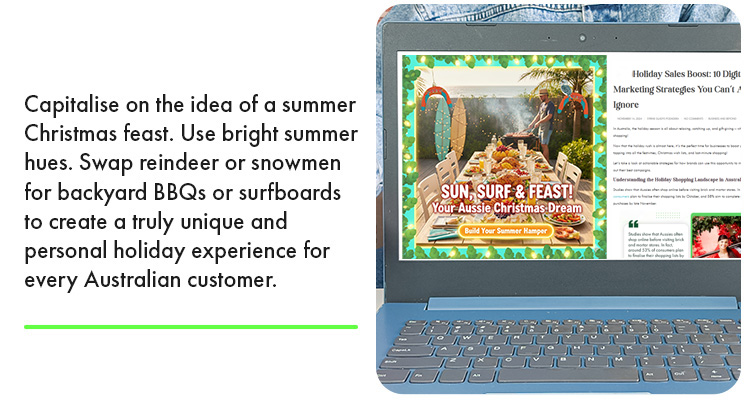
    Capitalise on the idea of a summer Christmas feast. Use bright summer hues. Swap reindeer or snowmen for backyard BBQs or surfboards to create a truly unique and personal holiday experience for every Australian customer.

    Moreover, focus on making delivery a smooth and positive experience despite the holiday rush. As early as November, remind customers about local delivery options and cut-off dates for express post. 

    To reduce logistical strain on your end, offer a Click-and-Collect option, especially if your business is in a high-traffic area or in a central business district.

    Automation: Email Flows and Scheduled Posts 

    It can be overwhelming to handle the influx of messages and orders as December approaches. However, this is a good problem to have – and it can be easily managed through automation and scheduling.

    You can ask your virtual assistant to set up automated abandoned cart sequences that include reminders about upcoming Christmas delivery deadlines. Meanwhile, your social media manager can pre-schedule holiday-themed posts leading up to the New Year. 

    This way, even if you’re on holiday (especially on Christmas or Boxing Day), your brand remains visible and active.

    Storytelling Over Discounts: Use of Emotional Pull 

    Lastly, don’t forget to tell stories that matter. After all, Christmas is all about celebrating with the people who matter most — and storytelling is what sets great brands apart.

    So, instead of relying only on red discount banners, take inspiration from brands like Coca-Cola and Australia Post. Focus on the emotional value of connection and family rather than product price. Highlight the joy of giving and receiving, not just the act of buying or shipping.

    At the end of the day, customers’ holiday purchases are driven by emotion — and when you tap into that, sales naturally follow.

    Frequently Asked Questions (FAQs) 

    Here are some frequently asked questions about Christmas marketing strategies in Australia.

    #1. When Should Australian Businesses Start Christmas Marketing?

    Ideally, you should start planning in October and launch your campaigns by early to mid-November. This aligns with the peak gift-buying season, which begins around Black Friday and Cyber Monday in late November.

    #2. How Can Small Businesses Compete with Bigger Brands?

    Focus on personal connection, localisation, flexibility, and authenticity. Customers are more likely to support businesses that humanise their brand. 

    Hence, show the faces behind your team and highlight your connection to the Australian community. Be flexible with rush orders when possible, and focus on emotional connection rather than simply offering the lowest price.

    #3. What Are the Best Christmas Campaigns for eCommerce?

    Give your loyal customers early access to Black Friday or Christmas deals to encourage more sign-ups before the public sale.

    You can also create a dedicated landing page for your Christmas offers, making it easier for customers to find items suited for the holidays or summer celebrations. Additionally, set a clear spending threshold for free shipping — this encourages customers to add more to their carts to qualify.

    #4. How Can I Make a Holiday Campaign Stand Out Locally?

    Skip the snow and use Aussie summer themes like beaches, BBQs, native flowers, and local slang in your ads and displays.

    You can also partner with a local organisation for holiday charity campaigns such as a “Donation per Purchase” program — a great way to boost sales while giving back to your community.

    Conclusion

    If you want to stand out this holiday season, start preparing now.

    By late October or early November, launch your loyalty campaign to capture high-value sales before Black Friday. Promote express and local delivery options, use authentic Aussie themes, and share heartwarming stories that connect with your audience.

    Don’t wait until December to start your marketing. The earlier you begin, the better your chances of ending the year strong.

    For more information on how to create effective marketing campaigns, call us today or request a callback so we can connect you with the right team.

  • 5 Ways AI Can Help Your Small Business Compete with Large Enterprises

    5 Ways AI Can Help Your Small Business Compete with Large Enterprises

    Australia’s small businesses are the backbone of the economy, accounting for 97% of all businesses and employing over 40% of the workforce.

    But in 2026, it was foreseen that the competition would be fiercer than ever. Large enterprises continue to dominate markets with the power of advanced technology and substantial resources.

    Fortunately, artificial intelligence (AI) is leveling the playing field. No longer the exclusive domain of billion-dollar corporations, AI has become affordable, accessible, and a game-changer for SMEs ready to embrace digital transformation.

    Whether it’s using virtual assistants to handle scheduling, deploying chatbots for customer service, or adopting AI-driven content marketing tools—AI is helping businesses across Australia improve operational efficiency and compete with bigger competitors like never before.

    Let’s explore five ways your business can harness AI today.

    Why AI Isn’t Just for Big Business Anymore

    It’s a myth that AI is too complex or expensive for small businesses. Thanks to cloud computing and AI service platforms, powerful tools that once cost millions are now available for a monthly fee -or even for free.

    Australian SMEs are already leveraging AI for competitiveness—from cafes using predictive analytics in business to forecast stock needs, to retailers using chatbots for customer service.

    AI is no longer about futuristic hype—it’s about practical, everyday tools that help small businesses perform well.

    1. Automate Repetitive Tasks and Free Up Time

    Every business has time-consuming, repetitive tasks that drain focus and resources. AI can take these off your plate so you and your team can concentrate on activities that really move the needle.

    Examples

    AI-enabled systems can process invoices, log expenses, and manage data entry with minimal human input.

    Virtual assistant tools can handle schedules, appointment confirmations, and reminders. These technologies not only save time but also help reduce errors.

    Tools

    Email & calendar management are made easier with AI-generated CRMs and virtual assistant platforms that automate follow-ups, reminders, appointment bookings, and even personalized email responses.

    These tools make sure no leads go to waste—-without you lifting a finger. Here are some examples of AI-powered tools helping businesses automate their admin workflows:

    • Calendly + AI Scheduling Assistants: Tools like Reclaim.ai or Motion use AI to automatically suggest the best times to meet based on preferences, priorities, and past behaviour—perfect for time-poor business owners juggling multiple meetings.

    • Google Workspace with Gemini AI (formerly Duet AI): Offers smart reply suggestions, automated summaries of long email threads, and AI-generated calendar insights so you can instantly review your day or week.

    • Microsoft 365 Copilot: Combines data from your emails, meetings, chats, and documents to draft responses, schedule tasks, and prioritise action items.

    • HubSpot CRM & Salesforce Einstein: These AI-enhanced platforms handle email outreach, deal forecasting, and intelligent follow-ups, ensuring no prospect falls through the cracks and to keep your sales pipeline active.

    • x.ai and Clara Labs: AI-driven scheduling assistants that act like real human assistants—responding to emails, confirming meeting times, and adjusting for time zones and cancellations.

    • Trello, Asana, and Notion AI: Project management tools that now incorporate AI features to schedule tasks, remind teams of deadlines, and auto-assign responsibilities based on project status.

    Outcome

    With AI taking care of admin and repetitive tasks, your team can focus on strategy, customer relationships, innovation—areas where human creativity still shines.

    A boss satisfying client request with the help of his virtual assistant and AI.

    2. Personalise Customer Experiences Like a Big Brand

    Gone are the days when personalised customer engagement was something only large corporations could afford.

    With AI, small and medium-sized businesses can now deliver curated, dynamic experiences that rival established brands, even without massive marketing teams or budgets.

    AI tools allow you to understand customer behaviours, anticipate needs, and engage at the right time with the right message.

    This results in better conversions, stronger customer loyalty, and ultimately, higher revenue.

    Chatbots, email flows, and recommendation engines

    AI-powered chatbots for customer service have become a frontline standard for both e-commerce and service-based businesses.

    These bots can handle common queries, assist in product selection, manage returns, or guide customers through processes 24/7.

    Platforms like Intercom, Tidio, and Drift offer AI online chat management and capabilities that improve over time through machine learning.

    Meanwhile, automated email flows powered by AI guarantee that your communication is timely and relevant. 

    Whether it’s sending an abandoned cart reminder, a follow-up after purchase, or a birthday discount, AI platforms like Klaviyo and ActiveCampaign create responsive journeys tailored to user behaviour and preferences.

    Recommendation engines, once exclusive to tech giants like Amazon, are now within reach.

    Tools like LimeSpot or Dynamic Yield can also help you personalise product suggestions on your website or email campaigns based on browsing history, past purchases, and real-time actions.

    AI in CRM tools for tailored service delivery

    Modern customer relationship management platforms have evolved beyond data storage.

    AI-enhanced CRMs such as Zoho CRM, HubSpot, and Salesforce use predictive scoring, behaviour analysis, and smart segmentation to guide how and when you engage with prospects and customers.

    For instance, your CRM might notify you about a hot lead based on emails and website visits that can prompt your virtual assistant to schedule a call or send a customised offer.

    This kind of AI-powered customer support solution guarantees you strike while the iron is hot.

    3. Improve Decision-Making with Smart Insights

    Data is a coveted asset—but only if you can interpret it. AI makes it possible for small businesses to use predictive analytics in business operations, just like the big corporations.

    Predictive analytics for inventory, pricing, and demand

    AI can analyse sales patterns, seasonality, and market trends to forecast demand, optimise pricing, and prevent stockouts or over-ordering.

    For example, AI tools can alert you when inventory is likely to run low or when it’s time to offer a promotion to move certain stocks faster.

    Dashboards for business performance tracking

    AI-powered dashboards bring your key metrics together in real time—from cash flow to customer satisfaction scores, so you can make smarter decisions faster.

    Digital marketing growth with the help of AI.

    4. Strengthen Your Digital Marketing Strategy

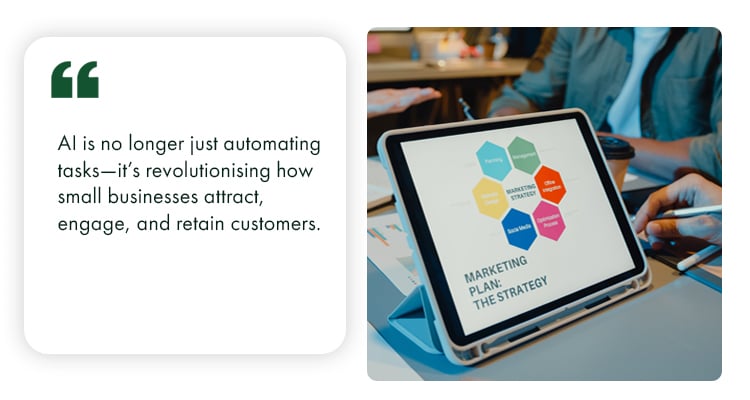
    AI is no longer just automating tasks—it’s revolutionising how small businesses attract, engage, and retain customers.

    With AI-powered tools, you can execute smarter, faster campaigns that rival the sophistication of enterprise-level strategies, without a massive marketing team or budget.

    AI helps businesses leverage digital channels more effectively, from social media and search engine marketing to content creation and customer engagement.

    By harnessing machine learning, natural language processing, and data analysis, you can make data-backed decisions, optimise campaigns in real time, and dramatically improve marketing ROI.

    Here’s how AI is transforming your marketing toolbox:

    AI for content generation and A/B testing

    Creating high-quality content consistently can be time-consuming, but AI tools make this easier by generating, optimising, and testing content based on what performs best with your audience:

    • Jasper and Copy.ai — Generate blog posts, ad copy, product descriptions, and social media captions using AI that understands your brand tone and objectives.

    • SurferSEO — Combines keyword strategy with AI-driven content creation for top-ranking SEO articles.

    • Unbounce Smart Traffic — Uses AI to automatically test and deliver the highest-converting landing page variant for each visitor.

    • Headline Studio (CoSchedule) — Analyses and improves your headlines using predictive engagement metrics.

    AI doesn’t replace your brand voice—it amplifies it by making content more relevant, faster to produce, and easier to refine through continuous testing.

    Keyword optimisation and trend monitoring

    Finding the right keywords at the right time can be a game-changer for traffic and visibility. AI tools now take the guesswork out of search optimisation and trend discovery through:

    • SEMrush and Ahrefs — Track keyword performance, discover new opportunities, and benchmark against competitors using real-time data.

    • Google Trends + AI Extensions — Identify what your audience is searching for today so you can respond quickly with relevant content or campaigns.

    • MarketMuse and Clearscope — Use AI to recommend content updates based on gaps in your current pages or articles.

    • BuzzSumo — Monitor content performance and viral trends across platforms so you can engage with timely topics before they peak.

    By integrating these insights into your content strategy, you can stay relevant, visible, and competitive in a fast-moving digital space.

    AI has deeply integrated with social and paid media platforms, helping businesses optimise ad spend, personalise messaging, and increase campaign performance without the guesswork:

    • Meta Ads (Facebook + Instagram) — Uses AI to automatically optimise content, targeting, and delivery for best performance.

    • Good Ads Smart Bidding — Adjusts bids in real time based on user behaviour, intent, and conversion probability.

    • Canva Magic Write and Adobe Firefly — Empower teams to design social assets with AI-assisted visuals and text generation.

    • Lately.ai — Turns long-form content like blogs or videos into dozens of social media posts tailored for each platform.

    • ChatGPT plugins and Zapier integrations — Automate social content generation, post scheduling, and performance reporting

    With these tools, small businesses can deploy high-impact marketing campaigns with precision, even with a much smaller team.

    5. Streamline Customer Support and Retention

    Small businesses can now offer customer support solutions without hiring large teams- thanks to AI.

    24/7 chatbots for FAQs and common issues

    Chatbots for customer service are now affordable, easy to deploy, and can handle high volumes of enquiries.

    They provide instant responses, boost satisfaction, and free human staff up for more complex cases.

    AI ticket triaging and customer satisfaction tracking

    AI can prioritise support tickets based on urgency and sentiment, making sure critical issues are addressed first.

    Sentiment analysis helps you gauge customer mood and improve service quality continuously.

    Multilingual support and sentiment analysis

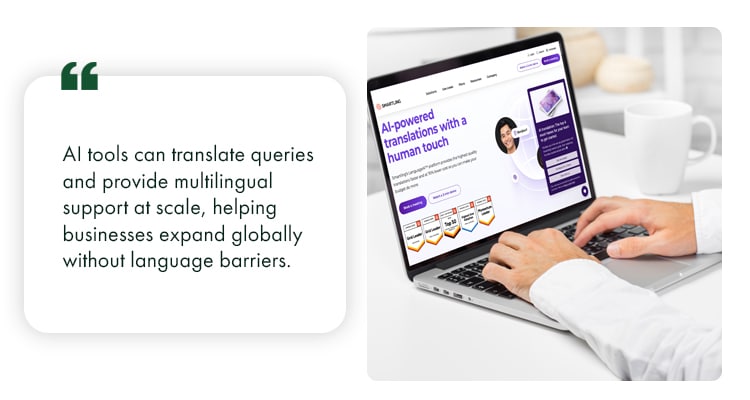
    AI tools can translate queries and provide multilingual support at scale, helping businesses expand globally without language barriers.

    A virtual assistant working with a laptop and AI application.

    How to Get Started with AI for Your Small Business

    Ready to begin your AI journey? Here’s how to start:

    • Assess Your Business Needs. Identify repetitive tasks, bottlenecks, or customer service gaps where AI could add value.

    • Explore Low-Cost or “Freemium” Tools. Many platforms offer free trials or entry-level plans. Test them on small projects before scaling with paid versions.

    • Partner with Local AI Consultants. Australian consultants understand local market needs and can help you choose the right solutions.

    • Invest in Staff Training. Tech-savviness is key. Provide basic AI literacy training so your team is ready to work alongside AI tools.

    FAQ: AI for Small Businesses in Australia

    Now, let’s go over the most common questions from business owners thinking about incorporating AI into their business processes.

    Is AI expensive for a small business?

    Not anymore. With cloud-based platforms and pay-as-you-go models, AI tools are accessible for almost any budget.

    Can I use AI without hiring a developer?

    Absolutely! Many AI tools are plug-and-play, designed for non-technical users with user-friendly dashboards.

    What are the risks of using AI tools?

    Common risks include relying too much on business process automation without oversight or using poor-quality tools that deliver subpar results. Always vet your platforms carefully.

    How do I measure ROI from AI investment?

    Track KPIs before and after implementation. For example, measure time saved, cost optimisation achieved, increased sales, or improved customer satisfaction.

    A virtual assistant busy composing AI prompts.

    AI Is Here to Level the Playing Field

    AI is no longer optional—it’s essential.

    The businesses that will thrive in the coming years are those that use AI to automate business tasks smartly and free up human talent to focus on what matters most.

    Don’t wait for competitors to outpace you. Start small—try a chatbot, test AI-driven content marketing, or automate one repetitive task.

    From there, scale smart and let AI help you achieve your business goals faster.

    The question isn’t whether you can afford to explore AI—it’s whether you can afford not to.

    • Want FREE AI Prompts for Different Areas of Your Business? Check out these 100 AI prompts
    • Curious About How to REDUCE Overhead Costs? Learn more here.
    • If you’re ready to experience the full advantages of working with a top global team, check out our 1,000 fully vetted and highly talented staff here.
  • How SMBs Can Go Green and Save Money

    How SMBs Can Go Green and Save Money

    Going green isn’t just good for the planet—it’s a smart move for Australian SMBs looking to save money through sustainability and stay competitive.

    With over 51% of Australian consumers preferring sustainable businesses, adopting eco-friendly practices like energy efficiency, green technology, and sustainable supply chain can boost both your reputation and your profits.

    Rising market expectations and policy pressures make this shift more urgent, but the transition is more accessible than ever.

    With the shift to work-from-home setups, SMBs can reduce fuel use and resource consumption—lightening their environmental impact. With support from Australian online business assistance and Australia VA teams, going green has never been more achievable.

    Keep reading to discover how to build a profitable and sustainable business with practical, cost-saving strategies.

    Why Sustainability Matters for Australian SMBs

    Sustainability is no longer just the domain of large corporations with deep pockets.

    For small and medium-sized businesses in Australia, embracing sustainable business practices is now a vital part for staying relevant and profitable.

    From shifting consumer values to growing environmental regulations, the green wave is reshaping how businesses operate -and how customers are wielding their purchasing power.

    More importantly, this shift is about building a smarter, more resilient business. Integrating green initiatives for SMBs and following a clear business sustainability strategy can help reduce costs, attract loyal customers, and future-proof operations.

    So, what’s driving this change? Let’s look at the pressures and expectations shaping sustainability for SMBs today.

    Environmental Regulations and Consumer Expectations

    Governments and consumers are making it clear—sustainability isn’t optional anymore.

    Australian SMBs are feeling the push towards new policies and the pull from a market that increasingly values eco-conscious initiatives.

    Key factors influencing this shift include:

    • Stricter environmental regulations requiring businesses to report on emissions and adopt sustainable practices.
    • Rising consumer demand for eco-friendly practices and sustainable supply chains.
    • Incentives and rebates for adopting green energy solutions and renewable energy for small business.
    • Sustainability expectations from investors, stakeholders, and business partners.

    Green Branding, Trust, and Competitive Advantage

    Businesses that lead with eco-conscious branding build stronger customer trust and stand out in crowded markets.

    Showcasing your commitment to sustainability—whether through green business certification or transparent practices—can turn one-time buyers into brand advocates.

    That’s a clear win for both your brand and the environment.

    Pros and Cons of Going Green for SMBs

    While the benefits are compelling, the green transition can come with challenges. Here’s what to expect

    Pros:

    • Lower long-term costs through energy efficiency for small businesses
    • Improved customer loyalty and brand perception
    • Access to green grants, rebates, and certifications
    • Alignment with market trends and government initiatives

    Cons:

    • Initial setup costs for green technology for SMBs
    • Time and effort to retrain staff and adjust operations
    • Possible supply chain shift or sourcing changes

    Practical Green Strategies SMBs Can Implement Today

    The path to sustainability doesn’t have to be overwhelming. With a few strategic changes, SMBs can make a meaningful impact—both environmentally and financially.

    These cost-saving sustainability tips are simple to apply and easy to scale as your business grows.

    Reduce Energy Usage in Office and Remote Setups

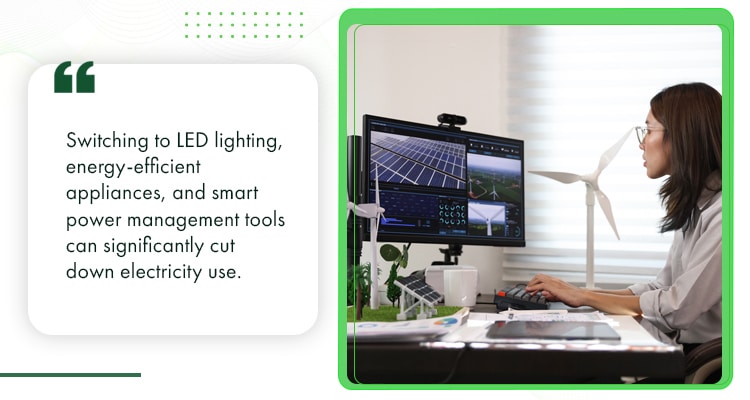
    Switching to LED lighting, energy-efficient appliances, and smart power management tools can significantly cut down electricity use.

    Reduce Energy Usage in Office and Remote Setups

    In remote work setups, supporting employees with energy-saving tips and tools pays off, too.

    This approach aligns with energy efficiency for small businesses and supports an environmentally friendly business model.

    Eco-Friendly Packaging and Products

    Switch to biodegradable, recycled, or reusable packaging wherever possible.

    Sourcing sustainable products helps minimise waste and promotes your commitment to sustainable business practices.

    It’s a smart move that resonates with eco-conscious customers.

    Go Paperless with Digital Tools

    Using cloud-based systems, e-signatures, and online collaboration tools helps you ditch the paper trail.

    Not only do they reduce carbon footprint, but they also streamline the operations of professionals working from home, like Australian virtual executive assistants.

    Going digital is better for business and better for the planet.

    How Green Practices Lead to Cost Savings

    It has been a common perception that going green is too expensive for a small business. Well, think again.

    When implemented wisely, green initiatives for SMBs often lead to significant cost reductions.

    From cutting down on energy use to improving operational workflows, sustainable actions can directly affect your bottom line.

    Businesses that adopt eco-friendly practices don’t just help the environment—they also unlock long-term savings, efficiency, and even tax perks.

    In a nutshell, the right business sustainability strategy can turn seemingly small improvements into powerful, cost-cutting transformations:

    Lower Utility and Resource Bills

    Using green energy solutions and improving energy efficiency for small businesses can slash electricity, water, and gas bills.

    Smart lighting, efficient heating systems, and waste reduction go a long way in minimising recurring costs. Every kilowatt saved is a dollar earned.

    Tax Incentives and Government Support

    Many local and federal programs in Australia offer rebates, subsidies, or tax deductions to businesses investing in renewable energy for small businesses or sustainable upgrades.

    These financial supports make green improvements more accessible. Staying informed about available incentives is thus a smart step toward maximising savings and in turn, revenues.

    Boosting Efficiency with Australian Virtual Executive Assistants

    Working with Australian virtual executive assistants streamlines operations and cuts overheads.

    These professionals help businesses operate leaner while contributing to eco-friendly practices. Here’s how they support a green shift:

    • Eliminate the need for in-house admin staff and reduce commuting emissions
    • Manage digital documentation to support paperless processes
    • Assist in coordinating green business certification applications
    • Source suppliers for sustainable supply chains and packaging
    • Help track eco metrics and integrate them into your business sustainability strategy

    How to Involve Employees and Stakeholders in the Green Transition

    Sustainability isn’t a one-person job—it thrives when the whole team is on board.

    For SMBs, involving employees and stakeholders in the green journey can strengthen culture, boost engagement, and amplify your environmental efforts.

    Encouraging collaboration around sustainable business practices guarantees your initiatives are more than just policies—they become part of everyday decision-making.

    Building a Culture of Sustainability

    Sustainability must be strongly implemented into your business culture to make green habits a lasting practice. Therefore, clear communication, shared goals, and leading by example are vital.

    Practical ways to cultivate this are:

    • Start green workplace challenges or eco-reward programs
    • Offer training on eco-friendly practices and energy-saving tips
    • Include sustainability goals in performance reviews
    • Encourage team input on green solutions or suppliers
    • Celebrate wins—big or small—publicly and consistently to make a statement and encourage others to join you in your crusade for a greener planet

    Remote Sustainability – A New Workplace Model

    Remote work models naturally support sustainability by lowering emissions, office energy use, and daily waste.

    When supported by Australian remote personal assistants, your business can reduce overheads and your carbon footprint. It’s a win for flexibility AND the planet.

    Measuring Impact and Promoting Your Green Brand

    Once your green initiatives for SMBs are in motion, the next big step is measuring and sharing your impact. Data doesn’t just help you fine-tune your approach, it also strengthens your credibility.

    Whether you’re aiming to reduce your carbon footprint, improve energy efficiency, or gain green business certification, presenting documented results reveals the sincerity of your commitment.

    Measuring Impact and Promoting Your Green Brand

    Your progress can be seen if you’ve lessened your electricity and water bills, or saved more from your usual paper consumption.

    Promoting this progress through smart branding builds trust and opens new market opportunities.

    And with help from Australian online business assistance providers like Remote Staff, measuring and marketing your green wins becomes a lot more manageable.

    Track Your Environmental Footprint

    Knowing your numbers is key to long-term impact. Measure energy use, waste output, and emissions to evaluate and improve your sustainability efforts.

    Here’s how to start:

    • Use free online tools or carbon footprint calculators
    • Track utility usage and compare every month
    • Conduct regular internal audits with support from administrative reports
    • Use project management software to log green initiatives and outcomes

    Marketing Your Sustainability Ethos

    Telling your green story sets you apart. Customers connect with businesses that show transparency and purpose, and your sustainability journey is a powerful part of that narrative.

    You can show your efforts by:

    • Sharing achievements through blogs, email newsletters, and social media
    • Displaying green business certification and eco-labels clearly
    • Highlighting the use of eco-friendly practices in product packaging and signage
    • Promoting employee involvement and community partnerships
    • Creating an “Impact” page on your website outlining your business sustainability strategy

    Collaboration with Australian Online Business Assistance Platforms

    Partnering with Australian online business assistance providers makes it easier to stay on track and scale your green progress.

    Tapping into remote support also frees up your resources and time for strategic planning, specifically through:

    • Hiring remote professionals to research and apply for grants or certifications
    • Delegating admin tasks to virtual assistants to streamline paperless workflows
    • Getting help from freelancers to source sustainable suppliers
    • Leveraging insights from Australian online administrative services to document and report progress

    FAQ: Green Business and SMB Profitability

    Making your business more sustainable can feel overwhelming at first—but with the right information and support, it quickly becomes a smart, profitable move.

    Below are answers to common questions small business owners have when exploring the green path.

    What are some quick, low-cost ways to start going green?

    Switch to LED lights, go paperless using cloud tools, reduce unnecessary printing, and unplug unused devices.

    Work with freelance professionals to digitise admin and cut waste. Encourage employees to embrace eco-friendly practices from day one.

    Are there any financial incentives or rebates available in Australia for SMBs going green?

    Yes, various government programs offer incentives for installing renewable energy for small businesses, upgrading to energy-efficient equipment, or applying for green business certification.

    Many states also offer rebates tailored for SMBs. Platforms offering online business assistance can help you identify and apply for these.

    How can I measure the environmental impact of my business?

    Start by tracking energy usage, water consumption, and waste output. Use online carbon calculators, or hire remote support to conduct simple audits.

    Document progress regularly as part of your business sustainability strategy.

    A Greener Path is a Smarter Path

    The future of business in Australia is green—and SMBs are perfectly positioned to lead the charge.

    Whether it’s cutting costs, earning customer trust, or making a real difference for the planet, the case for sustainability has never been stronger.

    A Greener Path is a Smarter Path

    With partnership from outsourcing companies like Remote Staff, you have the right support to take action—without exhausting your resources.

    It’s time to act! Start small, think big, and commit to building an environmentally friendly business that saves money while shaping a better future.

    • Want FREE AI Prompts for Different Areas of Your Business? Check out these 100 AI prompts.
    • Curious About How to REDUCE Overhead Costs? Learn more here.
    • If you’re ready to experience the full advantages of working with a top global team, check out our 1,000 fully vetted and highly talented staff here.
  • 5 Innovative Ways to Reduce Overhead Costs for Your Small Business

    5 Innovative Ways to Reduce Overhead Costs for Your Small Business

    Labour costs can eat up to 70% of a business’s total expenses.

    That said, the most obvious strategy for most business owners is to cut costs, while the smartest ones are for redefining how they operate.

    How? By outsourcing tasks and optimising workspace solutions. To cut your overhead costs means you have to do business smarter and it’s not always about just spending less.

    Read on and learn about more practical and game-changing ways to cut overheads and build a more profitable business, whether in production or service.

    Understanding Overhead Costs and Fixed Costs in Small Businesses

    Running a business is never easy and always comes with its fair share of challenges—one of them is managing overhead costs.

    What are overhead costs? These expenses cover rent and utilities, payroll processing, and administrative costs, which can quickly consume your revenue if not managed correctly.

    Moreover, many entrepreneurs struggle to keep the right balance between cutting costs and investing in resources that can actually drive growth.

    A proactive approach to managing overhead can make a huge difference in your business,so it’s also vital to learn about the different types of overhead expenses.

    Types of Overhead Expenses

    Not all overhead costs are the same and they are categorised into three main types:

    • Fixed Overhead Costs: Expenses that remain constant regardless of business performance, such as rent, insurance, and salaried staff wages.
    • Variable Overhead Costs: Costs that fluctuate based on business activity, such as office supplies, shipping costs, and marketing expenses.
    • Semi-Variable Overhead Costs: These have both fixed and variable components. For example, a coworking space membership may have a base fee (fixed) but additional charges for extra utilities (variable).

    Cutting unnecessary expenses and reallocating your resources

    Why Reducing Overhead Is Critical for Small Business Success

    High overhead costs make it difficult for businesses to invest in growth, hire the right professionals, or even expand operations.

    Cutting unnecessary expenses and reallocating your resources strategically can help your business remain competitive and financially stable. One of the most effective ways to cut staffing costs is by outsourcing to the Philippines.

    Filipino remote professionals offer cost-effective services without compromising quality and Remote Staff has helped countless AU SMEs find the right talents for their specific needs.

    One more way to cut your company overheads is shifting to shared workspaces or building a remote team to lessen rent and utility expenses.

    Automating Administrative and Repetitive Tasks with AI

    Small businesses often spend a significant portion of their business expenses on administrative tasks that don’t directly generate revenue.

    Fortunately, AI-powered tools have made it easier to automate repetitive processes, reducing the need for large in-house teams while boosting productivity.

    By integrating automation into daily operations, businesses can cut payroll expenses, save time, and improve customer experience without overburdening staff.

    Whether it’s customer service, accounting, or marketing, AI solutions streamline workflows and lower operational costs.

    Implementing AI-Powered Chatbots for Customer Support

    Hiring full-time customer service representatives can be costly, especially for small businesses.

    AI-powered chatbots bridge this gap by providing 24/7 support, answering customer inquiries, and resolving common issues without human intervention.

    This significantly reduces payroll expenses while enhancing customer experience. Modern AI chatbots can handle everything from order tracking and FAQs to troubleshooting and appointment scheduling.

    They learn from interactions, continuously improving their responses and allowing human agents to focus on more complex queries that require personal attention.

    Using Cloud-Based Accounting and HR Software for Efficiency

    Managing payroll expenses, bookkeeping, and HR functions manually is both time-consuming and expensive.

    By switching to cloud-based accounting and HR solutions, businesses can reduce the need for full-time administrative staff while improving efficiency.

    Platforms like Xero and QuickBooks automate financial reporting, invoice tracking, and payroll management, allowing business owners to make data-driven decisions in real-time.

    Similarly, cloud-based HR platforms simplify employee records, performance tracking, and compliance, reducing administrative burdens.

    By switching to cloud based accounting and HR solutions

    Many Filipino remote professionals specialise in managing these digital tools so outsourcing bookkeeping or human resources is a smart move to cut back on in-house staffing costs.

    AI Tools for Invoicing, Scheduling, Email Marketing, and Content Creation

    AI is a game-changer for any business looking to reduce manual workload and overhead costs. AI-powered tools can handle tasks such as:

    • Invoicing: Automating payment reminders and invoice generation reduces late payments and improves cash flow.
    • Scheduling: AI-based scheduling tools eliminate the back-and-forth of booking meetings, saving time and effort.
    • Email Marketing: AI-driven platforms personalise marketing campaigns and automate responses, increasing engagement with minimal human intervention.
    • Content Creation: AI tools assist in generating blog posts, social media content, and ad copy, allowing businesses to maintain a strong digital presence without hiring a full content team.

    By integrating these AI-driven solutions, businesses can cut operational costs, increase efficiency, and free up valuable time for strategic growth initiatives.

    Smart Energy and Utility Optimisation

    Managing utility expenses is an essential part of reducing overhead costs. Adopting smart energy solutions is another way to lessen operational expenses and maintain efficiency.

    Installing IoT-enabled smart energy management systems

    Smart energy management systems use IoT technology to automate lighting, heating, and cooling adjustments.

    Reducing your electricity bills based on occupancy and usage patterns can also eliminate unnecessary energy consumption.

    Shifting to cloud computing instead of maintaining on-premise servers

    Take note that having on-premise servers requires costly hardware, maintenance, and cooling systems that can obviously add to your utility costs.

    A more cost-effective alternative are cloud-based solutions, which can also lead to better data accessibility, security, and scalability.

    Using energy-efficient office equipment and appliances

    LED lighting, energy-star-rate appliances, and eco-friendly equipment can help reduce long-term electricity consumption.

    Moreover, switching to low-power monitors and smart plugs can also help lower your bills over time.


    [rcb_show_form]

    Optimise Office Space and Utility Costs

    For many entrepreneurs, a major portion of overhead expenses come from office rent and utility costs.

    By considering remote work, shared office spaces, and energy-saving strategies, you can effectively save on costs and reallocate resources into growing your business.

    Transitioning to remote work to cut rental expenses

    Having a remote team doesn’t require large office spaces, so you won’t need to pay for rental costs, utility expenses, and office supplies.

    The trend today is to embrace hybrid or fully remote work models that can help you allocate resources more effectively. It’s a new business model that business of any size and in any industry are latching on to fast, especially due to a demand surge in many sectors in Australia today.

    Sharing office space or opting for coworking spaces

    Trying coworking spaces is a cost-effective alternative compared to traditional offices because you only pay for the space you need.

    Shared offices also eliminate maintenance costs and promote networking opportunities.

    Energy-saving strategies to lower utility bills

    Simple changes like switching to smart thermostats, setting computers to energy-saving mode, and encouraging paperless workflows can cut your expenses.

    Outsourcing to the Philippines is a proven method to reduce payroll expenses

    For in-house employees, you can encourage them to turn off unused devices and use natural lighting more to lower energy consumption further.

    Outsourcing to the Philippines for High-Quality, Cost-Effective Talent

    Outsourcing to the Philippines is a proven method to reduce payroll expenses without compromising work quality.

    Having access to a Filipino remote workforce lets you hire talented professionals in various fields while cutting down on operational costs.

    Filipino remote professionals are top-tier talents at a fraction of the cost of local hires

    Salaries and benefits for locals cost more than outsourcing the same roles to Filipino virtual assistants.

    This way, businesses can save on payroll expenses while still benefiting from high-quality services in customer support, IT, and marketing.

    That said, the Philippines outsourcing solutions industry is well-developed, offering expertise in:

    • Customer service and technical support so businesses can improve customer satisfaction.
    • Bookkeeping and financial management can reduce administrative burdens and increase accuracy.
    • Digital marketing and content creation can enhance online presence and brand visibility.
    • IT support and web development offer cost-effective tech solutions.

    Virtual staffing through Philippines virtual assistants reduces:

    • The need for physical office space.
    • Employee benefits and insurance expenses, as outsourced staff are managed externally.

    Calculate the numbers yourself based on your business strategy and size, using our Free Virtual Assistant Calculator:

    Interactive Outsourcing Calculator Tool(Click, scroll inside, move the toggles, or change the numbers)
    Can’t see the numbers? Use a desktop browser or scroll within the box for the best experience.

    Cutting Marketing Expenses Without Reducing Impact

    Marketing is vital for your business growth -but it doesn’t have to be expensive.

    That said, many businesses struggle to balance brand visibility with cost efficiency because they spend so much on paid ads and promotions.

    However, using free digital tools and referral programs can increase brand awareness and sales at a fraction of the cost:

    Using organic marketing strategies

    These can increase a business’s visibility, drive engagement, and boost sales without relying on expensive paid ads:

    • Search Engine Optimisation (SEO): Keyword optimisation, high-quality content, and link-building can help your business to rank higher on Google by attracting traffic.
    • Social Media Marketing: Social media platforms like Facebook, Instagram, and TikTok allow you to engage with your audience through organic posts and interactive content, leading to better brand visibility.
    • Content Marketing: Boost your customer engagement by regularly publishing blog posts and videos.
    • Email Marketing: Keep your existing customers updated by sending targeted newsletters and exclusive promotions.

    Leveraging free digital tools for brand promotion

    Boost your brand awareness by leveraging free graphic design, email marketing, and social media management tools.

    Examples of this include Canva for design, Mailchimp for email campaigns, and Hootsuite for social media scheduling.

    This way, you and your team can execute effective marketing strategies without having to pay hefty agency fees.

    Referral programs and strategic partnerships for cost-effective growth

    Encouraging customers to refer your brand to new clients through incentives (like discounts or rewards) can significantly lower acquisition costs while driving revenue growth.

    Moreover, forging strategic partnerships with complementary businesses enables cross-promotions, resource sharing, and access to a broader audience.

    FAQs About Reducing Overhead Costs

    Here are some of the most commonly asked questions on how to reduce your monthly expenses:

    What are the biggest overhead costs for small businesses?

    Rent, payroll expenses, utility expenses, and administrative costs are among the largest overheads that affect profitability.

    Transitioning to remote work, outsourcing to the Philippines, and optimising business expenses can help reduce these costs.

    Is outsourcing to the Philippines reliable for small businesses?

    Yes, Filipino remote professionals offer high-quality services in various areas like customer support, digital marketing, bookkeeping, and IT support at cost-effective rates.

    The Philippines outsourcing solutions industry is also well-developed and shows no signs of stopping with a projected revenue of around $40 billion by 2025.

    This data shows that Filipino professionals are a reliable option for small businesses abroad looking to scale efficiently.

    How do virtual assistants compare to full-time employees in terms of productivity?

    Philippines virtual assistants are highly skilled, flexible, and capable of handling a wide range of tasks. Since businesses can opt to pay only for the services they need, they can often be a more cost-effective option compared to their local counterparts as well.

    What is the best way to track and manage business expenses?

    Using cloud-based accounting software and AI-powered invoicing tools enables businesses to monitor spending in real time and reduce financial inefficiencies and unnecessary costs.

    Outsourcing to the Philippines, leveraging digital tools

    Final Thoughts

    Reducing overhead costs is about optimising operations and making smarter financial decisions.

    Outsourcing to the Philippines, leveraging digital tools, or transitioning to coworking spaces are some of the most popular strategies to reduce business expenses.

    Make the first move today by implementing strategies to cut overhead costs and get ready for long-term success!

    • Want FREE AI Prompts for Different Areas of Your Business? Check out these 100 AI prompts.
    • Curious About How to SAVE and Maximize on Taxes? Learn more here.
    • If you’re ready to experience the full advantages of working with a top global team, check out our 1,000 fully vetted and highly talented staff here.
  • Updated 2025: Time Management Strategies for Busy Entrepreneurs

    Updated 2025: Time Management Strategies for Busy Entrepreneurs

    Twenty-four hours may seem enough to get things done – unless you’re a business owner.

    Well, let’s face it. Running a business is tough, especially if you’re an entrepreneur trying to do everything all at once. Hence, it’s common to see business owners stretching themselves thin to make the business thrive.

    But, is multitasking really the best use of limited time?

    In this article, we will look at some time-saving tips and tricks for business owners to manage their time wisely – so you can get more things done while doing less.

    IN THIS BLOG

    Understanding the Importance of Time Management

    Time is relative. 24 hours is more than enough time to work, rest, and have fun. But, it’s different if you’re building a company.

    Understanding the Importance of Time ManagementHence, there’s a need to be more intentional with how you use your time.
    How Effective Time Management Empowers Entrepreneurial Success

    Successful business owners are often excellent time managers. With years of experience, they’ve learned to prioritise tasks, set deadlines, and minimise distractions, allowing them to:

    • Focus on tasks within allocated time blocks;
    • Make better decisions;
    • Seize opportunities faster; and
    • React quickly to market changes.

    Challenges Faced by Entrepreneurs Juggling Multiple Responsibilities

    Conversely, entrepreneurs who have yet to learn efficient time management and delegation usually struggle with multiple responsibilities.

    They usually have to deal with:

    • Time Constraints – Handling everything from marketing and sales to customer service and finance often leaves little time for rest, personal life, and unexpected challenges.
    • Procrastination and Distractions – Without a plan, entrepreneurs often get lost in urgent but unimportant tasks.
    • Stress and Burnout – There’s also the constant pressure to succeed and meet deadlines, hence long hours spent working – including holidays and weekends.
    • Wearing Multiple Hats – Entrepreneurs are great at creating products or services, but they can’t do it all—especially when it comes to accounting, legal issues, and marketing. Worse, taking on tasks outside their expertise often leads to costly mistakes.
    • Difficulty Delegating – Letting go of certain tasks can be tough, especially at the beginning. Hence, it’s common for entrepreneurs to struggle with delegating since many worry that others won’t handle tasks as well as they would.

    Strategic Planning as a Tool for Increased Productivity and Profitability

    While you may not be able to do everything in 24 hours, it’s possible to make the most out of every hour.

    Strategic Planning as a Tool for Increased Productivity and ProfitabilityYou just have to:

    1. Define your goals clearly;
    2. Identify your objectives; and
    3. Create actionable steps.

    In other words, have a concrete plan. When you’re crystal clear about where you want to go, it’s easier to remove distractions and focus on your goals.

    More importantly, a clear plan with specific milestones keeps you and your team accountable for your progress.

    Prioritisation Techniques: Working Smarter, Not Harder

    Gone are the days when working hard alone is admirable. Today, it’s just as important to make use of your time wisely.

    Using the Einsenhower Matrix to Identify and Prioritise Tasks

    If you’re overwhelmed with the day’s tasks, it helps to identify which tasks are:

    • Important;
    • Not important;
    • Urgent; and
    • Not urgent.

    This is where the Einsenhower Matrix comes in. According to its creator, Dwight D. Eisenhower, the 34th President of the United States, the Matrix was created as a simple decision-making tool.

    “I have two kinds of problems: the urgent and the important. The urgent are not important, and the important are never urgent,” he emphasised.

    To illustrate things better, here’s the visual representation of the matrix:

    eisenhower matrix urgent important four quadrants
    Source: Vertex24

    Based on the diagram above, entrepreneurs have a visual guide for which tasks they need to do themselves, which ones to prioritise, or which ones to delegate.

    Thus, if you’re pressed for time, the Eisenhower Matrix says to focus the tasks that fall under “Do” and schedule the ones under “Plan.”

    As for the rest, you can delegate them to your team members or ignore them completely.

    Focusing on High-Value Activities to Enhance Outcomes

    Since time is limited, it’s highly important to focus on the important things.

    If you’re a business owner, for example, your goal is to grow your operations and increase your bottom line. However, you can’t do this if you’re running around doing everything from accounting, marketing, or legal compliance.

    Thus, you have to concentrate on core business functions, such as product development, sales, and innovation, to keep your business thriving.

    The Role of Task Management Tools in Efficient Workflows

    Aside from the Eisenhower Matrix, there are many software and task management tools such as ClickUp, Trello, Notion, and Asana to help keep you on track.

    These platforms offer:

    • Central hubs for tasks, deadlines, and assignments;
    • Features like task lists, Kanban boards, and prioritisation matrices; and
    • Task completion rates, time spent on tasks, and project progress.

    With the help of these tools, it’s easier for business owners like you to visualise your workloads, identify potential bottlenecks, and better manage your time.

    The Power of Scheduling and Consistency

    Managing your time wisely is a conscious and continuous effort. It requires dedication, especially if you want to make optimising productivity a daily habit.

    But, how can you ensure that you’re on track, regardless of how you feel on certain days?

    The Power of Scheduling and ConsistencyMany entrepreneurs resort to scheduling. They list down their tasks for the day, week, or even a month in advance.
    Let’s take a look.

    Benefits of a Structured and Consistent Schedule

    Training your mind and body to be productive at certain hours can do wonders.

    A predictable routine helps business owners plan ahead and feel more in control, giving them confidence in knowing what to expect.

    Moreover, by dedicating specific time blocks for focused work, entrepreneurs can concentrate and maintain sustained attention for certain tasks. As a result, they can innovate and come up with better products and/or services.

    Time-Blocking and Block Scheduling

    How does time-blocking and block scheduling differ from the usual to-do list?

    Time-blocking divides your day into specific time blocks. This can mean allocating timeframes for specific tasks, like so:

    • 8-10 AM – Respond to emails
    • 10-11 AM – Work on project
    • 11-12NN – Call client

    On the other hand, block scheduling has a similar concept, but it uses larger blocks of time. For instance, important meetings happen in the morning, while emails are answered in the afternoon.

    With the help of some automated appointment-setting tools or a skilled appointment setter, you’re well on your way to staying on top of your to-do list!

    Both time-blocking and block scheduling need careful planning and the occasional tweak to come up with the optimal schedule. Thus, it’s also important to stay flexible and adjust when things aren’t working as expected.

    The key is finding what works for you. When done right, time-blocking and block scheduling can help you stay organised with less stress and fewer worries.

    The Art of Delegating: Letting Go to Grow

    Entrepreneurs love to take control, and that’s a great trait, especially when it comes to maintaining high-quality processes and operations.

    However, taking on too much with so little time can be counterproductive. Thus, delegation is a must for every business owner seeking growth.

    Significance of Delegating Tasks for Business Growth

    It can be scary to hand over the reins to someone else, but delegating tasks is a critical business skill.

    Significance of Delegating Tasks for Business GrowthWhen you stop stressing over administrative tasks and non-core functions, you can focus more on high-level decisions. This lets you innovate and stay focused on where your company is headed.
    Additionally, micromanaging can do more harm than good. Even though it might seem like you’re helping, it often comes across as distrust and can undermine your employees’ confidence and autonomy.

    Examples of Tasks You Can Delegate

    The secret to delegation is knowing which tasks to let go of.

    No matter how great your employees are, some responsibilities should always remain with the business owner, like:

    • Core strategic decisions such as long-term vision and market positioning;
    • Major financial decisions;
    • Hiring key leadership positions;
    • Crisis management;
    • Early stages of product development and innovation; and
    • Major business partnerships, acquisitions, and negotiations.

    However, the rest can be outsourced or delegated to your team, including:

    • Administrative Tasks
      • Scheduling
      • Answering routine emails
      • Booking flights, hotel, and transportation
      • Expense reports
      • Data entry
      • Filing
      • Handling initial customer support
    • Marketing and Sales
      • Posting and engaging with followers on social media
      • Writing blog posts and social media captions
      • Creating and sending newsletters
      • Lead generation
      • Market research
      • Sales calls for initial screening or follow-up
    • Finance and Operations
      • Bookkeeping
      • Payroll processing
      • Inventory management
      • Order fulfillment
      • Project management
    • Other Tasks
      • Research
      • Proofreading
      • Transcription

    Aside from knowing which tasks to delegate, finding the right people is just as important.

    For many AU business owners, this starts with hiring a competent and reliable online appointment setter who can manage their schedule and calendar.

    Aside from keeping your meeting calendar updated, they can also handle email management, data entry, and other administrative tasks.

    Tips for Hiring a Competent Appointment Setter

    Start by creating a detailed job description.

    1. Outline specific tasks;
    2. Define target metrics; and
    3. Specify preferred communication channels.

    Once you’ve clearly outlined the tasks, you can post the job offer on social media platforms like Facebook and LinkedIn. If you have a broad network, asking for referrals is also a great way to find the right candidates.

    After receiving several applications and completing the interviews, screen the applicants by:

    • Skills
      • Do they communicate well, both verbally and through the written word?
      • Are they good listeners?
      • How on point is their phone etiquette?
    • Experience
      • What is their prior work experience?
      • What scheduling platforms are they familiar with?
      • Are they experienced with AI-based software?
    • Personality Traits
      • Are they coachable and adaptable?
      • How do they manage stress?
      • What do they do if they make mistakes?

    You need an appointment setter, an online booking specialist, or a virtual calendar coordinator who is flexible and adaptable, especially since meetings can get rescheduled or cancelled. They should also be proactive—calling clients or customers for follow-ups if the business owner is tied up with other important tasks.

    Thus, many Aussie entrepreneurs choose to outsource by partnering with providers like Remote Staff, which offers a pool of pre-vetted, experienced, and qualified appointment setters. This allows them to find reliable talent without the hassle of extensive hiring processes.

    Leveraging Technology for Enhanced Efficiency

    Time management takes discipline and effort, which can be tough, especially when you’re just starting.

    Leveraging Technology for Enhanced EfficiencyFortunately, technology makes staying productive much easier.

    Must-Have Productivity Apps and Tools

    Here are some software and/or online tools you can use for better productivity:

    • Focus and Time Management
      • Forest
      • Freedom
      • Toggl Track
    • Note-Taking and Organisation
      • Evernote
      • Notion
      • Google Keep

    Tools for Task Management, Communication and Collaboration

    Managing your time becomes easier with the right tools. Aside from the examples above, here are other tools that could come in handy:

    Task Management

    Writing down your tasks is one way to get organised. However, if you want to take it to the next level, you can also use:

    • Asana – This task management platform is great for creating tasks, assigning them to team members, and tracking progress. It also offers various views like lists, boards, and timelines.
    • Trello – If you’re a fan of Kanban boards, Trello is a great option. It’s excellent for simple projects and workflows, making it easy to see what’s in progress and what needs more attention.
    • Monday.com – There’s also Monday, a highly customisable platform with a colourful interface, great for those who appreciate a visually appealing dashboard. It lets you manage projects, tasks, and workflows, just like other task management tools.

    Communication

    Aside from emails, you can use these platforms for updates:

    • Microsoft Teams – If you’re already using Microsoft for your documents and processes, integrating Microsoft Teams is practical for chat, video calls, file sharing, and document collaboration.
    • Google Chat – Meanwhile, if you’re into Google Workspace, you can use Google Chat which provides chat functionality alongside Gmail, Google Drive, and Google Meet.
    • Slack – Of course, there’s Slack–a popular messaging app with channels for different topics, direct messaging, and video calls. It’s also a great tool for quick communication and building team culture.

    Collaboration

    If you’re managing a distributed team, these platforms are particularly ideal:

    • Notion – Aside from simple note-taking, Notion is a highly versatile tool that can be used for databases and project management. It’s highly customisable and can be adapted to the various needs of your team.
    • Miro – Meanwhile, Miro is a collaboration platform with a large canvas for mind mapping, project planning, and brainstorming. As such, it’s a great option for teams that always need to visualise ideas.
    • Airtable – There’s also Airtable, a flexible platform that combines the features of a spreadsheet and a database. Thus, if you need to collaborate on organising and tracking information, this tool is the way to go.

    Aside from these tools, entrepreneurs and their appointment setters also rely on appointment-setting software, such as:

    • Calendly – Calendly is easy to use and can be integrated easily with various calendars. This makes it a popular choice for both individuals and business owners.
    • Doodle – If you need to find a time that works for a group, Doodle is perfect. You can propose multiple times, and everyone votes on their preferences, making it easy to coordinate meetings with many attendees.
    • Pick – Some appointment setters prefer Pick, which lets you create a personalized link (e.g. pick.co/yourname) to share. Simply set your availability, and let anyone choose a time that works for them!

    Things to Consider When Choosing the Right Software

    Before you subscribe to any software or tool, ask yourself:

    • Does it fit your budget?
    • Does it enable you to manage your schedule and book appointments on the go?
    • Does it have the features you need, such as calendar integration, automated reminders, payment processing, or customisation options?
    • Does it integrate with the other tools you use, such as your CRM or calendar?
    • How intuitive is the tool for you and the people you’re meeting with?

    Avoiding Common Time Management Pitfalls

    Most of the time, time management equates to self-management. It means recognising your strengths and weaknesses, especially when you’re feeling overwhelmed or procrastinating.

    For some individuals, tasks feel endless because they don’t know how to say no. Others, on the other hand, are unsure where to start.

    So, how can you avoid all these pitfalls? Let’s take a look.

    The Risks of Overcommitting and Failing to Say No

    A good business owner is a risk taker. They are willing to take the leap and find ways to resolve any problem.

    Being a “yes” person opens up many possibilities, but without the right strategy, it can also be counterproductive. When you’re stretched too thin, the quality of your work suffers.

    You might rush tasks, miss details, and make mistakes – ultimately damaging your reputation.

    The Risks of Overcommitting and Failing to Say NoMoreover, constantly switching between tasks leads to wasted time and decreased concentration. Paradoxically, saying “yes” to everything can hinder your business growth.
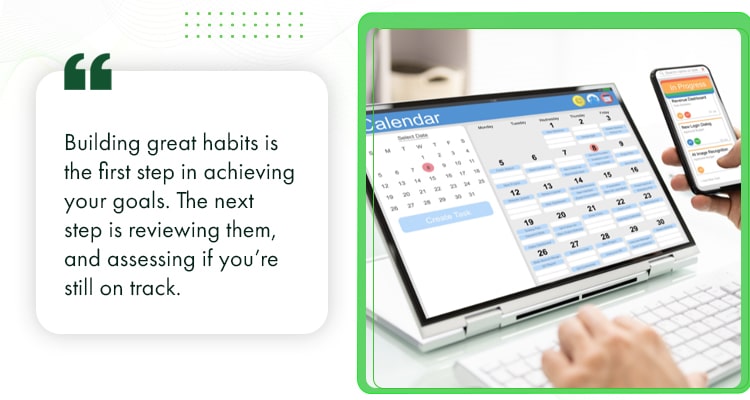
    By spreading yourself too thin and being afraid to say “no,” you risk losing the time and energy needed to focus on high-impact projects that truly grow your business.

    Addressing the Downsides of Multitasking with Actionable Strategies

    Multitasking doesn’t always equate to productivity. More often than not, it’s actually the opposite.

    Contrary to popular belief, multitasking does not save time. In fact, our brains aren’t designed to handle multiple, complex tasks simultaneously.

    While we can do anything, we can’t do everything at the same time. When we switch tasks, our brains leave behind a “residue” of the previous task, making it harder to fully focus on the new one.

    For instance, if you’re brainstorming for a new product at 9 am, it’s difficult to focus on accounting by 10 am. Each time you switch, there’s a cognitive cost – and it takes time and energy to re-engage with the new task.

    So, how can you address this?

    Here are some tips:

    1. Make a conscious decision to focus on one task at a time.
    2. Remind yourself that focusing on one thing will make you more efficient.
    3. Politely decline requests that don’t align with your priorities.

    Aside from these, schedule short breaks throughout the day as well and resist the urge to check emails or social media while you’re on them. Instead, go for a quick walk, stretch, or do something relaxing.

    Methods to Maintain Focus Amid Constant Distractions

    Focusing on one task can be stressful, especially if your mind is ready to work on the next one. Hence, it’s important to avoid distractions so you can get things done faster.

    Here’s how:

    Minimise Distractions

    • Create a dedicated area for work, free from clutter and visual distractions;
    • Use noise-cancelling headphones, white noise, or ambient sounds to block out voices or disruptive noises; and
    • Install proper lighting to avoid eye strain.

    Digital Detox

    • Silence your phone or turn off all notifications, especially social media, emails, and messaging apps;
    • Use website blocking apps like Freedom or Forest to restrict access to distracting websites; and
    • Put your phone on “Do Not Disturb” mode.

    Optimise Your Workflow

    • Use the Pomodoro Technique i.e., work in focused bursts (25 minutes) followed by short breaks (5 minutes);
    • Remember the Eisenhower matrix: Identify the most important tasks and tackle them first; and
    • Divide large projects into smaller, more manageable chunks.

    Cultivate Focus Habits

    • Get enough sleep as it significantly impacts focus and cognition function;
    • Eat a balanced diet rich in fruits, vegetables, and whole grains; and
    • Exercise regularly as it improves blood flow to the brain.

    Building Habits for Long-Term Productivity

    On average, it takes 21 days to build a habit. Within this timeframe, you have to consciously and consistently make an effort to show up, focus, and prioritise.

    The Impact of Daily Habits on Entrepreneurial Success

    If you want to become a successful entrepreneur, you need good habits, such as:

    • Time management;
    • Progress tracking;
    • Clear goal-setting;
    • Getting enough sleep;
    • Exercising;
    • Creating a routine;
    • Networking; and
    • Taking care of yourself.

    To make this happen, you need a predictable structure to reduce decision fatigue, so you can focus on what really matters. (Fun fact: This is also why famous founders like Mark Zuckerberg and Steve Jobs wear the same clothes every day.)

    Reflecting on Goals and Adjusting Strategies for Better Results

    Building great habits is the first step in achieving your goals. The next step is reviewing them, and assessing if you’re still on track.

    Reflecting on Goals and Adjusting Strategies for Better ResultsHere’s how you can do it:

    • Set aside dedicated time to review your goals;
    • Monitor your progress;
    • Assess yourself with honesty:
      • Are you on track?
      • Are you facing unexpected challenges?

    Afterwards, identify the strategies and actions contributing to your progress. You should also determine the obstacles, such as external factors, internal limitations, and unforeseen challenges.

    Based on your analysis, identify areas where you can improve your strategies. If needed, adjust your methods. Don’t be afraid to pivot; focus on your end goal, not just on the way to get there.

    Real-Life Insights: Time Management Habits of Successful Entrepreneurs

    Here are some examples of time-management habits from real-life business magnates:

    • Warren Buffett’s 5/25 Rule – Renowned investor Warren Buffet uses the 5/25 rule to focus on his most important priorities. He simply identifies the five most important goals for his life and business and then spends at least 25% of his time working toward them.
    • Steve Jobs’ “Less is More” – Apple founder Steve Jobs highlights the importance of prioritising ruthlessly. According to him, “Deciding what not to do is as important as deciding what to do.” In other words, focus on the tasks that have the highest leverage and do them right.
    • Jeff Bezos’ “Delegate and Let Go” – Amazon founder Jeff Bezos values delegation. He believes in making fast, quality decisions and knowing when to hand tasks off. Thus, identify what others can do, let go, and empower your team to take charge.

    Frequently Asked Questions

    Here are some of the frequently asked questions entrepreneurs ask about time management and appointment-setting hacks.

    #1. Can Automating Client Appointments Really Save Significant Time?

    Absolutely! Many entrepreneurs partner with a remote scheduling professional, virtual meeting planner, or virtual appointment coordinator to set up automated appointments or manage existing ones.

    Aside from taking calendars off your hands, these professionals also help analyse booking trends, identify peak times, and optimise your availability.

    #2. Are There Appointment-Setting Tools That Work Offline?

    Aside from the good-old pen and paper, the following apps work offline:

    • Google Calendar – Google offers offline access but with limited features. However, you can still view your schedule and add new events which will sync when you reconnect.
    • Apple Calendar – If you’re using Apple devices, MacOS and iOS allow users to view and create events offline.
    • Outlook Calendar – Microsoft Outlook also has offline access for viewing appointments and basic scheduling.

    #3. What Is the 7-8-9 Rule for Time Management?

    The 7-8-9 rule is a simple guide that tells you to get:

    • 7 hours of sleep;
    • 8 hours of work or study; and
    • 9 hours for everything else (e.g. meals, relaxation, and personal time).

    This approach is key for business owners aiming for a healthy work-life balance. It might seem hard, especially when you’re starting out, but being strategic about being productive at work can actually help you spend less time working.

    Conclusion

    Effective time management is a skill. However, with consistent practice and determination, you will be able to find a workflow that works for you.

    Whether it’s employing the Eisenhower matrix, identifying five important goals, or adopting the 7-8-9 principle, it all boils down to your preferences. Try and test different productivity methods and don’t be afraid to adjust your approach as needed.

    Furthermore, if you’re like other business owners in AU’s most profitable industries, you need to get the best team to keep your productivity growing.

    For more information and assistance on where to get skilled appointment setters, online scheduling experts, or remote time management assistants, call us today or request a call back now.

    [rcb_show_form]

  • Ultimate Guide to Hiring Software Developers in 2025

    Ultimate Guide to Hiring Software Developers in 2025

    By 2025, hiring top-tier software developers will become more crucial and challenging than ever. This comprehensive guide will walk you through the essential steps of recruiting, evaluating, and onboarding software developers, covering everything from talent acquisition strategies to remote hiring practices. 

    Whether you’re looking for full-time developers, freelancers, or contractors, this guide will help you explore the competitive tech talent market and build a strong development team.

    What to Look for When You Hire Software Developers?

    When hiring software developers in 2025, it is essential to evaluate a combination of technical skills, soft skills, and cultural fit to ensure developers share the same values as your team. Here are the key areas to focus on to meet your business needs for hiring back-end developers:

    Key Skills to Evaluate in a Software Developer

    1. Programming Languages. Proficiency in relevant languages such as Python, Java, JavaScript, C++, or Ruby is essential for hiring the best talent in software development.
    2. Software Engineering Skills. These skills are important in meeting the demand for software developers. Understanding of data structures, algorithms, and object-oriented programming.
    3. Cloud Computing. Experience with platforms like AWS, Google Cloud, or Azure is often required for hiring a web developer.
    4. DevOps Practices. Familiarity with continuous integration, continuous deployment, and containerisation.
    5. Version Control Systems. Proficiency in Git or other version control tools.
    6. Database Management. Knowledge of SQL and NoSQL databases.
    7. API Development. Experience in designing and implementing RESTful APIs.
    8. Front-end and Back-end Development. They are crucial skills to consider in the hiring process of hiring a software developer. Full-stack capabilities or specialisation in either area.
    9. Mobile App Development. Skills in iOS or Android development for mobile-focused roles.
    10. Emerging Technologies. These are crucial for companies looking to hire a software developer skilled in the latest advancements. Familiarity with AI, machine learning, blockchain, or IoT is crucial depending on your project requirements.

    Coding proficiency remains a cornerstone of software development.

    Importance of Coding Proficiency

    Coding proficiency remains a cornerstone of software development. When evaluating candidates, consider their understanding of software and how it aligns with your different software development project.

    • Code Quality. Clean, well-documented, and efficient code is essential for experienced software developers.
    • Problem-Solving Skills. Ability to approach complex issues systematically, especially when you are looking to hire top software developers.
    • Debugging Techniques. Skill in identifying and resolving software bugs is essential for any software development team during the hiring process of hiring a software developer.
    • Code Optimisation. Capability to improve performance and scalability is essential for meeting project requirements.

    Understanding Software Development Methodologies

    In 2025, familiarity with various software development methodologies is crucial. Look for candidates who understand:

    • Agile Methodologies. Scrum, Kanban, and other agile frameworks are essential methodologies for top software developers.
    • Project Management. It is crucial to make sure that offshore developers remain engaged throughout the development process, especially since many developers have never worked in such environments. Experience with agile project management tools and practices.
    • Test-Driven Development. Ability to write and maintain automated tests is crucial for hiring the best software programmer.
    • Continuous Integration/Continuous Deployment (CI/CD). These practices are essential for any software development team. Understanding modern development workflows is vital for highly skilled software developers to succeed in their roles.

    How to Write an Effective Job Description for Software Developers?

    Crafting a compelling job description is crucial for attracting successful software developers. Here’s how to create one that stands out:

    Essential Components of a Software Developer Job Description

    1. Clear Job Title. Be specific about the role (e.g., “Senior Full-Stack Developer” or “Machine Learning Engineer”).
    2. Company Overview. A vital part of the process of hiring a software developer. Briefly describe your company, its mission, culture, and the need to hire skilled software developers.
    3. Job Responsibilities. Outline the key tasks and expectations for the role in your software development hiring efforts.
    4. Required Skills and Qualifications. For hiring managers in the software development market, list both technical and soft skills needed for the type of software your team will be working on.
    5. Nice-to-Have Skills. Mention additional skills that would be beneficial but not mandatory.
    6. Project Information. It is crucial when you want to hire the right developer you need, as many freelance developers have never received clear project outlines. Provide a glimpse into the types of projects the developer will work on.
    7. Team Structure. Describe the team composition and reporting structure.
    8. Growth Opportunities. Freelance software developers can lead to exciting projects, especially if you are looking for a software that meets client needs. Highlight potential for professional development and career advancement.

    Be specific about the technical skills required for the position.

    Highlighting Required Technical Skills

    Be specific about the technical skills required for the position to make sure you hire the right software developer.

    • Programming languages (e.g., Python, Java, JavaScript)
    • Frameworks and libraries (e.g., React, Angular, Django) are essential for skilled software development and can help offshore developers ramp up quickly.
    • Database technologies (e.g., MySQL, MongoDB) are important skills for experienced software developers.
    • Cloud platforms (e.g., AWS, Azure)
    • Version control systems (e.g., Git) are vital tools for any software project.
    • DevOps tools (e.g., Docker, Jenkins)

    Defining Company Culture in Your Job Posting

    Emphasise your company’s unique culture to attract candidates who will be a good fit for your software development team, as developers have never experienced such alignment before.

    • Describe your work environment (e.g., collaborative, innovative, fast-paced) to attract the freelance software developers you want to hire.
    • Mention any remote work or flexible hours options
    • Highlight your commitment to diversity and inclusion when you look for when hiring software developers in 2024.
    • Showcase any unique perks or benefits (e.g., continuous learning opportunities, hackathons)

    Where to Find the Best Software Developers?

    In 2025, finding top software development talent requires a multi-faceted approach:

    Utilising Job Boards for Software Developer Recruitment

    Popular tech-focused job boards remain a valuable resource:

    • LinkedIn Jobs is another effective way to hire a developer for your software development project.
    • Stack Overflow Jobs is an excellent platform to hire the right talent for your software product, especially if you’re hiring experienced software developers.
    • GitHub Jobs is a great resource for finding software developers in 2024.
    • Dice
    • AngelList (for startups)

    Optimise your job postings with relevant keywords to improve visibility and attract qualified developers.

    Exploring Freelance Platforms to Hire Developers

    For project-based or flexible hiring, consider freelance platforms:

    • Toptal is a platform where you can hire someone from top developers across various fields, including software experts in niche areas.
    • Upwork is a popular platform to hire the best developers for various software development projects, including freelance software developers.
    • Freelancer.com
    • Gun.io is a great resource for finding vetted remote developers.
    • Remote Staff is another platform to find talented and experienced developers on various technologies. 

    These platforms often offer a global talent pool, allowing you to find specialised skills in the software development industry.

    Networking and Referrals in the Software Development Community

    Leverage your professional network and attend industry events to enhance your hiring efforts.

    • Tech conferences and meetups.
    • Hackathons and coding competitions are great ways to hire a developer for a software development project.
    • Developer forums and online communities (e.g., Stack Overflow, GitHub) are great places to find the right software developers across various specialties.
    • Employee referral programs.

    Engaging with the developer community can help you identify passive candidates and build relationships with potential hires.

    What is the Hiring Process for Software Developers?

    A structured hiring process is essential for identifying the best-qualified developers efficiently:

    Steps to Follow in the Hiring Process

    1. Resume Screening. It is vital, especially since many developers have never tailored their resumes for specific roles. Review applications and shortlist candidates based on qualifications.
    2. Initial Phone or Video Screening. Conduct a brief interview to assess basic qualifications and interest.
    3. Technical Assessment. Administer coding tests or take-home projects to evaluate technical skills in potential candidates.
    4. In-depth Technical Interviews. They can help to identify the best developers for your specific project requirements, ensuring you’re hiring the right talent that developers have never had the chance to showcase. Dive deeper into the candidate’s technical knowledge and problem-solving abilities.
    5. Behavioral Interview Questions. They can help you find the right software developer for your team.: Assess soft skills, cultural fit, and past experiences to ensure you hire software developers efficiently.
    6. Team Interview. A critical step in ensuring you find the right candidate for your software development project. Allow potential team members to meet and evaluate the candidate.
    7. Reference Checks. They are vital to ensure that you hire developers who will help your software development company succeed. Verify the candidate’s work history and performance.
    8. Offer Negotiation For Qualified Developers. Present a competitive offer and negotiate terms with hiring managers if necessary.

    Shape your hiring process to include questions that reveal how developers may fit into your company culture.

    How to Conduct Effective Interviews

    To get the most out of your interviews, shape your hiring process to include questions that reveal how developers may fit into your company culture.

    • Prepare a structured set of questions for consistency across candidates
    • Use a mix of technical and behavioral questions to ensure that developers have never encountered such a thorough evaluation.
    • Allow time for the candidate to ask questions about the role and company
    • Involve team members in the interview process for diverse perspectives
    • Provide a positive candidate experience, regardless of the outcome

    Evaluating Candidates: Tests and Challenges

    Implement a variety of assessment methods:

    • Coding Tests. Use platforms like HackerRank or CodeSignal for standardised assessments when you’re looking to hire top software developers.
    • Take-Home Projects. They can help you assess the skills of the developer you need. Assign realistic, time-boxed projects that reflect actual work.
    • Pair Programming Sessions. Collaborate with candidates on a coding task to assess their thought process and communication skills.
    • System Design Challenges. For senior roles, include questions about architecting complex systems.

    How to Evaluate Software Developers During Interviews?

    Effective evaluation during interviews is crucial for making the right hiring decisions, especially when developers have never been assessed properly.

    Technical Skills Assessment Techniques

    • Whiteboard Coding. It is a common practice in front-end development interviews. Ask candidates to solve problems on a whiteboard or shared online tool to assess their solid understanding of software.
    • Code Review. An important process to ensure the quality of the software product being developed. Present a piece of code and ask the candidate to review and improve it, assessing their understanding of software best practices.
    • Technical Discussion. Engage in in-depth conversations about past projects and technical decisions.
    • Scenario-Based Questions. Present real-world scenarios and ask how the candidate would approach them.

    Behavioral Interview Questions to Ask

    • “Describe a challenging project you worked on and how you overcame obstacles.”
    • “How do you stay updated with the latest technologies in your field?”
    • “Tell me about a time when you had to work with a difficult team member.”
    • “How do you handle tight deadlines and competing priorities?”

    Assessing Cultural Fit within Your Team

    • Ask questions that reflect your company values and work style when you’re hiring mobile app developers.
    • Involve team members in the interview process to gauge compatibility and understanding of software requirements.
    • Discuss the candidate’s preferred work environment and collaboration style
    • Consider a trial period or project to assess fit in practice when you need a software developer, as developers have never had this opportunity before.

    A smooth onboarding process is vital for new hire's success and retention.

    How to Integrate New Software Developers into Your Team?

    A smooth onboarding process is vital for new hires’ success and retention, particularly since developers have never faced such challenges.

    1. Pre-boarding. Send welcome materials and set up necessary accounts before the start date.
    2. First-Day Orientation. It should include an introduction to the development process and team dynamics, focusing on the type of software being developed. Provide a comprehensive introduction to the company, team, and projects to attract the right candidates, as developers have never had such insights before.
    3. Technical Setup. Ensure all necessary tools and access are ready from day one.
    4. Assign a Mentor. Pair the new hire with an experienced team member for guidance in the software development company.
    5. Gradual Project Integration. With an understanding of software development processes, start with smaller tasks that align with business needs and gradually increase responsibility for qualified developers.
    6. Regular Check-ins with Developers. This practice may help maintain motivation and performance throughout the project lifecycle. Schedule frequent one-on-ones with hiring managers to address questions and concerns.
    7. Team Integration Activities. They are vital when you are hiring experienced software developers. Organise team-building events to foster relationships.

    Creating a Supportive Environment for New Hires

    • Encourage open communication and questions to ensure alignment with business needs.
    • Provide clear documentation of processes and codebase to facilitate the onboarding of new software programmers.
    • Foster a culture of knowledge sharing and collaboration to support the development process.
    • Recognise and celebrate early wins and contributions

    Continuous Training and Development Opportunities

    • Offer access to online learning platforms and resources
    • Support attendance at relevant conferences and workshops
    • Encourage participation in internal tech talks and knowledge-sharing sessions to find the right skilled developers.
    • Provide opportunities for cross-functional projects and skill development

    By following this comprehensive guide, you’ll be well-equipped to manage the challenges of hiring software developers in 2025. Remember that the global tech industry is constantly evolving, so stay flexible and adapt your hiring strategies as needed.

    With the right approach, you can build a talented and diverse development team that drives your company’s success in 2025, especially if you hire software developers efficiently.

    For more references that will help you grow your business — read here!

    • Want FREE AI Prompts for Different Areas of Your Business? Check out these 100 AI prompts.
    • Ready to Build a FULLY Remote Team with the Right People? Click here.
    • Check Out Our 1,000 Fully Vetted and Highly Talented Staff here.
  • Marketing Lessons from Taylor Swift’s Eras Tour

    Marketing Lessons from Taylor Swift’s Eras Tour

    Taylor Swift has achieved phenomenal success with her Eras Tour, which is the highest-grossing concert tour in history, surpassing US$1 billion in revenue.

    Each show has been a celebration of her illustrious career, drawing in massive crowds and generating millions in revenue, further solidifying her status as a global superstar.

    Swift’s journey from a young country singer in Nashville to a global pop sensation is nothing short of inspiring.

    Starting with a dream and a guitar, she quickly rose to prominence, amassing 14 Grammy awards, selling over 200 million records worldwide, and headlining some of the most memorable concerts of the past decade.

    Taylor Swift has become a formidable brand
    Beyond her music, Taylor Swift has become a formidable brand in her own right, with the ability to influence consumer behaviour on a massive scale.

    A prime example is her endorsement of Nicki Minaj’s Superbass, which saw the song soar to chart-topping success after Swift gave it her stamp of approval.

    It’s clear that there’s a lot that business owners can learn from the Taylor Swift brand, particularly the strategic marketing brilliance behind the Eras Tour.

    By analysing her approach to personal branding, fan interaction, and innovative marketing, you can uncover the key elements that have driven her extraordinary success and apply these insights to your own business endeavors.

    Overview of the Eras Tour

    Taylor Swift’s Eras Tour is more than just a series of concerts —it is a cultural phenomenon that has taken the world by storm, raking in over a billion dollars and revitalising local economies across the globe.

    Each show is a vibrant celebration of her evolution as a musician, with fans eagerly embracing every era of her career.

    From stunning visual displays to unforgettable performances, the Eras Tour has set a new standard for live entertainment.

    With tickets selling out in record time and fans traveling far and wide to attend, Taylor Swift has once again demonstrated her unmatched influence and star power.

    Impact on Fans and Media

    Taylor Swift’s Eras Tour has had a monumental impact on fans and media alike, becoming a defining moment in pop culture.

    With each show, the fans can feel like they are active participants as they are encouraged to express their passion through homemade props and themed outfits.

    Fans are also sharing their experiences across social media, creating viral trends, and driving a surge in Taylor-related content.

    The tour’s influence even extended to the big screen. The Eras Tour movie shattered box office records as the highest-grossing concert film of all time with a total gross of US$123.5 million.

    Swift has truly transformed the concert experience into a global phenomenon.

    Building a Strong Personal Brand

    The Eras Tour is essentially the culmination of Taylor Swift’s continuous efforts to build a powerful personal brand.

    By highlighting every phase of her career, Swift has created an emotional bond with fans, where each era serves as a soundtrack to their own lives, reminding them of the different phases they’ve been through while growing up.

    Swift’s lyrics are cleverly written to simultaneously spark intrigue about her personal life and thus keep her in the spotlight – and making her music feel deeply personal to each listener.

    This authenticity, combined with her evolution as an artist, has allowed her to build a brand that has kept her young (and young-ish) audiences entranced and invested – despite undergoing dynamic phases in life that may have otherwise changed or altered their tastes and preferences.

    Swift’s meticulous attention to detail in her music, performances, and fan interactions has certainly paid off:

    • Easter Eggs in Music and Video. Swift is famous for embedding hidden messages, symbols, and references in her songs, music videos, and album artwork. These Easter eggs keep fans guessing – and Swift herself culturally relevant.
    • Thematic Concerts. Each concert on the Eras Tour is designed to immerse fans in the specific era it represents, from the set design and costumes to the setlist and choreography.
    • Personalized Fan Engagement. During the Eras Tour, Taylor Swift’s tradition of creating memorable moments for her fans reached new heights with the “22” black hat ritual. In each performance, as she sings her hit song “22,” Swift takes off her black hat and hands it to a lucky fan in the audience.
    • Handwritten Lyrics and Autographed Albums. Swift often includes handwritten lyrics or signs albums for fans, adding a personal touch that makes each interaction or purchase feel special and valued.
    • Storytelling in Lyrics. Swift’s ability to weave detailed, relatable stories into her lyrics is another testament to her attention to detail.

    So much so that even her current partner Travis Kelce experienced a significant boost to his personal brand after being linked to Taylor Swift during the height of the Eras Tour.

    As one of the NFL’s top players, Kelce already had a strong following, but the association with Swift catapulted him into a new level of fame.

    The media frenzy surrounding their rumored relationship brought unprecedented attention to Kelce, attracting new fans who were not initially interested in American football – let alone in the said player himself.

    His social media presence surged, his merchandise sales spiked, and he became a household name far beyond the sports world – simply because he became part of Taylor Swift’s brand.

    Consistency and Evolution

    Swift’s success lies in her perfect balance of consistency and evolution—a strategy many small businesses can learn from.

    Over the years, Swift’s evolution from a country singer to a global pop sensation is deeply intertwined with her personal life, particularly her romantic relationships.

    Starting as a teenage country artist, Swift’s early songs were filled with tales of young love and heartbreak. As her career progressed, so did the complexity of her relationships, and her music reflected this.

    Consistency and Evolution

    Her transition to pop with the album 1989 marked a bold shift, where she fully embraced her experiences in love and heartbreak, crafting hits that were not only sonically different but also lyrically candid about her personal life.

    This adaptability, paired with a strong sense of authenticity, has allowed her to build and maintain a loyal fan base since.

    Small businesses can apply this by finding ways to stay true to their brand values as they strive to meet changing market and consumer demands.

    A prime example is Thankyou, an Australian social enterprise that started with bottled water and expanded into a range of personal care products.

    Thankyou has stayed committed to its core mission of ending global poverty while adapting its product offerings to meet consumer preferences for ethical and sustainable goods.

    Another great example is Grill’d, a burger chain that consistently aligns its brand with health-conscious and environmentally friendly values, while innovating its menu to cater to changing dietary trends, such as plant-based options.

    By doing so, businesses can cultivate lasting customer relationships and thrive in a competitive landscape, just like Swift has in the music industry.

    Creating a Narrative

    Taylor Swift has mastered the art of creating a compelling narrative through her music, earning her a reputation as a lyrical genius.

    Each album is more than just a collection of songs—it’s a carefully crafted story that fans eagerly follow.

    From the heartache of Red to the dreamy escapism of Folklore, Swift’s ability to weave personal experiences, vivid imagery, and relatable themes into her lyrics keeps listeners captivated.

    Her songs often feel like chapters of a book, inviting fans to join her on a journey of love, loss, and self-discovery.

    This storytelling prowess and emotional branding have solidified her as one of the most influential artists of our time.

    How can businesses execute a similar strategy for their brand narrative?

    Examples would be to share the history of their brand, highlighting key milestones, challenges overcome, and the values that drive them.

    By doing so, they invite customers to become part of their journey, fostering a deeper emotional connection

    Businesses can also use customer testimonials, case studies, or even behind-the-scenes content to illustrate how they have positively impacted their clients’ lives.

    Leveraging Social Media for Engagement

    Taylor Swift has mastered the art of social media engagement, using her platforms to promote her music and foster a deeply connected community of fans.

    With over 272 million followers on Instagram and millions more across other platforms, Swift’s reach is unparalleled.

    Her approach is a blend of authenticity, strategic storytelling, and direct interaction with her audience, which keeps her followers invested and engaged.

    Fan Interaction

    Swift’s social media presence is a prime example of how to turn followers into loyal fans.

    She frequently interacts with her audience by liking, commenting, and even sharing fan posts, making her fans feel seen and valued.

    This personal touch strengthens the bond between Swift and her audience, creating a sense of belonging and mutual respect.

    User-Generated Content

    Swift’s fans are incredibly active on social media, creating content that further amplifies her brand.

    Whether it is recreating her iconic looks, analysing her lyrics, or sharing concert experiences, the user-generated content adds layers to her narrative.

    Swift often shares this content, encouraging creativity and deepening the connection with her fanbase.

    This dynamic social media strategy is a testament to Swift’s marketing brilliance and seamlessly feeds into her overall brand management.

    Small businesses can adopt a similar approach by using social media as a promotional tool and as a platform for storytelling, showcasing their unique brand personality, and engaging with customers on a personal level.

    To maximize the use of social media for promoting your business, consider the following strategies:

    • Consistent Daily Postings. Keep your brand visible by sharing daily content, like product updates to engage your audience regularly.
    • Leverage Influencers. Collaborate with influencers whose followers align with your target market to increase brand exposure and build credibility.
    • User-Generated Content. Encourage customers to share their experiences with your products on social media, which you can repost to foster community and authenticity.
    • Engage Directly with Followers. Respond to comments and messages to build a personal connection with your audience, making your brand more relatable.
    • Use Stories and Reels. Share quick, engaging content through Stories and Reels to reach a broader audience and showcase the dynamic side of your business.
    • Run Social Media Contests. Boost engagement and attract new followers by hosting contests that encourage users to interact with your posts.
    • Utilise Social Media Ads. Target specific demographics with paid ads to make sure your content reaches the most relevant audience, driving more targeted results.

    By being authentic, interactive, and creative, businesses can build a loyal online community, drive brand awareness, and ultimately, boost sales.

    By being authentic, interactive, and creative
    Crafting Memorable Experiences

    The Eras Tour is a masterclass in crafting unforgettable, immersive experiences that leave a lasting impact on Swift’s fans.

    The meticulous attention to detail and creativity in every aspect of the tour has set a new standard in live performances, making each show a spectacular event that fans will cherish for years.

    Immersive Concert Experiences

    In the Eras Tour, the stage design is nothing short of breathtaking, featuring elaborate sets that change with each era, creating a vivid backdrop for Swift’s storytelling.

    Concert transitions are seamless, with Swift diving into the stage at one point, leaving fans in awe and adding to the magical atmosphere.

    This level of immersion captivates the audience and strengthens the emotional connection they feel with Swift’s music.

    Merchandising Strategies

    Merchandising strategies during the Eras Tour are a key factor in the tour’s massive success, both financially and in terms of fan engagement.

    In 2023 alone, Swift reportedly made $200 million from the sale of merchandise such as t-shirts, sweatshirts, and other items featuring her name and logo.

    This impressive figure adds to the $1 billion generated from ticket sales, reminding us of the power of her brand.

    By offering exclusive, era-themed merchandise at each concert, Swift has boosted her revenue and enhanced the overall fan experience, allowing attendees to take home a tangible piece of the tour.

    Strategic Collaborations and Partnerships

    The Eras Tour is an example of strategic collaborations and partnerships.

    By aligning with the right brands, Swift has created a multifaceted experience that extends beyond the concert stage, solidifying her presence in various industries.

    Collaborations with Brands

    Swift has partnered with several iconic brands during the Eras Tour, each adding a unique dimension to the concert.

    For instance, her long-standing relationship with Apple, which began with her advocacy for artist rights, has continued to flourish, with exclusive content and promotions tied to the tour.

    Another significant partnership is with Coca-Cola, a brand she has endorsed for years, which featured specially branded merchandise and limited-edition bottles during the tour.

    Cross-Promotions

    Beyond brand collaborations, Swift has effectively utilised cross-promotions to engage diverse audiences.

    Her NFL appearance, where she supported Travis Kelce, generated buzz both in sports and entertainment.

    Swift also embraced her literary side with “The Tortured Poets Department” pop-up shops, which offered exclusive tour merchandise.

    Additionally, her support of Pride Month during the tour underscored her commitment to inclusivity, further endearing her to fans and broadening her cultural impact.

    Business owners can learn several key lessons from Taylor Swift’s approach to strategic collaborations and partnerships during the Eras Tour:

    • Align with Complementary Brands. Partner with brands that share similar values or appeal to your target audience to create mutually beneficial collaborations.
    • Enhance the Customer Experience. Use partnerships to provide even more value, much like Swift’s collaborations with iconic brands that offered exclusive merchandise and promotions.
    • Expand Market Reach. Collaborate with well-known brands to tap into their customer base, increasing your brand’s visibility and reach.
    • Create Unique Products or Services. Develop limited-edition products or services in collaboration with other brands to generate excitement and exclusivity.
    • Engage in Cross-Promotions. Leverage cross-promotions to engage with different audience segments, as Swift did with her NFL appearance and support for Pride Month, to broaden your brand’s appeal.

    Understanding and Targeting Your Audience

    The Eras Tour is a testament to Swift’s deep understanding of audience targeting effectively:

    Segmented Marketing Approaches

    Swift’s marketing for the Eras Tour was meticulously segmented to appeal to various fan demographics.

    Whether it was nostalgic throwbacks for longtime fans or fresh, modern visuals for newer audiences, Swift guaranteed that every segment of her fanbase felt seen and valued.

    This targeted approach filled stadiums and created a tailored experience for every attendee, enhancing their connection to the tour -and to Swift herself.

    Emotional Connection

    At the heart of the Eras Tour is Swift’s ability to forge a deep emotional connection with her audience.

    By revisiting each era of her career, she taps into the memories and emotions that her fans associate with her music.

    This emotional resonance turns each concert into more than just a performance – transforming it into a shared experience where fans relive important moments of their lives alongside Swift.

    Business owners can learn several valuable lessons from Taylor Swift’s approach to understanding and targeting her audience during the Eras Tour:

    • Know Your Audience Deeply. Invest time in understanding the diverse preferences, needs, and desires of your audience to tailor your products, services, and messaging effectively.
    • Segment Your Marketing. Divide your audience into distinct segments based on demographics, behaviors, or interests, and create targeted marketing campaigns that resonate with each group.
    • Personalize the Experience. Provide custom experiences that make each kind of customer feel valued and connected to your brand.
    • Build Emotional Connections. Focus on creating emotional connections by positioning your product or service as a key part of your target market’s life experiences – or even simply by regularly engaging with your audience on social media.
    • Evolve with Your Audience: Continuously adapt your offerings to meet the evolving needs and preferences of your audience, ensuring your brand remains relevant and engaging throughout every stage of their life.

    Maximizing Media Coverage and Public Relations

    The Eras Tour has been a masterclass in leveraging media coverage and public relations to enhance the overall experience.

    By strategically controlling the narrative and introducing surprise elements throughout the tour, Swift received high media buzz, keeping her at the forefront of public attention.

    Maximizing Media Coverage and Public Relations

    Controlling the Narrative

    Swift has expertly managed the narrative around the Eras Tour by releasing carefully curated information and exclusive content to select media outlets.

    This approach allows her to shape how her tour is portrayed, ensuring that the focus remains on the themes and messages she wants to highlight.

    By controlling the narrative, Swift maintains a positive image and keeps the excitement alive throughout the tour.

    PR Stunts and Surprise Elements

    The Eras Tour has been peppered with PR stunts and surprise elements that keep both fans and the media on their toes.

    From unexpected guest appearances to unannounced song performances, these surprise moments generate significant media coverage and social media buzz, amplifying the tour’s reach and creating unforgettable experiences for her audience.

    Business owners can learn several important lessons from Taylor Swift’s approach to maximizing media coverage and public relations during the Eras Tour:

    • Control the Narrative. Take an active role in shaping how your brand is portrayed by releasing well-curated information to select media outlets. This helps maintain a positive image and keeps the focus on your key messages.
    • Build Relationships with the Media, Whenever Possible. Establish and nurture strong relationships with media channels and journalists to ensure favorable and consistent coverage of your brand.
    • Utilise PR Stunts. Incorporate creative PR stunts or surprise elements to generate buzz and media attention. These can be special events, product launches, or unexpected announcements that captivate your audience and attract coverage.
    • Leverage Surprise Elements. Introduce unexpected and engaging elements in your events or campaigns to keep your audience and the media interested, ensuring ongoing coverage and social media engagement.
    • Sustain Media Momentum. Keep the momentum going by regularly introducing new angles or updates to your products or services on social media.

    Data-Driven Decision-Making in Tour Planning

    The Eras Tour made full use of data-driven marketing to amplify its immense success.

    Swift and her team carefully utilised audience insights and economic data to maximise the tour’s impact, both financially and experientially.

    By relying on data, Swift was able to make strategic decisions that optimised fan engagement while boosting local economies across the U.S.

    Ticket Sales and Dynamic Pricing

    The Eras Tour sold 4.35 million tickets over 60 shows, averaging 72,500 tickets per show at an average price of $238.95 each.

    This impressive turnout demonstrates the tour’s massive popularity and strong ticket demand, further solidifying its record-breaking success.

    While many artists and event organisers use dynamic pricing—adjusting ticket prices based on real-time demand—Swift famously chose not to rely on this model during the Eras Tour.

    Ticket Sales and Dynamic Pricing

    Dynamic pricing often leads to higher costs for fans, but Swift prioritised maintaining accessibility (and securing fan loyalty) by keeping ticket prices consistent- and more affordable otherwise.

    This decision not only won her praise from fans but also contributed to the positive buzz surrounding the tour.

    Audience Insights and Feedback

    Swift’s team also leveraged audience insights and feedback throughout the planning process.

    By analysing data on fan preferences, buying behaviours, and venue feedback, they tailored the tour experience to maximise fan satisfaction.

    …and it paid off, big-time, as evidenced by much of the feedback from the Eras Tour audience:

    An impressive spectacle

    A spectacle with dazzling dance moves, impressive stage graphics, and a big finale with fireworks and bright lights. They also said that the flashing wristbands lit up the sky, and that the show left them with full hearts.”

    —- Zara Hill, The Edinburgh Reporter

    Magnificent show

    The atmosphere was what truly elevated the show, and that the Swifties create a gorgeous vibe.

    —- Daz Gale, All That Dazzles

    Generous and genuine

    A generous and genuine performer, and that her stamina is incredible. The 10-minute version of “All Too Well” and the live debut of “You’re Losing Me” on piano were highlights of the show.

    —- Giselle Au-Nhien Nguyen, The Guardian

    FAQ

    Below are some key takeaways for businesses looking to leverage Swift’s strategies for success:

    How can local businesses use Taylor Swift’s social media strategies to enhance customer engagement?

    Local businesses can enhance customer engagement by consistently posting relatable and engaging content, similar to how Taylor Swift shares behind-the-scenes moments and interacts directly with fans.

    Using user-generated content, personalised responses, and collaborations with influencers can also help foster a stronger connection with their audience.

    What can startups learn from the Eras Tour’s approach to creating a memorable customer experience?

    Like the Eras Tour, businesses should focus on crafting personalised, memorable interactions, using data and customer feedback to tailor experiences that resonate deeply with their audience.

    How did the Eras Tour demonstrate the value of strategic partnerships for small businesses?

    The Eras Tour showcased the power of partnering with complementary brands to expand one’s reach and enhance the customer experience.

    Small businesses can emulate this by collaborating with local or niche brands that align with their values, offering co-branded products, services, or exclusive promotions to amplify their impact.

    The Bottom Line

    The success of Taylor Swift’s Eras Tour highlights the power of strategic marketing, audience engagement, and data-driven decisions.

    From social media mastery to building emotional connections and leveraging partnerships, her approach offers valuable lessons for businesses of all sizes.

    By adopting these strategies as befitting your business, you can create memorable customer experiences, strengthen your brand, and drive growth.

    The best part? You don’t have to do it alone. Take your business to the next level with the help of digital marketing experts, from Remote Staff’s rich pool of remote talents who are ready when you are!

    Click here to schedule a callback today.

    For more references that will help you grow your business — read here!

    • Want FREE AI Prompts for Different Areas of Your Business? Check out these 100 AI prompts.
    • How About More Ideas for Surprising Indirect Marketing Activities to Take Your Business Further? Click here.
    • Ready to Build a FULLY Remote Team with the Right People? Click here.
    • Check Out Our 1,000 Fully Vetted and Highly Talented Staff here.
  • Why You Shouldn’t Write Off Senior Citizens When Building a Remote Team

    Why You Shouldn’t Write Off Senior Citizens When Building a Remote Team

    We tend to prioritize younger workers for remote teams since we see them as more tech-savvy, overlooking the valuable contributions of seniors.

    While millennials and Gen Z now make up a huge percentage of the modern workforce, seniors can bring in valuable experience, a strong work ethic, and hard-won perspectives that can greatly enhance your team’s performance.

    For example, hiring a senior citizen virtual assistant can potentially bring in excellent organizational skills and years of experience in managing tasks effectively.

    If you need more reasons as to why including senior citizens in your remote team can truly be a game-changer, and here are some:


    Eagerness to Learn and Adapt

    Contrary to popular belief, many seniors are eager to learn and adapt to new technologies. Their ability to embrace change means they can master remote tools with the right support. 

    After all, the baby boomer generation has a history of adapting to significant career changes, such as transitioning from typewriters to computers, adapting to the rise of the internet, and mastering new software and tools throughout their professional lives.


    Extensive Work Experience

    Senior citizens have accumulated years of experience that can provide valuable insights, effective problem-solving, and strong decision-making skills.

    Their deep understanding of industry practices and historical trends can guide your team through complex challenges and enhance overall performance.


    Strong-Work-Ethic, virtual assistant

    Strong Work Ethic

    Senior citizens often bring a disciplined approach to their work, developed over years of experience. 

    Their dedication, reliability, and commitment to excellence mean they are likely to consistently meet deadlines, produce high-quality work, and maintain a high level of professionalism.

    This strong work ethic not only contributes to the success of projects but also sets a positive example for the entire team.


    Different Perspective

    Including senior citizens in your remote team adds generational diversity, leading to a broader range of ideas and solutions. 

    Their unique experiences offer fresh insights that can enhance and balance the ideas of younger team members. 

    For example, a senior citizen virtual assistant with decades of experience might streamline workflows and set up efficient organizational systems in ways you never would have thought of otherwise.

    Moreover, if your business caters to an older demographic, senior team members can provide valuable customer insights to better understand and meet their needs. 

    Overall, this diversity boosts creativity, innovation, and decision-making within your team.


    Commitment-and-Loyalty, virtual assistant

    Commitment and Loyalty

    Ever heard of people working for 20-30 years at a company? They’re likely senior citizens now due to their remarkable commitment and loyalty throughout their careers. 

    Having navigated various phases of their professional lives, seniors typically exhibit strong responsibility and dedication.

    At retirement age, many seniors seek online jobs because working from home offers a flexible schedule that accommodates health needs and personal commitments. 

    In return, companies that tap into this experienced workforce can benefit from their loyalty, which often leads to lower turnover rates and a deeper investment in the success of the team and projects.

    However, where can you find the best remote talent for your business – regardless of their generation?

    From a virtual assistant to IT professionals, Remote Staff can connect you with experienced remote workers who fit your needs. 

    Call us or schedule a callback to find yours today!