Category: What’s Trending

  • AU’s Economy To Continue Reopening Despite Omicron: What SME’s Should Know

    AU’s Economy To Continue Reopening Despite Omicron: What SME’s Should Know

    I’m writing this in the first week of January 2022, but it may as well be 2020 or 2021. It feels as though relatively little has changed two years after the covid-19 pandemic turned the world upside down.

    Sure, we’ve got vaccines now and lots of people have gotten them, but the virus seems to be mutating at an alarming rate too.Β 

    And just when we thought that things would go back to normal (as normal as can be after a mass extinction event anyway), here comes the Omicron variant.

    What Is the Omicron Variant and Is It Now The Dominant Strain in Australia?

    What Is the Omicron Variant and Is It Now The Dominant Strain in Australia_

    Omicron is the 15th letter in the Greek alphabet. Right now, it’s also the name of the 14th covid variant. First reported in South Africa last 24 November 2021, the World Health Organization (WHO) has tagged it a variant of concern. This is largely due to preliminary evidence that this variant spreads even more quickly than the Delta variant.

    As of this writing, the Omicron variant is now the dominant strain in countries like the United Kingdom and South Africa. Perhaps even the United States.

    Is it currently the dominant strain in Australia? It could well be, if it isn’t already.

    Recently, infections Down Under hit a record high of more than 37,000 with hospitalisations increasing accordingly. Just this Monday, Victoria, Queensland, South Australia and Tasmania, as well as the Australian Capital Territory, all reported record daily cases.Β 

    Last 27 December, the country also confirmed the first death from the Omicron variant. However, the patient was in his 80’s and had pre-existing health conditions.

    Just How Severe Is It?

    Just-How-Severe-Is-It

    While the Omicron variant is more contagious, early reports reveal that it is less virulent. So far, it’s inflicted mostly mild symptoms among the younger population and the vaccinated.

    Will the Vaccines Work Against Omicron?

    Will-the-Vaccines-Work-Against-Omicron

    Yes, according to all the evidence so far. It also helps that Australia is one of the most vaccinated countries in the world against covid-19.

    Still, the Australian Technical Advisory Group on Immunisation (ATAGI) recommends getting a booster. They’ve also reduced the time between primary doses and booster doses to 4 months. Soon, it could be down to 3 months.

    What Does This Mean For My Business?

    What-Does-This-Mean-For-My-Business

    Apparently, there’s no need to brace for a lockdown just yet. AU authorities are still planning to push on with plans for reopening the economy, but they have reinstated some restrictions.

    For instance, it’s currently compulsory to check into public venues with a QR code in New South Wales. Many states have also brought back mandatory mask-wearing in all indoor public venues.

    Yet the Federal Health department has advised that while the Omicron variant is more transmissible, it also has milder symptoms. Thus, there is less risk to both individuals and the healthcare system.

    β€œWe have to stop thinking about case numbers and think about serious illness, living with the virus, managing our own health and ensuring that we’re monitoring those symptoms and we keep our economy going,” Prime Minister Scott Morrison was quoted saying.

    What Precautions Should I Take Now?

    What-Precautions-Should-I-Take-Now_

    Don’t get me wrong, though. We’re not quite out of the woods yet.

    β€œEven among vaccinated populations it is likely that Omicron will take over as the dominant variant. We should expect to see significant community spread.” Assoc Prof Stuart Turville, a virologist at the Kirby Institute, said. β€œDay by day we’ll know more, but for now, people should follow government advice on boosters, social distance, wear masks where appropriate and follow the public health orders.”

    Businesswise, it would definitely help to establish your company’s online presence – and to cultivate a remote team to help you run it. Should things lead to another lockdown, you can still service and expand your customer base and sustain the business. Even in the absence of face-to-face interactions till God knows when.

    Speaking of a reliable remote team, Remote Staff has been helping AU businesses like yours scale faster and more sustainably with the help of skilled remote staff from the Philippines for over 14 years. We have also refined our processes while providing countless companies with talented Filipino remote talent that helped them survive (and even thrive) during a pandemic.

    So whether it’s your first time to hire a virtual assistant or are looking for an entire remote customer service team, we’ve got you covered.

    Call us today or schedule a call back so we can get started.Β 

  • What Is Tree Change & Regional Migration Australia: Higher Demand for Staffing Outside Cities

    What Is Tree Change & Regional Migration Australia: Higher Demand for Staffing Outside Cities

    More and more people are moving from Australia’s capital cities to regional towns than the other way around. The Movers Index pins that number at nearly 30% more, and up from 26% in the previous comparable period. They’re calling it Tree Change.

    What is tree change? And what is this regional migration Australia’s trekking toward?

    This was once a pandemic and a post-pandemic oddity of an occurrence. But no longer. It’s becoming a recurring demographic and migration pattern.

    Are you among those making the move? Do you run a business in regional Australia and you’ve been given the heads-up to absorb the incoming population? Either that, or you’re only now reading about it, and you’re getting ready.

    What does Tree Change mean for your business, and what does its acceleration have to do with staffing in towns now welcoming this population influx?

    What Is a Tree Change in Australia?

    Key Takeaway // Quick Answer

    A tree change in Australia means moving from a capital city or urban area to a regional or rural community, usually in search of more space, lower living costs, and a different pace of life. It’s often associated with leaving the city for a smaller town or regional centre, rather than moving somewhere completely remote.

    What Does Tree Change Mean in Australia?

    Tree Change is a coined phrase that means relocating from a capital city or urban area to a regional or rural setting. Reasons can include anything from affordability to a shift from a fast- to slow-paced lifestyle, from business or financial practicality to something as simple as a change of scenery.

    “Tree” and “change” because it’s a relocation from a concrete β€œjungle” to one where jungle grows actual trees, and much, much more of them. Where there are more canopies than high-rises and grey lanes.

    Not Necessarily Off-Grid

    This doesn’t mean resettling to some obscure town where the population’s so small, everyone knows each other by name. Although this does happen, and it’s becoming quite the attractive option for Aussies who now want a simpler, quieter, away-from-it-all kind of life.

    What tree change spans is everything from a commuter-belt regional centre, whether it’s right inside a capital or an hour away from it, to a genuinely rural town hours away.

    What is the difference between tree change and sea change?

    Key Takeaway / Quick Answer

    A tree change means moving from the city to a regional or rural area for more space, a quieter pace, or a different way of life. A sea change is similar, but the move is specifically to a coastal area, usually for the beach, climate, and seaside lifestyle. In short: tree change = city to the country; sea change = city to the coast.

    Is Tree Change Still Happening in 2026, or Did It Fade After COVID?

    Yes, it’s still happening. It faded shortly after COVID, before picking up again.

    The March 2026 Numbers

    The Regional Movers Index for that quarter came in as the strongest since tracking started back in 2021:

    • Up 20.1% on the December 2025 quarter
    • Up 4.7% compared to the same time last year
    • For every person moving back into a capital city, almost 30% more made the opposite move
    • Sydney alone accounted for 55% of everyone who left a capital city that quarter

    Given what rent looks like in Sydney right now, the last bullet point above shouldn’t come as a surprise.

    [rcb_show_form]

    A Growing, Constant Momentum

    Back in September 2025, capital-to-region moves were already running 26% ahead of the reverse. But some reporting from around that time called it a slowdown, even claiming it had dropped to its lowest point since COVID.

    Then March 2026 landed and beat every previous quarter on record.

    So which version is true? Both, really. Tree change has quiet stretches, and it has surges. What matters is the direction over the long run, and that direction has been pointing upward for years now.

    Did You Know?

    The term β€œtree change” has been around longer than most think, and has been used decades before it became more prominent during COVID and after. Thus, marking it as something more than a pandemic-born trend or a short-lived movement.

    One More Number That Backs This Up

    Close to one in three Australians say they’re planning to buy, invest in, or rent something in a regional area, according to Westpac’s Home Ownership Report.

    A third of the country’s actively thinking about a life outside the capitals.

    If you’ve been working off the assumption that tree change was a pandemic thing that’s since cooled off, the data says otherwise. It built momentum, and 2026 is the strongest proof of that yet.

    Why Are Australians Leaving Sydney and Other Capital Cities? (The Regional Move Boom Today)

    Why Are Australians Leaving Sydney and Other Capital Cities in Regional Migration Australia and Tree Change

    Housing costs are at the top of most of the whys.

    More than half of everyone leaving Australia’s capital cities came from Sydney alone: 55%, as of March 2026. Considering what renters are paying in Australia’s most populous city, it’s really not much of a surprise. The same is true of the rest of the big cities

    • Sydney: AUD$824/week in rent
    • Melbourne: AUD$675/week in rent
    • Brisbane: AUD$726.75/week (about AUD$725 to 730/week) in rent

    Australians are now stashing away at least 33.4% of their pre-tax income for rent, nationally. The threshold’s 30%, which defines β€œrental stress.” One can only imagine how β€œstressed” big-city dwellers are at present.

    Not to mention how, on top of that, household budgets are absorbing somewhere around $176 in cost of living, additionally. Higher, once more, than in previous years. And cutting spending’s not doing much to ease the strain on families or businesses.

    Regional Property Costs Meaningfully Less

    Here are a few examples:

    • Aberdeen, NSW Hunter Valley: median house price around $495,000
    • Seymour, VIC: median house price around $455,000
    • Atherton, QLD: median house price around $466,000

    A fraction of what the same budget gets you in Sydney or Melbourne.

    What Do Tree Changers Want? (Not Just Rent Prices and Lifestyle)

    Australia wasn’t quick to adopt remote work during COVID. But it has been among the strongest to do so since. Remote and hybrid work diminished the need to live near or inside a capital city in order to be as close to offices as possible. A company or site based in Sydney or Melbourne will have employee addresses away from the city centre, or even outside the city border.

    Trading Rush Hours For More Grounded Living

    Lifestyle is consistently a reason for the migration. Too much traffic. Too much noise. The daily grind and rushing to and fro. So many people and so many things happening all around.

    The opposite, which has to do with quality of life and the green, quiet appeal of regional living, along with stronger community ties, is luring more people out of metropolitan hubs.

    Cost is usually the most important reason, followed by the pace of everyday living. The latter, the more meaningful, lasting motivation.

    Illustration: Tessa’s an owner of a small marketing consultancy in Sydney’s inner west. After 10 years, she’s ready to move their headquarters; rent has doubled in three years. Not just office space, but residential, too. Three of her five staff have asked for hybrid work schedules, since they’ve moved out of Sydney to find cheaper residential spaces.

    She scouted around and did the math, finally deciding on Bendigo as their new main operations hub.

    operational excellence

    Unsure Where to Start?

    Find the Role That Owns Support Work.

    Hire a Remote Staff specialist to support operations while you focus on scaling your core business vision.

    Trusted by 3,000+ businesses to scale remotely since 2007.

    Which Australian States Are People Moving To?

    Top Regional Migration Hotspots

    Once again, the golden rays are on the Sunshine Coast, the coastal region in southeast Queensland. Net migration here has increased, and continues to increase, taking the top spot away from Greater Geelong a year prior. Both remain the two most consistently popular destinations for migration.

    But the fastest growth isn’t happening in the places you’d expect:

    Region
    State
    Growth Figure

    East Pilbara
    WA
    Up 311% annually, the largest increase of any tracked region

    Albury
    NSW
    16-fold increase in net migration from capital cities, FY2024-25

    Hinchinbrook
    QLD
    Among the five fastest-growing migration destinations nationally

    Murrindindi
    VIC
    Among the five fastest-growing migration destinations nationally

    Greater Shepparton
    VIC
    Among the five fastest-growing migration destinations nationally

    Kalgoorlie
    WA
    Dwelling values up 7.6% in a single quarter

    Wagga Wagga
    NSW
    Highest-performing individual property market nationally: dwelling values up 8.1% in the quarter, 14.9% annually, median price $665,026

    Queensland’s share of Australians moving from capital cities to regional areas grew from 19% in the June 2024 quarter to 28% in the June 2025 quarter. It’s the second most popular destination behind New South Wales at 32%.

    Home prices in regional Western Australia rose, inevitably, and faster than anywhere else in the country:

    6.1% higher in just three months.

    Movers Are Noticing the Migration, Too

    Movers or moving companies are realigning their routes as they anticipate wide regional relocations other than the famous three: Sunshine Coast, Greater Geelong, Lake Macquarie (Regional Australia Institute).

    The biggest percentage increases are coming from smaller regional areas like East Pilbara and Albury, which aren’t the places that used to top the list in previous decades.

    Direct Channel

    Have questions? Drop our team a line anytime.

    Copy Email:inquiry@remotestaff.com

    Is Tree Change Only for Retirees and Baby Boomers? Who Are Tree Changers?

    This is the common assumption, and it’s, in fact, a misconception. Here’s what the data shows about who’s relocating out of capital cities in Australia:

    Research rebuts the stereotype that migration out of urban hubs is confined to retirees. It’s never been the case, even historically.

    What’s the demographic consistently pointed to in terms of the ongoing urban exodus?

    Families, and more and more today, millennials:

    • Millennials are the single largest cohort moving from capital cities to regional Australia; 59% up from pre-COVID’s %49
    • People aged 24-40 are at the head of the tree change movement Australia

    Is Tree Change Appealing to Young Australians?

    Millennials are now in their late 20s to early 40s, meaning many are buying their first home or raising young children. Some families today are their generation’s first tree-changers and want that change of scenery, culture, and community atmosphere.

    Migrants have also been contributing meaningfully to regional population growth. In some regions, migrants account for over 50% of local growth. Between 1996 and 2016, that was just 26%.

    β€œTree changer” isn’t a synonym for β€œretiree.” Today’s Australian families, millennials, and migrants are moving to the regions by choice. Some are downsizing, avoiding the high costs of city living. But many long for a lifestyle change, away from the hustle and bustle of the capitals.

    What Does the Regional Population Boom Mean for Business Owners and Staffing?

    The regional population boom is tagging alongside it a labour problem, and trailing behind that, a housing one.

    Regarding the first, here are findings that describe a business environment absorbing population growth without the workforce to match it (COSBOA, CommBank Small Business Perspectives Report):

    • 87% of regional small businesses that tried to recruit in the past year had difficulty filling roles (skilled trades and specialist occupations)
    • 87% reported rising business expenses
    • 18% of businesses expect profit to improve in the year ahead (rising costs)
    • Over 50% say the lack of housing is making it harder to hire and keep staff
    • 77% reported business-related stress or anxiety in the past year

    Are Regional Businesses Still Struggling to Find Staff?

    National data answers that with a yes: there’s a worker shortage, and it’s sharper in these very areas. Areas outside the capitals.

    Jobs and Skills Australia‘s fill rate figures show regional areas filling open roles at 59.4%, compared to 66.7% in metro areas.

    Regional Population Growth and the Economy

    The difference between these figures will only grow wider over time. Country areas are feeling the weight more because they can’t simply hire someone from the next suburb or across town like businesses in big cities can.

    Regional business owners are dealing with rising local demand, a shrinking pool of available workers, and a housing shortage that affects both new residents and the staff local employers are trying to hire.

    What To Do: Split your open roles into two lists. One for work that requires someone on-site in your town. The other, for everything else: admin, bookkeeping, customer service, marketing coordination, and scheduling.

    The second list is where you have the most flexibility to hire right now, with offshore market pools turning up with faster responses.

    Get Matched AI Recruiter Banner

    What Should You Weigh Up Before Making the Move?

    Think, plan, think again, and re-plan. Here’s what you need to know as you contemplate moving to regional Australia.

    Housing Supply

    Tight in popular regional destinations. Ballarat, Bendigo, Geelong, Albury, and Wodonga have vacancy rates at an alarming 1%. The notion of affordability isn’t what it is because of simple supply and demand.

    The less housing available, the more rents rise.

    Internet Connectivity Has Improved, But Not Everywhere

    Some areas are catching up. Coverage still differs depending on location. The bright side is that the NBN regional rollout and programs like the Regional Connectivity Program ($370.3 million awarded across 300 projects) are evidence that infrastructure is being supported, though some parts continue to deal with mobile black spots and patchy coverage.

    Government Incentive Programs Exist In Some States/Regions

    Relocation support exists in a number of regions, like state-based regional business support grants. Check what’s available in the state you’re considering to make sure such programs are still running, or if changes have been made to them.

    Income and Client-Base Disruption

    Moving your business means developing new connections with new communities. You’ll be adjusting to how people hire, work, how much they charge for work, what the norms are when it comes to business transactions, etc.

    How Remote Staff Helps Regional and Tree-Changing Business Owners Build Their Team

    The migration concern from cities to the regions is an opportunity. Hiring locally is proving difficult. Hiring from cities is costlier now, because of their own ongoing worker shortages.

    Regional business who are ahead of their competitors by miles are hiring offshore professionals through managed providers like Remote Staff.

    Remote Staff has been pairing regional Australian SMBs with remote professionals for over 18 years. We’ve been monitoring the worker shortage, as well as population migration, for over a decade. We know where the squeeze is with staffing, and which industries.

    With our team’s support, you don’t need to wait months before making a decision on your final hires. We do the vetting and make sure you have candidates who know the role, carry the experience, and are ready to join your team today. Since we value long-term relationships, you’re placed with professionals who’ll grow with your business for the long run.

    Even better, as your business expands, we’ll be with you as you continue to bring in new offshore specialists at every new stage of growth.

    We’re also here to help you with compliance. Here are articles that talk about Payday Super Rules Guide and Modern Slavery Australia.

    FAQs

    Why are more Australians leaving cities for regions?

    Rising rent and mortgage costs in major cities are the biggest reason. Next is quality of life (slower, quieter pace against capital city rush), and finally, an increase in the adoption of remote and hybrid work.

    People also prefer less congestion, more space, and stronger community ties, which aren’t typically found in bigger cities.

    Where is the cheapest but nicest place to live in Australia?

    If you’re looking for a regional town, Albury-Wodonga, Bendigo, Orange, and Launceston are the top picks. They offer more affordable homes without giving up everyday conveniences.

    If you’d rather stay in a capital city, Adelaide is widely considered Australia’s most affordable. Just remember that β€œcheaper housing” isn’t everything and is subjective (differing prices per location). Consider job opportunities, healthcare, and other essential services on top of where the cheapest rent is.

    Is housing available in regional areas where Australians are moving to?

    Not always. This is one of the growing concerns that arrives with an influx of city dwellers into the regions. Vacancy rates below 1% are becoming the norm in several fast-growing towns and non-urban places, including Ballarat, Bendigo, Geelong, Albury, and Wodonga.

    Affordability (and quality of life) is drawing Australians out of the metropolitan cities. But the regions aren’t up for the demand, or are only trying to adapt to this new reality. And since demand is high while vacancies are low, rent is higher compared to recent years, though still comparably lower than rent in capital cities.

    Does a growing local population translate into more business for existing regional shops and services? How can population change affect business?

    Generally, yes, but not automatically, and not for all businesses. Regions with strong population growth, like Geelong, are seeing business numbers rise together with the growing population.

    Businesses that are doing better now (in the context of migration) are those that have the staff and capacity to serve the increasing demand. At the same time, only businesses where populations spend locally are the ones reaping the benefits.

    How long does relocating a business to a regional area take? How hard is it to move a business?

    There’s no fixed timeline. The time it will take and how difficult it will be (or otherwise) depends on how the business operates, along with business size. Service-centred or digital businesses can typically complete the move within a few months; the main work has to do with people, such as client and staff communication.

    Such businesses that don’t rely on heavy machinery, physical inventory, or infrastructure are generally faster and easier to move. Businesses with a storefront or that are infrastructure-dependent will take longer.

    Related Read: With the surge in regional migration in Australia is a shortage of professionals. Learn about how to outsource Property Management Virtual Assistants.

    Business Opportunity in Regional Migration

    …but only if you approach it the right way. And that’s β€œready.” Ready with staffing, with the capacity to handle the influx, without going above your operating limit.

    This relocation is happening, and it’s more than an overflow being absorbed by non-urban areas. It’s a culture and a lifestyle shift, and will continue to be, as cities become too crowded, too loud, too expensive.

    Whether you’re a business owner in regional Australia or are moving your business from capital cities, strategy is where it’s at. And staffing the smarter way, when hiring locally is becoming more and more difficult as shortages play out.

    Ready your operations with a remote workforce of professionals who can join your team today. Call us or Request a Callback.

  • Floating Solar Arrays Guide Australia: Save Farm Dam Water

    Floating Solar Arrays Guide Australia: Save Farm Dam Water

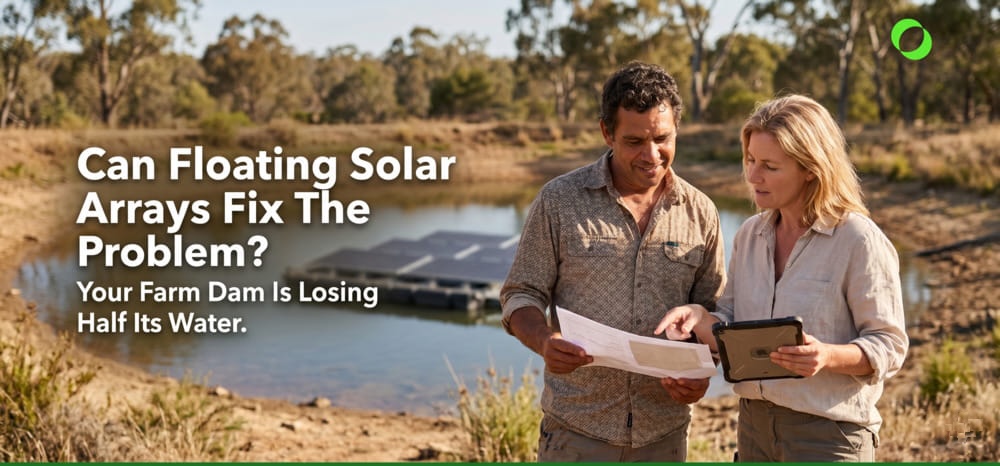
    Water allocations in Australia are tightening. Energy costs are rising. And every year, around half of stored on-farm water may never reach productive use due to evaporation. (CRDC/NEESTI data)

    But there’s a niche, energy-generating technology that can both save the dam and give it a second function:

    Floating solar panels or floating solar arrays.

    As evaporation continues to draw water levels down, and nature, not always returning water as predictably as farms rely on, here’s what other farm owners are doing:

    They’re talking to the right people about transforming their agricultural irrigation dams into sites for floating photovoltaics.

    The on-farm dam becomes a part of the solar energy generation system. And that same energy it produces can power the farm’s own irrigation pumps.

    This article explains how an irrigation dam becomes a floating solar site to generate clean energy, protect stored water, and create a second source of income.

    What are floating solar panels in Australia? (Do floating solar panels work?)

    Key Takeaway / Quick Answer

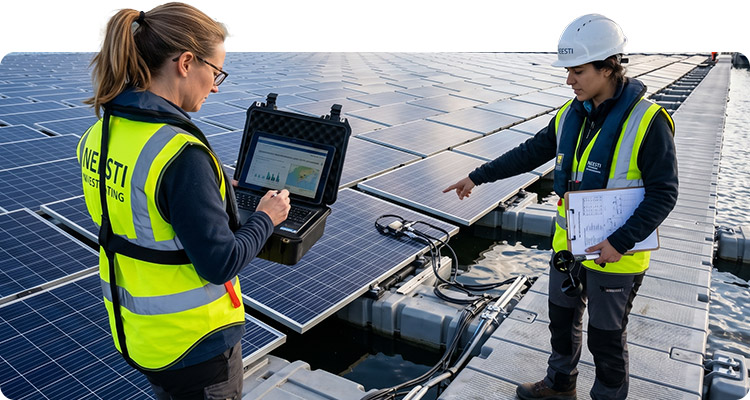
    Floating solar panels (also called floating solar arrays or floating photovoltaic systems (FPV) are solar energy systems installed directly on bodies of water instead of land. They sit on floating support platforms and generate electricity the same way conventional solar panels do: by converting sunlight into usable power through photovoltaic (PV) cells. Their main purpose is still energy generation, but floating arrays come with a second benefit: they shade the water beneath them, helping reduce evaporation while the water itself cools the panels and improves performance. Because they use existing water infrastructure rather than productive land, floating solar is becoming increasingly attractive for farms, reservoirs, and irrigation systems. Even land with lakes, ponds, and similar bodies of water.

    Evaporation Control Farm Dams Solar: What Is a Floating Solar Array? (What Are Floating Solar Panels?)

    50% of on-farm water storage volume dissipating into the atmosphere year after year doesn’t seem that alarming to some. Because, like evaporation, water replenishment is part of the natural hydrological cycle, too.

    The scientific explanation behind water movement suggests as much. Rainfall. Surface runoff. Channels. Diverted flows. These are a few of the inflows that refill agricultural irrigation dams.

    However, there’s a looming concern hidden in seemingly calm waters: replenishment isn’t happening as much as, nor as often as, farmers and agriculture businesses are counting on it to. And when water levels don’t rise back the way they once did, neither does the level of production the farm depends on.

    More numbers that shed light on the matter:

    • In NSW and Queensland, evaporative losses from irrigation water storage total approximately 1,320 gigalitres annually (The Energy)
    • For cotton growers whose operations rely heavily on storing and moving water, electricity, and diesel account for up to 50% of total input costs (energy.gov.au)
    • Irrigated crop farmers spend AU$150–280 per hectare, per year, on electricity for water pumping (Sustainable Future Australia)

    The Turn of the Tide

    But did you know that if farmers could prevent just 10% of on-farm storage evaporation loss and send that flow back to crop production, the economic benefits are enormous?

    AU$41 million-enormous.

    Installing an innovation in solar, floating photovoltaics (FPVs), also called “floatovoltaics,” on irrigation dams is one of the ways that can make it happen.

    More stored water β†’ more water available for irrigation β†’ more irrigated area β†’ higher efficiency and crop yield β†’ better capacity and agricultural returns

    FPVs typically add a second function to existing irrigation infrastructure rather than take farmland out of production.

    How much money can I make from floating solar panels Australia?
    Key Takeaway / Quick Answer

    Floating solar panels in Australia can generate income by lowering electricity bills, reducing water losses from evaporation, and, in some cases, exporting surplus solar power back to the grid. How much you can make depends on your dam size, system capacity, local electricity prices, and whether your property qualifies for renewable energy incentives. For many irrigators, the biggest financial gain comes from combining lower operating costs with more productive water storage rather than relying on electricity sales alone.

    What To Do: Multiply your on-farm storage capacity (in megalitres) by 0.5 to get a rough estimate of how much your on-farm dam loses water prior to the growing season. Multiply that by your water entitlement price today, and you arrive at an AU amount you can add to your seasonal or annual floating solar cost base.


    [rcb_show_form]

    What Is the Warrnambool Project? (Why Is It Important?)

    The Australian-owned developer, Enervest, completed a 500kW floating solar array at the Brierly Basin reservoir in Warrnambool, Victoria, in 2026. It did so on behalf of Wannon Water (a regional urban water corporation owned by the Victorian Government).

    The array uses 1,260 bifacial solar modules. That equates to 500kW capacity, which is estimated to generate over 600,000 kWh annually. It’s now the sole source that powers the water treatment plant entirely. The entire system is set to contribute to greenhouse gas emissions reduction by over 650 tonnes per year.

    Total project development and estimated cost is AU$2 million.

    This project is technically on public water infrastructure. Even so, the same technology is being tested on irrigation storage across five agricultural sectors:

    Cotton, rice, sugar, horticulture (fruit, vegetables, nuts, etc.), and dairy.

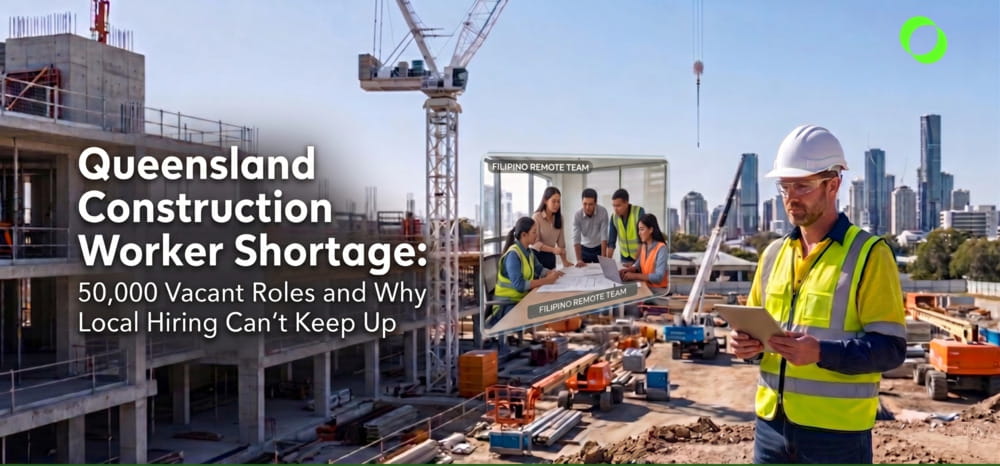
    Extra Read: Australia’s Solar Panel Recycling time bomb and Queensland Construction Worker Shortage are about to explode. Here’s how not to get caught in the impact, and what business opportunities await those who get to the starting line first.

    Get Matched AI Recruiter Banner

    Why the Government Is Backing Floating Solar on Farm Dams

    The Australian government is all-in on FPVs on agricultural irrigation dams. Otherwise, it wouldn’t have committed AUD 6 million in funding towards a research initiative under the NEESTI program. It wouldn’t have backed research programs for the technology if there weren’t plans to apply them in the field.

    What Is NEESTI? The Pioneering Project Behind It

    The Novel Energy and Evaporative Storage Technologies for Irrigators (NEESTI) project is a AU$13-million, five-year initiative that launched in June 2025. Of that amount, AU$6 million came from the Federal Government’s AU$5 billion Future Drought Fund Resilient Landscapes program. The other AU$7 million, from in-kind contributions from the project partners.

    It’s the first research project of its kind in Australia, focused specifically on farm-based irrigation storages.

    The project is led by AgEcon Australia, with support from the University of Southern Queensland and Macquarie University, and the main industry partner is the Cotton Research and Development Corporation (CRDC).

    Worth Noting: The NEESTI project points to something bigger: floating solar on irrigation dams is already being worked into real agricultural use cases.

    What Is NEESTI Investigating? (Or Isn’t)

    What Is NEESTI Investigating

    It isn’t testing whether floating solar works. That part’s been proven and tested. NEESTI is forming the AU-specific foundation for Australian farmland and agriculture. The frameworks, whether technical, economic, policy, or legal, that make it possible for an irrigator to approve and adopt the system on their own property.

    The idea is to evaluate whether floating solar behaves differently depending on how each of the five sectors stores and uses irrigation water. (CRDC)

    The research is looking at everything that would need to fall into place for irrigators to install it, from economics and approvals to insurance and grid access.

    What To Do: Track NEESTI outputs through crdc.com.au and arena.gov.au. The project aims to make it easier for irrigators to assess whether floating solar is worth installing.

    ARENA runs ongoing funding programs apart from NEESTI. The July 2025 announcement of AU$60 million for Ultra Low-Cost Solar PV R&D reveals long-term government investment in this area of solar. Set up funding alerts on arena.gov.au, so you stay up-to-date on application rounds.

    Which Farm Operations Are Best Positioned Right Now

    Floating solar isn’t one-size-fits-all. Not every irrigated farm is at the same stage. Research, funding frameworks, and regulatory pathways are tailored towards each of the five agricultural sectors.

    Floating Solar Fit by Agricultural Sector:

    Sector
    Why FPV Fits
    Key Opportunity
    Cotton
    Energy costs = up to 50% of input costs; large on-farm storages common
    Pumping cost offset; evaporation reduction in large flat storages
    Sugarcane
    High irrigation water demand; Queensland heat accelerates evaporation
    Water retention during dry season; energy for processing support
    Grains
    Large dam infrastructure already in place across Murray-Darling Basin
    Scalable FPV coverage; phased floating solar panel installation possible
    Rice
    Among the most water-intensive crops in Australia; storage dams essential
    Every megalitre saved directly improves yield economics
    Pecans
    Covered explicitly in NEESTI; high-value crop justifies infrastructure investment
    Dual income: energy generation and water savings


    The common thread across all five sectors? Large, existing water infrastructure that’s currently used as a single-purpose infrastructure.

    Since FPV adds a second purpose to the same surface, there’s no need for land clearing. No need to build new infrastructure to avoid competing with the crop for space.

    Note: Australia’s primary solar installation and safety standards (such as AS/NZS 5033) are legally required to align with international IEC (International Electrotechnical Commission) standards.

    What To Do callout: If your property has 5 megalitres or more of on-farm water storage, it may be worth exploring whether floating solar could work there. The NEESTI project outputs will eventually provide a standardised framework, but preliminary assessments from FPV installers with agricultural experience are readily available.

    As you plan to grow your team remotely, use the Remote Staff Free Outsourcing Calculator to punch in your numbers and see actual totals:

    Use the Remote Staff FREE VA Calculator and see real numbers, actual costs on your screen.

    OUTSOURCING CALCULATOR Tool

    Annual Savings vs. Onshore

    $73,680

    Per VA β€’ Per Year


    ONSHORE$7,040/MO
    FILIPINO VA$900/MO

    Cost Reduction: 87%

    VA CALCULATOR PRO

    Who Runs the System After It’s Installed?

    Once a floating solar system is commissioned on an agricultural dam, there’s more to manage besides the generation of energy: an ongoing layer of administration and compliance that keeps the system operational and economically worthwhile.

    The talent is scarce in local market pools. So, Australian farm owners and irrigators are looking for specialists remotely.

    Remote Staff has been pairing technical and operations professionals with Australian businesses for over 18 years. For agribusinesses and renewable energy operators moving into FPV, the roles most needed are platform-based, output-measurable. They don’t require physical site presence.

    Grant and rebate administrators, energy project coordinators, compliance documentation specialists, data monitoring analysts, etc. All the roles you need for back office support, we vet for experience.

    You’re accessing the same standard of professional work at a materially lower total cost because the talent is based in a different market.

    Related Read: Here’s something about Agrisolar Hubs or Agrivoltaics Hubs, and Solar Farm Lease Guide Australia —how they, too, are changing Australia’s paddocks into power-generating sources of income.

    FAQs

    Can I put floating solar panels on my farm dam in Australia?

    Yes, and the technology is being actively trialled across Australian irrigation dams right now. The NEESTI project is testing floating PV feasibility in cotton, sugarcane, grains, rice, and pecan sectors. Regulatory and technical frameworks for farm-level deployment are soon to be deployed.

    How much water does floating solar actually save?

    Research shows floating solar panels reduce evaporation from water surfaces by 25 to 70%, depending on the proportion of surface area covered and local climate conditions.

    Does floating solar generate more power than ground-mounted solar?

    Yes, in most conditions. The water underneath keeps panel temperatures 5 to 15Β°C cooler than equivalent land installations, which translates to 5–15% higher annual energy output. In Australia’s high-heat agricultural regions, the efficiency advantage is at the higher end of that range.

    What is the 20% rule for solar?

    It’s a sizing guideline that recommends designing a solar power system to produce 20% more energy than your household’s average usage. This intentional 120% target creates a crucial safety buffer to offset cloudy weather, natural efficiency drops in wires and inverters, and seasonal spikes in power consumption (like running summer air conditioning). It ensures that your home remains reliably powered year-round without running short.

    What government funding is available for floating solar on Australian farms?

    The NEESTI project, backed by AU$6 million from the Federal Government’s Future Drought Fund Resilient Landscapes program, is the primary current initiative. ARENA (Australian Renewable Energy Agency) also funds broader solar and agricultural technology programs. Monitor arena.gov.au and the Future Drought Fund portal for upcoming grant rounds targeting irrigator adoption.

    Related Read: Stay compliant as you run your business internally and externally through the lens of the Modern Slavery Act Australia, as well as Payday Super Rules Guide.

    Dams Are Losing Water. Will You Lose Your Source of Income, Too?

    What is floating solar? Well, one thing’s for sure: there’s no going around what’s happening throughout farms and agricultural irrigation dams in Australia. The water’s getting depleted, and they’re not being replenished as fast, and as much, as they’re disappearing. It’s costing you money. And because it means less water for crops year after year, lower yields mean lower income as well.

    The research backing, the government funding and support, and the testing and deployments are telling farmers and irrigators that the technology’s ready.

    Save the dam, save your source of income, and the planet. Too idealistic? It’s more real now than it was a decade ago. All you have to do is make your irrigation dam available for a clean energy-generating system. As it happens, doing so even opens up a second and steady stream of income for you.

    The farm dam has always been infrastructure. FPVs are just going to make it a productive one.

    Ready to bring in remote specialists to your backend team? Call us or Request a Callback today.

  • Leasing Land to a Solar Energy Company in Australia: Drought-Proof Income For Your Marginal Paddock

    Leasing Land to a Solar Energy Company in Australia: Drought-Proof Income For Your Marginal Paddock

    Rolling greens and cattle under clear blue skies. The rhythm of mustering sheep, as you wait for rain. Sounds almost romantic, doesn’t it?

    Only, the reality of running a grazing property, especially marginal, low-performing country, is anything but.

    And it’s because of rain. Or the unrelenting absence of it, from one dry season to the next.

    Australia’s climate extremes mean seasons of low yield due to drought literally come with the territory. When harsh, dry cycles stretch on longer than the better ones, not even an excellent yield is enough to make up for the bad.

    Not when you have a family to feed. Not when you have livestock and pasture to care for continuously.

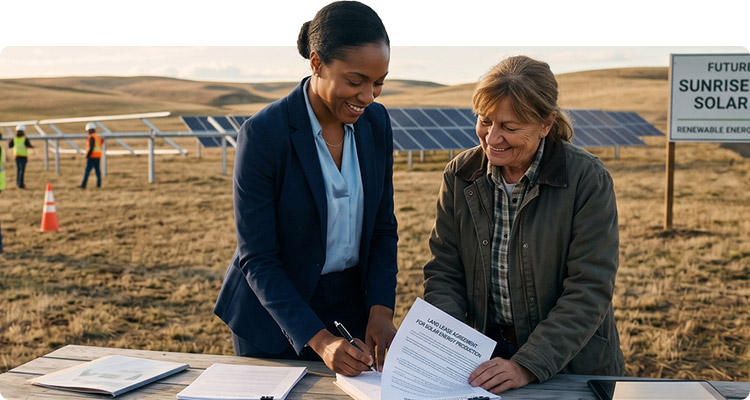
    Then you hear about a farm owner signing a solar farm lease agreement with developers. That’s stable income, no matter the weather.

    Should you make the same move?

    CSIRO’s 2026 research says that the land most likely to host solar is lower-profitability grazing country. It can represent reliable, drought-proof income.

    Solar developers are ready to strike a deal. The question you need to ask is whether you understand the deal well enough to know what you’re agreeing to.

    What is a solar land lease?

    Key Takeaway / Quick Answer

    A solar land lease is a long-term commercial agreement where a landowner rents a portion of their property, frequently underutilized or lower-yielding grazing country, to a renewable energy developer in exchange for stable and predictable rental income. The developer installs, operates, and maintains utility-scale solar infrastructure on the site, typically committing to a timeline of 25 to 60 years. While the primary use of the designated acreage shifts toward clean energy production, strategic contractual frameworks like agrisolar can allow farmers to simultaneously run livestock, effectively transforming marginal country into a diversified, drought-proof asset.

    From Prime to Marginal: Solar Farm Lease Australia and How the Land Shift Came

    The appetite for prime agricultural land use for renewable energy development has cooled. Marginal grazing country is picking up steam.

    CSIRO (Commonwealth Scientific and Industrial Research Organisation) research shows that using marginal country instead of prime agricultural land for solar infrastructure is better for Australia’s economy.

    Turns out, the estimated loss to overall agricultural profit falls from around AU$29 million to AU$2.6 million. A reduction of roughly 90%.

    Put simply, less prime productive land converted, less agricultural income displaced nationally. Smaller total loss for a solar land lease.

    How Developers Found the Right Kind of Land

    Developers define β€œsuitable” land for solar infrastructure as:

    Relatively flat or gently sloping. Has to be cleared, or previously cleared. Good proximity to transmission infrastructure. Good solar irradiance.

    A perfect description of large parcels of land in the Australian grazing country, particularly lower-performing land in NSW’s Central-West, Queensland’s south-west, and inland Victoria. These are the same regions that belong to the list of potential REZs or Renewable Energy Zones. All hotbeds for renewable energy buildouts. (AEMO Integrated System Plan, 2026).

    Is your marginal land within any of the corridors mentioned, according to solar farm companies looking for land? If it is, it just got renamed from β€œlower-yield pastoral country” to β€œstrategic grid location.”

    Worth Noting: low-yield land within these areas can claim higher negotiated leasing rates.

    What To Do: Search ANU’s (Australia National University) renewable energy heatmap online and locate your property. If it’s in a high-solar-resource area close to transmission infrastructure, your property may already be on a developer’s shortlist. Whether you’re aware of it or not.

    Related Read: Agrisolar and Regional Agrivoltaics Hubs are on the rise today. Discover more about the mechanisms behind them, and how industries are responding to the shift.


    [rcb_show_form]


    Numbers That Land: How Much Is Land Worth to Lease in Australia?

    Standard solar farm leases are at AU$750–AU$1,500 per hectare per year (AUD$304 to $607 per acre per year). A 1,000-hectare lease at AU$1,000/ha equals AU$1 million per year (AUD$404.69 per acre per year). Every year. Regardless of rainfall. Small parcels can yield a profitable six-figure outcome: 20 hectares at AU$1,500/ha is a guaranteed AU$30,000 yearly. (CEC/Farmers for Climate Action report, 2025 to 2026)

    Lease terms generally run for 25 to 30 years. Extensions bring that up to 40 to 60 years.

    New Renewables Projects, New Numbers

    Battery Storage Projects (5 MW BESS)

    Landowners in QLD, NSW, and Victoria are being offered AU$30,000 per hectare per year for one hectare to host a 5 MW battery system. (Rok Solid AU renewable energy land brokerage report, August 2025). AU$900,000 over a 30-year term from a single hectare alone.

    Wind Projects

    Wind company payments are now above AU$40,000 per turbine per year. It’s a decent alternative, as some farmers who host dozens of turbines can continue to graze cattle or sheep around them.

    Agrisolar and the Dual Income Potential

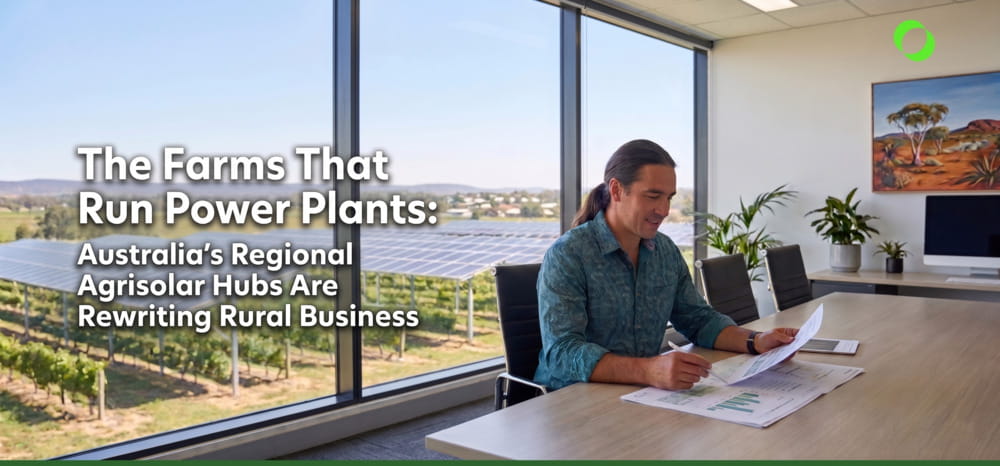
    Agrisolar, or Agrivoltaics, allows income both from land leasing and continued grazing under panels. Similar to wind projects.

    Real-life agrisolar examples:

    Tom Warren, a NSW farmer near Dubbo, leased part of his property to a French solar developer. Tom now grazes 250 sheep under 64,000 panels. His land’s carrying capacity has increased nearly 25%. Wool quality is up due to reduced heat stress, and cleaner fleece (no burrs, less dust).

    β€œ

    CEC estimates that between 2024 to 2050, farmers and landholders will receive AU$7.7–AU$9.7 billion in direct payments from renewables projects, mainly in land leasing or conversion.

    β€” Clean Energy Council (CEC)
    Projected Australian Renewable Landholder Payments (2024 – 2050)

    What To Do callout: Before making any decision on a developer’s offer, compare their numbers with others. Developers are in a race to close the most projects all over regional Australia. One tip? Don’t sign the first deal you come across.

    When Guaranteed Solar Lease Income Replaces Yield Risk (What You’re Giving Up and What You’re Gaining)

    When Guaranteed Income Replaces Yield Risk in Solar Land Leasing

    Leasing marginal land for solar development makes that parcel of land no longer viable for agricultural production. Throughout the term.

    It can be difficult, parting with land you’ve relied on for agricultural livelihood for so long. But think of it this way: it’ll be committed to a different kind of use. Something that’s just as important not only to every Australian, but the planet:

    Renewable energy production.

    You’re also doing away with yield risks and red flags. No more depending on rainfall patterns for yield. No more carrying the uncertainty of season-to-season returns.

    What The Exchange Implies

    You remain the landowner. Only the use of your land changes. Often, within the scope of the developer’s operational requirements.

    The reward is very promising: stable, contracted income. Predictable cashflow and passive income (and these are very good things). For utility-scale solar leases in Australia, payments are commonly structured annually, quarterly, monthly, or with option payments first.

    Just note that you won’t feel that full income the moment you sign. Lease payments usually start once the project becomes operational, while use of the leased area may be restricted during construction.

    The Contract Terms You’ll Live With For Decades

    Here are some of the terms and long-term costs worth negotiating early, before signing. Changing them later may not be an option, especially once you start computing for farmland value.

    When a Deal Looks Bad

    Lease rates you agree to without independent advice? And quickly? You’re writing your way to a poor tradeoff. What seems an acceptable rate today can turn sour when factoring in inflation over time. That’s called the β€œinflation lock-in risk.” There’s no contractual provision or legal pathway to revisit or revise it.

    Once you’re locked in, that’s it.

    The protection against this is a rent escalator clause written into the contract from the very beginning. Typically linked to the CPI (Consumer Price Index), payments increase annually, in parallel with inflation. That way, it doesn’t stay flat throughout the contract’s lease term.

    Decommissioning

    As the lease comes to a close, the infrastructure should be removed and your land restored. Everything from panels to inverters, fencing, and access roads. They’re the developer’s responsibility.

    If the contract says nothing about this obligation, or is ambiguous, the responsibility falls to you. Including the cost.

    Taxes

    Australia considers solar lease income as β€œassessable income.” The law treats it as taxable income. This means a change in land use can lead to a land tax reassessment. Something farmers don’t automatically account for when considering a lease.

    Example: A farmer signed a 25 year lease. To his surprise, he received a significant property tax reassessment 18 months later. The farmer expected new lease income. What he didn’t expect:

    Changing part of the property from agricultural use to commercial energy use could change how the property would be assessed for tax.

    Work with a tax accountant and a rural property lawyer to avoid this complication. Income tax treatment and potential land tax implications should be laid bare before the contract is finalised.

    What To Do: Do not make any decision on your first meeting with developers. Ask questions. Take notes. Don’t commit to anything. Not even if the developer asks you for some kind of verbal assurance. Make decisions only when your legal representative is around.

    Related Read: Stay up-to-date with the looming Solar Panel Recycling Australia time bomb, and the opportunity you shouldn’t miss either.

    Get Matched AI Recruiter Banner

    The Most Misunderstood Step: Option Agreement

    An option agreement comes before a solar land lease agreement. And it deserves just as much scrutiny as the main lease agreement.

    What is an Option Agreement?

    An option agreement gives a developer the exclusive right to lease your land at a future date, if the project moves ahead. In other words, not right now.

    During the option period, the developer evaluates whether the project is viable. They do so through grid connection checks, environmental research, etc. Agreeing to this means that for this period, you get an option fee, not a part of the lease payments.

    Call it compensation for reserving your land. If the findings show a low chance of success, the project won’t proceed. The developer leaves your land as is. You keep the option fee. If the project gets a green light and you sign, you still keep the fee. Win-win.

    However, signing the option agreement means that, during the evaluation period, you won’t be able to:

    • Lease the same land, or a part of it, to someone else
    • Accept another solar proposal
    • Sell freely without conditions

    Depending on the clause, you can only decline or defer opportunities you encounter within the option agreement timeline.

    The Option is More β€œTheirs” Than β€œYours”

    This agreement is designed to protect the developer. They have flexibility. You have less to none. Many landowners assume they can negotiate later, when really, many of the important terms may be locked in. Long-term.

    The option agreement can feel preliminary to you, but parts of it may already function like the real negotiation. It may include terms such as:

    • Rent escalator provisions (e.g. CPI-linked increases)
    • Lease term and extension rights
    • Land area covered by the lease
    • Permitted uses of the land
    • Access rights and access routes
    • Exclusivity provisions
    • Construction and development rights
    • Decommissioning obligations
    • Land restoration requirements
    • Option period length and extension terms
    • Termination rights and exit conditions
    • Assignment or transfer rights
    • Operational restrictions on surrounding land use
    • Compensation arrangements

    Many AU landowners aren’t aware of this agreement, and they sign without knowing the long-term implications.

    This isn’t necessarily unfair. You can choose to sign or not sign, after all. It just means the time to ask questions and negotiate is before signing. The terms are usually locked in at the option stage and carried through to the final lease.

    Worth noting: The developer may pay for your lawyer (up to a reasonable amount) to review the option agreement before you sign. One more reason for you not to skip an independent legal review.

    What To Do: Have a rural property or renewable energy lawyer review the full document before you sign. Present all lease drafts attached. Exit conditions. Terms. Legal costs. Any clause about the rent escalator.

    Having professionals go over the option agreement helps bring out obscure statements. They can also present scenarios and questions you haven’t thought of.

    The Demand For Agrisolar Is Rising Fast.
    Find the Roles You Need Now.

    Hire Remote Staff specialists to support operations while you take care of your business vision.

    Trusted by 3,000+ businesses to scale remotely since 2007.

    Agrisolar: When the Back Paddock Becomes a Two-Income Asset

    Here’s where solar isn’t just. It’s agriculture activity plus solar production. On the same parcel of land. In our dedicated article about Agrisolar a.k.a. β€œAgrivoltaics Hubs” (LINK), we mentioned β€œsheep grazing under solar panels.”

    It really does work.

    Why Sheep, and Not Cattle?

    It’s a size thing. Panels are spaced to allow sunlight and rainfall between rows. Sheep happen to comfortably fit in those rows. The panels then become useful to the flock, and even result in clearer fleece (less contamination from dust and burrs). They help improve pasture quality, too.

    Tom Warren, one of Australia’s most cited early examples of agrisolar, saw land carrying capacity increase nearly 25% in the Dubbo Solar Hub. Other studies in different hubs report wool production up approximately 15%.

    The Agrisolar Dual Income Structure

    You receive an option fee, separate from lease payments. They need the grass managed. You need the grazing. It’s common in many agrisolar arrangements today.

    Other Unforeseen Benefits

    Overnight moisture collected on panels drains into the surrounding ground. A small contribution to drought-prone areas, but a massive help to solar leased farms.

    What To Do callout: If your property grazes sheep and you’re thinking of considering a solar lease, ask if an agrisolar arrangement can be looked into. Something not all developers automatically include in a standard lease. Still, many aren’t averse to it. Some may even pay you a separate grazing management fee on top of the land lease rate.

    Land Is Ready. So Is Solar. Now, You Need a Team.

    Marginal land leasing in Australia has more people involved in agreements, disagreements, and negotiations than the developer and the farmer. You may need a rural property lawyer, a tax accountant, a valuer, a land agent or advisor, and planning and approvals specialists.

    On some occasions, an agronomist or environmental consultant has a role to play as well, depending on the project.

    These roles aren’t always readily available locally. In fact, with a demand spike in renewables, several roles are scarce in many areas. That’s why business and farm owners are turning to hiring offshore.

    Remote Staff has been helping AU farmers and landowners get their back office set up for over 18 years. As you plan for leasing your grazing land, we vet the candidates you need for support, before and after you sign. Even after the project’s done, and you need a solid operational workforce, we’ve got your back.

    The cost is friendlier than that of the local standard, only because the market location is elsewhere. The talent? The same high quality as anywhere else.

    As you plan around refinancing or growing your business, learn How to Calculate Outsourcing Cost in Australia and hire for the right solar farm jobs.

    And while you’re at it, be sure to stay compliant with this Payday Super 2026 Guide and the Modern Slavery Act Australia.

    FAQs

    How much do solar companies pay to lease farmland in Australia?

    It’s generally AU$750–AU$1,500 per hectare per year range for solar, the AU$30,000/ha anomaly for small battery storage (5 MW BESS projects), and the AU$40,000+ per turbine for wind. Rates vary by location, proximity to transmission, project type, and your negotiation with the developer.

    Can I still farm my land if I lease it to a solar developer?

    Yes, with conditions. Agrisolar (sheep grazing under panels) and the dual-income model give you room to still farm land. Note that agrisolar arrangements are increasingly common and can be negotiated into the deal. With such an arrangement, the land is the developer’s alone to use.

    What happens to my land at the end of the solar lease?

    Decommissioning obligations take place. It’s important to have land restoration written into the contract. It should be clearly stated as the developer’s responsibility. If it isn’t, you shoulder both the obligation and the cost of doing so.

    Is solar lease income taxable in Australia?

    Yes. The income tax component often comes with the possibility of land tax reassessment on a change of use. Something many farmers aren’t aware of. Be sure to get tax advice before signing, rather than after.

    In Marginal Land Leasing, The Margins Go Beyond What You Think

    …as long as you review the agreement, negotiate terms, and ask questions before signing. All while you have legal representation guiding you through every step and lease draft.

    For a parcel of land that’s idle, unused on the back of your property, it’s a meaningful income stream that also positively impacts the environment and the broader Australian economy.

    You don’t need to be an expert in energy markets to make a good decision. You need the right advisers and the right questions. What you need is enough time to read what you’re signing.

    Australia’s leap towards a renewable energy future is here. Catch it now before it slips past you.

    When you’re ready to explore how to staff the administrative side of a long-term land lease, and beyond, Call us or Request a Callback. We’ll help you find the right person.

  • Solar Panel Disposal Cost: PV Recycling Australia and the $7 Billion-Dollar Opportunity

    Solar Panel Disposal Cost: PV Recycling Australia and the $7 Billion-Dollar Opportunity

    50 million solar panels are about to enter their end-of-life in Australia.

    They’re calling it a β€œsolar panel recycling Australia time bomb.”

    The term was coined to describe a waste problem long since predicted: there isn’t enough recycling capacity for all the AU solar panels about to be decommissioned by 2030.

    Australian households were among the first adopters of rooftop solar. In the world. 1 in every 3 homes. With solar rooftop design spanning 25 to 30 years, most panels that went up from 2005 to 2010 are now entering retirement.

    In a different part of the world, nobody would think twice about it. But when that means one million tonnes of solar PVs have nowhere to go in one of the world’s largest landmasses, it becomes a national-scale liability.

    There’s barely an industry to catch it. No nationwide system. No large-scale solution.

    Yet.

    Here’s what’s inside this massive environmental burden, and where the business opening is, before larger players and regulation crowd it out.

    What happens to solar panels at the end of their life in Australia?

    Key Takeaway / Quick Answer

    Australia is approaching a major wave of solar panel retirements, with an estimated 50 million panels expected to reach end-of-life by 2035. While up to 95% of a solar panel can be recycled by weight, the country currently lacks enough collection and processing infrastructure to handle the growing volume. As waste levels rise, solar panel recycling in Australia is emerging as both an environmental necessity and a significant business opportunity.

    Australia’s Solar Waste: What Happens to Solar Panels at the End of Life?

    Australia is a world leader in rooftop solar. That much is clear. What’s coming is less so.

    The 2000s were when it all began. Howard-era rebates, followed later by the STC (Small-scale Technology Certificates) scheme, drove mass residential adoption well ahead of most countries. But Australia now has around 4.6 million rooftop solar installations, many of them installed during the early adoption wave.

    No panel decommissioning system in place.

    This is the degradation curve:

    β€œ

    Clean Energy Council data states that AU panels commissioned during that period still produce around 85% of original capacity, with 30 years as the standard lifespan of a system.

    β€” Clean Energy Council
    AU Panel Degradation Data

    Wait. They’re still usable? Technically, yes. But replacement starts happening earlier because efficiency drops even if they’re still functioning.

    As of today, the lifespan of 2000’s panels is four years closer to replacement. The industry refers to it as voluntary early replacement, and it’s generating waste volume that the current Australian infrastructure can’t make room for.

    By 2028: It Gets Serious

    Residential panels are the first to slide downhill. There’s a bigger avalanche approaching: large, utility-scale solar farms built between 2008 and 2012. 200-500 MW facilities. Hundreds of thousands to more than a million panels. Those begin decommissioning from 2028 onward.

    Here’s what the timelines say:

    2030: PV waste will hit 100,000 tonnes annually (UNSW / ARC data)

    2035: Cumulative waste is projected at 1.0–1.3 million tonnes (roughly 50 million panels per government estimates)

    2035+: Annual waste volumes are projected to exceed 150,000–180,000 tonnes (IndexBox market data)

    Australia’s National Solar Panel Recycling Pilot: Solar Waste Year by Year

    Year
    Estimated Annual PV Waste (tonnes)
    Notes
    2026
    30,000–40,000
    Mostly residential + early commercial
    2028
    Growing sharply
    Utility-scale decommissioning begins
    2030
    100,000 (5 to 7 million solar panels)
    UNSW/ARC projection
    2035
    150,000–180,000 (8 to 12 million solar panels)
    Cumulative total: 1M+ tonnes

    What To Do callout: For Australian SMBs, if you want to enter the solar afterlife logistics and processing economy, your infrastructure needs to be operational now. By 2027 to early 2028, at most.

    Related Read: The renewables and clean energy sectors are creating more opportunities for SMBs. Learn about Agrivoltaics Hubs Australia a.k.a. Agrisolar Hubs, and Solar Farm Lease Australia.


    [rcb_show_form]

    What Is the Solar Panel Disposal Cost for Businesses?: Solar Panel Recycling and Urban Mining

    When a solar panel dies, what happens to it? Recycling has a crucial role in the chain. Some panels sit in storage yards waiting for processing. Others are stripped for parts. The rest, a much larger number, ends up in landfills because recycling is expensive.

    Landfill disposal is around AUD $1–$5 per panel in some areas. Proper recycling costs somewhere in between AUD $15–$45+ per panel, depending on transport, disassembly, materials recovery, and location)

    Recycling is labor-intensive and nowhere near widespread. As Australia’s early rooftop systems begin aging out together, few enterprising minds are asking, β€œHow about turning this solar waste problem into an urban mine?”

    What is the Breakdown of a Solar Panel?

    The breakdown refers to the materials inside a solar panel once it’s taken apart. A panel can be broken down into glass, aluminum, silicon, copper wiring, plastics, and trace metals like silver.

    Understanding that breakdown is crucial to planning which materials can be recovered and which ones require special handling when the panel reaches the end of its life.

    β€œ

    95% of a solar panel by weight is recyclable. a remarkably high figure compared to most electronics.

    β€” Solar Recycling Dynamics
    Material Recovery Potential

    Material composition per panel (approximate):

    • Glass: 65-70% by weight; can be reused in new panels or construction
    • Aluminium frame: 15-20%; fully recyclable, high scrap value
    • Silicon solar cells: 3-5%; the highest-value material
    • Silver (conductive contacts): 0.1%; tiny by weight, enormous by value
    • Copper wiring: 1%; valuable, easy to recover
    • Plastic/encapsulant: 10%; the hardest to deal with, mostly incinerated or landfilled

    Urban Mining and the Valuable Side of Solar Waste

    Under the right processing conditions, newer recycling methods, such as advanced thermal and chemical delamination processes, can recover more than 90% of the usable materials inside old solar panels.

    What’s being retired from rooftops is becoming a new resource stream:

    • Output per tonne of input panels: high-purity silicon (99.5%+), silver concentrate, aluminium, copper
    • Value per tonne of input: AUD $400–800 (IndexBox market data) using advanced processing
    • AU government’s own estimate: a national product stewardship scheme could unlock up to $7.3 billion in economic benefits through reduced waste and material reuse

    It’s branching out, too. Researchers from the University of Newcastle have developed a more efficient method for high-grade silver recovery, specifically from PV cells.

    High-purity silicon recovery is described by IMARC (International Market Analysis Research and Consulting) as “the greatest economic opportunity” in the sector and “the industry’s biggest technical hurdle” simultaneously.

    Illustration: A facility processing 3,500 tonnes of retired panels a year no longer looks at this as dealing with abstract β€œwaste.” It’s handling thousands upon thousands of panels. Those panels move through conveyors, glass separation systems, and more each week. From those come aluminium, copper wiring, silver concentrate, and high-purity silicon; materials already tied to active global supply chains.

    Urban mining via solar panel recycling becomes financially meaningful once enough panels are being processed consistently.

    Related Read: Solar and clean energy are changing what powers Australia. Read this Solar Farm Lease Guide and Agrivoltaics Hubs Australia (Agrisolar Hubs). Because farm owners and operators, as well as SMBs, have opportunities waiting. But the window’s narrow. And it’s now.

    Get Matched AI Recruiter Banner

    Fewer Than 5% of Australia’s Solar Panels Get Recycled

    Australian homes and businesses want to recycle their panels, but national-scale infrastructure is limited. These three things are holding solar recycling back:

    #1. Logistics Costs

    Moving retired panels across Australia is costly. A panel coming off a roof in Toowoomba or Kalgoorlie will need to travel hundreds, sometimes thousands, of kilometres before reaching a recycling facility. In many cases, sending it to a landfill is cheaper.

    The country’s too large, too spread out for a centralized, systematic collection system to work easily.

    What this means in numbers:

    Cost Component
    Range (per tonne)
    Gate fees (standard c-Si panels)
    AUD $150 – $350
    Logistics/transport
    AUD $50 – $120
    Landfill disposal (comparison)
    AUD $5 – $30 est.

    The 100 collection sites in the government’s $24.7M pilot program are meant to generate the transport cost data needed to design a logistics model that works at a national scale.

    #2. No Domestic Commercial-Scale Processing

    End-of-life panel material recovery is there. The technology’s available. Only, there’s not enough of it. Not enough facilities. Not enough equipment. Too-thin processing capacity to handle the growing number of retired and retiring PV solar panels.

    What the current system’s up against:

    Cost Component
    Range (per tonne)
    Gate fees (standard c-Si panels)
    AUD $150 – $350
    Logistics/transport
    AUD $50 – $120
    Landfill disposal (comparison)
    AUD $5 – $30 est.

    Estimated Solar Panel Waste Volume:

    30,000 to 40,000 tonnes by 2026

    100,000 tonnes by 2030

    The existing processing capacity versus projected solar waste is massively imbalanced. And Australia’s still dependent on imported recycling technology and specialised processing equipment.

    Domestic supply chains for the machines themselves? Zero.

    #3. Back-Office and Compliance Capacity

    Recycling operations are documentation-heavy by nature. Every panel that moves through a certified facility generates:

    • Waste tracking records
    • Chain-of-custody documentation
    • Recycling certificates
    • EPA compliance reports
    • Extended Producer Responsibility reporting (from 2028-2029 onward)

    Most operators currently in this space are small-to-mid-size businesses. Their workforce is lean. The compliance and administration infrastructure are just as important, but are afterthoughts. Many businesses only start putting up proper systems once the operational problems have begun.

    By then, the workload’s too messy and backed up to untangle easily. Volume will grow from 2028 onward. This part of the workforce should, too.

    What To Do: If you’re entering this market, or want to, logistics and compliance are your first operational hires. The processing technology for standard recovery is accessible. High-purity silicon recovery is coming. Reinforce your back-office infrastructure now.

    Regulations Are Catching Up, Rules Are Tightening

    So, hurry. Not to cause panic, but it’s a fact: the Australian government is beginning to take the afterlife of solar seriously. The grace period is now. The silver lining is that this is good news for early participants. Businesses can build proper compliance systems while the industry is young and rules are still taking shape.

    How Does Product Stewardship Work (What is the meaning of product stewardship for businesses)?

    The Productivity Commission has recommended a national solar panel recycling scheme. The pilot will begin mid-2026. 100 sites. 250,000 retired solar panels. The project’s aim is to generate data to be used as the basis for a mandatory permanent solar panel recycling scheme.

    Mandatory Extended Producer Responsibility (EPR)

    Industry observers expect mandatory Extended Producer Responsibility (EPR) requirements later in the decade. Mirroring EU WEEE-style (Waste Electrical and Electronic Equipment) frameworks, the EPR will mandate that producers (manufacturers and importers) be legally required to fund end-of-life management.

    In essence, it creates a government-backed, reliable stream of incoming work for recycling operators.

    In the U.S., Washington and California have state-level PV stewardship laws up and running; Australia is following the same legislative setup.

    Is EPR Compulsory? What’s About to Change?

    Extended Producer Reliability will rearrange gate fees and logistics cost distribution, shifting to producer-funded schemes. Manufacturers and importers would help pay for the collection and recycling of old solar panels. Recyclers won’t be carrying most of the cost themselves.

    Producers must route panels only through certified operators. It’s strict, but it guarantees volume.

    Other changes include:

    • Compliance documentation requirements increase substantially; operators who have systems in place hold a competitive advantage
    • Certification and chain-of-custody requirements become non-negotiable

    Before oversight tightens, treat this as a grace period for compliance. Businesses can build infrastructure, establish certification, and form relationships with producers before they become mandatory throughout the industry.

    Related Read: Another clean energy solution is catching industry attention—here’s what you need to know about Floatovoltaics Australia or Floating Solar Panels Australia, and how your agricultural dam can be turned into a new source of income.

    The Real Business Opportunities: Where They’re Wide Open

    There are three market entry points, each one a path that leads to the most significant business opportunity.

    Entry Point #1. Collection and Logistics Networks

    The least capital-intensive entry point, collection and logistics networks don’t belong to material recovery. They have to do with the movement of panels.

    The competitive advantage is geographic coverage. More so in regional and rural areas where no collection infrastructure exists.

    Where the opportunity is:

    • pickup routes
    • local installer relationships
    • storage sites
    • transport access
    • regional collection points

    The other advantage is coverage across more parts of Oz.

    The country’s 100-site panel recycling and collection pilot program is helping the government figure out the real cost of collecting and moving retired solar panels across Australia.

    Early participants will learn routes, costs, bottlenecks, and operational patterns long before newer entrants do. The quickest way to a steady panel supply is through partnerships with entities that presently have panel volume.

    Entry Point #2. Processing Facilities

    Higher capital requirement, but higher margin. Collection is one thing. Taking thousands of retired panels apart every week requires industrial sites, machinery, and coordinated transport systems. But unlike collection networks, they also generate revenue from recovered materials like aluminium, glass, copper, silicon, and silver.

    Where the opportunity is:

    • Standard mechanical recycling (aluminium frame + glass separation) is accessible with existing technology
    • Advanced delamination for silicon and silver recovery is where the margin is, and where research investment is currently focused (UNSW hub, University of Newcastle silver recovery)
    • Regional processing hubs reduce logistics costs and create local employment, a factor in government funding decisions

    The current market is too small and too thinly distributed. No single recycler holds more than 15-20% market share (IndexBox). No one’s dominating. That’s your opening.

    Entry Point #3. Material Recovery Value Chains

    The most mechanically complex. But the highest-margin of the three. You get a clean and short entry into manufacturing supply chains. If you’re a business that can produce high-purity silicon (99.5%+), silver concentrate, or high-grade aluminium, this is the express lane to manufacturing contracts on the premium side.

    Where the opportunity is:

    As Australia classifies silicon, silver, and copper as strategically important materials, locally recovered supplies will likely receive stronger government backing over time.

    β€œ

    Australia published its Critical Minerals Strategy 2023–2030 and updated its official critical minerals and strategic materials lists in February 2024. Silicon is included on the critical minerals list, while copper is treated as a strategic material.

    β€” Critical Minerals Strategy
    Official Resource Classification Update

    As of 2026, no Australian business is operating in this entry point commercially. It’s as open now as β€œopen” will ever get from here on.

    What To Do callout: Choose from the market entry points based on your capital position and timeline. Collection networks can be operational in months. Processing facilities require a minimum of 12-24 months. Material recovery value chains take 3 to 5 years. All three need wheels turning now.

    All three also need a stable backend office infrastructure early. Ideally, before the solar panel retirement wave accelerates.

    As you plan to grow your team remotely, go over How to Calculate Outsourcing Cost and use the Remote Staff Free Outsourcing Calculator to punch in your numbers and see actual totals:

    Learn How to Calculate Outsourcing Cost in Australia

    Use the Remote Staff FREE VA Calculator and see real numbers, actual costs on your screen.

    OUTSOURCING CALCULATOR tool

    Annual Savings vs. Onshore

    $73,680

    Per VA β€’ Per Year


    ONSHORE$7,040/MO
    FILIPINO VA$900/MO

    Cost Reduction: 87%

    VA CALCULATOR PRO

    The Backbone of Your Business: Assembling Your Team Before the Wave Crashes

    Early entrants. Lean operations. Both describe Australian SMBs in the solar recovery slice of the urban mining market. Most are focusing only on the infrastructure and the technology. But administration, compliance documentation, logistics coordination, and data management belong to the foundations as well. Something the local market pool doesn’t have enough of.

    This is where Remote Staff lays the next stone. We match Australian SMBs with remote professionals, from compliance documentation administrators and logistics scheduling coordinators, to regulatory research analysts, data entry specialists, and administrative support.

    We screen for skill and experience. We handle the HR work, onboarding, payroll, and admin.

    Businesses that staff these functions before the 2028 decommissioning surge are operationally ready when volume arrives.

    No matter the role, no matter the question, from What is a No Code Platform to what’s happening in the Queensland Construction Worker Shortage, and everything else that has to do with job search virtual assistant pooling, we’re here for you.

    FAQs

    How long do solar panels last in Australia? (When do solar panels need to be replaced?)

    Solar panels in Australia have a 25 to 30-year lifespan. But this can vary, since panels need earlier, voluntary replacement if performance gradually drops over time. If your panels were installed in the 2000s, they’re most likely approaching their final decade. Or less.

    Is it worth replacing 10 year old solar panels?

    Not immediately. Most 10-year-old solar panels can produce around 90% of their original output. However, usability is different from efficiency. Replace them if they’ve been heavily degraded due to weather or are no longer compatible with newer systems.

    What happens after 20 years of solar panels?

    Most solar panels work even after 20 years, at a lower efficiency. Depending on the system and conditions, output gradually declines to around 80-90% of the panel’s original capacity. Many owners keep using them. Others replace them for better performance or system upgrades.

    What materials are recovered from solar panels? What components of a solar panel can be recycled?

    Glass (65–70%), aluminium (15–20%), silicon (3–5%), silver, and copper can all be recovered from solar panel recycling. 95% are recyclable by weight. High-purity silicon is the highest-value but most technically complex material to recover.

    Since most solar panels’ are recyclable, the same goes for their components. The glass, aluminium frame, copper wiring, and silicon cells can be recovered and reused, while specialised recycling facilities can safely process or dispose of the remaining materials.

    Are solar panels being recycled in Australia?

    Yes. However, Australia currently recycles less than 5% of its retired solar panels. Most end up in storage or landfill because the country doesn’t have enough collection networks and processing facilities to handle the growing volume.

    Is solar panel recycling currently mandatory in Australia?

    Recycling is currently voluntary. The government’s $24.7 million solar panel recycling pilot will be in the works by mid-2026. It’s to test how old solar panels can be collected, transported, and recycled across the country before larger national recycling rules are introduced and made mandatory.

    How much does solar panel recycling cost in Australia? (How much does it cost to dispose of solar panels in Australia)

    Right now, recycling solar panels in Australia is relatively expensive. Facilities can charge roughly AUD $150–350 per tonne just to process the panels. Transport adds another AUD $50–120 per tonne, depending on distance. For homeowners, recycling a single panel often costs somewhere around AUD $20–40. These costs are expected to ease as more facilities open and larger panel volumes begin moving through the system.

    Related Read: Understand the Modern Slavery Act Australia and Payday Super 2026 changes to make sure every part of your business stays compliant.

    Solar Panel Recycling Is Your Opportunity. It’s Now.

    Australia’s the world’s most solar-dependent residential grid. Yet there’s almost no solid infrastructure to manage what happens at the panels’ end-of-life. And the countdown says β€œ2030.”

    The government has acknowledged it. Funding is moving. Research hubs are opening. Mandatory legislation is taking shape. Solar panel recycling services in Australia are gearing up. The market is forming right now, and formation is the only period where first-mover advantage isn’t a hyperbole.

    50 million panels are coming off rooftops. The urban mine is already loaded.

    Businesses that treat 2026 to 2028 as a construction period, not a waiting period, are the ones who will own this market when volume arrives.

    When you’re ready to assemble the back-office team that makes this operation run, Call us or Request a Callback today.

  • Agrivoltaics Hubs in Australia: How Regional Agribusinesses Are Scaling Dual-Yield Farms

    Agrivoltaics Hubs in Australia: How Regional Agribusinesses Are Scaling Dual-Yield Farms

    Sheep grazing and utility-scale solar generation. Sounds like they don’t belong in the same sentence. They do now.

    Australia is pioneering a new type of operation that makes farms more than farms: the “agrivoltaics hub.” Also called the agrisolar hub.

    A cotton farm is building a facility that produces green hydrogen and ammonia using solar power. Regional farms are being transformed into integrated energy producers.

    It’s land use for farming and solar generation simultaneously. It’s landowners building these hubs on their own land to power themselves. What follows is a self-powered farm and a supply chain that’s independent of overseas logistics chains.

    But what does it actually take to build and run a hybrid operation?

    What does the back-office infrastructure look like when a farm becomes a regulated energy and chemical producer?

    What is an agrivoltaics hub? (What is an agrisolar hub?)

    KEY TAKEAWAY / Quick Answer

    An agrivoltaics, sometimes referred to as an “agrisolar hub,” is a facility that co-locates agricultural production with renewable energy infrastructure on the same land. In the most advanced current examples, like GEGHA in New South Wales, the energy produced on-site powers the agricultural operation, replacing imported fuels and fertilisers with locally generated alternatives.

    What is an Agrivoltaics Hub Australia a.k.a. Agrisolar Hub: Definition and Purpose

    Agrivolatics hubs are converted land so that they’re no longer used only for farming, but for solar farming Australia (systems) and solar energy generation. On the same plot. At the same time. Instead of replacing agriculture with renewable infrastructure, the two operate side by side.

    In Australia, the term is often interchanged with “agrivoltaics.” Same definition.


    [rcb_show_form]

    What Makes Agrivoltaics Research Hubs Unique?

    Besides crops growing beneath elevated panels and livestock grazing between solar arrays, the energy produced on agrivoltaics hubs can help power the farm itself. Solar grazing systems, if you will. It can even power nearby operations or larger industrial processes like hydrogen and ammonia production.

    No more costly freight chains stretching across oceans. No more weeks- to months-long waits for critical farm inputs to reach Australian shores.

    This one integrated system, through agricultural solar integration, is what the next generation of agrisolar hubs in Australia is hurtling toward.

    Where It Really Started

    This sustainable, regional farming tech Australia innovation began with sheep roaming under solar infrastructure. The first of the rest of the agrisolar projects. The Royalla Solar Farm introduced this operation in 2015, making it the baseline model since. It works because grazing stock fit naturally under standard panel mountings and don’t interfere with energy output. Low-tech, effective, and increasingly common across regional NSW, Victoria, and Queensland.

    Today, the category has grown well beyond the woolly and the merino. Elevated panel systems allow cropping underneath. Horticulture trials are being done on partial shade structures, and aquaculture testing on floating PVs (floating solar panel systems installed on bodies of water).

    At the more advanced end of this renewable energy agriculture shift is solar infrastructure, now being used to power hydrogen and ammonia production directly on-farm. That’s what this article will be diving into.

    Extra read: learn about the Modern Slavery Act Australia, guidelines, and how SMBs should stay compliant.

    Get Matched AI Recruiter Banner, encouraging offshoring agrivoltaics hub and agrisolar hub hiring.

    GEGHA: The Model Everyone Will Be Watching

    The Good Earth Green Hydrogen and Ammonia project, or GEGHA, broke ground in May 2026 and gave Agrisolar the momentum to push past the experimental.

    It’s a joint venture between New Zealand-based Hiringa Energy and Moree’s own Sundown Pastoral Company. The latter operates out of Keytah Farm, one of the largest cotton and cropping operations in the region.

    The farm used to import fossil fuel-based fertilisers from overseas or have them transported from Sydney, Brisbane, or Newcastle. With GEGHA, it will produce its own green hydrogen and ammonia on-site using solar power, which it then uses as fertiliser for its own land and neighbouring agricultural properties in the New England region.

    $71.6M combined with 65,000 acres, and the project is forecasted to produce 4,500 tonnes of low-carbon ammonia a year.

    An Isolated Project No More

    GEGHA is the most concrete example yet of a pattern forming across regional Australia: the merging of farming operations and renewable energy infrastructure.

    β€œ

    Agrisolar CRC is launching a 10-year, $100M industry-led research program running from 2026 to 2036; this will allow industry, landholders, government, and research partners to expand agrisolar commercially across Australia.

    β€” Agrisolar CRC
    10-Year Commercial Expansion Program (2026–2036)

    Here’s what’s being coordinated and funded for agrisolar, further signaling that it’s evolving into its own sector:

    • NSW Government has committed $45.2 million to GEGHA alone

    • NSW Hydrogen Hubs Initiative has invested $109.3 million into projects across Hunter, Port Kembla, and Moree since 2023

    • The initiative is targeting 700MW of green hydrogen capacity by 2030

    Most Australian SMEs reading about GEGHA and similar projects think this is all about the technology and the investment figures. But the more important question is what it takes to run one of these operations once the panels are up and the electrolyser comes alive.

    The Part Less Talked About: What Does It Take to Run An Agrisolar Hub in Australia?

    A β€œfarm with solar panels” has always been too simplistic and slightly wrong as an understanding of AU agricultural solar hubs. Though the hype tends to circle around the tech and mechanisms, and they are impressive, there’s something else about self-powered agriculture that’s not getting as much attention:

    The back-office challenge. It’s as important as the front-end engineering and technology, and nobody’s talking about it.

    A regional agrisolar hub is an agricultural operation, a licensed energy generator, a chemical manufacturer in GEGHA’s case, and a participant in multiple regulatory frameworks, collectively. That’s a lot of hats, and a lot to juggle, for a pastoral business in regional NSW.

    The Regulatory Side Is A Major Undertaking

    When you run an agrisolar hub, you answer to multiple regulators at once. Each one has different rules and requirements. Each one holds a different ideal of what β€œcompliance” is and isn’t.

    That stack looks something like this.

    The Four Regulators Agrisolar Hubs Answer To:

    Regulatory Framework
    Key Requirements
    Who Oversees It
    Clean Energy Regulator
    LGC creation, EGR reporting, STC claims (geotagged evidence from March 2026)
    Clean Energy Regulator
    NSW Planning Framework
    State significant development approvals, SEARs, EIS obligations
    NSW Dept of Planning
    Chemical Manufacturing
    Ammonia production compliance
    SafeWork NSW / EPA
    Climate Disclosure
    Mandatory reporting expanding July 2026 for larger entities
    ASIC / Treasury

    Australia’s regulatory landscape works on a higher standard at present, and expects hubs to be audit-ready. They should provide real-time visibility and evidence: if a hub claims a certain number of solar certificates, or reports a certain output to the regulator, they need to be able to prove it with timestamped and traceable records the moment a regulator asks.

    For a cotton farm in Moree, that’s a new and overwhelming side of the business that’s an entirely different professional lane.

    Data Demand Is Growing Fast

    A hub like GEGHA generates operational data across multiple systems: solar generation and battery storage. Then, electrolysis output, ammonia production, crop monitoring, irrigation, and transport logistics. A lot of data from a lot of systems, and they don’t automatically work together.

    These are cotton farms and pastoral properties. To expect software company-level outputs is too much to throw at a farming corporation, no matter the size. They don’t have data teams.

    Regulators put their foot down anyway. It’s the same standard of reporting regardless.

    Illustration: A regional NSW agrisolar operation receives a compliance query from the Clean Energy Regulator six months after commissioning. The owners and operators know the records are there. They know they have the ammonia logs. But they don’t have a strategy, nor do they have a data administrator, compliance officer, or operations coordinator in their workforce.

    It takes them weeks to consolidate everything, and consultant turnovers drag the process out further. With a dedicated back-office structure, that could have been completed in an afternoon.

    The Hiring Problem That Could Stall All of This

    The NSW Government calls GEGHA a template, and the plan is to roll this model out across regional NSW and beyond.

    But that requires very specific types of roles. The market pool in agriculture typically doesn’t share the same ground with these skills.

    As it turns out, that combination is rare anywhere. In Moree? Rarer still.

    GEGHA created 93 jobs in construction and operational roles alone. The compliance and management positions are where hiring gets tougher:

    • Regulatory coordinators

    • Compliance officers

    • Data administrators

    • Operations managers well-versed in both farming and energy

    These are in short supply, especially in regional centres. The Agrisolar CRC (Cooperative Research Centre) surfaced the problem, as the sector needs research, demonstration sites, supportive policy, and knowledge sharing if agrisolar is going to take root across regional Australia.

    The unexpected solution that’s growing in demand is remote staffing. These operations are turning to global specialists to fill the roles.

    Scaling Regional Agrivoltaics: Managing the Operational & Back-Office Burden

    Remote Staff connects Australian businesses with experienced offshore professionals across compliance, data administration, and operations coordination. The back-office roles that agrisolar hubs need most are the roles our team specialises in placing.

    The talent pool for this specific skill mix isn’t in Moree. Even when it exists in the cities, it comes at a cost most regional operations can’t justify.

    A compliance officer or data administrator working remotely can do the same job at a fraction of the local hiring cost. How? They’re in a different part of the globe with a different cost of living. Same high-quality, in-demand talent.

    If you’re in the agrisolar space, that’s the problem Remote Staff solves. Onboarding, payroll, HR, and admin are on us, too.

    As you plan for your next remote hires, read the Payday Super Rules Guide. Just to make sure you aren’t missing out on anything.

    Commercial Agrivoltaics: What the Next Wave of Agrisolar Hubs Looks Like

    GEGHA is a “Moree” of a much larger picture.

    The NSW Hydrogen Hubs Initiative is targeting 700MW of green hydrogen capacity by 2030, with projects already underway across Hunter, Port Kembla, and Moree. The Agrisolar CRC’s $100M research program running from 2026 to 2036 is meant to help Agrisolar settle into mainstream agriculture across Australia.

    Further west, the Australian Renewable Energy Hub in the Pilbara is proposing 26GW of wind and solar to produce green hydrogen for export. Whether it’s a few livestock plus farming under solar panels, crop production with solar, or utility-scale electrolysers with government funding, they’re moving towards the same direction.

    β€œ

    The Australian Journal of Agricultural and Resource Economics noted in 2026 to date that agrisolar here is still mostly sheep grazing and pilot projects. Commercial-scale agrisolar hubs are still the exception.

    β€” Australian Journal of Agricultural and Resource Economics
    State of Commercial-Scale Agrisolar (2026)

    What needs to happen? Funding certainty and stronger planning pathways.

    The federal government also needs to take a firmer stance on agrisolar and make it a standard, if not one of the standards, for regional farming. Australia has no unified policy integrating agriculture and renewable energy to date. There’s no existing legal definition or clear land-use rights for farms producing both crops and power on the same ground.

    The hubs are going up. The paperwork governing them is still being figured out. Climate-smart agriculture? Yes, to this. But for another blog.

    Extra Read: Learn about remote professionals SMBs are hiring fast: What is the Role of a Project Manager and Best Industries for Project Management.

    FAQs

    What is agrisolar? (What is agrivoltaics?)

    Agrisolar is the practice of using the same land for both farming and solar energy generation at the same time. It ranges from sheep grazing under solar panels to hydrogen and ammonia production on-farm, powered by solar.

    What is the GEGHA project in NSW?

    GEGHA stands for Good Earth Green Hydrogen and Ammonia. It’s a joint venture between Hiringa Energy and Sundown Pastoral Company. With a $71.6M budget, construction began in May 2026. Once operational, and it’s expected to be by 2027, it will produce up to 4,500 tonnes of low-carbon ammonia and 224 tonnes of green hydrogen annually. This will be done using a combined 35.65MW solar installation and 15MW electrolysis system.

    What is the difference between agrisolar vs agrivoltaics?

    The terms are used interchangeably in Australia in terms of integrated solar agriculture. “Agrivoltaics” is the more common technical and academic term, and “agrisolar” is used more widely in industry. Both describe the co-location of agricultural production and solar energy on the same land.

    What is the biggest problem with solar? (agrisolar context)

    Regulatory complexity and data management. Agrisolar hubs need to pass through a plethora of regulatory frameworks, from energy generation to planning. Being able to consistently deliver audit-ready data can be an operational burden, especially because these responsibilities don’t naturally overlap into agriculture.

    Is there an agrisolar policy in Australia?

    Not yet. Australia currently has no federal policy on integrating agriculture and renewable energy. The absence of a legal definition for agrisolar and unclear planning rights across dual land uses continues to be a challenge, especially for broader use and in expanding the industry.

    Extra Read: Find out what business opportunities lie in wait in the Queensland Construction Worker Shortage, and Best No Code Tools.

    The Farm Isn’t Just a Farm Anymore

    GEGHA is the first credible proof of turning agrisolar into a working industry model. There are operational complexities, with a shortage in role specialisations hanging over it. The systems for coordinating them are still being ironed out.

    Once again, the technology is ahead of the workforce and infrastructure.

    Panels and electrolysers are the easy part. The farms that run power plants will be won or lost on whether the back office is reinforced. And if the back office doesn’t keep up, the farm will spend more time and resources on compliance than operations.

    Australian farmers and land owners, as well as SMBs in the agriculture sector, are finding the right talent offshore. What about you?

    Looking at how to staff the operational side? Ready to grow your agrisolar offshore team? Call us or Request a Callback today.

  • Best Mother’s Day Gift Ideas For Every Mom: Gifts For Working Moms, Single Moms, Mompreneurs, and More

    Best Mother’s Day Gift Ideas For Every Mom: Gifts For Working Moms, Single Moms, Mompreneurs, and More

    β€œHow does she do it?”

    You wonder, as mum flexes her superpowers, casually making your family’s life better every day… just by being.

    Yet for mothers, exhaustion can be every day, too:

    • 72% of women reported burnout in the past 12 months, according to Women’s Agenda’s 2024 Women’s Ambition Report.

    As Mother’s Day 2026 becomes the search and talk of every panic-scrolling child, adult, or otherwise, you’re asking:

    What are the best Mother’s Day gifts for mom?

    When no gift can truly suffice for all they do and are, what gift do you give stay at home work from home moms, mompreneurs, single moms, and working moms for a lifetime of love, tenderness, and sacrifice no one could ever repay?

    You’ve seen Tom Brady’s Mother’s Day Tribute. Now, it’s your turn.

    Whether you’re in Sydney, New York, or LA, this Mother’s Day gift guide 2026 (which also serves as a guide for last-minute gift ideas) for the mom in your life who deserves nothing less than the world.

    What are the best Mother’s Day gifts moms love? (What are the most popular Mother’s Day gifts to give mom this year?)

    Key Takeaway / Quick Answer

    The most popular Mothers Day gift ideas for every type of mom center on relaxation and self-care, including spa bookings, household help, and high-end beauty gadgets like LED masks or Dyson Airwraps. While luxurious sleepwear is a top trend for 2026, classic tokens such as flowers, chocolates, personalized photo frames, and watches remain perennial favorites.

    #1: Best Mother’s Day Gifts for Working Moms

    She Clocks Out of Work or Logs Out, Then Heads To Her Home Shift.

    What do working moms actually want for Mother’s Day? But the more pulse-pounding thought is: Are there gifts she’ll actually use?

    Mothers who work in offices or are work from home stay at home moms want something that won’t add to their tiredness. More than trinkets, they want relief. An hour, preferably more, when they get to spend time for themselves or enjoy a meal that someone else in the family made.

    Time, and taking something off her to-do list, are among the best Mother’s Day gifts for working mums.

    β€œ

    According to the Australian Bureau of Statistics, two-thirds of all primary carers in Australia are women.

    β€” Australian Bureau of Statistics
    Gender Breakdown of Primary Carers

    General research shows that the average working mum logs 98 hours per week across work and caregiving combined.

    It’s no wonder, nor is it a secret, that mums get tired. Still, they don’t stop being mothers. There’s no time off or clocking out. They fill the role with radiance and strength, and through the fatigue, 24/7, flat out.

    Give mum something to ease her exhaustion.

    List of gifts for working and work from home stay at home moms:

    • Meal delivery subscriptions (Menulog, Door Dash, Uber Eats); one less meal for her to cook, delivered especially for mum
    • Treat mum to a same-day spa or massage; she’d never book this for herself, but she’ll definitely use it if it’s scheduled
    • Sleep and recovery gift; mums almost always run on less sleep. A high-quality sleep mask or a massage pillow tells them you notice
    • Heartfelt video compilation from her kids, plus a day off; film the vid on your phone for that extra genuine touch
    • Audible subscription for a book she’s always wanted to buy but hasn’t (because she knows she won’t have time to read it)

    Next: For the mum who had an idea and ran boldly with it, with her spouse and kids at her side.

    Learn about Four Ways Outsourcing Can Help Working Moms Stay Sane


    Get Matched AI Recruiter

    #2: Mother’s Day Gift Ideas For Mompreneurs / Mumpreneurs

    She Built or Runs Something, While Raising a Family.

    The first years of motherhood have mums dedicated to raising their kids and supporting their working spouses. According to Mums & Co, half of Australian business mums are between 30 and 39, with one in three starting their business while on parental leave and one in 10 starting while pregnant.

    For many, becoming a mumpreneur begins when the kids are school-aged, so they get more time to devote to themselves.

    β€œ

    60% of moms feel overwhelmed juggling home and family care with career.

    β€” Cost of Care Report
    2026 Career and Family Balance Impact

    The other story says that nearly half of mothers in business created their own because working for someone else was no longer viable. The primary reason being inflexibility, according to the same business report.

    Just like the way many mumpreneurs attend to their households, there’s no customer care team, no HR department asking β€œHow can we help?” They are the company, and often, you and the rest of the family are her only support. Until her business idea kicks off and growth becomes the next obvious step.

    For a thoughtful Mother’s Day present, give back two things she hasn’t had enough of: time and headspace. Something that stokes her pleasantly unexpected, sneaky-good ideas is also ribbon-and-gift-wrap worthy.

    Mother’s Day gift ideas 2026 for mompreneurs / mumpreneurs:

    • Business audiobook, or better again, ask if she’d come across one but hasn’t bought it yet (suggest Hidden Potential, Value Whispering, and The Art of Spending Money; depending on where she is in her business)
    • Canva Pro subscription, or whichever creative platform she’s on, or wants to be on (get the pro plan)
    • A proper afternoon off, which means no checking notifications on her mobile, even if she’s technically logged off her laptop.
    • Arrange childcare, preferably with family or close friends, and let her take her pick of how to spend the day; no work tasks or home errands
    • Book a lunch at her favorite restaurant; if she wants to spend it with the family, make time for the date
    • Make a purchase from a small business she’s inspired by; she gets to indirectly support a fellow small business on the side, something she’ll always remember
    • Book a discovery call with a remote staffing provider; she’ll learn about roles to add to her team, so she can focus on what she really wants her business to be

    Top it off by sharing this blog as the icing on the cake: The AU Entrepreneurs Ultimate Guide to Hiring and Working With a Filipino Virtual Assistant.

    Now, for the mom whose job title isn’t on any chart or business card, the work of her hands, often unacknowledged but forever cherished.

    #3: Mother’s Day Gifts 2026: For Full-Time Moms

    She Runs the Whole Operation Full-Time, and Nobody Calls It a Job.

    The full-time, SAHM doesn’t have a job title other than β€œMom.” But if you added up everything she does in a week and placed a dollar amount on her hours, she’d be earning a six-figure salary. More, even.

    Insure.com puts it at AUDAUD$224,000 a year. Salary.com goes higher: AUD $285,000, based on 106 hours of work per week. Her roles include childcare, cooking, teaching, housekeeping, logistics, bookkeeping, and running the household budget. She’s also the household CFO.

    All of it, day-to-day, unpaid.

    β€œ

    Mothers work an average of 77 hours a week: 30 hours on household work, 27 hours on childcare. 20 hours are in paid work, if they work part-time.

    β€” Australian Institute of Family Studies
    Weekly Work and Care Hour Statistics

    For mums who don’t work part-time, the extra 20 hours are still put towards household tasks and childcare.

    Full-time mums don’t want gifts they have to look after. The best gift you can give them on Mother’s Day is one that’s completely theirs and doesn’t need to be shared or maintained.

    Mother’s Day gift ideas 2026 for full-time SAHMs:

    • Full day off; everyone else in the family handles the household chores and errands, like cooking, cleaning, child logistics, grocery shopping, sending and picking the younger kids to and from school, all of it
    • Following the above is breakfast in bed, and is always a favorite
    • Kindle Paperwhite or Audible subscription; she’s been meaning to read for months; it’s also quiet time during her otherwise busy, chaotic day-to-day
    • Grocery delivery subscription; one errand she doesn’t have to stress over
    • A framed family photo; pick the one she likes best, and have her decide where she wants to put it
    • Spa gift card, a hair treatment booking, or a shopping gift card, and gift vouchers are also great alternative

    Upcoming are the best presents for mum who holds the fort on their own, wishing she could be in several places at once if it were possible).

    #4: Popular Mother’s Day Gifts For Single Moms

    She Does It Alone, And Does It Again Tomorrow.

    Single mums are doing every role simultaneously. She’s the breadwinner, caregiver, household manager, and emotional anchor, without a significant other to share the weight of it all with her.

    But she does everything magnificently, because she can.

    β€œ

    Single-parent families make up 1 in 5 of all families with dependent children. Around 8 in 10 of those are headed by mothers.

    β€” ABS Labour Force Status of Families
    Single-Parent Family Demographics in Australia

    The data also shows that two in three single mothers are in paid employment, on top of their solo unpaid care responsibilities.

    Though the majority are employed, a large number of them worry about long-term financial circumstances. That worry is mainly tied to their children’s futures. (Council of Single Mothers and their Children)

    They may or may not need it, but a helpful gift is a welcome one.

    Mother’s Day gift ideas 2026 for single moms:

    • Grocery delivery subscription (Woolworths Everyday Delivery or Coles Plus); an errand she can cross out of her weeklies
    • Meal prep or delivery service (Marley Spoon, HelloFresh AU), or you can cook something yourself; a treat that’ll literally be off her plate for the day or so
    • Cleaning service booking; even one session will lighten her load
    • Full-day childcare covered, again, preferably with family and close friends; give her a Saturday, or a weekend, that’s hers
    • Heartfelt letter from her kids for a personalised gift; from you, if you’re one of them; help the kids write if they can’t on their own
    • An extra special gift card for something that belts out β€œpamper me-time”; it can be anything from a massage to lunch, or coffee with a book, whatever her vibe

    What does every kind of mom need most right now?

    Every mum, whether she’s doing double shifts in the office, doing full-time household care, nurturing a new venture while being with her family, or taking care of things solo, carries the load without complaint and without nearly enough support.

    One of the best ideas, the best presents to spoil mum has to do with this: she needs to know that the load doesn’t always have to be that heavy.

    The Perfect Mother’s Day Gift For Any Season (What Every Mom Is Running Low On)

    The Perfect Mother's Day Gifts For Stay At Home Mums and Full-Time Mums

    Burnout. It happens. But burnout doesn’t make mums any less of a β€œmother,” and it doesn’t mean they’re doing terribly. It just means they’re human, and they get tired. Physically and emotionally.

    If your mum is looking to command her own business, or is doing so but needs reliable support, find the right roles through Remote Staff. For over 18 years, we’ve been working with American and Australian business owners, pairing them with exceptional offshore professionals whom we vet for skill and experience.

    We know mothers do everything at home and at work; that’s why everything else, from screening candidates to hiring and onboarding, along with HR work and payroll, is on us. You can also let her choose if she wants to engage with the hire part-time or full-time.

    The point is: mothers deserve all the support they can get, and if you’re looking for the best kind of support, we’re here to help them carry the load.

    Bonus Read: Get ready for Payday Super 2026 Rules and the Modern Slavery Act Australia. Practical guides, especially if mum wants to spread her wings in the AU business sphere even more.

    FAQs

    When is Mother’s Day 2026?

    Mother’s Day is Sunday, May 10, 2026. In Australia, it’s always the second Sunday in May, which is the same date observed in New Zealand, Canada, and the United States.

    What is the most given gift on Mother’s Day? (Best Mother’s Day gift ideas for moms)

    Flowers, as they’re considered an ideal gift. 37% choose flowers as their favourite Mother’s Day gift, according to Roy Morgan / ARA 2025. Apart from flowers, time off from household chores and errands, pampering or me-time gift sets, and bookings for spa days and hair days, a luxury gift (for those who aren’t thinking of budget-friendly gifts and are willing to splurge), and personalised photos are on the list.

    How much money do work from home stay at home moms earn?

    Mothers work an average of 77 hours a week: 30 hours on household work, 27 hours on childcare, and 20 hours in paid work (if working part-time). Salary.com estimates the global market value of that unpaid role at $184,820 per year, just for basic chores. Either way, it’s a six-figure job that they do for free and out of love.

    What is a mumpreneur? (What does it mean to be a mompreneur?)

    A mumpreneur is a mother who runs her own business, most often while being her household’s primary caregiver.

    How can I make money as a work from home stay at home mom?

    You can work online. There are agencies that match work from home moms with business owners, and the roles are completely remote. If you’re thinking about starting a venture, consider offshoring roles, so your attention stays on growing your business. Asking about roles and rates from legitimate outsourcing agencies like Remote Staff is a good place to start.

    They Deserve All the Mother’s Day Gifts 2026 Can Offer, And Always

    The best thoughtful gift for moms is something that tells her you understand how hard she’s been holding the household together. The perfect gift that gives her time to herself: a day off to relax, reenergize, and breathe a little, or perhaps to just not do anything at all.

    It won’t hurt to shower her with flowers, chocolates, mementos, and luxurious items (if it’s in your budget). But let the message come through: she needs to be taken care of, too. And Mother’s Day is a meaningful way of expressing that to her.

    Let her feel seen. Make her feel celebrated. Because there’s no one else like Mom.

    If you think she’s ready for support when it comes to her passion projects and creative detours, go ahead andΒ Request a Callback today.

    Happy Mother’s Day to every mom around the world!

  • Queensland Construction Worker Shortage: 50,000 Vacant Roles and Why Local Hiring Can’t Keep Up

    Queensland Construction Worker Shortage: 50,000 Vacant Roles and Why Local Hiring Can’t Keep Up

    Queensland is 50,000 workers short as of early 2026.

    When the third most populous state in Australia, home to a population of 5.5 million, is unable to fill the Queensland construction worker shortage, the problem becomes less a statistic and more a matter of urgency.

    It’s not just construction workers either.

    Key roles like Estimators, CAD Designers and Technicians, BIM Modellers, Accounts and Payroll Specialists, and Administrative Support are in the mix, too, among many others.

    At the current pace of things, local talent pools won’t be able to meet the demand deluge, the Queensland Auditor-General’s Major Projects 2025 report confirms.

    The work is waiting. But the workers are nowhere to be found.

    So what does a Queensland construction business do when the local talent pool is wearing thinner by the day, and can’t keep up with the work that’s running on a tight, years-long deadline?

    Why is there a construction worker shortage in Queensland?

    Key Takeaway / Quick Answer

    Queensland is facing a massive construction worker shortage because four major pillars, housing, transport infrastructure, the net-zero energy transition, and Brisbane 2032 Olympics preparations, are all competing for the same limited local talent pool simultaneously. As project commissioning continues while supply remains stagnant, this deficit will compound annually, making traditional local hiring increasingly unsustainable.

    Behind the Construction Worker Shortage Queensland Is Facing Today (Why 2026-27 is the Forecasted Peak)

    The peak construction labor shortage Queensland is up against in 2026-27 comes from Construction Skills Queensland, or CSQ, an industry-funded body representing Queensland’s construction sector. They’re responsible for workforce planning and training investment, they make recommendations, and identify gaps throughout the sector and in construction occupations.

    Their flagship workforce research report, Horizon 2032, is a decade-long outlook for Queensland’s construction workforce that ties to the Brisbane 2032 Olympics timeline.

    That pipeline? It’s been said to grow from AU$53 billion in 2024-25 to AU$77 billion in 2026-27, and at the moment, beyond capacity.

    According to the Construction Skills Queensland’s (CSQ) findings:

    Queensland is heading for a peak shortage of 50,000 construction workers in 2026-27. The average shortfall is 18,200 workers per year, over the next eight years.

    Four concurrent demand drivers pulling from the same workforce pool simultaneously:

    • Housing construction targets
    • Transport infrastructure (Cross River Rail, Gold Coast Light Rail, Sunshine Coast Rail)
    • Net-zero energy transition
    • Brisbane 2032 Olympic venues


    [rcb_show_form]

    Is the Main Cause of Queensland Skilled Worker Shortage the Brisbane 2032 Olympics?

    No. Not entirely. TheΒ Brisbane Olympics construction demand is a driver, and one of the larger ones at that. But it’s not the major factor spinning the demand-supply propulsion out of order. The trade shortage Queensland issue had been plaguing the state and the continent at large since the post-pandemic construction boom of 2021 to 2022.

    The sudden surge in residential building, infrastructure investment, and materials costs rubbed against an already reduced workforce, with skilled migration slipping from behind it and forcing a hiring block.

    Facts about the construction worker shortage Queensland is dealing with at present:

    • Queensland accounts for a disproportionate share, given its pipeline density, weighed against the national context
    • Infrastructure Australia’s 2025 Market Capacity Report projects the national shortfall will reach 300,000 workers by mid-2027, up from 141,000 currently
    • 11 of 17 Brisbane 2032 venues were still in business case processes (as of mid-2025)
    • Queensland Government capital spend is AU$116.8 billion across four years in infrastructure, transport, housing, and public works

    What To Do: The shortage isn’t constrained to construction work alone. If you’re in the construction industry, do an audit of your operations and manpower. Identify every role that’s either vacant or understaffed.

    For any role that’s platform-based or doesn’t require physical site presence, offshore hiring is the immediate and viable answer right now.

    Use our FREE Outsourcing Calculator Tool and see the numbers for yourself, and read about How to Calculate Outsourcing Cost for Australian SMEs.

    Ready to Audit?

    Free ROI Calculator

    Compare local hire costs vs. Filipino VA rates in under 60 seconds.

    OUTSOURCING CALCULATOR TOOL

    QLD Construction Jobs Project Bottleneck: Are Estimators High In Demand In Australia?

    Yes, estimators, among others, are in high demand. There are three shortage categories named by the QAO (Queensland Audit Office) report: Engineering, project management, and trade roles. Estimators are perched right in between the first two.

    The lack of estimators in the industry can be particularly damaging because choke points mushroom before anyone sets foot on site. Estimators are responsible for reviewing plans and specs. They calculate qualities like materials, labour, and time, and price everything out from suppliers to equipment to wages. They build a cost estimate or bid.

    It boils down to this: no estimators equals no tender. No pricing, no bid.

    And this will compound, with the direction going nowhere else but upstream. Damage will only multiply from this one source of delay.

    Important details about the estimator shortage:

    • Queensland estimator listings as of April 2026 show open roles stacking up disproportionately against applicants
    • Australia’s job boards consistently list civil engineering professionals, including quantity surveyors, among the most in-demand occupations nationally
    • Surveyors Australia warns that the sector is about to hit a workforce shortfall of over 2,000 professionals per year by 2029

    Headcount isn’t the predicament here. There’s an overwhelming scarcity of senior estimators with platform experience in tools like Buildsoft, Cubit, or CoConstruct. The local pool is there, but is largely composed of junior or mid-level workers.

    Illustration: A Queensland subcontractor is missing a tender submission window because their company’s sole estimator resigned months ago. The replacement search is past the deadline, and they still can’t find a local candidate who can fulfil the role for the Queensland infrastructure workforce shortage.

    Not Just A Construction Workforce Gap Australia’s Staring Down, Not Just An Estimator Shortage

    The pre-site bottleneck isn’t the only leak in the building industry labor shortage QLD pipeline. Here are other roles that need filing, and why these, like Estimators, are best hired offshore.

    Quantity Surveyors

    Cost planning, contract administration, and financial reporting across the project lifecycle; in acute shortage.

    Drafters and CAD Technicians

    Produce construction drawings, shop drawings, and as-builts in AutoCAD, Revit, or ArchiCAD. Filipino drafters with AU construction project experience are among the most established offshore roles in the market.

    BIM Modellers

    Build information modelling for complex infrastructure and commercial projects. Where AU builders are increasingly adopting BIM-mandated procurement processes, demand for this role is rising.

    Project Administrators and Document Controllers

    RFI management, submittal tracking, contract documentation, and compliance registers. Their responsibilities do not need to be done on a site manager’s desk. The high-volume, process-driven work is system-based and is ideally offshored.

    Scheduling Coordinators

    Primavera P6 or MS Project-based programme management and progress reporting. This role is required in government-funded Queensland projects.

    Accounts and Payroll Specialists for Construction

    Progress claim processing, subcontractor payment schedules, and retention tracking. Construction-specific finance roles with AU compliance knowledge are easily available in global talent pools.

    Related Read: Stay updated about the Modern Slavery Act Australia strictly adheres to, and how you can stay compliant in supply chains and more.


    What’s the Biggest Killer in Construction? (Roles, Shortage, Remote Solutions)

    Role category
    Specific roles
    Shortage peak
    Remote-staffable?
    Engineers, Architects & Scientists
    Civil engineers, structural engineers, building designers
    Late 2026; 126,000 nationally
    Partially; Design, documentation, modelling
    Project Management Professionals
    Project managers, estimators, quantity surveyors, schedulers, procurement managers
    Mid-2027; 59,000 nationally
    Fully remote-compatible
    Trades Workers & Labourers
    Carpenters, electricians, plumbers, concreters, labourers
    Mid-2027; 126,000 nationally
    Site-based only
    Drafters & BIM Modellers
    CAD technicians, BIM modellers, documentation specialists
    Ongoing through 2028–29
    Fully remote-compatible
    Document Controllers & Project Admins
    RFI managers, contract administrators, compliance coordinators
    Ongoing through 2028–29
    Fully remote-compatible
    Finance & Accounts
    Progress claim processors, payroll, accounts receivable
    Ongoing through 2028–29
    Fully remote-compatible

    Sources: Infrastructure Australia 2025 Market Capacity Report; CSQ Horizon 2032; Queensland Audit Office Major Projects 2025

    What To Do: Go over this list and add roles you need apart from the ones mentioned. If more than two are vacant, or whoever’s fulfilling those roles is overloaded, now’s the time to launch your hiring roadmap.

    QLD Construction Work Hours

    On-site: Monday to Saturday, 6:30 am to 6:30 pm (noise regulation hours; shift hours will vary depending on contract and employer)

    Off-site / Remote / Offshore :Β 

    7:00 am – 3:00 pm AEST

    8:00 am – 4:00 pm AEST

    9:00 am – 5:00 pm AEST

    Normal office-style schedules aligned to Australian business operations.

    Why Is It So Hard to Find Construction Workers in Australia Right Now?

    Construction projects will continue to get commissioned year after year, and the work won’t stop. Every year the “construction jobs demand Queensland 2026″ goes unaddressed, it rolls over and adds to the next year’s deficit. The longer it goes unmet, the harder it becomes for theΒ construction workforce in Australia to meet work demand.

    As construction ramps up from 2027, it will compete with every other active project from then on.

    Note:

    Infrastructure Australia identifies that most shortage occupations require “a mix of general, technical, and specialised skills, which take time to develop.

    Negative impacts as direct results of the worker scarcity:

    • Some Queensland construction sites, averaging only 2.5 productive days per week, are bracing for productivity loss, which compounds the workforce shortage
    • Labour scarcity is inflating project costs; construction cost growth in Brisbane is forecasted at 5% in 2026 (RLB), with regional Queensland at up to 6%
    • 63% of firms cite labour cost as a substantial threat to project delivery
    • 59% of firms cite labour and skills shortages (Infrastructure Australia industry survey)

    Apart from these, there’s the competition issue. Smaller construction businesses and SMEs won’t be able to match the pay rates or guaranteed work volumes of larger, major contractors. Let alone government-backed projects bidding for the same scarce talent.

    Local-only hiring is out of the equation, and the data proves so. Local training also takes years, while interstate recruitment has its constraints because every other Australian state is facing its own shortage.

    Related Read: Don’t miss out on the current rules and changes about Payday Super 2026Β and stay compliant as you grow your team during this skills shortage, and beyond.

    The Roles Are Being Filled, But Not The Way Most Think

    For every role that runs inside a platform and produces a measurable output, remote hiring is a direct and immediate answer to the shortage. Such roles don’t require a physical presence, and these include estimators, quantity surveyors, drafters, project administrators, accountants and bookkeepers, administrative roles, BIM modellers, and schedulers.

    All are platform-based by nature.

    Filipino remote professionals working in this industry typically hold degrees in civil or structural engineering, quantity surveying, construction management, or architecture. Most bring several years of hands-on experience, such as direct work on AU residential, commercial, and civil projects.

    Remote Staff Australia has been placing remote professionals with Australian construction businesses for 18 years. On cost: the local hire equivalent for most of these roles carries a base salary of AU$80,000 to AU$120,000 before Superannuation, leave entitlements, and more.

    A comparable remote professional represents a materially lower total spend, not because the capability is different, but because the cost of living in their market is.

    Related Read: Wondering what Australian business owners are asking about What Is a Marketing Automation Specialist and The Best No Code App Development Platforms for Australian Businesses? Quick reads so you don’t miss out.

    FAQs

    Can a remote estimator handle AU construction software like Buildsoft or Cubit?

    Yes. Filipino construction professionals working in the offshore market frequently have hands-on experience with AU-standard estimating platforms, including Buildsoft, Cubit, Bluebeam, and CoConstruct. Screen for demonstrated project output, not just platform name recognition on a resume.

    Is the estimator shortage in Queensland expected to ease anytime soon?

    Not within the current infrastructure cycle. CSQ projects the average shortfall persisting across the next eight years, with the peak hitting in 2026-27. The Brisbane 2032 construction ramp-up from 2027 adds further pressure to the shortage of builders Queensland is facing.

    What’s the difference between a remote estimator and a quantity surveyor?

    A remote estimator focuses primarily on pricing, takeoffs, and bid preparation. A quantity surveyor covers a broader scope, including cost planning, contract administration, and financial reporting across a project’s lifecycle. Both roles are in acute shortage in Queensland.

    How quickly can a remote estimator be operational?

    With clean software access and a documented tender process, most remote estimators contribute within two to three weeks. Businesses that hand over a brief, platform login, and one completed example tender consistently report better ramp-up times.

    Related Read: Learn about other in-demand roles and find out how Marketing Automation Specialists and the No Code Developer are reshaping operations in AU SMBs.

    Demand Won’t Ease Up, Neither Will Local Supply Catch Up Quickly

    The point is that hiring remotely is the remedy. There’s no other way around it, unless you’re willing to gamble on a local search that drags on for months to years.

    You settle for a candidate who doesn’t have the expertise you’re looking for, and all the while, projects are halted. Everything, from tenders delayed to understaffed bid teams, brings costs in from different sides, layer upon layer.

    The numbers may look like they’re just part of another statistic. But if you’re a serious business owner, you know that they represent a moment that can change how you build and grow your team, and how far ahead of the market you end up.

    The remote estimator model is already working for AU construction businesses. The talent is vetted and available.

    The decision is whether to move now or after the next worker shortage. Request a Callback to discuss your estimating requirements today.

  • Best No Code App Development Platforms for Australian Businesses: Unbiased Tips + Owner Guide

    Best No Code App Development Platforms for Australian Businesses: Unbiased Tips + Owner Guide

    Ready to crack those fingers and scour through the list of the best no code app development platforms? The ones Australian businesses are lunging toward, this not-so-new tech phenomenon that keeps quietly reshaping how small teams build software?

    Maybe you’re already running one. Or two. A few, even. Maybe you’ve just started reading up on them, warming up to the idea, wondering how far “no code” can actually go in 2026.

    There’s a pattern showing up across AU businesses this year, and subscriptions, active, tools are live. And yet the builds don’t ship. Workflows stay manual. Platforms quietly gather dust in the background while the monthly invoice keeps landing.

    The question isn’t whether the best no code tools work. They do. The question is whether the ones you’re paying for are the right category for what you’re actually trying to build. Most businesses find out they’re not, long after the free trial ended.

    Here’s a breakdown of the 11 best platforms worth your money in 2026, grouped by what they help you build. The tool is half the job, though. Someone still has to run it. More on that as you read on.
    For the HEADER:

    What is a no code platform?

    Key Takeaway / Quick Answer

    A no-code platform is a software development environment that allows you to build functional websites, mobile apps, databases, and automations without writing traditional programming code. Instead of manual line-by-line coding, users design software through visual drag-and-drop components, pre-built templates, and conversational AI prompts (a.k.a. “vibe coding”). These platforms translate human intent and plain-language instructions into production-grade systems complete with backend logic and data storage. While accessible to non-technical users, they are powerful tools heavily used by specialists to rapidly ship software, prototypes, and internal business workflows.

    What Are No Code App Development Platforms? (Not the List, The Definition)

    What such platforms do for you: no code app development platforms let you build software, from apps, websites, internal tools, to automations, with “no code.” No writing code at all levels, the way a software developer does. No-code development or vibe coding is cut from a different cloth, since it’s intent-driven and prompt-based.

    The no-code developer identifies what language to use in crafting the right instructions, essentially to “tell” AI how to behave, how to generate the expected output.

    πŸ’‘

    Did You Know?

    2026 marks the year when the terms “no-code development” and “vibe coding” became one and the same, the latter being newer of the two. But because most, if not all, no code platforms now are AI-integrated, they now fit the “vibe coding” description.

    Scenario: In traditional development, the developer writes the entire line-by-line code that builds the software. The non code developer writes, not code, but the promptβ€”the instructions AI needs for it to start building.

    It’s in plain language, the vibe coder dialoguing with the AI tool. But it’s nowhere like how you type prompts in ChatGPT. This process requires technical knowledge and is skill-specific.

    After all, what’s being built is a moving, breathing app, website, or workflow that’s very much production-grade software. It runs with backend logic, user authentication, data storage, and integrations. All of these are to hold together with zero breakdowns, or as little as what’s acceptable, after launch.

    β€œ

    70% of new business applications will use low-code or no-code technologies by 2025 (up from 25% in 2020). Pairing your business operations and workflows with the right no code developer AUSMEs, a space Remote Staff can help fill.

    β€” No-Code Market Trends
    Global Technology Adoption Forecast

    The Platform Category Blind Spot

    Having the right vibe coding tools is where square one is. They don’t immediately work well the moment they’re switched on. The “platform category blind spot” is the mistake of picking a tool before identifying which category of problem you’re solving.

    Avoidable, when you identify what you need, and work with the ideal no code consultant.

    11 Best No Code App Development Platforms (What Are Examples of the Best No Code Platforms?)

    Enough setup. These 11 no code software below are grouped into five categories based on what software type they produce: what job they do. Use the categories to understand the general purpose, and skip straight to the 11 named platforms for the details.

    AI-Powered App Builders

    This one’s considered the newest in the growing sphere of no-code platforms. They generate full applications and build the full app. Through natural language prompts, the developer writes what they want (again, in a way the AI will understand).

    As in a conversation, the AI, if the language is understood, builds what’s being asked, and the build is polished and tweaked until the outcome is as the developer originally prompted.

    #1. Lovable

    Here’s an AI-first full-stack builder. It creates complete, ready-to-use apps you can “take with you” via exportable code. Normally, or at least for many no-code platforms, whatever’s built is locked within the platforms themselves.

    With builders like Lovable, you have the option to take what’s built out (the actual programming files created by AI), so that, should you decide to use a different platform, the next developer can continue the work.

    There’s a trade-off with this level of independence, of course. Complicated builds need to be overseen, ideally by a specialist who understands the output.

    Best for: SaaS prototypes and MVPs where you want code you can take with you. Starting cost (AUD): Free tier, paid plans from ~$30/month.

    #2. Bolt.new

    Browser-based, Bolt.new is fast, to put it simply and easily. It’s prompt-to-app, so you “describe” the tool that needs to be built.

    prompt-to-app, and fast. You describe the tool, it builds it, and you iterate or adjust it right there, same window. The benefit of speed is accompanied by a limitation, and it’s that for it to be production-ready, careful, meticulous validation is more than a must.

    Best for: Quick internal tools and functional prototypes you can ship in hours.

    Starting cost (AUD): Free tier, paid plans from ~$30/month.

    What To Do: If speed is your main goal at the moment, for a build that’s more on the less complex, less precise side, choose AI-first builders. Before it goes live, have the developer fully validate the output.


    [rcb_show_form]

    Visual App Builders

    This is considered one of the established categories, having been around since the early 2010s. Visual configurations are the main build operation through drag-and-drop canvas editors. Think of it like how you drag and drop elements in a slide on PowerPoint.

    It’s a go-to for many AU SMEs whose core businesses revolve around consumer-facing products.

    #3. Bubble

    Bubble is this category’s most flexible web app builder. It’s found across the pond of Australian commerce, from marketplaces to SaaS products, widely adopted throughout the spectrum.

    It handles more demanding setups. Apps that follow and work on different rules for different types of users, and custom data setup tailored to your workflow. It’s also great for processes that go through a series of steps.

    This is a specialised role, definitely best placed under the oversight of a specialist, and nowhere near self-building.

    Best for: Complex web apps with custom logic and databases.

    Starting cost (AUD): From ~$49/month.

    #4. Adalo

    Adalo goes onto iPhones and Android phones; directly to Google Play and the App Store. This mobile-first tool is for those whose products need to be found in an app store instead of a browser. Less powerful than Bubble when it comes to complex logic, but simpler when the project is a mobile app.

    Best for: Mobile-first apps where App Store and Play Store distribution matters.

    Starting cost (AUD): From ~$60/month.

    #5. FlutterFlow

    FlutterFlow uses Google’s open-source framework, Flutter, as its engine underneath. The build is visual, but it makes exporting clean Flutter code possible, so your app isn’t confined to the same platform.

    This is the most technical within its category.

    Best for: Cross-platform apps where you want the option to take the code with you.

    Starting cost (AUD): From ~$45/month.

    #6. Glide

    Clunky, unorganised spreadsheets can be transformed into polished apps through platforms like Glide. You link it to your Airtable or Google Sheets. It does the job in minutes, building you a straightforward, usable interface.

    The limitation is in customisation, especially in comparison to platforms like Bubble. However, for internal tools, it’s a reliable choice.

    Best for: Internal tools built on Google Sheets or Airtable data.

    Starting cost (AUD): Free tier, paid plans from ~$40/month.

    Understand How to Calculate Outsourcing Cost in Australia in this article. Then calculate using your own numbers and compare the results using our Free Outsourcing Calculator Tool below (click and type):

    Interactive Outsourcing Calculator Tool
    (Click, scroll inside, move the toggles, or change the numbers)
    Can’t see the numbers? Use a desktop browser or scroll within the box for the best experience.

    #7. Softr

    Softr is the customer-facing side of Airtable. The frontend layer. For data that’s already inside Airtable, it gives it a professional website-style interface. Speed? Fast. It’s strong suit? Membership sites, customer portals, and internal directories.

    There’s no catch. Just the obvious that Airtable should first be underneath.

    Best for: Customer portals and membership sites where your data’s already within Airtable.

    Starting cost (AUD): Free tier, paid plans from ~$75/month.

    What To Do: Visual app builders are the recommended category for customer-facing products with a polished UI. The way to choose is by starting with where your data’s currently stored.

    Website and CMS Platforms

    From a marketing site to a content-heavy one, you’re looking at the dominant option. Even for a blog. If you want less reliance on an on-call developer, this is it. Your team can make updates themselves in these platforms.

    #8. Webflow

    Webflow lets you build a beautifully designed website with a proper system for managing your content behind it. It gives you full design control, hence, the note about not being constantly dependent on an expert to execute changes.

    Weekly copy and content updates become easier here. There’s a learning curve that might take non-designers by surprise at first, but the hand-off and learning curve afterwards is manageable. Outputs appear highly professional.

    Best for: Marketing sites, blogs, and content-heavy sites your team can update without a developer.

    Starting cost (AUD): From ~$30/month.

    Operational Excellence

    What Is a No Code Platform? Find the Right No Code Developer / Vibe Coder, First.

    Hire a Remote Staff specialist to build the systems that work while you sleep.

    Trusted by 3,000+ businesses to scale remotely since 2007.

    Data and Internal Tools Platforms

    Problems in fragmented spreadsheets? Endlessly messy records? These are the storage behind the apps you build. Field teams stop working off paper with data and internal tools platforms that are built to consolidate and organise scattered data and sheets.

    #9. Airtable

    Airtable is a no-code database that gives the appearance and feel of a spreadsheet. It operates as the foundation of most of the tools in this list: Glide, Softr, and Zapier. It takes care of simple workflows, team collaboration, and reporting all on its own.

    Best for: The backend and data layer underneath most other tools on this list.

    Starting cost (AUD): Free tier, paid plans from ~$15/user/month.

    #10. Clappia

    Mining, construction, logistics, and agriculture businesses use Clappia, having been purposely built specifically for field operations, with available options for AU data residency: your data is stored on Australian servers.

    It digitises everything, from inspections to field team coordination. Your team can work offline through the mobile app, an important feature for remote Australian environments.

    Best for: AU businesses running distributed field teams in mining, construction, logistics, or agriculture.

    Starting cost (AUD): From ~$12/user/month.

    What To Do: If your problem is disconnected data or field teams on paper, don’t jump to any frontend builder just yet. Start here.

    Workflow Automation Platforms

    These don’t build apps. They connect the apps you already have, so your team don’t have to manually copy data while looking at one tool to the next.

    #11. Zapier

    The most widely used automation platform, not just in Australia, but in the U.S. and other parts of the globe, Zapier connects SaaS tools by the thousand, through trigger-action logic.

    Make (formerly Integromat) is accepted as the stronger alternative for multi-step workflows with conditional branching. n8n is another option. In case Zapier becomes too heavy on business cost, and when data residency or high-volume automation becomes the main concern, it’s a self-hostable platform worth considering.

    Best for: Connecting the SaaS apps you already use.

    Starting cost (AUD): Free tier, paid plans from ~$30/month.

    What To Do: Before building anything new, check whether automation between your existing tools is the solution, since in many cases, it usually is.

    Businesses deep in the Microsoft 365 or Google Workspace ecosystem are better paired with Microsoft Power Apps and Google AppSheet. Both are ecosystem-dependent rather than general-purpose picks, which is why they’re not listed above.

    Free app builders? You can try them out, too. Some features might be limited, but they’re a good place to start.

    How Much Do No Code App Development Platforms Cost in Australia? (No code App Builder Cost)

    Category
    Recommended Platforms
    Best For
    Starting Cost (AUD)
    AI-Powered Builders
    Lovable, Bolt.new
    MVPs, rapid prototypes
    Free / from ~$30/mo
    Visual App Builders
    Bubble, Adalo, FlutterFlow, Glide, Softr
    Customer-facing and internal apps
    From ~$40–75/mo
    Website / CMS
    Webflow
    Marketing sites, CMS content
    From ~$30/mo
    Data / Internal Tools
    Airtable, Clappia
    Databases, backends, field ops
    From ~$12–15/mo
    Workflow Automation
    Zapier (+ Make, n8n)
    Connecting existing apps
    Free / from ~$30/mo

    The Australian Compliance Layer (Yes, This Matters)

    No code app development platforms move a lot of business activity into one place. Customer forms. Booking systems. Internal dashboards. Automated emails and SMS flows. Payment collection. Team records. Connecting tools, storing information, and handling customer data across multiple systems are done under the hood.

    What is the Australian Privacy Act 1988?

    The Australian Privacy Act 1988 becomes relevant the moment personal information enters the workflow. Names, phone numbers, email addresses, payment details, staff records, customer enquiries. Australian businesses remain responsible for how that information is collected, stored, accessed, and transferred, including when the platforms underneath operate outside Australia.

    It’s one of the reasons experienced no-code developers matter beyond simply knowing how to use the tool itself.

    What is the Spam Act 2003?

    The same goes for the Spam Act 2003. Automated follow-ups, newsletters, promotional emails, SMS reminders, onboarding sequences, abandoned-cart flows. These are standard inclusions across modern no-code builds because they reduce manual admin work across teams. But commercial messaging still requires consent handling and unsubscribe functionality properly configured into the workflow.

    The automation doesn’t remove the business responsibility attached to it. Take note.

    The platform is the way towards the deliverable, and that’s the configured system inside it. Something many AU SMEs misunderstand, and the reason why no-code subscription keeps getting renewed when build’s don’t hit the mark, if they even work at all.

    You need a no-code developer along with the no code development platforms. They craft the prompts that direct the AI tools to build data models. They know what the AI responds to, to integrate the APIs and maintain the system as your business continues to grow or change.

    There’s also an Australian compliance layer that cannot be overemphasised, nor ignored. Builds that go through customer data or sends commercial messages should comply with the Spam Act 2003 and the Privacy Act 1988.

    The vibe coder knows how to build these mandatory requirements into the workflows, so your business steers clear of penalties.

    Related Read: When it comes to marketing automation Australia is advancing towards, learn about What Is a Marketing Automation Specialist first.

    ℹ️

    While no-code development and vibe coding are technically distinct approaches, the lines have blurred significantly in 2026 as every major no-code platform has integrated AI. For practical purposes, the two terms are used interchangeably across the industry and throughout this guide.

    The Support AU Businesses Need To Match the Right No Code Platform With

    With Remote Staff, every no-code developer in the candidate pool is screened for actual workflows, actual integrations. Our team ensures specialists know how to build production systems meant to work inside businesses.

    Remote Staff has spent 18 years placing technical professionals with Australian businesses. Your project, your business needs dictate the engagement model, from project-based and part-time to full-time. Even the administrative side of it, payroll, and onboarding stays off your plate and on ours.

    As you strategise around hiring remotely, here’s The Foreign Employer’s Guide to Payroll Taxes in the Philippines.

    FAQs

    What is a no code app development platform? (What is a no-code app builder?)

    A no code app development platform lets you build functional software through visual interfaces and drag-and-drop components. All without writing code. These platforms replace traditional programming with configuration and templates. In 2026, AI-powered generation from natural language prompts.

    Are no code development platforms suitable for small businesses in Australia? (Are no code platforms good?)

    Yes. Most AU SMEs use them for internal tools, MVPs, customer portals, and workflow automation successfully. High-concurrency apps serving thousands of simultaneous users, or highly regulated builds in finance or healthcare are the exception, as these are better build through traditional development.

    What is the difference between low-code and no-code platforms? (What is meant by no code platforms)

    No code platforms require zero programming. They’re built for non-technical business users. Low code platforms allow some customisation through code, which is useful when developers want faster delivery, without stretching the timeline to that of complete traditional coding.

    What is the difference between low-code and no coding?

    Low-code still involves coding at certain stages. Low code reduces how much manual programming developers need to write, but for custom logic, technical work remains part of the process. That includes integrations, or advanced functionality. No-code removes direct coding almost entirely, relying instead on visual builders, drag-and-drop systems, prompts, and prebuilt workflows.

    The simpler way to look at it: low-code helps developers build faster. No-code helps non-developers build without traditional code writing. In practice, many Australian businesses end up using a mix of both, depending on how complex the software needs to become.

    Can a no code platform replace a traditional software developer?

    For most AU SME use cases, that answer is yes. No for high-concurrency, mission-critical, or ownership-sensitive builds, no, because of the “Platform Prisoner” risk. What gets built inside a no-code platform usually can’t be exported elsewhere, an important detail when your business strategy or the vendor’s workflow changes.

    Stay compliant in all areas of your business with the Modern Slavery Act Australia and Payday Super 2026 Rules.

    The Best No Code Tools Aren’t The Only Solution

    Not on their own. Picking a no code app development platform is merely a part of the long game. Knowing which category fits your problem, and having the right person execute inside it, answers the problem.

    The research you’ve done about no-code already puts you ahead of most businesses that are still unable to use the tools they have because they don’t have the specialist.

    The platform is the easy part. The execution is the product.

    When you’re ready to match the right platform with the right specialist, and call us today or Request a Callback.

    Thinking of what role to start with, alongside Vibe Coders? Project Managers, Online Business Managers, and Chief of Staff positions are catching AU SMBs’ eyes. Go ahead and check our other offshore roles and take your pick.

    Trending, In-Demand Roles in Australia now

  • No Code Development Australia Guide: When You Don’t Need a Dev for Everything

    No Code Development Australia Guide: When You Don’t Need a Dev for Everything

    It’s real, and it’s a race Australian SMEs are only now catching up to:

    The rising demand for no-code development.

    You buy the tools and subscribe to the platforms. You tell your team to make like a developer and try building inside them.

    “No code,” so no writing code, right? How complicated can it be?

    It’s true that no-code development, or “vibe coding,” as it now goes by, does not require programming. But it isn’t so simple that anybody can watch a tutorial and build like it’s nobody’s business.

    This is intent-driven visual building. Instead of writing code, you work with visual interfaces, drag-and-drop tools, and pre-built logic that set the gears of your platform in motion.

    This is a specialisation. It requires a specialist.

    As you look deeper into no code development, understand the following: What does no-code development cover? What can it build? And why does your business need it?

    What is no code development?

    Quick Answer

    No-code development is the practice of building apps, automations, portals, and workflows using visual platforms and AI prompting, without writing traditional code. It encompasses everything from internal operational tools and client-facing portals to e-commerce automations and workflow systems that remove manual, repetitive work from your team. The practice now overlaps with vibe coding, where a specialist directs AI to generate the build.

    No Code Development Guide: What is No Code or Vibe Coding?

    No-code development is the process of building apps, automations, tools, and workflows with no traditional programming. It uses visual programming tools and drag and drop app builders, so that the no-code developer essentially “tells” the platform what to generate.

    The developer or “builder” handles the logic or instructions, while the platform carries them out.

    Today, “no-code development” and “vibe coding” are used interchangeably.

    While the former originally referred to building without code and the latter meant building without thinking in code through AI-prompting, they now largely overlap in practice.

    Although the main draw is that the approach requires “no code,” it isn’t always zero code. In limited cases, when you build apps without coding, a no-code developer can get behind what’s built and lightly modify the code.

    πŸ’‘

    Did You Know?

    “No code” and “vibe code” were once recognised as related, but varied methods. As of 2025, the two have become synonymous, with “vibe coding” being the newer jargon, made popular by the creator of the phrase itself: AI researcher, engineer, founding member of OpenAI, and former Director of AI at Tesla, Andrej Karpathy.

    Low Code vs No Code (How Is No Code Different From Low Code?)

    In low-coding, coding is expected, especially for complex use cases, much less than its line-by-line counterpart. In no-code, coding is not part of the model, and is optional (i.e. conditional rules that go beyond what the no code website builders supports, unusual data structures).

    To understand the distinction better:

    No code = visual building with generally zero programming (with occasional coding in advanced customisation, and more complex setups)

    Low code = also visual building, but with more programming involved than no-code, and less than traditional coding

    What No-Code Development Isn’t

    No-code development is not a self-managing development model. It’s not just for simple tasks, though highly complex systems requiring custom backend logic or full source code ownership still belong with traditional developers.

    It’s not a developer shortcut.

    Yes, it’s a faster, simpler way of building, but a different route altogether.

    Illustration: Kai has been running his 20-person logistics company in Perth for almost five years. His operations team tracks driver assignments, job statuses, and delivery confirmations using two Google Sheets, updated by four people daily. A recipe for lost jobs and duplicate information.

    A traditional developer quoted AUD$55,000 to build a dispatch system within a five-month timeframe. A no-code developer presented a lower quote and a more conservative build schedule. Kai went with the latter.

    The vibe coder built an Airtable operations hub in four weeks. Driver assignments update in real time, and job status changes trigger automatic notifications. Overlaps and misaligned information, gone.

    [rcb_show_form]


    Best No Code Tools: What Vibe Coders Work With

    Here is a quick reference across the most common no code platforms and their primary use cases.

    Platform
    Category
    Best For
    Airtable
    Database and Internal Tools
    Operational databases, job trackers, asset registers
    Glide
    Internal Tools
    Mobile-first internal apps built from spreadsheet data
    Softr
    Internal Tools and Portals
    Client portals and internal dashboards
    Bubble
    Web Application Builder
    Custom web apps, booking systems, client portals
    Lovable
    AI App Builder
    Rapid web app prototyping via AI prompting
    Bolt.new
    AI App Builder
    Fast MVP and portal builds through AI prompting
    Webflow
    Website and CMS
    Marketing websites your team manages without IT
    Klaviyo
    E-Commerce Automation
    Post-purchase flows, abandoned cart, loyalty triggers
    Make
    Workflow Automation
    Multi-step trigger-action automations between platforms
    n8n
    Workflow Automation
    Self-hosted automation for teams that want full data control
    Zapier
    Workflow Automation
    Connecting apps and automating simple repeated tasks
    HubSpot
    CRM and Marketing
    AI features, lead scoring, workflow automation
    Salesforce
    CRM and Enterprise
    AI-powered features, pipeline automation, data management
    Cursor
    AI Code Editor
    Reviewing and lightly editing AI-generated code outputs
    Supabase
    Database and Backend
    Structured data storage for more complex no-code builds
    Firebase
    Database and Backend
    Real-time databases for apps built on Bubble or Glide
    Xano
    Backend and API
    No-code backend for web apps requiring more complex data logic

    A Note for AU Businesses: A no-code developer does not need to be experienced in all no code automation tools on this list. Hire for the platforms your business is already on or is moving toward.

    What Can You Build With No Code Development?

    What Can You Build With No Code Development?

    Most AU business owners underestimate the scope. This is not a tool for building simple contact forms or basic landing pages. What can vibe coding do for your business? Here is what actually gets built.

    #1. Internal Tools and Operational Databases

    Your team is tracking important details in a shared spreadsheet that multiple people edit. Much like in the earlier illustration about Kai, records conflict, overlap, and disappear by accident.

    A no code developer builds a purpose-focused system inside Airtable, Glide, or Softr that replaces it. From job trackers, asset registers, project status boards, to staff onboarding checklists, it becomes the one source of accurate data your whole team works from.

    What To Do: Name one or two internal processes your team currently tracks in a spreadsheet. That’s where you start.

    #2. Workflow Automation

    When customers fill out a form, does someone manually copy the information onto another system? Any other similar manual processes that take place within your team week after week?

    With a vibe coder, trigger-action logic that removes that laborious relay is built. When a form is submitted, your CRM updates. When a job is marked complete, your client is sent a notification. Next steps kick in automatically inside Make, n8n, or Zapier.

    Practical Note: Workflows handling personal customer data need to be held to the letter of the Privacy Act 1988. An expert vibe coder will know to plan for this at the outset.

    What To Do: Write down every task your team repeats more than three times a week that involves moving data from one place to another. Each task is a candidate for automation.

    #3. Client-Facing Portals and Web Applications

    Bubble, Lovable, or Bolt.new house client-facing systems like booking systems, brief submission portals, shared project trackers, and approval workflows. These give clients direct access without routing everything through email.

    The Spam Act 2003 applies even when it’s the portal, not a human being, who sends automated messages to clients. The same requirements are mandatory for properly acquiring consent, clear sender identification, and providing an option to unsubscribe, all of which should be built in beforehand.

    Illustration: Rachel runs her architecture firm from Sydney. With 12 people currently on her team, and new project briefs coming in via email, four members are assigned to copy the details into a shared folder. When information is missing, they talk to each other and manually trace what went wrong.

    This back-and-forth means projects are delayed for days before work can begin.

    A no code developer built a Bubble client portal in six weeks. Clients submit briefs directly, upload files, and track project milestones themselves. The email chain for new projects is now a thing of the past.

    #4. Websites Your Marketing Team Can Update Themselves

    The no code developer builds the capability in Webflow: your marketing team publishes pages, updates content, and makes changes on their own. Having IT or an external agency on call is done away with.

    What To Do: If your team sends requests to change something on your website frequently, or within the last 30 days, this is the fix that solves the dependency loop permanently.

    #5. E-Commerce and Post-Purchase Flows

    For AU direct-to-consumer (DTC) and Shopify-native brands, abandoned cart sequences, post-purchase follow-ups, loyalty triggers, and predictive segments are where recoverable revenue lies dormant if not acted upon.

    Klaviyo handles most of this, but it needs the person who’s built inside it to configure the flows correctly.

    #6. AI Features Already Inside Your Existing AI No Code Platforms

    HubSpot, Salesforce, and Klaviyo include AI-powered features for lead scoring, content personalisation, and send-time optimisation. Most AU SMEs have never switched them on.

    A no-code developer gets inside the platform and activates what is already there, without additional software spend or a traditional developer involved.

    Vibe Coding vs. Traditional Software Development: Where Each One Belongs

    Both have their place. This table helps you tell which one your situation actually calls for.

    Your Situation
    Right Approach
    Building an internal tool, portal, or MVP
    No code development
    Automating manual business processes
    No code development
    CMS-driven website your marketing team controls
    No code development
    Complex system with custom backend logic
    Traditional development
    IP-sensitive software you plan to sell or list for acquisition
    Traditional development
    Build where you need “full” source code ownership (i.e. custom products with unique logic or features)
    Traditional development

    By 2026, more than 75% of new enterprise applications are expected to include no-code or low-code components.

    What To Do: Before you accept the next developer quote, ask yourself and your team: Does this need to be custom-coded, or does it just need to work? If you need it to work, then vibe coding should be your direction.

    Ready to Audit?

    Free Cost Savings & ROI Calculator

    Compare local hire costs vs. Filipino VA rates in under 60 seconds. Type in your numbers and click.

    OPEN Interactive OUTSOURCING CALCULATOR

    Platform Ownership and the Set-Up-and-Forget Problem

    Platform ownership and initial set-up are ground zero. From there to where your platform should be today is a distance only a vibe coder can cover.

    Australia’s Documented Digital Skills Challenge

    There’s an increasing demand for technical talent and services, and a shortage that’s climbing alongside it. You’ll find that no-code development is one of the specialisations Australian businesses are gearing up for over the next decade, and the qualified local pool is lagging behind demand.

    What To Do: You already know that nothing’s been touched in your platform since it’s been set up. Audit your monthly tools and check which ones haven’t been revisited. This list is the no-code development backlog that requires specialised attention.

    Operational Excellence

    Build Faster Without Code.

    But don’t do it on your own. Hire a Remote Staff specialist to build the systems that work while you sleep.

    Trusted by 3,000+ businesses to scale remotely since 2007.

    You Need No-Code Development, We Have The No-Code Developer

    The market is becoming tighter and more competitive in the chase for no code developers. Even more so locally, where there is a growing supply-demand strain between specialists and the tools they work with. It’s why AU businesses are setting their sights on hiring offshore.

    You don’t have to force your way through that race. At Remote Staff, we take on the responsibility to do the search ourselves and qualify candidates within their market locations.

    We screen them for build experience, platform familiarity, and working knowledge of AU compliance.

    Full-time or otherwise, it’s your call. Through us, you’re getting the same-quality developer as you would locally, but at a more accessible price point, because of talent based in markets with a lower cost of living.

    FAQs

    Is no-code development only for simple projects?

    No. Modern no-code platforms support multi-step workflows that cover most of what an AU SME actually needs built: CRM integrations, client portals, and e-commerce automations. Large-scale systems requiring custom backend logic or full source code ownership are a cut above simple. For the majority of business tools, no-code development is sufficient.

    Can my existing team handle no-code development, or do I need a no-code developer?

    A team member can use no-code tools for basic personal tasks. But building a production-ready portal or a client-facing application is a scope that requires a developer. This developer will have built these systems in a live business environment before.

    What is the difference between a no-code developer and a team member who knows Zapier?

    Knowing Zapier is a tool skill. A no-code developer combines platform expertise and, in many cases, AI prompt fluency to build systems that hold up in a production environment. Someone who knows Zapier connects two apps. The developer builds the system your business runs on.

    How long does a no-code development project take compared to traditional development?

    Traditional software development in Australia typically runs three to twelve months. A no-code developer working on a defined scope delivers working prototypes in days, where production-ready builds take about four to ten weeks.

    Do no-code developers in Australia need to understand local compliance requirements?

    Yes. No-code developers working with Australian clients or business owners should know about the Spam Act 2003 and the Privacy Act 1988. This is mandatory.

    The Race Towards No Code Has Begun. Are You In?

    Before vibe coding, you needed separate tools for every workflow, and a developer on call. But “on-call” usually meant waiting months for an update, a fix, or a new build to get done.

    This is what we mean by no-code development or vibe coding changing the way businesses operate from within. With a vibe coder at the helm using intent-driven prompts, you get faster results at a cost that makes sense.

    A form that routes submissions automatically. A dashboard that your team logs into and can be updated without a developer. A portal your clients use. A sequence that fires emails based on customer response. No line-by-line code writing needed.

    Building is more accessible now than ever before. Don’t be a bystander in the race and join it: Call us and find your no code developer through Remote Staff today.

    ℹ️

    While no-code development and vibe coding are technically distinct approaches, the lines have blurred significantly in 2026 as every major no-code platform has integrated AI. For practical purposes, the two terms are used interchangeably across the industry and throughout this guide.

    Trending, In-Demand Roles in Australia now