Category: Business and Beyond

  • Agrivoltaics Hubs in Australia: How Regional Agribusinesses Are Scaling Dual-Yield Farms

    Agrivoltaics Hubs in Australia: How Regional Agribusinesses Are Scaling Dual-Yield Farms

    Sheep grazing and utility-scale solar generation. Sounds like they don’t belong in the same sentence. They do now.

    Australia is pioneering a new type of operation that makes farms more than farms: the “agrivoltaics hub.” Also called the agrisolar hub.

    A cotton farm is building a facility that produces green hydrogen and ammonia using solar power. Regional farms are being transformed into integrated energy producers.

    It’s land use for farming and solar generation simultaneously. It’s landowners building these hubs on their own land to power themselves. What follows is a self-powered farm and a supply chain that’s independent of overseas logistics chains.

    But what does it actually take to build and run a hybrid operation?

    What does the back-office infrastructure look like when a farm becomes a regulated energy and chemical producer?

    What is an agrivoltaics hub? (What is an agrisolar hub?)

    KEY TAKEAWAY / Quick Answer

    An agrivoltaics, sometimes referred to as an “agrisolar hub,” is a facility that co-locates agricultural production with renewable energy infrastructure on the same land. In the most advanced current examples, like GEGHA in New South Wales, the energy produced on-site powers the agricultural operation, replacing imported fuels and fertilisers with locally generated alternatives.

    What is an Agrivoltaics Hub Australia a.k.a. Agrisolar Hub: Definition and Purpose

    Agrivolatics hubs are converted land so that they’re no longer used only for farming, but for solar farming Australia (systems) and solar energy generation. On the same plot. At the same time. Instead of replacing agriculture with renewable infrastructure, the two operate side by side.

    In Australia, the term is often interchanged with “agrivoltaics.” Same definition.


    [rcb_show_form]

    What Makes Agrivoltaics Research Hubs Unique?

    Besides crops growing beneath elevated panels and livestock grazing between solar arrays, the energy produced on agrivoltaics hubs can help power the farm itself. Solar grazing systems, if you will. It can even power nearby operations or larger industrial processes like hydrogen and ammonia production.

    No more costly freight chains stretching across oceans. No more weeks- to months-long waits for critical farm inputs to reach Australian shores.

    This one integrated system, through agricultural solar integration, is what the next generation of agrisolar hubs in Australia is hurtling toward.

    Where It Really Started

    This sustainable, regional farming tech Australia innovation began with sheep roaming under solar infrastructure. The first of the rest of the agrisolar projects. The Royalla Solar Farm introduced this operation in 2015, making it the baseline model since. It works because grazing stock fit naturally under standard panel mountings and don’t interfere with energy output. Low-tech, effective, and increasingly common across regional NSW, Victoria, and Queensland.

    Today, the category has grown well beyond the woolly and the merino. Elevated panel systems allow cropping underneath. Horticulture trials are being done on partial shade structures, and aquaculture testing on floating PVs (floating solar panel systems installed on bodies of water).

    At the more advanced end of this renewable energy agriculture shift is solar infrastructure, now being used to power hydrogen and ammonia production directly on-farm. That’s what this article will be diving into.

    Extra read: learn about the Modern Slavery Act Australia, guidelines, and how SMBs should stay compliant.

    Get Matched AI Recruiter Banner, encouraging offshoring agrivoltaics hub and agrisolar hub hiring.

    GEGHA: The Model Everyone Will Be Watching

    The Good Earth Green Hydrogen and Ammonia project, or GEGHA, broke ground in May 2026 and gave Agrisolar the momentum to push past the experimental.

    It’s a joint venture between New Zealand-based Hiringa Energy and Moree’s own Sundown Pastoral Company. The latter operates out of Keytah Farm, one of the largest cotton and cropping operations in the region.

    The farm used to import fossil fuel-based fertilisers from overseas or have them transported from Sydney, Brisbane, or Newcastle. With GEGHA, it will produce its own green hydrogen and ammonia on-site using solar power, which it then uses as fertiliser for its own land and neighbouring agricultural properties in the New England region.

    $71.6M combined with 65,000 acres, and the project is forecasted to produce 4,500 tonnes of low-carbon ammonia a year.

    An Isolated Project No More

    GEGHA is the most concrete example yet of a pattern forming across regional Australia: the merging of farming operations and renewable energy infrastructure.

    Agrisolar CRC is launching a 10-year, $100M industry-led research program running from 2026 to 2036; this will allow industry, landholders, government, and research partners to expand agrisolar commercially across Australia.

    — Agrisolar CRC
    10-Year Commercial Expansion Program (2026–2036)

    Here’s what’s being coordinated and funded for agrisolar, further signaling that it’s evolving into its own sector:

    • NSW Government has committed $45.2 million to GEGHA alone

    • NSW Hydrogen Hubs Initiative has invested $109.3 million into projects across Hunter, Port Kembla, and Moree since 2023

    • The initiative is targeting 700MW of green hydrogen capacity by 2030

    Most Australian SMEs reading about GEGHA and similar projects think this is all about the technology and the investment figures. But the more important question is what it takes to run one of these operations once the panels are up and the electrolyser comes alive.

    The Part Less Talked About: What Does It Take to Run An Agrisolar Hub in Australia?

    A “farm with solar panels” has always been too simplistic and slightly wrong as an understanding of AU agricultural solar hubs. Though the hype tends to circle around the tech and mechanisms, and they are impressive, there’s something else about self-powered agriculture that’s not getting as much attention:

    The back-office challenge. It’s as important as the front-end engineering and technology, and nobody’s talking about it.

    A regional agrisolar hub is an agricultural operation, a licensed energy generator, a chemical manufacturer in GEGHA’s case, and a participant in multiple regulatory frameworks, collectively. That’s a lot of hats, and a lot to juggle, for a pastoral business in regional NSW.

    The Regulatory Side Is A Major Undertaking

    When you run an agrisolar hub, you answer to multiple regulators at once. Each one has different rules and requirements. Each one holds a different ideal of what “compliance” is and isn’t.

    That stack looks something like this.

    The Four Regulators Agrisolar Hubs Answer To:

    Regulatory Framework
    Key Requirements
    Who Oversees It
    Clean Energy Regulator
    LGC creation, EGR reporting, STC claims (geotagged evidence from March 2026)
    Clean Energy Regulator
    NSW Planning Framework
    State significant development approvals, SEARs, EIS obligations
    NSW Dept of Planning
    Chemical Manufacturing
    Ammonia production compliance
    SafeWork NSW / EPA
    Climate Disclosure
    Mandatory reporting expanding July 2026 for larger entities
    ASIC / Treasury

    Australia’s regulatory landscape works on a higher standard at present, and expects hubs to be audit-ready. They should provide real-time visibility and evidence: if a hub claims a certain number of solar certificates, or reports a certain output to the regulator, they need to be able to prove it with timestamped and traceable records the moment a regulator asks.

    For a cotton farm in Moree, that’s a new and overwhelming side of the business that’s an entirely different professional lane.

    Data Demand Is Growing Fast

    A hub like GEGHA generates operational data across multiple systems: solar generation and battery storage. Then, electrolysis output, ammonia production, crop monitoring, irrigation, and transport logistics. A lot of data from a lot of systems, and they don’t automatically work together.

    These are cotton farms and pastoral properties. To expect software company-level outputs is too much to throw at a farming corporation, no matter the size. They don’t have data teams.

    Regulators put their foot down anyway. It’s the same standard of reporting regardless.

    Illustration: A regional NSW agrisolar operation receives a compliance query from the Clean Energy Regulator six months after commissioning. The owners and operators know the records are there. They know they have the ammonia logs. But they don’t have a strategy, nor do they have a data administrator, compliance officer, or operations coordinator in their workforce.

    It takes them weeks to consolidate everything, and consultant turnovers drag the process out further. With a dedicated back-office structure, that could have been completed in an afternoon.

    The Hiring Problem That Could Stall All of This

    The NSW Government calls GEGHA a template, and the plan is to roll this model out across regional NSW and beyond.

    But that requires very specific types of roles. The market pool in agriculture typically doesn’t share the same ground with these skills.

    As it turns out, that combination is rare anywhere. In Moree? Rarer still.

    GEGHA created 93 jobs in construction and operational roles alone. The compliance and management positions are where hiring gets tougher:

    • Regulatory coordinators

    • Compliance officers

    • Data administrators

    • Operations managers well-versed in both farming and energy

    These are in short supply, especially in regional centres. The Agrisolar CRC (Cooperative Research Centre) surfaced the problem, as the sector needs research, demonstration sites, supportive policy, and knowledge sharing if agrisolar is going to take root across regional Australia.

    The unexpected solution that’s growing in demand is remote staffing. These operations are turning to global specialists to fill the roles.

    Scaling Regional Agrivoltaics: Managing the Operational & Back-Office Burden

    Remote Staff connects Australian businesses with experienced offshore professionals across compliance, data administration, and operations coordination. The back-office roles that agrisolar hubs need most are the roles our team specialises in placing.

    The talent pool for this specific skill mix isn’t in Moree. Even when it exists in the cities, it comes at a cost most regional operations can’t justify.

    A compliance officer or data administrator working remotely can do the same job at a fraction of the local hiring cost. How? They’re in a different part of the globe with a different cost of living. Same high-quality, in-demand talent.

    If you’re in the agrisolar space, that’s the problem Remote Staff solves. Onboarding, payroll, HR, and admin are on us, too.

    As you plan for your next remote hires, read the Payday Super Rules Guide. Just to make sure you aren’t missing out on anything.

    Commercial Agrivoltaics: What the Next Wave of Agrisolar Hubs Looks Like

    GEGHA is a “Moree” of a much larger picture.

    The NSW Hydrogen Hubs Initiative is targeting 700MW of green hydrogen capacity by 2030, with projects already underway across Hunter, Port Kembla, and Moree. The Agrisolar CRC’s $100M research program running from 2026 to 2036 is meant to help Agrisolar settle into mainstream agriculture across Australia.

    Further west, the Australian Renewable Energy Hub in the Pilbara is proposing 26GW of wind and solar to produce green hydrogen for export. Whether it’s a few livestock plus farming under solar panels, crop production with solar, or utility-scale electrolysers with government funding, they’re moving towards the same direction.

    The Australian Journal of Agricultural and Resource Economics noted in 2026 to date that agrisolar here is still mostly sheep grazing and pilot projects. Commercial-scale agrisolar hubs are still the exception.

    — Australian Journal of Agricultural and Resource Economics
    State of Commercial-Scale Agrisolar (2026)

    What needs to happen? Funding certainty and stronger planning pathways.

    The federal government also needs to take a firmer stance on agrisolar and make it a standard, if not one of the standards, for regional farming. Australia has no unified policy integrating agriculture and renewable energy to date. There’s no existing legal definition or clear land-use rights for farms producing both crops and power on the same ground.

    The hubs are going up. The paperwork governing them is still being figured out. Climate-smart agriculture? Yes, to this. But for another blog.

    Extra Read: Learn about remote professionals SMBs are hiring fast: What is the Role of a Project Manager and Best Industries for Project Management.

    FAQs

    What is agrisolar? (What is agrivoltaics?)

    Agrisolar is the practice of using the same land for both farming and solar energy generation at the same time. It ranges from sheep grazing under solar panels to hydrogen and ammonia production on-farm, powered by solar.

    What is the GEGHA project in NSW?

    GEGHA stands for Good Earth Green Hydrogen and Ammonia. It’s a joint venture between Hiringa Energy and Sundown Pastoral Company. With a $71.6M budget, construction began in May 2026. Once operational, and it’s expected to be by 2027, it will produce up to 4,500 tonnes of low-carbon ammonia and 224 tonnes of green hydrogen annually. This will be done using a combined 35.65MW solar installation and 15MW electrolysis system.

    What is the difference between agrisolar vs agrivoltaics?

    The terms are used interchangeably in Australia in terms of integrated solar agriculture. “Agrivoltaics” is the more common technical and academic term, and “agrisolar” is used more widely in industry. Both describe the co-location of agricultural production and solar energy on the same land.

    What is the biggest problem with solar? (agrisolar context)

    Regulatory complexity and data management. Agrisolar hubs need to pass through a plethora of regulatory frameworks, from energy generation to planning. Being able to consistently deliver audit-ready data can be an operational burden, especially because these responsibilities don’t naturally overlap into agriculture.

    Is there an agrisolar policy in Australia?

    Not yet. Australia currently has no federal policy on integrating agriculture and renewable energy. The absence of a legal definition for agrisolar and unclear planning rights across dual land uses continues to be a challenge, especially for broader use and in expanding the industry.

    Extra Read: Find out what business opportunities lie in wait in the Queensland Construction Worker Shortage, and Best No Code Tools.

    The Farm Isn’t Just a Farm Anymore

    GEGHA is the first credible proof of turning agrisolar into a working industry model. There are operational complexities, with a shortage in role specialisations hanging over it. The systems for coordinating them are still being ironed out.

    Once again, the technology is ahead of the workforce and infrastructure.

    Panels and electrolysers are the easy part. The farms that run power plants will be won or lost on whether the back office is reinforced. And if the back office doesn’t keep up, the farm will spend more time and resources on compliance than operations.

    Australian farmers and land owners, as well as SMBs in the agriculture sector, are finding the right talent offshore. What about you?

    Looking at how to staff the operational side? Ready to grow your agrisolar offshore team? Call us or Request a Callback today.


  • Modern Slavery Australia: Complete Guide For Business Owners and How To Check If You’re Compliant

    Modern Slavery Australia: Complete Guide For Business Owners and How To Check If You’re Compliant

    What comes to mind when you think about “Modern Slavery Act Australia”? The big players like Woolworths? Telstra? BHP?

    Many SMEs think that the Act has nothing to do with small to medium-sized AU businesses. Maybe your team’s less than a hundred. Maybe even less than 20. Surely it has nothing to do with you.

    A dangerous misconception.

    Business owners have fallen into the trap of thinking along those lines. They have virtual specialists from an outsourcing agency and a few more local hires, but they’ve never thought about how the Act might impact them.

    The Act doesn’t care about business size. It’s also about to have a longer arm, reaching well below the $100M annual consolidated revenue threshold.

    How is it enforced?

    Indirectly, through supply chain pressure and client questionnaires. And with the 2024 Fair Work ruling recently changing what “offshore contractor” means legally, SMEs haven’t caught up with all of them.

    Here are links to:

    Modern Slavery Supplier Questionnaire for suppliers Australia

    Supplier self-assessment questionnaire template

    There are so many reforms, most of them live and actively changing. Where does your business stand with the Modern Slavery Act, and how can you make sure you stay compliant?

    What is the Modern Slavery Act in Australia? (What does the Modern Slavery Act do?)

    Key takeaway / Quick Answer

    The Modern Slavery Act 2018 (Cth) requires Australian businesses with AUD $100M+ in annual consolidated revenue to identify, report on, and publish their modern slavery risks across their operations and supply chains. It covers eight practices including forced labour, human trafficking, debt bondage, and deceptive recruitment. While the Act applies directly to large businesses, supply chain pressure and recent legal rulings have effectively extended its reach to smaller enterprises as well.

    What Is The Modern Slavery Act Summary? (Modern Slavery in Australia)

    Australia’s Modern Slavery Act is a transparency law requiring large businesses operating in Australia to identify and report on modern slavery risks within their operations and supply chains.

    Instead of imposing direct penalties, companies must publish annual statements outlining risks and the actions they’re taking to address them.

    You may have already breathed a sight of relief at the phrase: “large businesses.” It’s actually what SMEs tend to focus on, and through the misassociation, ignore the Act altogether.

    Although the Act directly applies to large businesses, it can affect even small to medium-sized ones. And even those whose teams are supported by offshore workers.

    The law encourages accountability, and its reach ripples through supply chains and vendors. That way, clients and partners can expect compliance even from businesses not formally within the scope of the modern slavery reporting requirement boundary.

    However, continuing reforms are about to clear up some of the grey areas in the 2018 rollout.

    Other details about the Modern Slavery Act Australia 2018:

    • The Act came into force on January 1, 2019, under the “Commonwealth Modern Slavery Act 2018”
    • Reporting threshold: businesses or entities operating in Australia with AUD $100M+ annual consolidated revenue
    • Eligible entities must file an annual Modern Slavery Statement, which is to be submitted to the Attorney-General’s Department and published on the Modern Slavery Statements Register

    As of today, over 3,000 entities are captured in the Register.

    8 Practices Classified as modern slavery:

    • Human trafficking laws Australia
    • Slavery
    • Servitude
    • Forced marriage
    • Forced labour
    • Debt bondage
    • Deceptive recruitment
    • Worst forms of child labour

    Pre-reforms, the 2018 Act didn’t mandate action before reporting. There are also no financial penalties.


    [rcb_show_form]

    Under $100 Million For Modern Slavery Australia? You’re Not Off the Hook Just Yet

    It’s easy to dismiss the Modern Slavery Act Australia introduced in 2018 because of that number. Businesses that haven’t been earning, or have never earned AUD $100 million+ in annual revenue, turn the other way, believing the Act doesn’t apply to them.

    But there are technicalities in between the named provisions, often unintentionally eluded by SMEs. These catch them off guard once they come under regulators’ radars.

    Mechanism 1: The Supply Chain Questionnaire

    Large businesses required to report under the Act must describe modern slavery risks across their entire supply chain. This includes their suppliers. In this context, “large businesses” are classified by annual consolidated revenue, regardless of headcount.

    But you don’t have to be that “large business.”

    If you supply goods or services to any entity with $100M+ revenue, you will be asked to demonstrate that your own supply chain is clean. Entities may include major retailers, government agencies, and publicly listed companies.

    Though many already do so, SMEs that are unable to prove a clean supply chain automatically lose the contract.

    Illustration: Andrew owns a cleaning business contracted to a major retail chain in Sydney. He has 15 people in his team and turns over well under $100M, so Australian modern slavery laws have never crossed his mind.

    Then his retail client’s procurement team sends a supplier questionnaire: 12 questions about labour practices, worker engagement, and his modern slavery policy.

    With the deadline looming in 30 days, Andrew has no policy and no documentation. He misses the deadline, and the contract goes to a competitor who has a modern slavery policy in place.

    The Complete DIY Playbook

    Hiring Virtual Assistants in the Philippines Without the Headaches

    A strategic, data-driven hiring framework trusted by Fortune 500 companies and startups alike.

    Mechanism 2: Government Procurement Requirements

    State and Commonwealth procurement policies increasingly require suppliers of any size to have a modern slavery policy within reach. One prominent example is the Queensland Supplier Code of Conduct 2023.

    According to this Code of Conduct, suppliers must meet certain standards and expectations, such as ethical behaviour, labour practices, human rights (including modern slavery Australia), environmental responsibility, and fair business conduct.

    If you want government contracts, you need to show you’ve made steps towards following said standards and requirements, even if you’re not formally reportable under the Modern Slavery Act Australia SME obligations.

    Mechanism 3: Pascua v Doessel Group [2024] FWC 2669

    This development directly targets outsourcing or offshore hiring. The Fair Work Commission ruled that a Filipino paralegal working remotely for an Australian firm, despite being engaged as a contractor, was legally an employee.

    The Filipino paralegal was awarded Australian employment protections and minimum wage entitlements.

    If your offshore worker is being paid below what the Fair Work Commission (FWC) considers adequate and can be classified as an employee, you’ll be facing a Fair Work liability and a potential modern slavery exposure simultaneously.

    The $100M threshold tells you whether you must report. But it doesn’t tell you whether you’re exposed.

    Illustration: A Brisbane-based 20-person logistics company supplies to a national retail client. The client sends a supplier questionnaire. The business owner has three VAs in the Philippines hired directly through a freelancer platform.

    With no documentation, no written policy, and no visibility into how the platform vets its workers, the business owner loses the contract review.

    Full Breakdown: Fair Equitable Contracting Policy

    Modern Slavery Act Reforms 2025 and 2026: What’s Changing and When

    Post-December 2024, the Australian government responded to the lack of reform at an SME level. Many AU businesses aren’t aware of the 2026 position paper, and have no clue they may risk being uncompliant to the Act’s mandates.

    While many are waiting for a final approval before being written into law, here are the reforms to take note of so you can stay ahead.

    The McMillan Review: May 2023

    The McMillan Review comprises 30 recommendations. These were put forward by Professor John McMillan AO following the Act’s first three-year review, where a key finding was this:

    “Modern slavery reporting is not being taken seriously enough.”

    The Act hadn’t led to meaningful change until then, and the McMillan Review called for penalties, lower thresholds, and mandatory modern slavery due diligence.

    The Anti-Slavery Commissioner: June 2024

    The Modern Slavery Amendment Bill passed both Houses and received Royal Assent. Chris Evans, Australia’s first Anti-Slavery Commissioner, was appointed. Among his responsibilities as Commissioner is to advise the government, support victims, help businesses stay compliant, and issue declarations on high-risk sectors and regions.

    The Government’s Response: December 2024

    The Australian Government agreed to 25 of the 30 McMillan recommendations. These are the key decisions:

    • Penalties for non-compliance: agreed in principle; coming, not yet passed into law
    • Reporting threshold: retained at $100M; the recommendation was to lower it to $50M, but it hasn’t been accepted at this stage
    • High-risk declarations: the Commissioner has the authority to flag high-risk sectors, regions, products, and supply chains
    • Mandatory due diligence: under active consultation; not yet implemented, but the direction is headed that way

    The Commissioner’s Position Paper on January 2026 (Who Is the Anti-Slavery Commissioner?)

    Commissioner Chris Evans released a position paper with two firm recommendations: mandatory, risk-based human rights due diligence for all reporting entities, and a formal high-risk declaration mechanism.

    The position paper marks a major reform where reporting-only compliance is no longer deemed sufficient.

    The Modern Slavery Compliance Australia Runway

    There’s a small window between now and when penalties and mandatory due diligence become law. If you’re unsure about your supply chains and partner compliance, make a modern slavery risk assessment and make sure everything’s in order before legislation forces the hammer down on your operations.

    What Does a Modern Slavery Statement Cover (And Whether Your Business Needs One)

    The law doesn’t require every Australian business to file a modern slavery statement. But understanding what one should cover, and how it can affect potential contracts with clients and government agencies you want to work with, remains relevant and independent of revenue size.

    Though mandatory ethical supply chain reporting is required for businesses with an AUD $100M+ annual consolidated revenue, operating in Australia, voluntary reporting and corporate modern slavery disclosure is for any business, often for commercial reasons.

    6 mandatory criteria every statement must address:

    1. The entity’s structure, operations, and supply chains
    2. Risks of modern slavery in supply chains and operations
    3. Actions taken to assess and address those risks
    4. How the entity assesses the effectiveness of those actions
    5. The process of consultation with entities it owns or controls
    6. Any other relevant information

    The Modern Slavery statement Australia accepts must be board-approved and signed by a director or a responsible member from the reporting entity itself. It must be submitted within 6 months of the financial year end.

    Example: If the year ends on December 31, the statement will be due on June 30.

    It should be published publicly on modernslaveryregister.gov.au.

    Related Read: To add to your reading, here’s something about The Foreign Employer’s Guide to Payroll Taxes in the Philippines.Get Matched and Work With a Compliant Outsourcing Agency

    Why SMEs Should Consider a Voluntary Statement

    A voluntary statement can be considered as one of the signals telling large clients and government procurement teams that your business has its house in order. It’s a preemptive approach against supplier questionnaires.

    It also serves as a disqualifier, in that the absence of a policy or statement can be interpreted as a compliance failure. So, your bid gets disqualified before it goes through the full and lengthy evaluation process.

    In construction, professional services, logistics, healthcare, and sectors where ESG scrutiny is growing, a voluntary statement is becoming an important prerequisite.

    Offshore Hiring Remote Staff Compliance, and the Modern Slavery Act: Where the Risk Lies

    How’s your business’s hiring process? Do you hire locally, remotely, or is it a mix of both?

    The Outsourcing Misconception

    Many AU business owners assume that because their Filipino VA or offshore team member is employed locally under Philippine labour law, Australian compliance obligations don’t touch that relationship.

    The Pascua ruling dismantled part of that assumption for employment classification. The Modern Slavery Act dismantles another part of supply chain accountability:

    If your offshore staffing arrangement can’t be or isn’t documented, it becomes a liability in your own supply chain report.

    Related Read: Stay updated with rules and guidelines around Payday Super 2026.

    Practical Steps: What Is Australia’s Stance on Modern Slavery?

    Below are things you can do as a business owner and employer, without the need for lawyer support.

    #1. Map Your Supply Chain (Even If It’s Small)

    List every person, contractor, agency, or platform your business uses to get work done. Note where each one is based and how they are engaged. This is the foundation of any modern slavery risk assessment.

    Map out the risks, then make the report.

    #2. Review How Your Offshore Workers Are Engaged

    Check whether your current offshore staffing arrangement can provide documentation of worker entitlements, pay rates, and employment classification. If they can’t, that is your risk. If you use a registered agency, request their modern slavery statement or employment practices documentation.

    #3. Write a Simple Modern Slavery Policy

    Even without a formal statement, a one-page internal policy establishes your position. State the following:

    • Your business does not knowingly engage suppliers that use forced labour, child labour, or debt bondage
    • You will conduct due diligence on new suppliers
    • You will respond to client requests for supply chain documentation.

    The Attorney-General’s Department publishes free guidance, so take advantage of it.

    #4. What to do when a client sends a Modern Slavery Questionnaire? Respond to Client Supplier Questionnaires IMMEDIATELY

    As soon as you receive the questionnaire, respond right away if possible. If a large client has sent you a modern slavery questionnaire, do not put it off. Unanswered questionnaires flag your business as a supply chain risk.

    Answer it, even if your response is: “We are at an early stage of implementing our modern slavery policy, and here is what we are doing.” Supply chain transparency Australia trusts wins over silence in this matter.

    #5. Get Ahead of the Compliance Runway

    Mandatory due diligence is under active consultation, and once approved, penalties will be imposed on non-compliance. The Anti-Slavery Commissioner has already stated plainly that passive compliance is no longer acceptable.

    Build practices now so when legislation passes, you won’t be under pressure to only then go by the guidelines. Businesses that act in 2025 will have a documented history of effort when the penalties framework arrives.

    #7. Consider an Employer of Record (EOR) Arrangement for Your Offshore Team

    If you hire offshore staff directly, whether through a freelancer platform or a direct contract, you’re carrying the employment classification risk that the Pascua ruling brought to light.

    An Employer of Record (EOR) arrangement removes that risk entirely, especially if you work with a compliant outsourcing agency. The staffing provider is the legal employer in the Philippines. Your contract is with the provider.

    The worker’s entitlements, statutory benefits, and employment classification are handled under Philippine labour law by a registered entity. If a supplier questionnaire asks how your offshore workers are engaged, you’ve got your clean, documented answer.

    Then again, you can do without an EOR, as long as you partner with a reliable managed provider (and not do the hiring yourself).

    As you go over your business strategy, read about How to Calculate Oustourcing Cost in Australia. Ensure proper budgeting for your offshore employees using the Remote Staff Free Outsourcing Calculator below:

    Ready to Audit?

    Use the Remote Staff Free VA Calculator

    Compare local hire costs vs. Filipino VA rates in under 60 seconds. Just put your numbers in and click.

    Outsourcing calculator tool

    Be a Supply Chain Asset By the Way You Hire Offshore

    Your approach to managing offshore workers influences your standing in a client’s supply chain assessment. Hiring directly through a freelancer platform with no formal documentation leaves you with nothing to show when a supplier questionnaire arrives.

    What holds steady under scrutiny: a compliant, registered staffing provider where workers are legally employed, properly classified, and covered by statutory benefits. That documentation is what procurement teams and tender assessors are looking for.

    Remote Staff Australia follows the Fair Equitable Contracting Policy, which outlines exactly how worker dignity, fair pay, and safe working conditions are maintained across every engagement. Every engagement is built around full compliance with Philippine labour law, so if a supplier questionnaire lands in your inbox tomorrow, you have something concrete to point to.

    Our team knows what compliant offshore hiring looks like for your business, and we help you review your current offshore hiring arrangement against the Act’s supply chain requirements.

    Related Read: Learn about the Queensland Construction Worker Shortage 2026, and where the opportunities are for SMBs.

    FAQs About Modern Slavery Australia Act

    Does the Modern Slavery Act apply to my business if I’m under $100 million in revenue?

    No, you are not legally required to report. But you are likely already affected via supply chain flow-on, client questionnaires, and government procurement requirements.

    Do I need a modern slavery statement if I hire staff in the Philippines?

    It’s not legally required unless you’re over $100M. But using a compliant hiring agency that maintains documented employment practices makes it easier for you: through the hiring agency’s help, you already have the evidence you’d need to answer a supplier questionnaire or pass a contract review.

    What are the penalties for not complying with the Modern Slavery Act in Australia?

    Currently, no financial penalties exist, but that is quickly changing. The Australian Government agreed to introduce penalties, in principle, following the 2023 McMillan Review. Once passed, businesses not meeting current reporting requirements should treat the current period as a very short compliance runway.

    Which countries have a Modern Slavery Act?

    Australia and the United Kingdom are the two countries with standalone Modern Slavery Acts. Australia’s came into force in 2019, the UK’s in 2015. Several other countries have comparable legislation: the United States has the Trafficking Victims Protection Act, Canada passed the Fighting Against Forced Labour and Child Labour in Supply Chains Act in 2023, and the European Union is finalising its Corporate Sustainability Due Diligence Directive.

    What is the role of the Australian Anti-Slavery Commissioner?

    Chris Evans was appointed as Australia’s first Anti-Slavery Commissioner in 2024. His role covers supporting victims, advising the government, helping businesses understand their obligations, and issuing declarations that flag high-risk sectors or supply chains. His January 2026 position paper recommended mandatory human rights due diligence for all reporting entities.

    How does the Pascua v Doessel ruling affect Australian businesses that hire offshore?

    The Fair Work Commission ruled in 2024 that a Filipino worker hired as a contractor by an Australian firm was legally an employee entitled to Australian workplace protections. This means businesses that directly hire offshore staff, particularly those who direct daily work, set hours, and provide tools, may face both employment law and modern slavery exposure if that worker is underpaid or improperly classified. The safest structure is an Employer of Record (EOR) arrangement, where the staffing provider is the legal employer in the Philippines.

    Related Read: Here’s a factual take on high-demand roles in business opportunities where the windows are wide open, but only if you’re among the first participants: Australia’s Solar Panel Recycling Time Bomb and Agrivoltaics Hubs Australia (how farms are turning into agrisolar hubs).

    Compliance Isn’t Just for the Big Players

    The $100M threshold is a reporting line. Smaller businesses are already pulled into the Modern Slavery Act’s reach through supply chain pressure and a 2024 Fair Work ruling. Add to that the redefinition of an “offshore contractor.”

    And nothing’s set just yet. Reforms are still being reviewed, and many are on the way to implementation.

    As early as now, Australian SMEs are mapping out who they work with and are going over how they engage their offshore teams. They’re making the right adjustments. They’re partnering with offshore hiring agencies for Employer of Record. So should you.

    The Act is about responsibility, irrespective of the dollar threshold or business size. Get it right now, and it’ll cost far less than backtracking and dealing with the consequences of non-compliance.

    Getting it right now costs far less than fixing it later. To understand more about what compliant offshore hiring looks like for your business, call us today or Request a Callback.

  • No Code Development Australia Guide: When You Don’t Need a Dev for Everything

    No Code Development Australia Guide: When You Don’t Need a Dev for Everything

    It’s real, and it’s a race Australian SMEs are only now catching up to:

    The rising demand for no-code development.

    You buy the tools and subscribe to the platforms. You tell your team to make like a developer and try building inside them.

    “No code,” so no writing code, right? How complicated can it be?

    It’s true that no-code development, or “vibe coding,” as it now goes by, does not require programming. But it isn’t so simple that anybody can watch a tutorial and build like it’s nobody’s business.

    This is intent-driven visual building. Instead of writing code, you work with visual interfaces, drag-and-drop tools, and pre-built logic that set the gears of your platform in motion.

    This is a specialisation. It requires a specialist.

    As you look deeper into no code development, understand the following: What does no-code development cover? What can it build? And why does your business need it?

    What is no code development?

    Quick Answer

    No-code development is the practice of building apps, automations, portals, and workflows using visual platforms and AI prompting, without writing traditional code. It encompasses everything from internal operational tools and client-facing portals to e-commerce automations and workflow systems that remove manual, repetitive work from your team. The practice now overlaps with vibe coding, where a specialist directs AI to generate the build.

    No Code Development Guide: What is No Code or Vibe Coding?

    No-code development is the process of building apps, automations, tools, and workflows with no traditional programming. It uses visual programming tools and drag and drop app builders, so that the no-code developer essentially “tells” the platform what to generate.

    The developer or “builder” handles the logic or instructions, while the platform carries them out.

    Today, “no-code development” and “vibe coding” are used interchangeably.

    While the former originally referred to building without code and the latter meant building without thinking in code through AI-prompting, they now largely overlap in practice.

    Although the main draw is that the approach requires “no code,” it isn’t always zero code. In limited cases, when you build apps without coding, a no-code developer can get behind what’s built and lightly modify the code.

    💡

    Did You Know?

    “No code” and “vibe code” were once recognised as related, but varied methods. As of 2025, the two have become synonymous, with “vibe coding” being the newer jargon, made popular by the creator of the phrase itself: AI researcher, engineer, founding member of OpenAI, and former Director of AI at Tesla, Andrej Karpathy.

    Low Code vs No Code (How Is No Code Different From Low Code?)

    In low-coding, coding is expected, especially for complex use cases, much less than its line-by-line counterpart. In no-code, coding is not part of the model, and is optional (i.e. conditional rules that go beyond what the no code website builders supports, unusual data structures).

    To understand the distinction better:

    No code = visual building with generally zero programming (with occasional coding in advanced customisation, and more complex setups)

    Low code = also visual building, but with more programming involved than no-code, and less than traditional coding

    What No-Code Development Isn’t

    No-code development is not a self-managing development model. It’s not just for simple tasks, though highly complex systems requiring custom backend logic or full source code ownership still belong with traditional developers.

    It’s not a developer shortcut.

    Yes, it’s a faster, simpler way of building, but a different route altogether.

    Illustration: Kai has been running his 20-person logistics company in Perth for almost five years. His operations team tracks driver assignments, job statuses, and delivery confirmations using two Google Sheets, updated by four people daily. A recipe for lost jobs and duplicate information.

    A traditional developer quoted AUD$55,000 to build a dispatch system within a five-month timeframe. A no-code developer presented a lower quote and a more conservative build schedule. Kai went with the latter.

    The vibe coder built an Airtable operations hub in four weeks. Driver assignments update in real time, and job status changes trigger automatic notifications. Overlaps and misaligned information, gone.

    [rcb_show_form]


    Best No Code Tools: What Vibe Coders Work With

    Here is a quick reference across the most common no code platforms and their primary use cases.

    Platform
    Category
    Best For
    Airtable
    Database and Internal Tools
    Operational databases, job trackers, asset registers
    Glide
    Internal Tools
    Mobile-first internal apps built from spreadsheet data
    Softr
    Internal Tools and Portals
    Client portals and internal dashboards
    Bubble
    Web Application Builder
    Custom web apps, booking systems, client portals
    Lovable
    AI App Builder
    Rapid web app prototyping via AI prompting
    Bolt.new
    AI App Builder
    Fast MVP and portal builds through AI prompting
    Webflow
    Website and CMS
    Marketing websites your team manages without IT
    Klaviyo
    E-Commerce Automation
    Post-purchase flows, abandoned cart, loyalty triggers
    Make
    Workflow Automation
    Multi-step trigger-action automations between platforms
    n8n
    Workflow Automation
    Self-hosted automation for teams that want full data control
    Zapier
    Workflow Automation
    Connecting apps and automating simple repeated tasks
    HubSpot
    CRM and Marketing
    AI features, lead scoring, workflow automation
    Salesforce
    CRM and Enterprise
    AI-powered features, pipeline automation, data management
    Cursor
    AI Code Editor
    Reviewing and lightly editing AI-generated code outputs
    Supabase
    Database and Backend
    Structured data storage for more complex no-code builds
    Firebase
    Database and Backend
    Real-time databases for apps built on Bubble or Glide
    Xano
    Backend and API
    No-code backend for web apps requiring more complex data logic

    A Note for AU Businesses: A no-code developer does not need to be experienced in all no code automation tools on this list. Hire for the platforms your business is already on or is moving toward.

    What Can You Build With No Code Development?

    What Can You Build With No Code Development?

    Most AU business owners underestimate the scope. This is not a tool for building simple contact forms or basic landing pages. What can vibe coding do for your business? Here is what actually gets built.

    #1. Internal Tools and Operational Databases

    Your team is tracking important details in a shared spreadsheet that multiple people edit. Much like in the earlier illustration about Kai, records conflict, overlap, and disappear by accident.

    A no code developer builds a purpose-focused system inside Airtable, Glide, or Softr that replaces it. From job trackers, asset registers, project status boards, to staff onboarding checklists, it becomes the one source of accurate data your whole team works from.

    What To Do: Name one or two internal processes your team currently tracks in a spreadsheet. That’s where you start.

    #2. Workflow Automation

    When customers fill out a form, does someone manually copy the information onto another system? Any other similar manual processes that take place within your team week after week?

    With a vibe coder, trigger-action logic that removes that laborious relay is built. When a form is submitted, your CRM updates. When a job is marked complete, your client is sent a notification. Next steps kick in automatically inside Make, n8n, or Zapier.

    Practical Note: Workflows handling personal customer data need to be held to the letter of the Privacy Act 1988. An expert vibe coder will know to plan for this at the outset.

    What To Do: Write down every task your team repeats more than three times a week that involves moving data from one place to another. Each task is a candidate for automation.

    #3. Client-Facing Portals and Web Applications

    Bubble, Lovable, or Bolt.new house client-facing systems like booking systems, brief submission portals, shared project trackers, and approval workflows. These give clients direct access without routing everything through email.

    The Spam Act 2003 applies even when it’s the portal, not a human being, who sends automated messages to clients. The same requirements are mandatory for properly acquiring consent, clear sender identification, and providing an option to unsubscribe, all of which should be built in beforehand.

    Illustration: Rachel runs her architecture firm from Sydney. With 12 people currently on her team, and new project briefs coming in via email, four members are assigned to copy the details into a shared folder. When information is missing, they talk to each other and manually trace what went wrong.

    This back-and-forth means projects are delayed for days before work can begin.

    A no code developer built a Bubble client portal in six weeks. Clients submit briefs directly, upload files, and track project milestones themselves. The email chain for new projects is now a thing of the past.

    #4. Websites Your Marketing Team Can Update Themselves

    The no code developer builds the capability in Webflow: your marketing team publishes pages, updates content, and makes changes on their own. Having IT or an external agency on call is done away with.

    What To Do: If your team sends requests to change something on your website frequently, or within the last 30 days, this is the fix that solves the dependency loop permanently.

    #5. E-Commerce and Post-Purchase Flows

    For AU direct-to-consumer (DTC) and Shopify-native brands, abandoned cart sequences, post-purchase follow-ups, loyalty triggers, and predictive segments are where recoverable revenue lies dormant if not acted upon.

    Klaviyo handles most of this, but it needs the person who’s built inside it to configure the flows correctly.

    #6. AI Features Already Inside Your Existing AI No Code Platforms

    HubSpot, Salesforce, and Klaviyo include AI-powered features for lead scoring, content personalisation, and send-time optimisation. Most AU SMEs have never switched them on.

    A no-code developer gets inside the platform and activates what is already there, without additional software spend or a traditional developer involved.

    Vibe Coding vs. Traditional Software Development: Where Each One Belongs

    Both have their place. This table helps you tell which one your situation actually calls for.

    Your Situation
    Right Approach
    Building an internal tool, portal, or MVP
    No code development
    Automating manual business processes
    No code development
    CMS-driven website your marketing team controls
    No code development
    Complex system with custom backend logic
    Traditional development
    IP-sensitive software you plan to sell or list for acquisition
    Traditional development
    Build where you need “full” source code ownership (i.e. custom products with unique logic or features)
    Traditional development

    By 2026, more than 75% of new enterprise applications are expected to include no-code or low-code components.

    What To Do: Before you accept the next developer quote, ask yourself and your team: Does this need to be custom-coded, or does it just need to work? If you need it to work, then vibe coding should be your direction.

    Ready to Audit?

    Free Cost Savings & ROI Calculator

    Compare local hire costs vs. Filipino VA rates in under 60 seconds. Type in your numbers and click.

    OPEN Interactive OUTSOURCING CALCULATOR

    Platform Ownership and the Set-Up-and-Forget Problem

    Platform ownership and initial set-up are ground zero. From there to where your platform should be today is a distance only a vibe coder can cover.

    Australia’s Documented Digital Skills Challenge

    There’s an increasing demand for technical talent and services, and a shortage that’s climbing alongside it. You’ll find that no-code development is one of the specialisations Australian businesses are gearing up for over the next decade, and the qualified local pool is lagging behind demand.

    What To Do: You already know that nothing’s been touched in your platform since it’s been set up. Audit your monthly tools and check which ones haven’t been revisited. This list is the no-code development backlog that requires specialised attention.

    Operational Excellence

    Build Faster Without Code.

    But don’t do it on your own. Hire a Remote Staff specialist to build the systems that work while you sleep.

    Trusted by 3,000+ businesses to scale remotely since 2007.

    You Need No-Code Development, We Have The No-Code Developer

    The market is becoming tighter and more competitive in the chase for no code developers. Even more so locally, where there is a growing supply-demand strain between specialists and the tools they work with. It’s why AU businesses are setting their sights on hiring offshore.

    You don’t have to force your way through that race. At Remote Staff, we take on the responsibility to do the search ourselves and qualify candidates within their market locations.

    We screen them for build experience, platform familiarity, and working knowledge of AU compliance.

    Full-time or otherwise, it’s your call. Through us, you’re getting the same-quality developer as you would locally, but at a more accessible price point, because of talent based in markets with a lower cost of living.

    FAQs

    Is no-code development only for simple projects?

    No. Modern no-code platforms support multi-step workflows that cover most of what an AU SME actually needs built: CRM integrations, client portals, and e-commerce automations. Large-scale systems requiring custom backend logic or full source code ownership are a cut above simple. For the majority of business tools, no-code development is sufficient.

    Can my existing team handle no-code development, or do I need a no-code developer?

    A team member can use no-code tools for basic personal tasks. But building a production-ready portal or a client-facing application is a scope that requires a developer. This developer will have built these systems in a live business environment before.

    What is the difference between a no-code developer and a team member who knows Zapier?

    Knowing Zapier is a tool skill. A no-code developer combines platform expertise and, in many cases, AI prompt fluency to build systems that hold up in a production environment. Someone who knows Zapier connects two apps. The developer builds the system your business runs on.

    How long does a no-code development project take compared to traditional development?

    Traditional software development in Australia typically runs three to twelve months. A no-code developer working on a defined scope delivers working prototypes in days, where production-ready builds take about four to ten weeks.

    Do no-code developers in Australia need to understand local compliance requirements?

    Yes. No-code developers working with Australian clients or business owners should know about the Spam Act 2003 and the Privacy Act 1988. This is mandatory.

    The Race Towards No Code Has Begun. Are You In?

    Before vibe coding, you needed separate tools for every workflow, and a developer on call. But “on-call” usually meant waiting months for an update, a fix, or a new build to get done.

    This is what we mean by no-code development or vibe coding changing the way businesses operate from within. With a vibe coder at the helm using intent-driven prompts, you get faster results at a cost that makes sense.

    A form that routes submissions automatically. A dashboard that your team logs into and can be updated without a developer. A portal your clients use. A sequence that fires emails based on customer response. No line-by-line code writing needed.

    Building is more accessible now than ever before. Don’t be a bystander in the race and join it: Call us and find your no code developer through Remote Staff today.

    ℹ️

    While no-code development and vibe coding are technically distinct approaches, the lines have blurred significantly in 2026 as every major no-code platform has integrated AI. For practical purposes, the two terms are used interchangeably across the industry and throughout this guide.

    Trending, In-Demand Roles in Australia now
  • Outsourcing Cost Australia: Interactive Calculator & Offshore Staffing Rates

    Outsourcing Cost Australia: Interactive Calculator & Offshore Staffing Rates

    Planning to hire offshore talent, but unclear salary averages online are blurring your way forward?

    You want to find out if outsourcing transition costs, from hiring locally to hiring remotely, is worth the price before taking the plunge. You want to know hourly rates per specialisation so you can compare one hiring agency’s numbers with the next.

    But when online averages and outsourcing pricing models aren’t providing you with practical insight and many offshore hiring agencies are asking for some sort of commitment before they give you answers, how do you calculate outsourcing costs in Australia?

    With the Remote Staff VA Calculator.

    You read that right, it’s FREE, and it’s easy to use.

    No extra steps or paying up front required. Just let the calculator do the maths for you.

    Before you work your way through the numbers, learn about what you’re actually measuring (see Calculator Tool below).

    Before Calculating Cost for Outsourcing Services: Which Tasks Aren’t “Free”

    The concept behind this is known as the “silent salary.” It explains how your time as a business owner has its own price. So does the time you waste by spending it on things that have little business value.

    Here’s a simple formula that reframes it:

    owner’s Monthly SALARY FORMULA
    Business Owner’s Monthy Salary = (Your Hourly Rate) × (Hours per Week on Low-Value Tasks) × 4 (ave. no. of weeks per month, rounded off from 4.33)

    Every hour you spend on admin responsibilities or self-training for specialised roles is an hour you’re not billing, selling, or growing. At AUD $120 an hour, 15 hours a week adds up to AUD $7,200 a month in time that went to the wrong work.

    It’s spending that doesn’t come back to you as revenue.

    What To Do: List down your daily tasks that have nothing to do with how you manage your business. This will set the tone as you calculate the cost of offshore hiring.

    AU Remote Staffing Cost Calculator

    Don’t want manual calculations and formulas? Type your own numbers and click the buttons in our Free Calculator below.

    Interactive Calculator(Click, scroll inside, move the toggles, or change the numbers)
    Can’t see the numbers? Use a desktop browser or scroll within the box for the best experience.

    The Hidden Loaded Costs of In-House Australian Hiring (Super, Taxes, & Overhead)

    The True Cost of Outsourcing in Australia

    The Loaded Cost Gap or the Loaded Cost “Trap” describes why hiring locally isn’t bound by the confines of a base salary. You’re adding payroll tax, which varies by state. You’ve got annual and personal leave entitlements, all mandatory according to the National Employment Standards.

    That’s just the visible tip of the staffing cost iceberg. Onboarding time is 4-6 weeks’ worth of non-productivity. Software licenses, equipment, and desk or office space are other layers buried in the ice.

    What Is the Superannuation Guarantee for 2026?

    Key Takeaway / Quick Answer

    Effective July 2025, governed at the federal level by the Australian government, the Superannuation Guarantee (SG) requires Australian employers to pay 12% of an employee’s ordinary earnings (up from 11.5% previously) on top of base salary.

    This new addition to mandatory payroll costs means base salary is compounded with:

    • Leave entitlements

    • Insurance

    • Onboarding downtime

    • Infrastructure costs

    And you’re not even computing according to specialist expertise and experience level yet.

    What To Do: Regarding in-house vs outsourcing costs, outsourcing will show you friendlier overalls. When comparing outsourcing options, look at the all-in rate. Some agencies quote a base salary. Others still include add-ons like leave entitlements. That’s no reason to pause. The all-in, no hidden outsourcing costs figure, and the total cost of ownership outsourcing reveal, come in well below what a local hire costs you. Ask upfront which total you’re looking at.

    Worth Noting: The silent salary shows what your time costs, and the loaded cost trap shows what a local hire costs.

    Extra Read: Here’s what’s going on in Australia’s Agrivoltaics Hubs a.k.a. Agrisolar Hubs, as well as in Solar Panel Recycling, and catch the business opportunity that awaits those who get in first.

    [rcb_show_form]

    4-Step Formula to Calculate Your Total Outsourcing ROI

    The four-step formula for calculating outsourcing costs in under 20 minutes:

    #1. Work Out Your Own Effective Hourly Rate

    What is your time worth? Not asking philosophically. There’s a dollar equivalence to this.

    Before you add up outsourcing costs, you need this one number first. It’s effectively what your hourly rate is as a business owner, and it’s what makes every other calculation in this process tailored to you.

    Set Your Baseline Rate: Calculate Your Time

    Business Owner’s HOURLY RATE CALCULATION FORMULA
    Hourly Rate = Annual Business Income ÷ Working Hours Per Year (Baseline uses 2,080 hours based on standard 52 weeks at 40 hours per week)

    Here’s an example:

    AUD $197,600 ÷ 2,080 hours = AUD $95 hourly rate = (Your) Effective Hourly Rate

    So how much does your time actually cost? If your business brings in AUD $197,600 a year, the answer is AUD $95. That’s the real dollar amount on paper. Use it to put a tangible figure on your daily and hourly tasks.

    This is what business owners often brush aside. They don’t account for the dollar amount of each hour they spend on what should be delegated to someone else.

    What To Do: Take a look at last year’s revenue figure and divide it by 2,080. Write that number down and hold on to it; you’ll need it for every step that follows.

    #2. Audit the Hours You’re Spending on the “Wrong Work”

    Track one week of tasks. Try last week’s (rough log). In a sheet, create two columns: column one for tasks that require specific expertise and column two for ones that don’t. For the latter, this includes inbox management, calendar scheduling, data entry, tutorials or skills learning (for specialisation or skills upgrading), and basic research.

    Name the total hours in column two as your “delegation inventory.” Defined simply, these are hours spent on things you shouldn’t be doing yourself, or doing at all.

    If you’re only now deciding to build a team, that’s all the more reason for you to hire remotely.

    Moment of Realisation

    “Many AU SME owners see 10 to 20 hours per week under the delegation inventory column (column two).”

    ● ● ●

    Illustration: Rachel runs an 8-person accounting firm. She and her team work directly from the main Brisbane office. She spends somewhere around 12 hours a week checking inboxes, chasing outstanding invoices, and going over call logs.

    Her effective hourly rate (from Step 1) is AUD $95.

    MONTHLY TIME-VALUE formula
    12 hours × AUD $95/hr (example) × 4 weeks = AUD $4,560 / month (Opportunity cost in owner time value performing tasks a VA could handle)

    Rachel pays her VA AUD $1,200 a month. Her monthly savings before factoring in any extra revenue from freed-up time = AUD $3,360.

    #3. Calculate the True Cost of the Outsourced Role (Cost-Benefit Analysis Outsourcing Data)

    This is where the comparison happens. Let’s take a standard local admin hire as the reference for this table’s computation.

    Another add-on, since you’re looking into remote hiring, here’s something about The Foreign Employer’s Guide to Payroll Taxes in the Philippines.

    Local Admin Hire Average Salary (AUD): SAMPLE ROLE & COST

    Local AU Admin Hire
    Costs & Details
    Base Salary
    AUD $70,000
    Superannuation (12%)
    AUD $8,400
    Annual & Personal Leave
    Included under NES
    Payroll Tax
    Varies by state
    Equipment & Software
    Your Cost
    Onboarding Downtime
    4–6 weeks
    Estimated Year-One Total (Base + Add-Ons)
    AUD $90,000–$100,000

    View Our Roles and Rates

    Outsourcing changes every element in this table. There’s technically no superannuation obligation outside Australia. The exact add-ons depend on the agency and the engagement structure, but the point is: your hire’s location pulls the total cost down.

    You’re paying for the same-quality hire. The difference is that they’re in a different part of the globe, where the cost of living is less than where you are.

    For Australian businesses hiring through Remote Staff, that total comes in at a fraction of what a local hire costs in year one alone.

    What To Do: Go back to your delegation inventory under #2. Consider hiring part-time if you’ve got 10–15 hours of weekly tasks to hand over. Full-time if it’s more than that.

    #4. Run the ROI Check: Outsourcing Financial Analysis

    The ROI check tells you whether hiring an offshore worker makes financial sense for where your business is right now. Using Rachel’s numbers as an example, here’s the formula:

    NET MONTHLY GAIN FORMULA
    (Your Hourly Rate × Hours Delegated/Week × 4) − VA Monthly Cost = Net Monthly Gain (AUD $95 [example] × 12 hours × 4 weeks) − AUD $1,200 = AUD $3,360 net monthly gain

    Give it 2 to 3 months. AU businesses typically begin to notice the payoff within 60 to 90 days, when simple, repetitive tasks are clearly outlined from the beginning.

    90-day Timeline Caveat: Expect a wider time for complex tasks without SOPs, since they take longer to hand over.

    Illustration: Tom has been running his business in Melbourne for over a year. He sells homeware direct-to-consumer (DTC). A part of his week is consumed in going over customer service emails, following up on suppliers, tracking orders, and answering order queries.

    After hiring a part-time VA through Remote Staff at $AUD 800 per month, he’s able to free 15 hours from his weekly schedule, and allots those to wholesale partnerships. Within 90 days, he’s locked in two new wholesale accounts, each worth $3,200 monthly in additional revenue.

    Tom’s ROI isn’t merely time saved, but revenue created because of it.

    What To Do: Review your numbers using the formula above. More preferably, use the Remote Staff FREE Outsourcing Calculator to generate your personalised estimate in less time.

    Ready to Audit?

    FREE Interactive Outsourcing Calculator

    Compare local hire costs vs. Filipino VA rates in under 60 seconds.

    Outsourcing CALCULATOR tool

    Taking The Pressure Of The Hiring Process Off Your Shoulders

    Maybe you’re still warming up to the idea of outsourcing or offshore hiring. Maybe you want to add more remote workers to your growing team. Whatever your hiring need, and whether you’re thinking about full-time, part-time, or project-based roles, Remote Staff is here for you.

    Let us answer your questions about “How to charge for outsourcing services.” We’ve been placing remote professionals with Australian businesses for 18+ years. We’re confident and experienced in how we handle placement, as we screen candidates for hands-on experience for every specialisation, industry, and business size.

    Your future hire isn’t tied to Australia’s Superannuation Guarantee. Equivalent add-ons vary by country and agency. But the fact remains that market location is your advantage regardless.

    Extra read: Learn about the Modern Slavery Act Australia and Payday Super 2026 guidelines, so you stay compliant in every part of your business.

    FAQs About Calculating Outsourcing Salary in Australia

    What is the formula for calculating actual cost? (How much do companies save by outsourcing?)

    Use two formulas, starting with your offshore hire’s base rate plus applicable agency fees. Place that side by side to the same role, at a local cost: base salary, superannuation at 12%, leave entitlements, payroll tax, equipment, and onboarding downtime. You should be looking at a local as well as a remote Actual Cost. Subtract one from the other, and the total is your Cost Advantage.

    Actual Cost = Base Rate + Agency Fees
    Cost Advantage = Local Hire Total − Actual Outsourcing Cost

    How much does outsourcing payroll cost in Australia?

    Add the base rate to any agency or management fees, then subtract what you’d otherwise pay for a local hire. Do two separate calculations: one where leave, payroll tax, and onboarding costs are included, and one with only the base salary. The net figure of either one is almost always lower than a local hire, often significantly so.

    What’s the difference between outsourcing cost and outsourcing value?

    Cost is the dollar amount you pay the remote worker. Value is the time you get back from outsourcing, and what you can now do with it, like focusing on work that brings in revenue.

    How many hours per week do I need before outsourcing makes financial sense?

    Aim for at least five to eight hours of clearly defined, repeatable tasks per week before hiring. This is the practical threshold. Above ten hours, and the maths will tell you that it makes more than financial sense.

    How long before I see ROI from a virtual assistant in Australia?

    Most AU businesses with clear task documentation and an active workload witness measurable ROI within 60 to 90 days. Businesses starting without documented processes need a full quarter or more. Things move faster when your tasks are clearly laid out before your remote hire begins.

    Bonus Read: Labour Day Australia 2026 is coming— here’s its history, and how the different dates confuse SMBs, and cause problems in the workplace!

    You’ve Calculated the True Cost Of Hiring Remotely. Pursue The Hire.

    There’s no such thing as “free” when it comes to offloading yourself from tasks that should be done by someone else. But the numbers are much more agreeable when you choose to hire remotely than locally.

    As a business owner, your hours should be earmarked to responsibilities that directly affect your business, like making decisions, bringing in revenue, partnering with other businesses, and winning clients.

    No more hours spent on tasks that have nothing to do with managing your business. No more confusion on direct and indirect outsourcing costs. You need offshore specialists who are already excellent at doing those things, so you can put your time and effort into working on your business goals instead.

    The calculation is simple. The outsourcing savings calculator? Even simpler to use.

    Whether you want to hire a virtual assistant Australia trusts, work with Estimators, Back-Office Administrators, Marketing Assistants, or any role you need, get the numbers right and hire offshore through Remote Staff, or Request a Callback.

    What’s trending in today’s marketplace
  • Marketing Automation Specialist Salary in Australia: What Salary Websites Won’t Tell You

    Marketing Automation Specialist Salary in Australia: What Salary Websites Won’t Tell You

    Three different salary websites, three completely different numbers.

    AU$65K on one, AU$98K on another, AU$146K on a third.

    That’s what you get after doing your research about “marketing automation specialist salary.”

    Actual numbers are buried in estimates, and no explanation for the differences.

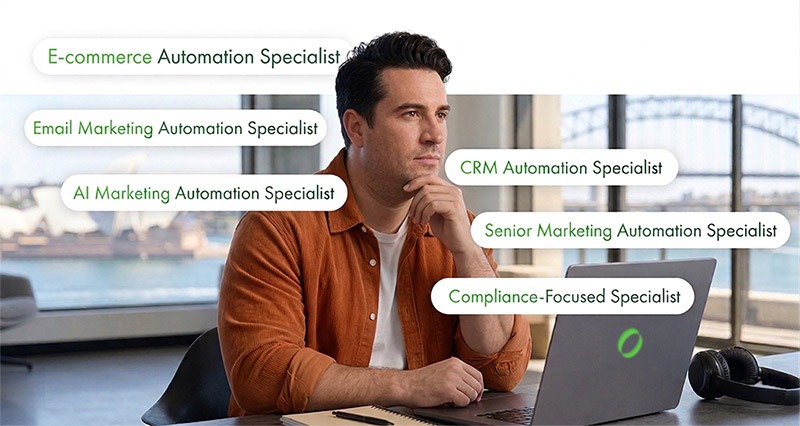
    It’s because the title covers several different specialisations, each with its own experience requirements, platform demands, and salary range. Most salary websites don’t make that distinction.

    Here’s what the numbers actually mean, and what Australian businesses are paying once the full cost of this hire is on the table.

    What are the average marketing automation specialist salaries in Australia?

    Key Takeaway / Quick Answer

    The average marketing automation specialist salary in Australia is typically between AU$85,045 and AU$98,000. For practical budgeting, use AU$90,000 to AU$100,000 as a realistic mid-level baseline, then adjust based on specific platform expertise, location, and superannuation structures.

    Marketing Automation Specialist Salary 2026: Why the Numbers You’re Finding Don’t Reflect Your Actual Hire

    Three things drive the salary range and marketing automation specialist salary trends you’re seeing, and none of them is visible on salary websites.

    Different role definitions under the same title

    Glassdoor AU reports an average of AU$98,000 for this role. PayScale AU reports AU$85,045. The AU$13,000 gap between them reflects the different levels of expertise, seniority, company size, and industry. Both figures are real, but neither is necessarily yours.

    Superannuation included or excluded

    Many advertised salaries in Australia are quoted as base only. Others include computations for the mandatory retirement savings system (superannuation). But it’s not clear which ones do or don’t.

    Since 1 July 2025, the Superannuation Guarantee rate has risen to 12% of ordinary time earnings. That means a AU$98,000 base hire costs AU$109,760 before a single on-cost is added on.

    When you’re comparing salary data across platforms, you’re often comparing figures that aren’t structured the same way.

    Platform complexity and scope aren’t captured

    A specialist managing HubSpot for an 8-person business will have a different skillset than one who was in a 200-person operation, running Salesforce Marketing Cloud with complex, automated follow-up sequences.

    Both roles carry the same title, but one commands AU$120,000+.

    Illustration: Marcus runs a B2B professional services firm in North Sydney. He searches salary data online, settles on AU$90,000 as a midpoint, and posts the role.

    Every candidate with three to five years of platform experience declines or doesn’t apply. The ones who do apply can execute campaigns, but have never built a workflow from scratch.

    He’s priced for a coordinator when he needs a specialist.

    What To Do: Define the role before you research the salary. Specify the platform you’re currently on, what the work entails, whether seniority is a factor, and whether you’re quoting base or base plus super.


    [rcb_show_form]

    Numbers By Experience Level: What Is the Marketing Automation Specialist Salary in Australia?

    When it comes to marketing automation salary by experience level, seniority is the first and most significant variable. Here’s what each tier actually delivers, and what it costs.

    A businessowner thinking about marketing automation specialist salary in Australia.

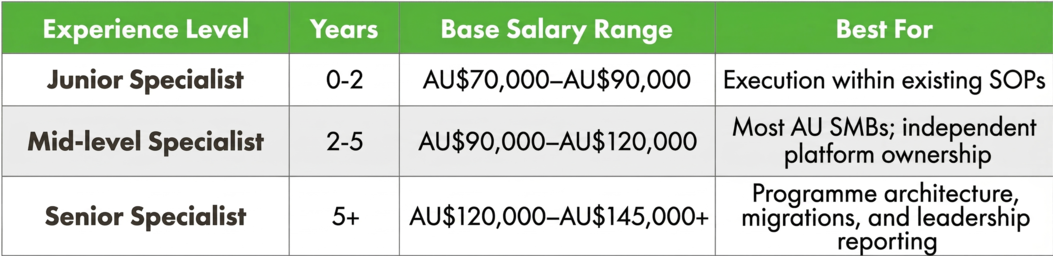
    #1. Junior Specialist (0–2 Years): AU$70,000–AU$90,000

    At an entry level marketing automation specialist salary, a hire comes in with platform familiarity and works within a process someone else has already set up. They can handle:

    • Basic workflow setup and email campaign scheduling
    • List hygiene and contact management
    • Standard A/B tests on subject lines and send times
    • Reporting on pre-built dashboards

    This specialist does not design systems from scratch or troubleshoot CRM integrations.

    According to PayScale AU, the average total compensation for a marketing automation specialist with one to four years of experience is AU$76,290.

    Brightbox Consulting, an Australian digital marketing recruiter, places junior roles between AU$70,000 and AU$90,000 based on 2024–2025 placement data.

    What To Do: This tier is for you if your automation strategy is already documented and your platform is configured. If you’re starting from scratch, a junior specialist might not be the best fit.

    #2. Mid-Level Specialist (2–5 Years): AU$90,000–AU$120,000

    This is the hire that runs the platform independently. A mid-level specialist works across:

    • Multi-step nurture workflow builds and optimisation
    • CRM integration and data sync maintenance
    • Contact database segmentation and lifecycle management
    • Campaign performance reporting and attribution

    They know how to troubleshoot what breaks and when to escalate what falls outside their scope.

    According to Glassdoor AU, the typical range at AU$84,000 to AU$121,000 (25th to 75th percentile), with a reported average of AU$98,000. Jora AU, which pulls directly from SEEK job ad disclosures, reports AU$97,500 as the current average for advertised roles.

    This is the most common hire for Australian SMBs, and this tier often sees ROI the fastest.

    What To Do: For most growing AU businesses without an existing automation programme, this is the starting point. The specialist works independently, and the cost is still manageable before the senior premium applies.

    #3. Senior Specialist (5+ Years): AU$120,000–AU$145,000+

    For senior marketing automation specialist salary, the expert moves from the day-to-day maintenance to designing the entire system. They decide how leads get scored, how contacts move through your funnel, handle platform migrations, and report to marketing leadership on what’s driving revenue.

    Brightbox Consulting places senior roles between AU$120,000 and AU$145,000. It’s consistent with Glassdoor AU’s 90th percentile figure of AU$146,880. Contract and day-rate specialists at this level typically charge AU$600 to AU$1,100 per day. The numbers may differ for marketing automation manager salary.

    What To Do: If your automation programme is still being built, hold off. A senior specialist is a mismatch when you’re only laying the foundation.

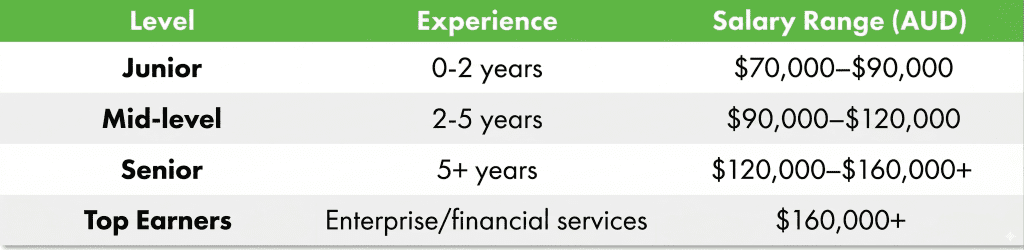
    Marketing Automation Specialist Salary Range Summary Table:

    Marketing automation specialist salary comparison table.

    Numbers Per Tier: What Makes Automation Specialist Salaries Different?

    These four factors determine where a specific hire lands within their band.

    #1. Platform Specialisation

    HubSpot is the most widely used platform at the SMB level in Australia. The qualified pool for Salesforce Marketing Cloud and Marketo is significantly smaller and attracts higher salaries accordingly. Enterprise platform depth drives mid-level salaries well above AU$100,000.

    And that’s just for mid-level specialists.

    The AU digital marketing software market reflects the same pressure: marketing automation recorded a 14.80% Compound Annual Growth Rate (CAGR) between 2025 and 2030. Platform-specific talent is becoming more scarce, yet demand is growing fast.

    What To Do: The platform you’re using is the first qualifier when hiring. If HubSpot is your stack, no need to screen for specialists who’ve worked mostly on Marketo.

    #2. Location

    Sydney and Melbourne consistently sit 10–15% above the national salary average for marketing roles. Brisbane and other capital cities are more moderate.

    Remote roles follow the same experience-based marketing automation specialist pay range, but at lower rates generally because of the difference in cost of living.

    What To Do: If you’re in a high-cost metro and hiring on-site, factor a location adjustment. Consider hiring remotely and offshore.

    Use our FREE VA Calculator and check the numbers yourself:

    Interactive Outsourcing Calculator Tool(Click, scroll inside, move the toggles, or change the numbers)
    Can’t see the numbers? Use a desktop browser or scroll within the box for the best experience.

    Get more tips: How to Calculate Outsourcing Cost

    #3. The True Cost Gap

    When hiring locally, on-costs turn a AU$98,000 hire into a AU$132,300 one. The 25–35% on top of marketing automation specialist compensation base salary includes:

    • Superannuation at 12% (effective 1 July 2025): +AU$11,760
    • Payroll tax (varies by state, 4.85%–6.85% above threshold)
    • Workers’ compensation and leave entitlements

    All up, before recruitment fees.

    Illustration: Sophie runs a SaaS company in Melbourne. She budgets AU$97,000 for a mid-level automation specialist. She’s surprised when her accountant projects the first-year total at AU$127,000.

    What To Do: Multiply your base salary figure by 1.25 to 1.35 to estimate the actual first-year employment cost. That’s the budget to build around.

    #4. Certifications

    Certifications carry a different weight depending on which one you’re looking at:

    • Marketo Certified Expert – associated with a 12–20% salary premium above uncertified professionals at the same experience level
    • Salesforce Marketing Cloud Consultant – similar premium range
    • HubSpot certifications – widely held, useful as a baseline signal

    28% of Australian businesses cite talent shortages as a top growth barrier, with advanced martech skills being the scarcest in the job market. Regarding marketing automation specialist salary Australia typically follows, certified candidates with live deployment experience pull toward the upper end of their band.

    What To Do: Ask candidates to walk you through a workflow they’ve built, and look at conversations only as a cue for probing further. Experience and work done are the credentials worth noting.

    Operational Excellence

    Unsure Where to Start?

    Hire a Remote Staff specialist to support operations while you take care of your business vision.

    Trusted by 3,000+ businesses to scale remotely since 2007.

    When the Budget Maths Points Toward a Different Hiring Model

    The marketing automation consultant salary range is practical and real. But the engagement model is a separate decision. For many AU businesses, it changes the maths more than most expect.

    Your Scope Doesn’t Justify a Full-Time Commitment

    If what you need is a defined platform build, such as an initial workflow setup, a CRM integration, or a one-time migration, a full-time salary commitment won’t serve you well.

    What To Do: Match the engagement model to what you’re building. Project-based for a defined scope. Part-time for ongoing maintenance. Full-time only when automation is the core of your growth engine.

    The Local Talent Pool Is Thin for Your Platform

    The advanced martech talent shortage is documented across the AU market. Businesses without access to specialist candidates on their specific platform often wait months to fill the role.

    Opening the search to remote talent addresses both at once.

    What To Do: Don’t confine your hiring to a postcode. Remote automation work is entirely platform-based. Where a specialist logs in from has no bearing on what they build.

    How Remote Staff Helps AU Businesses Make This Hire Work

    The hard part for most AU businesses is absorbing the full cost of hiring locally.

    That’s why Remote Staff works with Australian businesses to source marketing automation specialists who’ve built real systems inside real platforms. The screening process focuses on what they’ve actually built: workflows, CRM integrations, reporting setups, and lead scoring logic that run in a live business environment.

    The engagement structure fits where your programme is right now. If you need someone full-time to own automation end-to-end, that’s available. If the scope is still being defined and a part-time arrangement makes more financial sense, that works. So do project-based engagements for a defined build.

    The cost difference comes down to geography: the same hands-on experience and platform depth, at a total spend that doesn’t carry AU employment on-costs on top of it.

    Payroll administration, onboarding, and HR support are handled on your behalf, so the time and overhead that usually comes with a new hire stays off your plate.

    FAQs

    Does the AU marketing automation specialist salary include superannuation?

    Not always. This is where the budget miscalculation usually happens. Since 1 July 2025, Australia’s Superannuation Guarantee rate is 12%. If your employment contract is structured as base plus super, a AU$98,000 salary becomes AU$109,760 before other on-costs. Always confirm which structure the advertised figure reflects before committing to a budget.

    Should I hire a full-time marketing automation specialist?

    It depends on what you’re building. For a defined platform setup, CRM integration, or one-time migration, a project-based engagement at AU$600–AU$1,100 per day is often more cost-effective than a full-time salary. For ongoing campaign management, database maintenance, and programme optimisation, full-time makes more sense.

    What are the benefits of offshore hiring for marketing automation specialists?

    Yes. Marketing automation work is entirely platform-based. Specialists build inside tools and systems that don’t require physical presence. Remote hiring is how most AU businesses are successfully accessing this skill set.

    Benchmark Your Budget Based on Your Programme Needs

    The confusion around the average marketing automation specialist salary in Australia comes from how every platform averages the title instead of the role.

    National averages won’t get you there. Your budget should be built around your platform, your seniority requirement, your engagement model, and the true employment cost. This includes superannuation and on-costs.

    Once you know what you’re hiring for, the number becomes a practical planning tool.

    The right budget is the one built around your actual hire.

    When you’re ready to hire marketing automation specialists, call us today or Request a Callback.

  • Email Marketing Automation Specialist: The Hire Collecting $$$ Your Platform Has Been Ignoring

    Email Marketing Automation Specialist: The Hire Collecting $$$ Your Platform Has Been Ignoring

    Email platform? Check. List of contacts and potential leads? Check. You green-light the sequences, and campaigns go out on schedule.

    But it’s been months. There’s still no movement in open rates. After the first email, sometimes even more than just one, leads suddenly go quiet. Nobody can answer why that is, or why sequences are set up the way they are.

    Many businesses miss out on billions in potential revenue because a huge portion of their marketing emails never pay off, thanks to deliverability issues, low opens, and poor strategy. Even though email can be extremely profitable when it’s done well.

    Only around 83–86% of marketing emails actually land in the inbox:

    About 1 in 6 gets blocked by spam filters or bounces; businesses are paying to send messages that can never convert.

    Most Australian SMBs are paying for email platforms that are only being used at a fraction of their capability. They have the tools, but not the person who makes them work the way they’re designed to.

    An email marketing automation specialist.

    What does the role involve? What specific signals tell you it’s time to hire one?

    Learn about why you need this specialist, what the hire costs in Australia, and how to make the hire without the full weight of local employment overhead.

    What is an email marketing automation specialist?

    Quick Answer

    An email marketing automation specialist builds and manages the automated systems inside your email marketing platform. They configure the rules that determine what your platform does after a contact takes an action, from filling in a form to making a purchase. For Australian businesses, the role also covers compliance with the Spam Act 2003 and Privacy Act 1988. The result is a marketing system that runs, responds, and improves without your team having to manage it manually.

    What Is an Email Marketing Automation Specialist?

    An email marketing automation specialist builds and manages the automations within your email marketing platform. They create the rules and configure them so that your platform “knows” what to do next after a trigger or an action.

    This could be anything from filling in a form, clicking a button or a link, making a purchase, or disappearing when they’re inches away to a close.

    A specialist is not the same as a digital marketer. A digital marketer works within the sphere of scheduling campaigns and writing and creating content. This role is also not a developer or an IT expert.

    An email marketing automation consultant sets up the technical side of your email platform. That way, your marketing strategy fires away, the right way, without any manual push, every single day. Or according to the timetable you set.

    Illustration: Rachel owns and runs an 11-person B2B software company in Brisbane. She hired a marketing coordinator to manage HubSpot. Twelve months later, the coordinator is sending newsletters and updating contact records singlehandedly. But that’s how her team had been doing things even before this hire.

    She knows that the workflows are inside the platform. It’s just that none of them has been evaluated. At this point, she’s paying HubSpot AU$1,200 monthly for what’s operating as an overpriced email writing tool.

    What Rachel needs is a specialist who can build the system her coordinator was never trained to create.

    [rcb_show_form]

    What Does an Email Marketing Automation Specialist Actually Do?

    At the core of this role is email, and everything else that relates to how you use it as a tool. A tool that, ultimately, meaningfully reaches out to the right audience, strengthens your brand’s relationship with them, and turns that into returns.

    Does it have to do with sending emails?

    Is it that you need email marketing automation tips or email automation best practices?

    Yes. But that’s only a small part of it.

    Building Automated Email Campaigns and Sequences

    Most marketing teams work a fixed calendar, and nothing more. An email automation specialist puts together sequences that respond to contact behaviour. This allows the messaging to be tailored to where the contact is in the customer journey automation.

    If a lead turns silent for two weeks, the platform sends the appropriate re-engagement email. A customer completes a purchase? They’re moved into a retention flow, an email series that keeps them coming back.

    All of these are done automatically: nobody in your team has to hit send.

    Lead Nurturing and Drip Email Campaigns

    Assuming that first contact immediately opens a door that leads to a purchase is a mistake many sales teams make. So is assuming anything at all about a lead. That’s where the specialist makes a difference. They create drip campaigns where the messaging mirrors the buying process stage.

    The goal shifts away from blindly sending sequences to every contact, at random, to sending emails to targeted, qualified leads.

    Audience Segmentation and Personalized Email Automation

    Research proves that rolling out the same email to everyone on your list produces lacklustre results.

    Actually, it’s worse than that.

    Besides poor (zero, in some cases) open rates, doing this breaks the link to cold leads that could have been potentially warmed up with the right strategy.

    The specialist segments the database by: behaviour, industry, lifecycle stage, or purchase history. They transform campaigns so that it’s about the message, and it speaks to each group specifically.

    No more contacts receiving messages that have nothing to do with their situation, what they’re looking for, or what they’re not looking for. Sequences are made relevant to them. General formulas written for every average customer, many of whom probably have nothing to do with what your business offers, are done away with.

    A/B Testing and Campaign Optimisation

    A specialist isn’t afraid to run structured tests for subject lines, send times, calls to action, email length, and more. They examine the data and act decisively.

    Over time, you’ll notice open rates steadily improving, and click-throughs going up. Sequences that have long been abandoned are given a revamp to match current performance data.

    Compliance Under Australia’s Spam Act 2003

    This is mandatory for Australian businesses. It’s also where many are exposed, and frequently, unintentionally.

    The Spam Act 2003 requires that commercial electronic messages sent to or from Australia must have the following:

    • Recipient consent
    • Accurate sender identification
    • A working unsubscribe option processed within five business days

    The Privacy Act 1988 adds obligations around data collection, storage, and use.

    The Australian Communications and Media Authority (ACMA) enforces these rules and has been escalating enforcement significantly. In 2025, Tabcorp received a AU$4 million penalty, Betfair paid AU$871,660, and PointsBet was fined AU$500,800.

    What does this have to do with SMEs?

    It’s a reminder that compliance oversight exists at every business size and type.

    What To Do: Confirm your specialist fully understands both the Spam Act 2003 and the Privacy Act 1988. Ask them how they handle unsubscribe processing and consent documentation within their workflows. If they can answer clearly, you have your hire.

    Operational Excellence

    Unsure Where to Start?

    Check What Role You Need.

    Hire a Remote Staff specialist to build the systems that work while you sleep.

    Trusted by 3,000+ businesses to scale remotely since 2007.

    Four Signs Your Australian Business Needs This Hire

    When you recognise two or three of these in your business, it’s enough reason to start the search.

    #1. The Frozen Sequence: Workflows Built Once Are Never Revisited

    Your automation platform has workflows running. Some were set up so long ago that nobody remembers when. Nobody has gone over them since. You don’t know if any of it still makes sense with where your business is today.

    Do they match your current sales process or your current database? How about your contact list?

    What To Do: Log into your platform and pull a list of every active workflow. Check when each was last modified. Modification dates that are from a year ago or further mean the logic is outdated. Keeping things business-as-usual without updating will affect your engagement rates.

    #2. The Manual Follow-Up Loop: Sales Still Chasing Leads by Hand

    Your sales team is sending follow-up emails manually. When the person who’s supposed to send the emails is caught up with other projects, leads are left on their own. For days. For weeks.

    There are no behavioural trigger emails in place to automatically follow up on someone who submits a form.

    What To Do: What does your CRM say about your average lead response time? Two to four hours is a warning. If it’s consistent, then it’s a problem.

    #3. The Compliance Blind Spot: No One Is Accountable For Your Spam Act Obligations

    Have you tested your unsubscribe links recently? What’s your process for opt-outs within five business days like? And your database, have you removed those who were initially added without consent?

    Answers to these questions are a barometer for compliance.

    What To Do: Run a basic compliance check on your last four to five campaigns. Check on the following: a working unsubscribe link, sender identification, and consent from every contact. If any one of these is missing, address it immediately.

    Stop any scheduled campaign until this is resolved.

    #4. The Invisible Inbox: Unclear Performance Even If Emails Are Going Out

    Campaigns are going out according to schedule, but no one in the team knows which sequences are doing well and which aren’t. Nobody can tell you which contacts fell off the radar, or what email activity is attracting leads. The platform is generating reports nobody seems to be reading, let alone acting on.

    What To Do: Do a performance summary. Let your team give you a report on open rates, click-through rates, unsubscribe rates, and what those emails led to in terms of actual business. The report should encompass data over the last 90 days.

    If it takes more than a day to produce, or if the data isn’t there, that’s all you need to know.

    Email Marketing Automation Tools in Australia: What a Specialist Should Use

    Your first qualifier when hiring email automation specialists is platform knowledge. Here’s how the AU market breaks it down:

    • HubSpot is the most widely used platform at the AU SMB level. Candidates should have experience with email workflow automation branching, contact lifecycle email marketing, and reporting dashboards.
    • Klaviyo leads in Australia’s direct-to-consumer and Shopify-native market. It’s built around purchase behaviour data.
    • ActiveCampaign is a strong option for SMBs with email-first automation needs. It’s more accessible than HubSpot at the entry level and ideal for businesses new to building their automation foundation.
    • Salesforce Marketing Cloud is standard for larger AU businesses running complex, multi-channel campaigns. Specialists with SFMC experience are rarer, so expect them to command higher salaries.
    • Zapier and Make are integration tools rather than email platforms. A specialist who knows how to use them can connect your email platform to your CRM email automation and other tools; you’ll no longer need to involve a developer each time.

    What To Do: Confirm which platform your business is currently on and whether a migration is planned. Screen candidates from there.

    What to Look for When Hiring Email Marketing Automation Specialists in Australia

    The difference between a capable candidate and the right one for your business isn’t limited to building. They should understand why a workflow is built a certain way.

    Technical Skills to Assess

    These are the specific skills worth checking for:

      • Experience building multi-step automated workflows
      • CRM integration
      • Data management across different platforms
      • Audience segmentation, email segmentation strategy, and lifecycle stage mapping
      • Basic HTML and CSS for email template customisation
      • A/B testing methodology
    • Performance reporting
    • Knowledge of the Spam Act 2003 and Privacy Act 1988

    Soft Skills To Screen For

    The specialist will be working across teams. They should be able to explain technical decisions to your content team, your sales team, and often your developers or IT specialists.

    They need to translate what they encounter in plain language, properly documenting it, so the data and email automation tools can be maintained by other members.

    Clear communication and organisation matter here because the specialist jumps to and from multiple parts of your business at once. They also need to be consistent with their work, regardless of team or staff changes.

    Three Screening Questions Worth Asking

    1. Walk me through a workflow you built from scratch. What was the business problem behind it, and what did the results look like?
    2. How do you handle unsubscribe processing across multiple platforms to stay compliant with the Spam Act 2003?
    3. How do you decide what should be automated versus what should stay as a manual process?

    What To Do: Although certifications carry their own importance, they’re not a major screening factor. Instead, use them to ask more questions about the candidate’s platform knowledge.

    What Does an Email Marketing Automation Specialist Cost in Australia?

    Salary ranges for this role in 2024–2025 are based on data from Glassdoor AU, PayScale AU, and Brightbox Consulting:

    These are base salary figures only. From 1 July 2025, Australia’s Superannuation Guarantee rate is 12%. A AU$95,000 base hire becomes AU$106,400 before payroll tax, workers’ compensation, recruitment fees, and onboarding time are factored in.

    A realistic total first-year cost for a mid-level local hire sits between AU$125,000 and AU$140,000.

    For most AU SMBs, that total cost changes the conversation about where to source the hire from.

    Experience Level
    Experience in Years
    Base Salary Range (AUD)
    Junior
    0-2 years
    $70,000 – $90,000
    Mid-level
    2-5 years
    $90,000 – $120,000
    Senior
    5+ years
    $120,000 – $145,000+

    How Remote Staff Helps You Make This Hire Work

    Finding the right email marketing automation expert takes time. It also takes knowing what to look for. That’s the part Remote Staff has been doing for Australian businesses for over 18 years.

    Our screening process looks at what candidates have built and delivered in real business environments. They’ve set up workflows and managed integrations. They’ve kept workflows running while helping businesses stay compliant.

    Maybe you want a hire who’ll work with your team as a member, full-time. If you’re still figuring out the scope, a part-time arrangement works. If you need a specific build done and handed over, a project-based engagement is an option, too. The structure adjusts to your business.

    On the cost side, the difference between hiring locally and hiring through Remote Staff comes down to the location of our candidates. The price reflects a different job market, but you’re accessing the same level of experience.

    Payroll, onboarding, and HR are handled on the Remote Staff side. That part of the process doesn’t land on your desk.

    FAQs

    What does an email marketing automation specialist do in Australia?

    They build and manage the automated systems inside your email marketing platform. That includes trigger-based email sequences, lead nurturing emails and workflows, audience segmentation, A/B testing, CRM integration, performance reporting, and compliance with the Spam Act 2003 and Privacy Act 1988. This expert sees to it that your platform runs as it was designed to.

    Does my specialist need to know the Spam Act 2003?

    Yes. This is non-negotiable for any AU business. ACMA enforcement has escalated significantly, with multiple companies receiving penalties in the millions in 2025 alone; a reflection of how ACMA enforcement has escalated significantly. A specialist who does not understand the Spam Act 2003 and Privacy Act 1988 is a compliance risk. Be sure to confirm this knowledge before you hire.

    What platforms should an AU email automation specialist know?

    HubSpot for most AU SMBs. Klaviyo for direct-to-consumer and Shopify-native businesses. ActiveCampaign for email-first SMB operations. Salesforce Marketing Cloud for enterprise. The candidate you hire should have demonstrated depth in the specific platform your business is currently using or migrating toward.

    Is hiring a remote email marketing automation specialist cost-effective for AU businesses?

    Yes. A mid-level local hire at AU$95,000 base reaches AU$125,000 to AU$140,000 in total first-year cost once super, payroll tax, and onboarding are included. Remote specialists through Remote Staff deliver the same technical capability at a lower total cost due to candidate location and cost of living.

    The Email Platform Runs While The Email Marketing Automation Specialist Makes It Work

    You feel like emails should be the least of your worries in your company. It’s both a medium and a channel you and your team should already have a pretty good handle on by now. But despite efforts in creating out-of-the-ordinary campaigns and email content, nothing’s changed. Not even after you subscribed to the tool.

    Most Australian SMBs have the software. What many don’t have is the “who.” The person who configures it correctly.

    The specialist grows your business. The platform is just the tool they use to do it.

    If you’re ready, the next step is straightforward:

    Want to learn more about the role of a marketing automation specialist? Or planning to hire the right email marketing automation specialist? Call us or request a callback.

  • Marketing Automation Specialists For Australian SMEs: You Have the Tools, But You Need the Expert

    Marketing Automation Specialists For Australian SMEs: You Have the Tools, But You Need the Expert

    ​​Your automation platform has been live for months. Nobody’s been hired to run it.

    That’s the whole problem.

    85% of Australian SMEs are paying for tools they don’t realise are barely being used. More than half of local businesses owning marketing software that’s basically sitting in their systems.

    Is your business one of them?

    The answer usually isn’t a missing platform, but missing marketing automation specialists.

    Most business owners either underestimate the role or hire the wrong version of it.

    Here’s what you should know about marketing automation, and how to find the specialist that fits your operation.

    What is a marketing automation specialist?

    Key Takeaway / Quick Answer

    A marketing automation specialist takes your software, like HubSpot, Klaviyo, or ActiveCampaign, and builds the operational logic inside it. They configure the system to handle lead scoring, email sequencing, and behavioural triggers, such as post-purchase follow-up emails, abandoned shopping cart, downloading a resource, etc. Essentially, they ensure your marketing runs on its own based on exactly how your contacts interact with your brand.

    What Does a Marketing Automation Specialist Do? The Role In a Nutshell

    Marketing automation specialists take your marketing strategy and configure the technical logic inside your tools so it runs without manual input. They build email sequences triggered by contact behaviour rather than fixed send dates.

    The customer journey piece is where most businesses are weakest: a first-time visitor and a returning buyer need different messaging at different moments, and a specialist builds the system that delivers both.

    Most businesses don’t know how much depends on having this person until something cracks.

    Illustration: Oliver is a Sydney-based e-commerce founder. He purchased HubSpot, assuming that his marketing coordinator could handle it. Several months later, workflows are weakly built, and the CRM data is cluttered. The sales team is going after cold leads as if the software didn’t exist.

    Without someone who knows how to configure it for his specific operation, HubSpot isn’t supporting his business. Just another line item on his monthly expenses.

    Key Responsibilities: Marketing Automation Specialist Job Description

    What does a marketing automation manager do? This specialist oversees technical aspects like configuring systems and maintaining data integrity. They help ensure that the right message reaches the right contact at the right funnel stage.

    Here’s what that looks like in practice.

    Automated Email Workflows

    Product page visits, form submissions, or purchases are triggers of email sequences and drip email campaigns. Rather than inputting a fixed send date, a specialist configures your tools so that your contact’s actions or responses determine when they hear from you and what they receive.

    Lead Scoring and Prioritisation

    Not every contact in your database is at the same stage, and not all of them warrant the same amount of your sales team’s time. A specialist sets up lead scoring to rank contacts by their likelihood to convert, and your sales team works from a prioritised list.

    CRM Data Management

    Your CRM is only as useful as the data inside it. The data has to be “clean.” The records, accurate and consistent enough to be trusted. A specialist keeps them deduped (deduplicated) and synced across your marketing platform and sales tools so both teams are always working from the same information.

    A/B Testing and Optimisation

    Subject lines, send times, calls to action: a specialist regularly runs these tests and acts on the results. They make incremental improvements based on what the data shows.

    Over time, those small adjustments compound; Better open rates. Higher click-throughs. Sequences that convert.

    Customer Journey Automation and Mapping

    A first-time visitor needs different messaging than someone who has already purchased. The specialist maps out each stage of the customer journey and aligns your workflows accordingly, so every contact receives communication that matches where they actually are.

    More about what the role entails: ,What Is a Marketing Automation Specialist, and how do they fit in your team?

    Operational Excellence

    Manual Marketing Workflows Not Working?

    Start Automating.

    Don’t let your growth hit a technical ceiling. Hire a Remote Staff specialist to build the systems that work while you sleep.

    Trusted by 3,000+ businesses to scale remotely since 2007.

    Marketing Automation Tools: What Platforms Do Automation Specialists Use?

    Platform choice depends on where your business is:

    • SMB and mid-market: HubSpot, ActiveCampaign, Klaviyo, Mailchimp
    • Enterprise and larger SMEs: Salesforce Marketing Cloud, Marketo, Pardot
    • Integration layer: Zapier, Make, Segment

    A marketing automation consultant who has spent three years building inside Salesforce Marketing Cloud operates at a different level than one who has surface-level familiarity with five tools.

    One common mistake when hiring is screening candidates based on platforms they’ve previously used. Maybe you’re looking only at a HubSpot automation specialist or a Marketo automation expert. The right call is to match them to the platforms your business uses.

    How To Self-Diagnose Your Business: Are You Ready For Marketing Automation?

    Readiness for this person is rarely hire-and-go. The truth is, specific, recurring patterns are easy to dismiss individually. But collectively, they’re expensive to ignore. These are four to watch for.

    #1. Paid Platforms

    Your automation tool has been live for over a year. You’re charged for its subscription monthly. But most of the features that were set up once run with no oversight. Some haven’t been touched at all. You’re covering the cost of a capability your business isn’t using. In most cases, nobody on the team has been assigned to change that.

    #2. The Manual Funnel

    The sales team is still sending follow-up emails by hand. They copy campaign sequences whenever a new one is needed. They track leads and lead stages in a spreadsheet. They’ve been doing these tasks the same way they’ve done so before you purchased the software.

    Now that the platform exists, the processes haven’t changed. There’s no sales funnel automation. Both the manual effort and the tool are running side by side, and yet the latter is barely involved.

    #3. Data Disconnect

    Your CRM and automation platform do not reliably converse with each other. The handoff between marketing and sales doesn’t garner good results because contacts fall through.

    Someone asks where the lead is from. Someone asks why it wasn’t followed up on. Nobody’s got a clue about one or the other.

    #4. The Headcount Reflex

    Every time volume increases, your response is to hire another person to manage it. Operational costs grow in direct proportion to revenue; an unscalable model. It’s the same system copying itself at a higher cost.

    What To Do: Two or three of these patterns creeping into your business is enough to justify starting the search. You don’t need all four.

    [rcb_show_form]

    Types of Marketing Automation Specialists (and Which One You Need)

    A businessman thinking about the types of marketing automation specialists.

    The title “marketing automation specialist” covers more ground than most business owners are aware of. To hire a marketing automation specialist that fill your business needs, learn how to identify the ideal fit for your team.

    #1. Email Marketing Automation Specialist

    This specialist focuses on email sequences, from welcome flows, lead nurturing strategies, to re-engagement campaigns. If your primary conversion mechanism is email and your sequences were built by someone who has since left the business, this is where the problem starts.

    What To Do: Check your open rates over the last four to six months. If they haven’t moved, or if nobody on your team can explain why a sequence was structured the way it was, this is your specialist.

    #2. CRM Automation Specialist

    Managing contact lifecycle stages, lead routing, pipeline automation, and data integrity between your marketing and sales platforms is this specialist’s space. When your sales team regularly complains about lead quality, the issue is usually the scoring and handoff logic that hasn’t been set up properly.

    What To Do: Ask your sales lead or sales team what percentage of the leads coming from marketing are worth following up on. That answer will confirm your need for this lifecycle marketing automation expert.

    #3. AI Marketing Automation Specialist

    By configuring AI features inside your existing platforms, this specialist activates predictive lead scoring and segmentation, dynamic content, and optimises send-time.

    For most Australian SMEs, this doesn’t mean hiring someone who builds AI models from scratch. It means hiring someone who can switch on and configure the AI capabilities already sitting inside HubSpot or Salesforce that nobody has enabled or used since.

    What To Do: Log into your current platform and look for any AI or “smart” features. If none are active or configured, that tells you why you need a marketing automation lead.

    #4. E-Commerce Automation Specialist

    This is particularly relevant for Australia’s large DTC and Shopify-native market. The automation specialist understands abandoned cart logic, post-purchase sequences, predictive segments, and loyalty flows.

    The mindset is different from B2B automation, since the automation is built around purchase behaviour data as opposed to just lead scoring.

    What To Do: This specialist is for you if you sell direct-to-consumer, and your post-purchase or retention flows either don’t exist or are still running on default settings.

    #5. Compliance-Aware Automation Specialist

    Also specific to the Australian market. The Spam Act 2003 governs all commercial electronic messages sent to or from Australia. It requires consent. It requires clear sender identification and a functional unsubscribe option honoured within five business days.

    The Privacy Act 1988 and the Australian Privacy Principles govern how customer data is collected and stored. Repeat violations can carry penalties of up to AUD $2.2 million per day, enforced by the Australian Communications and Media Authority.

    A specialist who understands these requirements builds compliance into your workflows from the beginning. One who doesn’t leave your business exposed.

    What To Do: Before any automation system goes live, verify that your specialist has working knowledge of both the Spam Act and the Privacy Act.

    #6. Senior Marketing Automation Specialist

    From scoring models, lifecycle stage mapping, platform migrations, to attribution reporting, this specialist owns the architecture.

    It’s the right hiring choice for businesses that have had their automation programs running for quite some time. Something has already been built. The person who built it is no longer a part of the team, and none of your current employees understands what’s running.

    What To Do: If your existing setup was inherited and nobody on your team can fully explain how it works or why it was built that way, you’re looking at the role that fixes it.

    What Does a Marketing Automation Specialist Cost in Australia?

    Salary figures for this role vary depending on platform specialisation and industry. This is a straightforward breakdown based on 2024–2025 data from Glassdoor AU, PayScale AU, and Brightbox Consulting:

    Marketing Automation Salary By Experience Level:

    The “Loaded Cost”

    The number on the job posting is not what you spend the first year. Add superannuation (11.5% as of 2025), recruitment fees, onboarding, and the first 30–60 days of productivity ramp. An AUD $95,000 base salary becomes AUD $130,000–$140,000 in total year-one cost.

    What To Do: Build your budget against the loaded cost. If that number is beyond your current stage, the remote hiring model is where the math takes a different route.

    Why Australian Businesses Are Hiring Marketing Automation Specialists Remotely, With Remote Staff

    That loaded cost is what pushes most Australian businesses toward remote hiring. Qualified specialists are in short supply locally, and the ones with real platform depth know the demand is high, and, well, let’s just say their rates areome even more askew.

    A Filipino marketing automation specialist in the foreground and an Australian businessman in a floating screen.

    Remote Staff has been placing technical marketing professionals with Australian businesses for over 18 years. Candidates are screened for actual platform builds and measurable results. Engagements are structured around where your business is: full-time, part-time, or project-based, with payroll, onboarding, and compliance handled on your behalf.

    Marketing automation is the fastest-growing segment of Australia’s digital marketing software market. The qualified specialist pool hasn’t kept pace, and that lag is where Remote Staff operates.

    As you plan to grow your business and your team, stay updated about Payday Super 2026 Rules and the Modern Slavery Act Australia to stay compliant in all areas of your operations.


    FAQs

    Do I need a dedicated marketing automation specialist, or can my existing digital marketer handle it? (Do I need a marketing automation team?)

    It depends on what your digital marketer was hired to do. Most are focused on content, campaigns, and channel management, and not the technical configuration of workflows, lead scoring, and CRM integration. If your platform is underperforming and nobody on your team owns it technically, a dedicated specialist is the practical answer.

    How long before we see measurable results?

    For businesses with a clean CRM and an active platform, most see measurable movement within 60 to 90 days. If the foundation needs work first (unorganised, inaccurate data, disconnected tools, or sequences that have never been properly built), allow a full quarter before expecting consistent output.

    What’s the difference between a marketing automation specialist and a CRM manager?

    A CRM manager focuses on the database, including contact records and pipeline stages. A marketing automation specialist works with the logic that runs on top of that data, such as workflows, scoring models, and integrations. In smaller teams, the roles overlap, but they are distinct functions.

    Does Australia’s Spam Act Affect Automation Workflows?

    Yes, directly. Every commercial electronic message sent to or from Australia must meet three requirements: recipient consent, clear sender identification, and a functional unsubscribe option. A specialist builds these requirements into your workflows as standard.

    The System Is Already There and Needs Someone to Run It

    HubSpot, ActiveCampaign, Salesforce, Klaviyo: all capable platforms. What most Australian SMEs are missing isn’t better software. It’s the person who owns it.

    Marketing automation specialists are the reason your CRM stays clean, your leads get scored correctly, your sequences improve over time, and your sales team stops chasing contacts that were never ready to buy.

    Find that specialist, define the scope, and let the system do its job.

    Unsure where to start? Call us today or Request a Callback or fill out the form from earlier for your free consultation.

  • Don’t Let January Kill Your Sales: How to Beat the Post-Holiday Slump

    Don’t Let January Kill Your Sales: How to Beat the Post-Holiday Slump

    The holiday season is one of the most anticipated periods for business owners. The shopping rush, the spirit of generosity, and shoppers’ fear of missing out all help boost sales and revenue just before the end of the year.

    Because of this, many businesses invest heavily in marketing and promotional efforts to capture the attention of generous holiday shoppers. 

    However, everything comes to an end, and as with any other year, the next challenge is how to survive, or even thrive, during the post-holiday slump.

    So, as we approach 2026 and welcome January, let’s explore some post-holiday sales strategies to maintain the momentum.

    Read on to know more. 

    Why January Sales Feels Like a Sales Black Hole 

    While every new year brings new opportunities, it can be challenging for business owners coming off the highs of the holiday season. 

    In fact, for many businesses, January becomes a sobering wake-up call after the adrenaline rush of Christmas and Boxing Day.

    The Holiday Hangover Effect 

    The psychological shift from December 31 to January 1 can be jarring. 

    Customers are no longer excited to shop until they drop. The majority are no longer interested in gift bundles and other promotional stunts that worked so well during the holidays.

    Reduced Consumer Spending Power in January

    After months of making spending decisions on gifts, travel, and events, customers often enter a state of “spending paralysis” by January. By then, the need for new purchases is far less appealing, especially as many people adopt “No-Spend Challenges” during this month.

    It also doesn’t help that much of the festive season is fueled by credit. 

    When the holiday cheer fades and statements arrive in mid-January, reality sets in for many households. As a result, they often shift into a “repayment-only” mode, cutting back on dining out and “unnecessary” purchases.

    Why Q1 Sets the Tone for the Year 

    Customers’ fear of spending at the start of the year can be particularly challenging for small and medium-sized businesses (SMBs). For many, boosting Q1 sales serves as the strategic foundation for the rest of the year for the following reasons:

    • Inventory Correction – January is the “great clearing,” when businesses manage excess inventory and determine their cash flow for the rest of the year.
    • Data Gathering – The behavior observed during a slow January serves as a “stress test” for your marketing. If you can convert customers during this month, the same strategy can be applied in the succeeding quarters.
    • Pipeline Building – Although people don’t buy as much in January, they often use this time to research big-ticket items for later. Your visibility during this month puts your brand on their shortlist when they’re ready to make a purchase.

    10 Proven Strategies to Reignite Sales in January 

    The January slump is expected. However, it doesn’t – and shouldn’t – mean that businesses should simply wait it out. 

    While you can’t change customers’ natural tendency to hold back on spending, you can shift your focus. Instead of the hard-selling approach that worked during the holidays, reframe your efforts to emphasise problem-solving.

    Here are some strategies to do just that.

    #1. Launch a “New Year, New You” Promotion 

    Customers are focused on their New Year’s resolutions, so align your brand with their desire for self-improvement. Position your product or service as a tool for a fresh start.

    For example, if you run a local café, offer a “Healthy Habits” loyalty card, where every fifth green smoothie is free.

    #2. Push Gift Card Redemptions With Upsells 

    Many customers may still have gift cards remaining or have recently received them. Maximise this opportunity by running an email or social media campaign encouraging them to cash them in. 

    To keep it aligned with the “no-spend January” mindset, position the offer as a way for them to spend less – or avoid wasting their gift card – while it’s still valid.

    #3. Use Scarcity-Focused Flash Deals 

    At this time, month-long clearance sales are likely still ongoing. To stand out from the crowd, consider launching a 24-hour flash sale instead.

    Include a countdown timer in your social media posts or email headers to highlight the flash sale. For example: “30% off for the next four hours” – and provide a specific code customers can use to redeem the offer.

    #4. Offer Bounce-Back Post-Holiday Discounts 

    Beyond posting a message of gratitude, reward the customers who kept you busy over the holidays. Send a “Welcome Back” offer to anyone who made a purchase in December. 

    As a tip, make the discount valid only during the last two weeks of January, typically the slowest period of the month.

    #5. Target Repeat Buyers With Thank You Offers 

    Repeat customers generate more business, and it’s generally easier to retain them than to acquire new ones. Segment your email list, if you haven’t already, and identify your VIPs, typically those who shopped more than three times last year.

    Then, send a “Founder’s Thank You” note along with an exclusive credit. You can also ask your website developer to create “Members Only” landing pages to keep these deals private and high-value.

    #6. Pivot to “Back-to-School/Work” Essentials 

    January is also the peak of many Back-to-School promotions. If your business isn’t in the education sector, find an alternative angle that resonates with the need for new routines. 

    For example, a home décor brand could launch a “Home Office Refresh” bundle, while a beauty brand might promote a “5-Minute Work Morning Routine” makeup set.

    #7. Host an Interactive Social Media Challenge 

    Social media continues to be a key part of your New Year marketing campaigns, especially during the post-holiday slump. Use January to strengthen your community by running challenges related to your niche.

    For example, if you run a gym, start a fitness challenge. If you’re in real estate, launch a campaign featuring a 21-day checklist on how to do home improvements for the new year.

    #8. Optimise for “Near Me” Local SEO 

    Use this time to boost your local search engine optimisation (SEO), as many shoppers will still be searching for stores and services near them.

    Update your Google Business Profile with your post-holiday hours and information about any in-store exclusive clearance items.

    #9. Introduce “Buy Now, Pay Later” (BNPL) Options 

    Credit card debt can be a major source of stress for many customers in January. Thus, focus on addressing customers’ fear of overspending in January by highlighting flexible payment options. 

    This includes Buy Now, Pay Later packages, which let them pursue their New Year plans while spreading the cost over several months.

    #10. Run a “Mystery Bag” or “Warehouse Clear-out” 

    Lastly, clear your inventory. 

    Jump on the “Mystery Boxes” trend, where you package random items in a box at a fixed price. Showcase some of the possible product combinations to entice customers to take a chance, driving excitement and high open rates.

    When executed correctly, this approach can quickly clear shelves and make room for new inventory in the next quarter.

    Revamp Your Email and SMS for January Conversions 

    It’s also important to revisit and recalibrate your campaigns across different platforms, particularly email and SMS marketing.

    Here are some tips on how to do it. 

    Send “We Miss You” Campaigns to Holiday Buyers 

    A large portion of your December sales are from one-time holiday shoppers. Without deliberate touchpoints to engage them and build a connection, these customers are likely to churn.

    To address this, set up an automated “We Miss You” or “Checking In” sequence 15 to 30 days after a customer’s last December purchase. 

    You can also use engaging copy like: “The decorations are down, but the perks aren’t. Here’s a little something to brighten your January.”

    Include Product Reviews to Reinforce Trust 

    December is a high-sales month, while January serves as its high-research counterpart. This is when customers plan and prepare for their purchases for the year ahead.

    During this period, consumers are more cautious with their spending and prefer to purchase items that feel like an investment. Thus, pivot your email and SMS content from being sales-heavy to showcasing user-generated content and 5-star reviews. 

    You may send an email titled, “What Everyone’s Saying About Their New Year Gear,” featuring a carousel of your products or services alongside their top-rated reviews.

    Segment Lists Based on December Purchase Behaviour 

    It also helps to review your customer lists and segment them based on their holiday purchases. Typically, they fall into two groups: gifters and self-shoppers.

    For gifters, send personalised emails and suggest items they might want for themselves now that the holidays are over. 

    On the other hand, recommend “Complete the Look” items to self-shoppers to complement their December purchases.

    Leverage Returns Season as a Sales Opportunity

    Many businesses also view January as the “Returns Tsunami,” when customers return or exchange items. While this may seem stressful, it can actually present opportunities.

    Here’s how.

    • Offer Exchange Incentives (Not Refunds) – Your primary goal in January is revenue retention, and whenever possible, avoid issuing refunds. For example, instead of offering a cash refund, give customers the option to exchange the item or receive store credit. You can also include an additional $5–$10 store credit or a 10% discount on their next purchase.
    • Promote Clearance and Overstock from Holiday Inventory – Customers who frequently visit your site or store to initiate a return are still engaging with your brand. Use this moment as an opportunity to clear out your holiday overstock. You can place “Sale” bins near the returns counter, or feature them on your e-commerce site with copy like: “While you’re here, check out our Last-Chance Clearance items at discounted prices.”
    • Bundle Returns With Add-On Offers – If a customer is returning an item due to size or color preferences, use the exchange as an opportunity to increase their total basket value. You can create a “Perfect Pair” recommendation. For example, if a customer is exchanging a sweater, suggest a matching scarf or a cleaning kit at a one-time discounted rate.

    Social Media and Paid Ads: Start the Year with the Right Energy 

    Unlike most Western countries, which are blanketed in snow at the beginning of the year, January marks the peak of summer in Australia. 

    It’s the height of the tennis season and the final stretch of the school holidays. This creates numerous opportunities for social media campaigns, allowing brands to stay relevant after the holiday season.

    • Refresh Creatives with Summer + New Year Themes – Swap out tinsel and festive reds for poolside blues, beach yellows, and crisp whites. Shift away from gift-focused messaging and instead highlight “summer living” or “get things done” campaigns to start the year on a positive note.
    • Retarget Holiday Visitors with January-Specific Offers – Revisit your “window shoppers” from November and December. Show them the exact items they viewed and include a copy like: “Still thinking about it? Start your year right with the [insert product] you had your eye on—now at discounted rates.”
    • Launch January Giveaways to Boost Engagement – When spending is low, engagement becomes your next most valuable currency. This is where giveaways come in to keep your brand top of mind. For example, you can run a “Summer Essentials” or “Resolution Starter Kit” giveaway. Ask your followers to tag a friend, comment their #1 goal for the year, and share the post to opt in.

    Smart Move in Slow Months: Try Remote Staff to Power Growth 

    The new year, especially January, is also an ideal time to reflect on your growth and plan for the year ahead. 

    For many SMBs, this includes finding the right staff and securing the right support from outsourcing providers like Remote Staff.

    Access to Full-Service Ecommerce and Marketing Support 

    During the quiet weeks of January, you will be busy focusing on retargeting after holidays, reviewing year-end sales performance, and planning for the upcoming quarters. Hence, it can be hard to track the non-core functions, especially the administrative part. 

    This is where Remote Staff comes in, providing you with skilled remote workers who can take care of the following tasks: 

    • Ecommerce order management; 
    • Customer service for returns; 
    • Campaign production; 
    • Data cleanup and inventory tagging; and 
    • Social media scheduling and moderation. 

    Remote Staffing Partner 

    For the past 18 years and counting, Remote Staff has partnered with over 3,000 Australian SMBs and business owners. They provide English-proficient Filipino professionals who are skilled and ready to help you prepare your business for the year ahead.

    With the four-hour time difference between the Philippines and Australia, your Filipino remote team is online exactly when you are. They’re also available based on your needs – whether for a one-off project, part-time work, or a long-term engagement.

    More importantly, Remote Staff offers transparent pricing and onboarding packages. 

    You can hire remote workers directly through them, or leverage their Employer of Record services. Either way, they provide upfront costs to help you determine which options best suit your needs and budget.

    Frequently Asked Questions

    Here are some of the frequently asked questions about the post-Christmas sales recovery.

    #1. Why Does Ecommerce Slow Down in January in Australia?

    Families are redirecting their remaining budgets toward essentials, such as back-to-school needs. Many Australians also receive their credit card statements in mid-January, which are often high, prompting an immediate slowdown of discretionary spending.

    #2. How Can I Improve January Conversion Rates? 

    Use the quiet period to showcase reviews from December shoppers. Seeing that others had a positive experience can help build the trust needed to convert hesitant January buyers.

    #3. Should I Lower My Prices or Focus on Customer Experience? 

    You can use price drops to manage inventory, such as excess holiday-themed items. 

    At other times, focus on value-added offers – free shipping, extended warranties, or flexible payment options – to ease the financial burden on customers without cutting into your margins.

    #4. What Kind of January Promos Work in AU Retail? 

    The AU market usually love: 

    • Bundle and Save – Bundle complementary products (e.g., yoga mat with a water bottle) to increase the average order value. 
    • Mystery Boxes – Aussies love a “deal” and the gamified nature of a mystery box can drive high engagement on social media. 

    #5. Can Remote Teams Really Help During Slow Sales Seasons? 

    Yes! Although sales are relatively low, your administrative and creative needs are often at peak due to returns and seasonal sales planning

    Fortunately, a Filipino remote team can help by: 

    • Handling the influx of January returns and customer inquiries; 
    • Building your marketing calendar for the rest of the year; 
    • Cleaning up your mailing list; and 
    • Optimising your SEO. 

    Conclusion: January Doesn’t Have To Be a Sales Graveyard 

    January doesn’t have to be a period of stagnation. It can be a fresh start and an opportunity for your business to plan for the year ahead.

    It’s the perfect time to stop working in your business and start working on it. Clear out your inventory, re-engage with your customers, invest in your local SEO, and personalise your marketing efforts.

    Every action you take now helps build the momentum needed for a successful first quarter – and, ultimately, a successful year.

    For more information on how to get all of this done quickly and efficiently, call us today or request a callback now.

  • EOR Philippines: Your Guide to Hiring Legally Through an Employer of Record

    EOR Philippines: Your Guide to Hiring Legally Through an Employer of Record

    Remote hiring in the Philippines is a great opportunity to access skilled and cost-effective talent, but navigating local labour laws, government registrations, and mandatory benefits can be challenging.

    For foreign companies or businesses without a local entity, managing DOLE (Department of Labor and Employment) compliance, payroll, and statutory contributions can quickly become complex and time-consuming.

    For instance, a recent high-profile case illustrates just how risky things can get: Joanna Pascua, a Filipino paralegal working remotely for an Australian firm, was classified on paper as an independent contractor. However, the Fair Work Commission ruled that she was in fact an employee, entitling her to Australian workplace protections.

    This landmark ruling is a wake-up call for businesses that hire offshore workers, especially in Australia: misclassifying remote staff can lead to serious legal and financial exposure. That is where an Employer of Record (EOR Philippines) becomes not just useful, but essential — helping you structure remote employment, stay compliant, and protect your company as you reap all the benefits of offshoring.

    What Is an Employer of Record (EOR)?

    An Employer of Record (EOR) is a service provider that legally employs workers on behalf of your company.

    While your business supervises the employee’s daily tasks, the EOR takes care of all employment-related responsibilities, including contracts, payroll, benefits, and regulatory compliance.

    For companies hiring in the Philippines without a local legal entity, an EOR ensures full compliance with local labour laws and government requirements while reducing administrative burdens.

    How Does an EOR Work in the Philippines?

    An employer of record in the Philippines acts as the official employer and ensures adherence to all labour regulations.

    Here’s what that involves:

    1. Legal Employment and Government Registration

    The EOR signs the employment contract and handles registrations with all regulatory bodies:

    • DOLE (Department of Labor and Employment)
    • SSS (Social Security System)
    • PhilHealth
    • Pag-IBIG Fund
    • BIR (Bureau of Internal Revenue)

    This ensures your employees are fully recognized and protected under Philippine law.

    1. Payroll and Mandatory Benefits

    The employer of record in the Philippines manages:

    • 13th-month pay (required for all employees)
    • Overtime pay, night differential, and holiday pay
    • Leave benefits, including service incentive leave
    • Statutory contributions to government agencies
    • Tax withholding and reporting

    This protects your business from penalties for non-compliance.

    1. HR Compliance and Risk Management

    The EOR ensures:

    • Proper employee classification
    • DOLE-compliant contracts and termination procedures
    • Handling employee grievances or disputes
    • Safe and legal working conditions

    You maintain control over tasks, work hours, and performance, while the EOR handles the legal and administrative side.

    Why Choose an EOR When Hiring in the Philippines

    Why Choose an EOR When Hiring in the Philippines?

    When hiring in the Philippines, businesses often weigh different models: independent contractors, local direct hires, or through an employer of record.

    Each option has advantages and risks, especially around compliance, payroll, and labour law obligations:

    EOR vs. Contractor Model vs. Local Direct Hire

    Feature EOR Model Contractor Model Local Direct Hire
    Setup Time Hire within days; no local entity required Immediate; no legal setup needed Weeks to months to establish a local entity in the PH
    Legal Employer EOR is the legal employer You are technically a client, not the employer Your company is the legal employer
    Payroll & HR EOR manages payroll, taxes, and benefits Client pays the agreed fees, but because the contractor handles their own taxes, misclassification or errors can create compliance risks. Company manages payroll, statutory contributions, and HR in-house
    Compliance Fully DOLE- and BIR-compliant Risk of misclassification; limited protections Full compliance required; company responsible for all of it
    Benefits Paid 13th-month pay, SSS, PhilHealth, Pag-IBIG No statutory benefits, only contractually agreed perks 13th-month pay, SSS, PhilHealth, Pag-IBIG, leave, other statutory benefits
    Costs Lower upfront and operational costs Often lower initially, but with significant risk of fines or legal costs Higher costs due to HR staff, legal support, and local office
    Flexibility Easy to scale team up or down Flexible; but limited control and high legal risk Less flexible; tied to local entity and contracts
    Risk Low legal risk High legal and financial risk if misclassified Moderate risk; compliance errors possible without proper HR support

    Summary: Choosing employer of record services in the Philippines allows businesses to hire quickly, stay fully compliant with Philippine labor regulations, and reduce operational burden.

    Contractors carry high legal and compliance risks in Australia, while local direct hires require a more involved setup for HR and administrative resources.

    When hiring in the Philippines, compliance with labour and tax laws is critical. Let’s dive deeper into how each hiring model handles these obligations:

    Feature EOR Model Contractor Model Local Direct Hire
    DOLE Compliance Fully compliant; EOR ensures contracts and labour standards Limited; high risk of misclassification Company must ensure full compliance
    Tax Withholding & Reporting Managed by EOR Often not handled; client may be liable Company manages all BIR reporting and withholding
    Government Contributions SSS, PhilHealth, Pag-IBIG fully managed Not provided Company must manage in-house
    13th-Month Pay Included and managed Not provided Company responsible
    Risk of Penalties Low High Moderate; depends on HR/finance accuracy

    Summary: An EOR ensures full compliance with labour laws, taxes, and statutory contributions (SSS, PhilHealth, and Pag-IBIG contributions), and 13th month pay in the Philippines, reducing the risk of fines, penalties, or legal disputes.

    Contractors are high-risk due to misclassification, while local direct hires require dedicated HR and legal management to stay compliant.

    Philippines EOR vs PEO

    Philippines EOR vs. PEO

    In addition to comparing contractors and local direct hires, businesses may also encounter Professional Employer Organizations (PEOs) when hiring in the Philippines.

    How are they different?

    While PEOs and EORs sound similar, there are key differences that affect compliance, legal responsibility, and flexibility.

    An employer of record acts as the sole legal employer of your team. The EOR handles all payroll, benefits, statutory contributions, and labour law compliance.

    This makes it ideal for companies that want to hire in the Philippines without a legal entity while minimizing legal and administrative risk.

    Your business continues to manage day-to-day tasks and employee performance, while the EOR takes care of all employment matters related to regulatory and legal compliance.

    A PEO, by contrast, operates through a co-employment arrangement. The client company and the PEO share certain legal responsibilities.

    While the PEO manages payroll, benefits, and HR administration, the client usually still needs a local legal entity and retains partial responsibility for compliance.

    Because of this co-employment setup, the client still needs to establish a presence in the Philippines, such as a registered business or legal entity, to handle part of the legal obligations.

    This setup works well for companies that already have a local entity and want HR support while maintaining some legal control.

    In short, if your goal is fast, compliant hiring without setting up a local entity, an EOR Philippines is typically the safer and more flexible option.

    A PEO is better suited for businesses that already have a local entity and want to outsource HR functions while keeping some legal oversight and authority.

    Key Services Included in EOR Philippines Solutions

    Key Services Included in EOR Philippines Solutions

    An EOR handles the most time-consuming HR and compliance tasks so foreign employers can focus on operations.

    Payroll and Tax Filing Made Simple

    An EOR handles all payroll processing, salary disbursements, tax withholding, and BIR reporting on your behalf.

    By using this payroll outsourcing in the Philippines, foreign employers no longer need to navigate complex PH tax rules, submit monthly filings, or worry about penalties for incorrect remittances.

    Plus, the EOR ensures accurate, on-time payroll every cycle.

    Streamlined Onboarding and Locally Compliant Contracts

    The EOR prepares DOLE-compliant employment contracts, manages onboarding documents, and ensures employees are properly registered before work begins.

    This simplifies onboarding employees in the Philippines and removes the need for foreign companies to interpret local labour laws.

    Labour Law Compliance and DOLE Registration

    From keeping up with labour standards to managing DOLE requirements, the EOR keeps your employment practices compliant.

    This includes correct employee classification, lawful termination procedures, proper record-keeping, and adherence to wage, overtime, and holiday pay rules.

    Leveraged with the advantages of EOR with Philippine compliance, it ensures your team operates fully within the law.

    Administration of Government Benefits (SSS, Pag-IBIG, PhilHealth)

    An EOR fully manages all statutory contributions required under Philippine law.

    This includes enrollment, monthly payments, and reporting to:

    • SSS
    • PhilHealth
    • Pag-IBIG Fund

    For foreign employers, this removes the entire administrative and regulatory burden of learning how these systems work and ensuring employees receive their full benefits.

    When Should You Use an EOR in the Philippines

    When Should You Use an EOR in the Philippines?

    Using an EOR makes sense whenever you want to hire Philippine talent quickly and legally, while minimising administrative work and legal risk.

    It’s particularly useful when you’re:

    Expanding Without a Local Entity

    If you want to hire employees quickly, an employer of record in the Philippines is the fastest and safest route.

    You can onboard staff within days while staying fully compliant with DOLE, BIR, and all statutory requirements, without forming a corporation or navigating complex registration processes.

    You can onboard staff within days while ensuring adherence with DOLE, BIR, and full statutory compliance with an EOR in the Philippines.

    That’s without even forming a corporation or navigating complex registration processes.

    Converting Freelancers to Full-Time Staff

    Many businesses start with contractors, but over time may need more stability, control, and legal certainty.

    An EOR allows you to convert freelancers into legitimate employees, giving them full protections and benefits while safeguarding your company from misclassification risks.

    This ensures seamless compliance while taking advantage of global employment solutions in the Philippines.

    Testing a New Market Without Long-Term Commitment

    If you’re exploring the Philippines as a potential market, an EOR lets you build a small team, validate demand, and operate locally—all without the cost or obligations of setting up a permanent entity.

    It’s a low-risk way to scale up or wind down depending on results.

    Still not sure if an EOR is the right fit for your team? You can refer to the following flow chart to help you decide:

    EOR chart

    Remote Staff’s Advantage as Your Philippine-Based EOR

    When it comes to hiring in the Philippines, having a local partner with deep knowledge of labour laws, payroll, and HR practices is invaluable.

    Remote Staff combines experience, expertise, and a fully local team to make remote hiring seamless and compliant.

    17 Years of On-the-Ground Expertise

    With nearly two decades operating in the Philippines, Remote Staff understands the nuances of local labour regulations, government registrations, and employee benefits.

    This experience ensures your team is onboarded efficiently and correctly the first time.

    Specialized in AU & US SMEs

    Remote Staff has extensive experience working with small and medium enterprises in Australia and the United States.

    We know the expectations of international clients and can tailor solutions to meet your business needs while staying fully compliant with Philippine laws.

    Our in-house HR and legal specialists handle all statutory requirements, from DOLE registration and BIR filings to SSS, PhilHealth, and Pag-IBIG contributions.

    This means you can focus on business operations and workforce management in the Philippines while we take care of compliance, payroll, and employee administration.

    With Remote Staff as your employer of record in the Philippines, you get the confidence of local expertise, ensuring your Philippine-based team is managed legally, efficiently, and professionally.

    Frequently Asked Questions (FAQ)

    Frequently Asked Questions (FAQ)

    Here are some of the most common questions businesses ask when considering an employer of record in the Philippines.

    How much does an EOR cost in the Philippines?

    Pricing depends on factors like the number of employees, roles, and level of services required.

    Generally, fees cover payroll processing, statutory contributions, compliance management, and HR administration.

    What’s the difference between a BPO and an EOR?

    A BPO (Business Process Outsourcing) provides outsourced support for specific business functions, such as customer service, accounting, or IT operations, but you don’t have direct control over how their team performs day-to-day tasks.

    An EOR, by contrast, legally employs your team, managing payroll, contracts, benefits, and compliance, while you direct their day-to-day work.

    Can I convert my contractor into an employee via EOR?

    Yes. An EOR can transition freelancers or independent contractors into full-time employees, ensuring they receive proper contracts, statutory benefits, and full compliance under Philippine labour law.

    This makes it an ideal solution for international hiring in the Philippines while reducing legal and administrative risks.

    Do I need to register a business in the Philippines to hire?

    No. One of the main advantages of an EOR is that you can hire legally without forming a local entity.

    The EOR serves as the legal employer while you supervise and retain control over your team’s daily tasks.

    What does an EOR not cover?

    An EOR manages employment, payroll, benefits, and compliance, but does not oversee or evaluate the employee’s daily tasks or deliverables.

    You will retain full control over managing your team’s performance, assignments, and operational outcomes.

    Start Building Your Philippine Team with Confidence

    Start Building Your Philippine Team with Confidence

    An EOR lets you hire skilled talent quickly, maintain full statutory compliance, and reduce administrative burdens without setting up a local entity.

    With Remote Staff as your partner, you can focus on managing your team and growing your business while we handle payroll, contracts, benefits, and all regulatory compliance – all so you won’t have to.

    Take the next step: schedule a call with Remote Staff today!

  • The Legal Grey Zone of Remote Work Contracts—And How EORs Solve It

    The Legal Grey Zone of Remote Work Contracts—And How EORs Solve It

    A growing number of employers are hiring remote professionals for various roles. 

    Many Australian firms, for example, outsource marketing, customer service, social media management, and other non-core functions, allowing their in-house teams to focus on core business tasks.

    This mixed office setup often leaves many businesses unsure how to manage remote workers alongside in-house employees. As more Australians hire offshore talent, the line between “independent contractor” and “employee” becomes increasingly blurred – and that grey area could cost your business thousands.

    Let’s take a closer look – and explore how an Employer of Record (EOR) can help you successfully navigate the legal complexities involved.

    The Rise of Remote Work and the Legal Complexities It Brings 

    Managing employees can be challenging. 

    You need to handle contracts, payroll, insurance, and other benefits while also monitoring productivity and ensuring employee satisfaction. Global hiring isn’t all that different. 

    The Acceleration of Global Hiring 

    There’s been a great shift Down Under, wherein many employers are hiring remotely as part of their growth strategies. 

    This expansion fundamentally reshapes human resources. HR teams must now navigate complicated measures, such as: 

    • Labour Law – Employment contracts must comply with the labour laws of the employee’s home country.
    • Tax Obligations – Companies must accurately calculate and withhold income tax and social security contributions in accordance with the laws of the employee’s country of residence. 
    • Currency and Payment – Processing payments in an employee’s local currency requires managing constant currency fluctuations and ensuring compliance with local banking regulations.

    legal advice

    Why Legal Clarity Matters More Than Ever

    Without proper guidance, global hiring significantly increases legal risks, often due to costly misclassification errors. This typically occurs when a business treats a worker as an independent contractor, even though local laws require them to be classified as an employee.

    When this happens, businesses can face severe penalties, including back payments, fines, or interest, as tax and labour authorities actively scrutinise these arrangements to recover lost revenue and protect worker rights.

    For example, in Australia, the Australian Taxation Office (ATO) and the Fair Work Ombudsman (FWO) actively enforce compliance. Penalties for serious violations of the Fair Work Act can reach as high as AUD $4.69 million.

    Recently, the Joanna Pascua case made headlines. Although she was classified as an “independent contractor” by her Aussie employer, she worked regular hours and reported to supervisors. Thus, when she filed a complaint against her employer, the Fair Work Commission ruled in her favor, recognising her as a regular employee. 

    This is a landmark case reflecting the complexities of a globalised workforce – and the blurred lines of employment law and how cutting corners can cost you. 

    The Legal Grey Zones Every Australian Employer Should Know 

    To avoid another Joanna Pascua controversy, here are some legal matters and grey areas every Australian employer should be aware of:

    Misclassification: When Contractors Are Actually Employees 

    In Australia, if a worker is employed by a business and operates under the employer’s direction and control, they are entitled to statutory rights such as fair pay, paid leave, and protection against unfair dismissal and discrimination. 

    Conversely, contractors are considered independent from the business if they have control over how and when they perform their work.

    While this may seem straightforward, the line often blurs when businesses exercise full control over a worker’s tasks and performance yet still classify them as independent contractors.

    Thus, the FWO and the ATO use the “Whole Relationship Test” to determine a worker’s true employment status, as demonstrated in Pascua’s case. This test transcends the written contract and considers factors such as the employer’s level of control, financial risk, ability to delegate tasks, and the expectation of ongoing work.

    Consequently, misclassifying an employee as a contractor is illegal under Australian law and can lead to serious financial and legal consequences.

    Tax Residency Complications 

    Tax considerations add another layer of complexity.

    While taxes are already complicated on their own, hiring an employee directly from another country makes them even more challenging. This setup can easily trigger dual tax residency for remote workers, while the company must also account for corresponding tax liabilities in its own country of operation.

    Generally, an Australian company is not required to withhold Pay-As-You-Go (PAYG) tax, pay the Superannuation Guarantee (SG), or remit payroll tax in Australia if the contractor performs all services outside the country.

    However, legal risks arise when the full-time nature of the arrangement causes a remote worker to be classified as an employee under the Whole Relationship Test. 

    In such cases, Australian government agencies may require the employer to comply with the applicable tax obligations mentioned above. Failure to do so could result in compliance violations or legal penalties.

    Compliance Pitfalls in Cross-Border Hiring 

    Ignorance of the law is not a defence for employers in any jurisdiction. 

    Similarly, the Australian government penalizes businesses that fail to meet statutory requirements, particularly those related to tax and labour laws.

    This complex web of regulations often discourages employers from directly hiring remote workers. The sheer volume of additional tasks can be overwhelming, particularly when managing the day-to-day demands of running a business.

    To overcome these challenges while still enjoying the benefits of remote work, savvy businesses turn to outsourcing – or, better yet, partner with an EOR. This strategy allows them to hire globally without managing legal complexities or risking non-compliance.

    How Employer of Record (EOR) Services Solve These Legal Challenges 

    Remote work is a win-win for both employers and employees. Employers gain access to skilled professionals at competitive rates, while workers can earn competitive salaries from working for international companies without leaving their homes.

    However, like any work arrangement, remote work comes with its challenges. In global hiring, a key issue is legal compliance, as grey areas often require expert guidance to navigate.

    This is where an EOR can help.

    What Is an Employer of Record (EOR?)

    An Employer of Record (EOR) is a third-party service that acts as the legal employer for a company’s staff in a specific country. This allows you to hire employees on your behalf, enabling access to global talent without the need to establish a branch or subsidiary abroad.

    As the legal employer, the EOR takes on all the administrative and legal burdens associated with employment. This includes: 

    • Ensuring compliance with complex labour laws; 
    • Drafting legally sound remote employment contracts
    • Running compliant multi-currency payroll; and 
    • Calculating and remitting taxes and social contributions. 

    With this model, companies retain day-to-day control over employees’ work, performance, and tasks, while the EOR handles all legal responsibilities and administrative paperwork. Crucially, this setup also minimises the risk of employment misclassification.

    Compliance Without the Red Tape

    An EOR ensures companies like yours can comply with the legal requirements without the administrative burdens of setting up legal entities in other countries. Thus, they take care of: 

    • Legal Documentation – They draft and execute employment contracts that include all mandatory provisions on probation, notice periods, and statutory leave, reducing the risk of future legal disputes.
    • Tax Filings and Contributions – They also handle all mandatory withholdings, including the remote employee’s income tax and the employer’s share of social contributions (pension, insurance, and healthcare). They then process payments and file all required reports on your behalf.
    • Employee Benefits – They manage statutory benefits to ensure compliance with local requirements for healthcare and paid time off. This ensures that all employees receive the full entitlements mandated by their country’s laws.

    Reducing Risk Through Local Expertise 

    Instead of setting up a branch or subsidiary, it’s more practical and cost-effective to partner with an EOR that can handle all the legal and financial risks of hiring overseas. 

    Their local expertise in laws and regulations also helps ensure full compliance with statutory requirements.

    For example, an EOR like Remote Staff has a dedicated network in the Philippines that provides on-the-ground legal support. This means they have in-depth knowledge of Philippine labour laws, tax regulations, and social security requirements for your Filipino remote workers.

    Real-World Scenarios: How EORs Solve Compliance Problems 

    Here are some examples of how Employers of Record can help your business. 

    Case Study #1: The Misclassified Remote Marketer 

    Many small and medium-sized businesses (SMBs) hire remote workers for non-core functions. For instance, if you’re a Sydney-based SMB, you can directly hire a content marketer from the Philippines.

    To keep things simple and cost-effective, you classified your remote worker as an independent contractor and stated this clearly in the contract. The agreement also outlined basic job details such as fixed working hours, direct reporting, and the use of company-issued software.

    The Compliance Problem

    If this working relationship is audited, your company could face legal issues because, under the Whole Relationship Test, the “independent contractor” would actually be considered an employee under Australian law.

    The EOR Solution

    By partnering with an Employer of Record instead of hiring directly, you can eliminate the risk of worker misclassification. The EOR will legally employ the content marketer on your behalf and will:

    • Draft a fully compliant local employment contract; 
    • Calculate and remit all mandatory taxes and social contributions in the Philippines; and 
    • Manage the required statutory leave and benefits. 

    Case Study #2: The Dual Tax Dilemma 

    On another note, suppose you’re a tech company looking to hire a highly skilled software developer. However, the developer works remotely from the Philippines for half the year and spends the rest of the time in Australia.

    The Compliance Problem

    The developer’s situation creates a dual tax residency issue, as he meets the residency criteria for both the Australian Taxation Office and the Philippine Bureau of Internal Revenue (BIR) for tax purposes.

    As his direct employer, you would then face conflicting tax obligations, including:

    • Australian Payroll – When the developer works in Australia, you must withhold PAYG tax and remit Superannuation Guarantee contributions as required.
    • Philippine Payroll – However, when he works in the Philippines, his income for that period may be subject to Philippine income tax, and you might need to register with the BIR to comply with local withholding requirements.
    • Double Taxation – Additionally, the employee risks being taxed on the same income in both countries if the AU-Philippine Double Taxation Agreement (DTA) tie-breaker rules are not correctly applied. 

    The EOR Solution 

    Fortunately, you can still hire the skilled software developer without the hassle or stress by using an EOR, which will handle:

    • Correct Withholding and Registration – The EOR will register the developer in the Philippines and ensure correct withholding according to local income tax rates while he is working there. They will also handle all mandatory Philippine social security contributions.
    • DTA Application – The EOR’s tax experts will structure the employment to correctly apply the DTA, ensuring the developer avoids improper double taxation. In short, the EOR manages compliance between the two tax systems.

    With this approach, the developer receives a single, compliant pay slip for all work, regardless of location. More importantly, your company stays compliant with both the ATO and BIR without needing to set up a costly, complex HR and tax entity in two countries.

    #3. Case Study 3: Cross-Border Contracting Made Simple

    Say you’re a fast-growing digital marketing agency in Brisbane that just secured a major international client, requiring you to quickly and compliantly hire three skilled marketing professionals — a graphic designer, a copywriter, and a video editor — each based in a different country.

    The Compliance Problem

    It’s back-breaking, not to mention financially draining, to set up legal entities in three different countries just to stay compliant with labour and tax laws. 

    And even if you somehow had the time and energy, dealing with three separate systems for payroll taxes and social contributions is rarely worth the stress. To make things worse, you’d still need to prepare three different employment contracts, each compliant with local rules on minimum wage, mandatory leave, and termination procedures.

    The EOR Solution

    An experienced EOR can take all these tasks off your plate. You can rely on them to:

    • Draft all employment contracts and ensure immediate compliance with local laws;
    • Handle the entire payroll cycle, including proper withholding and tax remittance;
    • Administer local employee benefits and manage mandatory annual leaves.

    This way, your agency avoids the cost, time, and risk of setting up three foreign subsidiaries just to hire the talent you need. 

    More importantly, you can onboard all employees within a week or two, allowing you to focus entirely on their output while the EOR handles 100% of the compliance requirements across all borders.

    Why Australian Businesses Shouldn’t Ignore the Legal Grey Zone

    Business and legal matters always go hand in hand.

    Whether you like it or not, you must understand and comply with various laws and regulations to keep your business running smoothly. While this can be complicated, it doesn’t have to be difficult, especially when you have an EOR supporting you.

    Financial and Legal Risks 

    Employee misclassification can happen even if it’s unintentional. But this mistake can be costly, especially in cross-border remote arrangements – as seen in the Joanna Pascua case.

    Such a mistake can lead to serious financial and legal risks, not to mention reputational damage, which is often even more costly in the long run. 

    That’s why legal compliance should be a non-negotiable part of your global hiring strategy. And if you don’t have the time or expertise to manage it properly, it’s best to partner with an EOR.

    Brand Reputation and Trust 

    Customers, investors, and potential partners often see companies with compliance breaches as unethical and unreliable. 

    This is even more true today, in an era of backlash and #cancelculture, where a company can be “cancelled” not only for its products but also for how it treats its employees.

    Existing employees may also lose trust in the company if they see a colleague exploited or subjected to non-compliant arrangements, leading to lower morale, reduced productivity, and ultimately, higher turnover. 

    Opportunity Cost of Non-Compliance 

    SMBs might hesitate to partner with an EOR because of the upfront cost. But the fines and legal fees from cross-border compliance mistakes can end up being far more expensive.

    When an Australian company faces an audit, the cost goes beyond legal fees and penalties. 

    Senior leaders, including the CEO and managers, may spend countless hours – or even months – responding to government inquiries, coordinating with lawyers, and calculating back-pay liabilities. 

    This diverts attention from core business activities like product development, sales strategy, and market expansion, leading to stalled growth and a loss of competitive advantage. Ongoing compliance issues also create stress and distraction across the organisation, lowering morale, productivity, and innovation.

    How Remote Staff Helps You Stay Legally Compliant

    For the last 17 years and counting, Remote Staff has helped over 3,000 Australian businesses legally hire skilled Filipino professionals – hassle-free.

    Remote Staff serves as the legal employer for your Philippine-based remote workers, handling HR management, compliance monitoring, and payroll and tax obligations. 

    This setup allows you to retain full control over their tasks and performance, while Remote Staff takes care of all administrative and compliance responsibilities, reducing the risk of misclassification and tax issues.

    Frequently Asked Questions (FAQs) 

    Here are some frequently asked questions about EORs and the services they provide.

    #1: What’s the Difference Between An EOR and a Recruitment Agency?

    A recruitment agency focuses on sourcing and vetting talent to fill open positions. Once a candidate is hired, the agency’s role ends, and the client assumes all employer responsibilities.

    In contrast, an EOR like Remote Staff not only sources and vets talent but also legally employs the chosen candidate on the client’s behalf. 

    They handle payroll, tax filings, benefits, and all local labour compliance, while the client focuses solely on managing the employee’s day-to-day work.

    #2. Can An EOR Protect Me From Tax Misclassification?

    Yes. The EOR framework is specifically designed to protect companies from the significant risks of tax and employment misclassification when hiring internationally.

    Since the EOR is the legal employer, they issue the required local employment contract and ensure the worker receives all statutory benefits. They also take responsibility for all mandatory local payroll and tax obligations.

    #3. How Much Does An EOR Service Cost?

    EOR service fees typically range from AUD $350 to $800 per employee per month, though costs may vary depending on the complexity of services provided.

    On average, EOR providers have two pricing models: 

    • Flat Monthly Fee – A fixed monthly fee per employee, regardless of their salary; and
    • Percentage of Payroll – The fee is calculated as a percentage of the employee’s gross monthly salary.

    #4. Is It Legal to Hire Full-Time Remote Workers Overseas Under An EOR?

    Yes. The EOR model addresses two major legal challenges in international hiring: setting up a local entity and ensuring employment compliance.

    Legally, the EOR is the official employer, responsible for meeting all government employment requirements. Additionally, the EOR maintains a registered legal entity in the employee’s country, ensuring the arrangement is fully compliant and shielding your Australian company from liability.

    Conclusion: Stay Compliant, Stay Competitive 

    Remote work is here to stay, and so is global hiring. 

    The business landscape has gone beyond borders, and to stay competitive, SMBs need to build a global workforce of skilled professionals from diverse backgrounds.

    However, this is easier said than done. With overlapping time zones and varying jurisdictions, it’s easy to get lost in the legal complexities. But with an Employer of Record, remote hiring can be safe and hassle-free.

    With the right EOR, businesses in Australia no longer have to worry about legal grey areas. By letting EORs like Remote Staff handle the legal responsibilities, Aussie SMBs can compete, scale, and grow their business – legally and ethically.

    So, what are you waiting for? Call us today or request a call back now.