Category: Business and Beyond

  • Mastering Local SEO: A Step-by-Step Guide for Australian Small Businesses

    Mastering Local SEO: A Step-by-Step Guide for Australian Small Businesses

    Businesses thrive on customer recall and referrals. Satisfied customers bring repeat business, which adds more to a company’s bottom line than one-off purchases. Hence, the need to make sure customers are happy with the service so they come back.

    You can market your business using traditional methods like print ads, outdoor advertising, and telemarketing. Alternatively, you can invest in digital marketing through search engine optimisation (SEO), social media, and email campaigns. 

    Due to the rise of artificial intelligence (AI), businesses are increasingly investing in digital marketing. In particular, there’s growing interest in local SEO, especially for small businesses operating in a specific city or locality.

    This article will explore some basic concepts of local SEO and explain why brick-and-mortar and service-area businesses in Australia can gain a significant competitive advantage in their local area by mastering it.

    Read on to know more. 

    Introduction: Why Local SEO Matters for Aussie SMBs

    According to the Australian Small Business and Family Enterprise Ombudsman (ASBFEO), small and medium-sized businesses (SMBs), with 0-19 employees, make up 97.2% of the country’s businesses. 

    However, a 2024 report found that only 42% of Australian local businesses have optimised for local search. This is a stark contrast to the approximately 81% of customers who begin their research online before purchasing products or services near them.

    Thus, to address this gap, a growing number of AU SMBs are including local SEO in their marketing strategies. 

    What is Local SEO and How Does It Work?

    Local SEO is the practice of optimising your online presence to attract more customers in your geographic area. 

    For example, if you have an accounting firm, you can optimise your online presence to appear in local search results and map-based searches whenever someone types in “accounting firms near me” or “accounting firms in (your city).”

    This feature is especially critical for brick-and-mortar and service-area businesses that rely on customers visiting their physical locations. Customers, both local and foreign, may not know where to go and will search online for options. This makes having an online presence essential for local businesses, as it ensures they’re among the first options potential customers see.
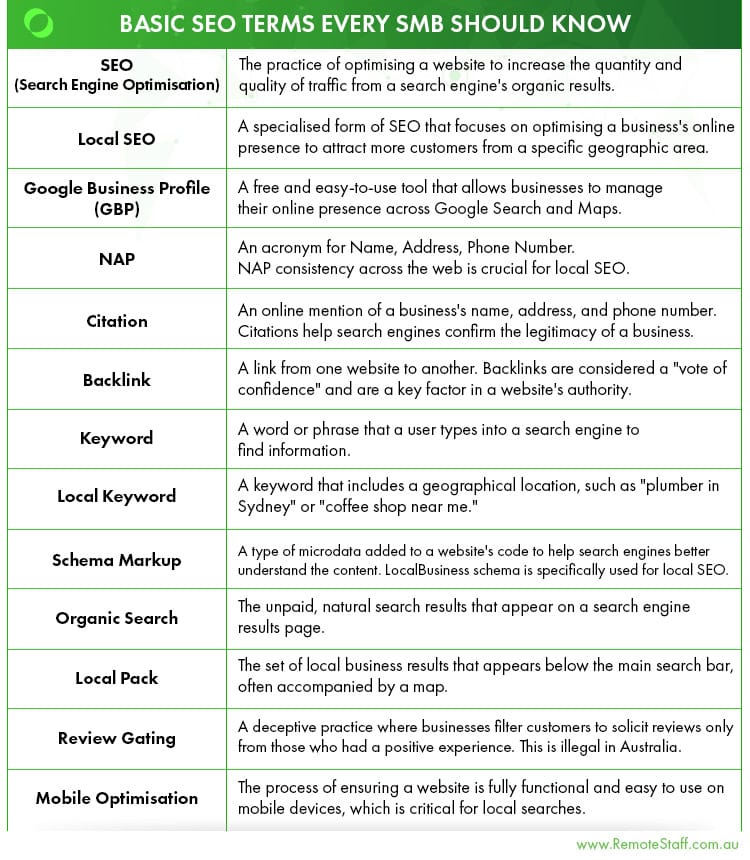
    basic seo terms

    Local SEO vs. Traditional SEO 

    SEO can seem intimidating, but it simply means optimising your company website to rank higher in search results. 

    Traditionally, brands have invested in their websites through keyword research, on-page and off-page optimisation, and content marketing to rank highly in national or even global search results. This allows Aussie stores, for example, to receive orders from other countries.

    Local SEO, on the other hand, is its organic, specialised counterpart. Instead of targeting international customers, local SEO for small businesses is designed for brick-and-mortar stores or service-area businesses that serve a local community. 

    It makes use of Google Business Profile (GBP) optimisation wherein you add your business name, phone number, opening hours, photos, and services. It also makes use of localised keywords that include a location, such as “real estate companies in Sydney” or “coffee shops near Byron Bay.”

    How Google Ranks Local Businesses

    There are approximately 16.4 billion searches on Google every day, and many of these are from people looking for products or services nearby. 

    With all these searches, Google ensures that relevant results reach the right audience by prioritising three main factors for local searches: relevance, distance, and prominence.

    • Relevance: How well a business matches a user’s search query;
    • Distance: How far a business is from the user’s current location; and
    • Prominence: How well-known and reputable a business is. 

    In short, if your business is relevant, nearby, and well-known, Google can show it to potential customers more readily.

    Key Benefits for Local Business Owners 

    Given its targeted nature, local SEO is a powerful advantage for local businesses, especially in areas where competitors are not yet fully utilising it.

    Increasing your local digital presence means: 

    • Attracting the right audience; 
    • Capturing the attention of customers who are already searching for what you offer; 
    • Building trust and credibility through online reviews; and 
    • Strategically competing with big brands through a more affordable form of marketing. 
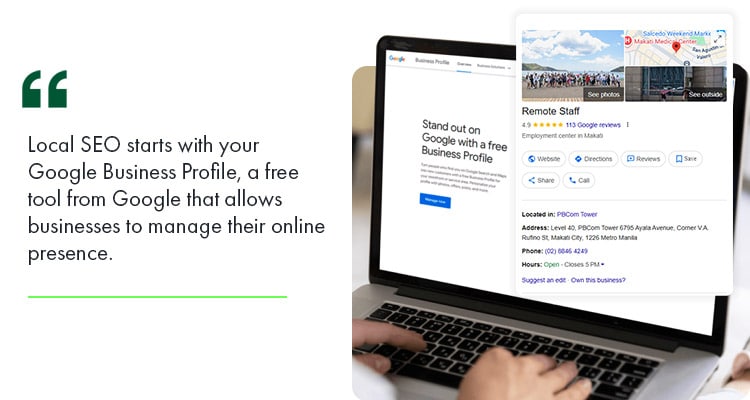
    setting up google business profile

    Getting Started: Your Local SEO Checklist 

    While local SEO might seem complex, a virtual assistant skilled and/or specialising in SEO can make it easier for your business to appear in local search results and on Google Maps:

    #1. Set Up and Verify Your Google Business Profile

    Local SEO starts with your Google Business Profile, a free tool from Google that allows businesses to manage their online presence. It helps customers: 

    • Find businesses; 
    • Get contact information; and
    • Avail services. 

    Conversely, it also allows businesses to interact with their customers by responding to reviews, posting updates, and showcasing their products or services. 

    Here’s how you can set it up: 

    1. Go to Google Business Profile Manager and create your profile. 
    2. Verify your ownership either via phone call, email, or postcard. 
    3. Complete your profile by adding the following:
      • Business name, address, and phone number (NAP); 
      • Primary and secondary categories that describe your business; 
      • Business hours; 
      • High-quality photos of your storefront, products, team, and work; 
      • List of services and/or products offered; 
      • Business description; and 
      • Q&A section to answer common customer questions. 

    #2. Ensure Consistent NAP (Name, Address, Phone) Across Directories 

    It’s also important to have a consistent name, address, and phone number across all your online profiles. Google’s algorithm monitors these details to confirm the legitimacy and accuracy of your business information.

    After listing your business on key directories like Yelp, Yellow Pages, Facebook, Apple Maps, etc., ensure that your NAP are identical on all platforms, down to the smallest details. 

    For example, if you used “Street” instead of “St.” on one platform, it should be the same on all the others. Even minor inconsistencies can confuse search engines and hurt your local rankings. 

    #3. Optimise Website Pages with Local Keywords

    In addition, you also need to set up and optimise your website. 

    While your Google Business Profile (GBP) helps you appear in local search results, your website helps you rank in the organic search results below the local pack.

    So, how is this done? 

    Start by doing local keyword research. You need to think like your customer and figure out what they would type into Google to find your services, such as:


    “Best plumber in Perth” 

    “Dentist near me” 

    “Bookstore in Brisbane” 

    “Surf shop bear Bondi Beach”


    After keyword research, you should integrate these keywords into your website. Place them in key areas like blogs, landing pages, and service descriptions. You should also use them in your website’s title tags, meta descriptions, and H1 headings to improve your SEO.

    #4. Include Location-Specific Schema Markup 

    Local SEO also needs a schema markup, a type of code added to your website’s HTML to help search engines understand its content and context more effectively. 

    It tells Google exactly what your business is, where it is located, and how to get in touch. You can either manually add the code to your website or use a plugin or an online generator. Thus, unlike SEO optimisation, this requires some technical knowledge. 

    Because of this, many Australian small business owners hire outsourcing providers like Remote Staff to find skilled marketers or website developers to tap into their expertise.
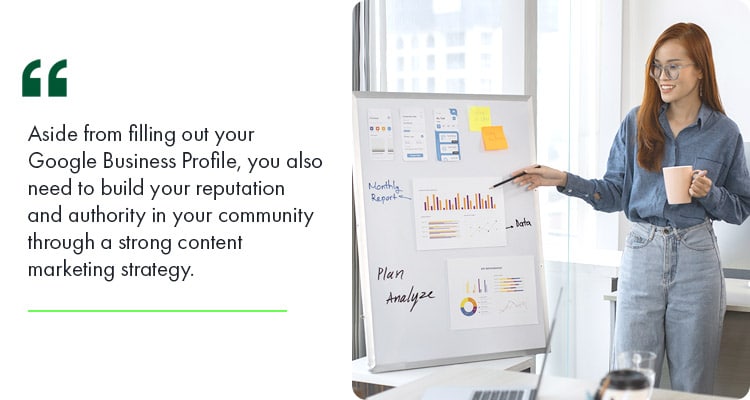
    content marketing strategy

    Content Marketing for Local Reach 

    Local SEO doesn’t stop once you’ve created your Google Business Profile and optimised your website.

    Aside from filling out your Google Business Profile, you also need to build your reputation and authority in your community through a strong content marketing strategy. 

    Here’s how.

    Creating Localised Blog and Landing Pages

    Google’s algorithm prioritises businesses that are relevant, nearby, and prominent. To be prominent, your brand should consistently create valuable content, showcasing your expertise and how you engage with your local audience. 

    Your website content is what helps you rank high on the organic search results. This is usually done through: 

    • Localised Landing Pages – If your business serves multiple cities, you can create a specific landing page for each location. For example, a home services company in Sydney could create individual pages for “plumbing services in Bondi” and “plumbing services in Manly.” Each page should contain unique, high-quality content that addresses the specific needs of customers in that area, not just information duplicated from other pages. You can further enhance these pages by including testimonials from local customers and a locally-modified call to action.


    • Localised Blog Posts – Blogs are still a crucial part of SEO and an excellent way to provide value to your local community. The key is to publish the right kind of content. For instance, a café could write a blog post titled “The 5 Best Study Spots in Brisbane CBD,” or a real estate company could release a post about “What the New City Council Zoning Means for Homeowners in Perth.” These articles create valuable content that answers questions and strategically positions your business as a knowledgeable and engaged member of the community.

    Writing About Local Events, News, and Partnerships 

    In addition, highlighting your community involvement builds trust. Content that shows your local engagement tells both customers and search engines that you are a legitimate and valued local entity.

    • Community Involvement – If you sponsor a local little league game, participate in a community cleanup, or host a charity drive, write a blog post about it. Don’t forget to include photos and quotes from the participants.
    • Local News – Offering a unique perspective on a local issue is also a great way to create content. For example, a financial services company could share insights on local tax exemptions or how a new government budget will impact SMBs.
      This strategy demonstrates your expertise and connects your business to local conversations.
    • Collaborations – Moreover, content about partnerships is an excellent local SEO strategy because it helps both businesses reach a wider audience and build their network of local links. For example, a bakery partnering with a local coffee roaster can announce the collaboration on its blog. This is newsworthy content for the local community and can lead to a mutually beneficial exchange of backlinks and social media shares.

    Using Testimonials from Local Customers 

    Brick-and-mortar stores as well as service-area businesses rely heavily on word of mouth marketing and referrals. 

    However, you should also back this up with online reviews and testimonials by creating a dedicated page for them on your website or by incorporating them directly into your website content.

    • Dedicated Testimonials Page – Consider creating a dedicated “Testimonials” page on your website where customers can read positive feedback. To build trust and credibility, include the customer’s full name, suburb or city, and a photo (with their permission).
    • Embed Reviews and Ratings – In addition to creating a dedicated page, you can use widgets to embed recent reviews from your GBP or other platforms directly onto your website. This provides a live, dynamic feed of your reputation, which encourages new customers to trust your business.
    • Video Testimonials – Encourage happy customers to provide short video testimonials about your business. Video is highly engaging and is a compelling way to showcase your products or services. You can then embed these videos on your website’s home page, landing pages, or a dedicated “Success Stories” page.
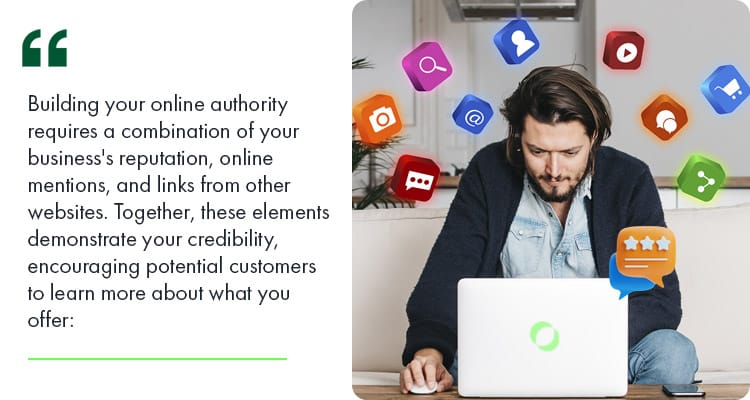
    building online authority

    How to Build Local Citations and Backlinks 

    Building your online authority requires a combination of your business’s reputation, online mentions, and links from other websites. Together, these elements demonstrate your credibility, encouraging potential customers to learn more about what you offer:

    #1. Submit Your Info to Australian Business Directories

    It’s crucial to get your business listed on online directories. These listings, also known as citations, help Google’s algorithm confirm that your business is legitimate. The most prominent and widely-used business directories in Australia include: 

    • Yellow Pages 
    • TrueLocal 
    • Hotfrog 
    • Yelp 

    There are also local-specific directories tied to your city or neighbourhood, such as a local chamber of commerce or a community business association. 

    #2. Partner with Local Bloggers and Media

    A backlink is a link from one website to another. Backlinks are fundamental to SEO because they signal to search engines like Google that your content is credible, valuable, and trustworthy.

    But how do you get another website to feature yours? 

    • Offer Expert Insight or Guest Post – You can reach out to local media outlets or bloggers in your industry to offer an expert quote for an article they’re writing or suggest a guest post on a topic you know well. For example, a real estate company could write an article with simple tips on how to design a property to maximise light and space. Within that article, they can subtly link to their own products or services, directing readers back to their website. 
    • Become a Resource – Meanwhile, some businesses create a resource on their own websites that local bloggers or news sites will link to. For example, a news outlet reporting on energy efficiency might link to a business’s blog that features articles about green energy and energy conservation in Australia. In some cases, these business owners get interviewed or invited as resource speakers, which leads to them being featured in news articles and online magazines. These publications often link back to the business’s website, which helps with their online authority.

    #3. Sponsor Community Events or Charities 

    Since many SMBs are known and well-positioned in their communities, they often sponsor local events or charities. Sponsoring these gatherings is not only good for the community but can also be a valuable source of local backlinks.

    When you sponsor an event, your business name and website link are often featured on the event’s website. This creates a powerful, geographically relevant citation that helps Google’s algorithm see your business as a trusted and prominent local entity, leading to higher rankings and more customers.

    Therefore, when you provide sponsorship, be sure to ask for your business to be featured on their website with a link back to your homepage. This creates a win-win situation: local organisations get the support they need, and your business can systematically build its online reputation and authority.

    Leveraging Online Reviews for Local SEO 

    Online reviews can make or break your business. 

    They act as a powerful form of social proof that directly influences how your business is perceived, especially by Google’s local search algorithm. This is crucial because almost all customers now research products and services online before making a purchase.

    Encourage Customer Reviews on Google and Facebook 

    While small business owners often ask for feedback in person or through surveys, for local SEO, your main focus should be on getting reviews on your Google Business Profile. 

    Additionally, Facebook reviews are also highly valuable for social proof and building brand credibility. Here’s how:

    • Ask Directly – Ask customers directly for a review, either at the point of sale, via a follow-up email, or through a text message. 
    • Make It Easy – Make it as simple as possible for customers to leave a review. For instance, you can generate a direct review link from your GBP and share it on your receipts, website, email signature, and social media. 
    online reviews

    How to Respond to Positive and Negative Reviews 

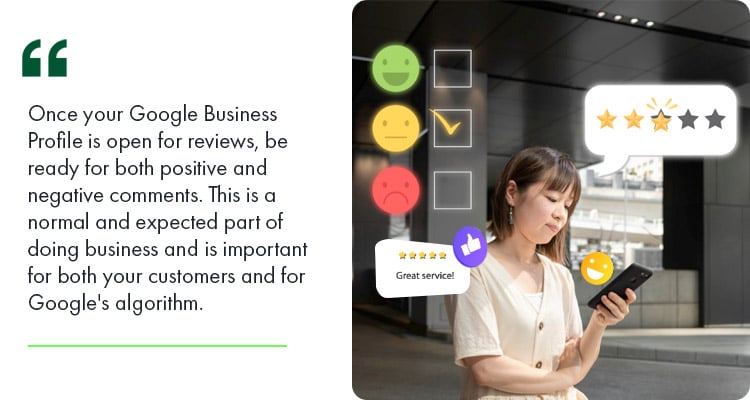
    Once your Google Business Profile is open for reviews, be ready for both positive and negative comments. This is a normal and expected part of doing business and is important for both your customers and for Google’s algorithm.

    Responding to reviews shows that you are an engaged and attentive business owner. Regardless of what you receive, here’s how you can deal with them:

    • Positive Reviews – When you get a positive review, always thank the customer for their feedback. A simple “Thank you for your kind words, we appreciate your business” goes a long way. To make your response more authentic, mention the specific product or service they enjoyed, which also shows you’ve read and valued their comment. You can even strategically and naturally include a relevant keyword for SEO purposes without sounding forced or unnatural. 
    • Negative Reviews – It can be disheartening to read negative reviews, however, you can always look at it as an opportunity to improve. More importantly, this is where your professionalism comes into play.

      When responding, you have to:  

      • Stay calm and professional; 
      • Never respond emotionally or defensively; 
      • Apologise for their negative experience without invalidating their feelings; 
      • Offer to resolve the issue privately by providing an email or phone number; and 
      • Be transparent, especially if there was a mistake on your end. 

    Bad Reviews and the Legal Risks of “Review Gating” in Australia 

    Many businesses fear bad reviews, which leads them to delete negative comments on social media. Some take this to an extreme by using review gating, a practice where they only ask customers with positive experiences to leave a public review.

    For example, a business might send an email asking for feedback. If a customer rates them highly, they’re sent to a public review site like Google. If they give a low rating, they’re directed to a private feedback form instead. While this practice might seem clever, it is actually considered misleading and deceptive under Australian Consumer Law, and may be subject to legal actions. 

    The Australian Competition and Consumer Commission (ACCC) has made it clear that businesses must not encourage or ask for only positive reviews. The principle is simple: all customers, regardless of their experience, should have an equal opportunity to provide a public review.

    Tracking and Improving Your Local SEO Performance

    Once you build your local SEO, the work is still far from over. Like any other marketing strategy, you need to: 

    • Regularly track your performance; 
    • Identify areas for improvement; and 
    • Adapt your strategy. 

    Fortunately, there are many tools and software to help you. 

    Best Free Tools for Local SEO 

    Aside from your Google Business Profile, Google provides entrepreneurs with two powerful, free tools that are essential for local SEO.

    • Google Search Console – This shows you how your website is performing in search results, including which keywords you rank for and what position you hold. For local SEO, Search Console can reveal the geographically-modified searches that are driving traffic to your site, helping you refine your keyword strategy. It also alerts you to technical issues, such as broken links or mobile usability problems.
    • Google Analytics – On the other hand, Google Analytics tells you what people do on your site. It provides valuable insights like:
      • How long visitors stay on your site; 
      • Which pages they visit most often; and 
      • Where they are located.

    This tool is critical for local businesses, as it allows you to segment your audience by location. More importantly, it helps you understand if your local SEO efforts are attracting the right audience and if your website is effectively engaging them. 

    Local Rank Tracking Tools 

    To complement Google’s free SEO tools, you can also invest in some specialised local rank trackers which offer more detailed, localised data. These include: 

    • BrightLocal – BrightLocal is a comprehensive local SEO platform that allows you to monitor and improve local Google rankings for specific keywords in different locations. For example, you can see if you rank #1 for “plumber in Perth” and also monitor your ranking for “plumber in Sydney.”
    • Whitespark – Meanwhile, Whitespark’s local citation finder allows you to track your own rankings as well as those of your top competitors. This is a great tool for competitor analysis, as it helps you identify opportunities and refine your strategy to outrank them.

    When to Hire SEO Help

    While this guide provides many local SEO tips, planning and launching a full-scale strategy can be overwhelming and time-consuming for small business owners who’ve got other things to do. 

    Thus, many Australian entrepreneurs find it more productive to learn the basics and then delegate the planning and implementation, especially in the following instances: 

    • When the Work Gets Too Complex – You can start with the basics, like setting up your Google Business Profile. However, you may eventually need help with more technical tasks, such as website audits, implementing schema markup, or running sophisticated link-building campaigns.
    • When You Need to Scale – If you’re expanding to new locations or facing increased competition, it helps to have a specialist who can scale your efforts efficiently while you focus on core business functions. This is where outsourcing providers like Remote Staff come in. For over 17 years, Remote Staff has been helping Australian businesses with their marketing campaigns by providing skilled specialists in:
      • SEO writing
      • Web development
      • Digital marketing
      • Content marketing

    Moreover, these specialists can handle everything from keyword research to link-building campaigns. By delegating tasks remotely, you get expert help without the overhead costs that come with hiring a full-time employee, making it a cost-effective solution for growing business. 

    Common Local SEO Mistakes and How to Avoid Them 

    Local SEO can be challenging, especially when you’re just starting out. To help you navigate these challenges, here’s a list of the most common mistakes small business owners make and how to avoid them.

    #1. Ignoring Mobile Optimisation

    Historically, SEO was focused on desktop computers. However, with the boom of smartphones, a significant number of local searches, particularly those using “near me” or “nearby,” are now conducted on mobile devices. This shift to mobile-first search has made optimising for mobile devices a crucial part of any local SEO strategy.

    Because of this, businesses also have to focus on mobile optimisation. This means designing or updating their websites to be responsive, so they automatically adjust to fit any screen size, from a large desktop monitor to a small phone screen.

    In addition, you should focus on site speed, which can be improved by: 

    • Compressing images;
    • Using fast hosting; and 
    • Avoiding unnecessary code. 

    You can also use Google’s free Mobile-Friendly Test and PageSpeed Insights tools to check your website’s speed and performance and get actionable recommendations for improvement.
    duplicate listing

    #2. Duplicate Listings and Inconsistent Info 

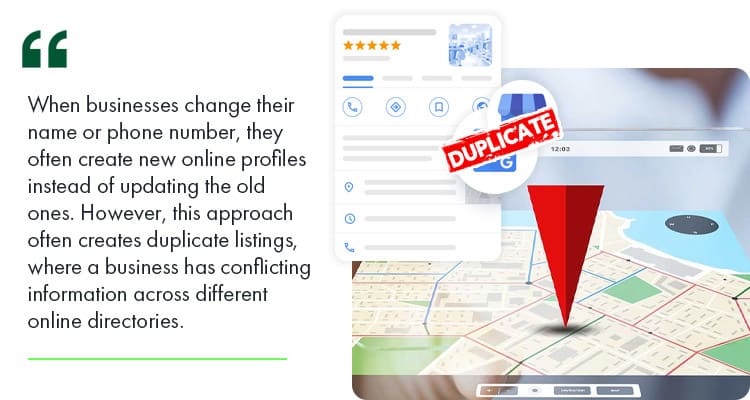
    When businesses change their name or phone number, they often create new online profiles instead of updating the old ones. However, this approach often creates duplicate listings, where a business has conflicting information across different online directories.

    For example, a bakery called “Cakes by Marie” at 123 Main Street in Perth moves and rebrands as “Marie’s Bakery” at 456 Oak Avenue. Instead of updating the old listing on Google and other directories, the owner creates a completely new profile for “Marie’s Bakery.” This leaves two separate listings online, which can confuse both customers and search engines.

    Thus, it’s important to regularly audit your online presence by:

    • Searching for your business name and all its variations;
    • Reporting any duplicate listings to the platform they’re on so they can be removed or merged; and
    • Using a centralised platform to update all of your listings at once, ensuring your information is consistent everywhere.

    #3. Overlooking Negative Reviews 

    It can be tempting to delete or ignore negative reviews, but this can actually be more harmful to your business. Leaving a negative review unanswered can make your business appear unresponsive, uncaring, and untrustworthy.

    In fact, Google encourages business owners to respond to negative feedback as it’s an opportunity to address a customer’s concerns publicly. When handled correctly, it can potentially turn a negative experience into a positive one – and also help cultivate trust.

    How Small Businesses in Australia Can Benefit from Local SEO 

    Small businesses are the heart of the Australian economy. 

    To support them, the AU government provides various opportunities for growth. However, it’s also necessary for SMBs to invest in strategic marketing, such as local SEO.

    The Competitive Edge Local SEO Offers 

    Small businesses can’t match the massive marketing budgets of large corporations. However, local SEO allows them to appear at the top of search results and in the crucial Google Maps “map pack,” often outranking much larger competitors.

    This is because Google’s algorithm prioritises a small cafe’s location and positive local reviews over a large national chain’s overall website authority. By mastering local SEO, your business can capture the attention of nearby customers who are ready to make a purchase.

    Local SEO as a Long-Term Growth Strategy 

    It’s also important to remember that local SEO isn’t a one-time campaign. Rather, it’s a continuous investment in your business’s future. 

    The work you put in today will determine your search rankings in the weeks and months to come, making it an asset that pays dividends for years. As consumer behavior continues to shift toward online research and the use of artificial intelligence, a business with a strong online presence is well-equipped to handle the change. 

    Many of the most impactful tasks – like optimising your Google Business Profile and responding to reviews – are completely free. In other words, local SEO is a cost-effective marketing strategy, making it ideal for small businesses. 

    Conclusion: Boost Your Local Visibility with Smart SEO 

    Running a business requires constant innovation and adaptation while keeping a close eye on your marketing expenses. This is especially true for small business owners, who must find the most cost-effective ways to maximise every revenue opportunity.

    Thanks to local SEO, this can all be a reality. 

    You can get your business in front of customers who are ready to buy, whether they are a local resident or a foreign tourist, all without a massive budget for TV ads. You just have to:

    • Set up your Google Business Profile; 
    • Optimise your website; 
    • Add some keywords; 
    • Respond to reviews, and
    • Consistently produce relevant and valuable content.

    But if managing these tasks feels overwhelming, don’t worry. 

    Many successful Australian business owners learn the basic SEO terms and then partner with Remote Staff for their staffing needs. This way, you can continue building your business offline while a remote worker ensures that your hard work is visible online, especially in search results.

    Ready to set up your Google Business Profile and take your business to the top of search results? Call us today or request a call back now

  • 5 Ways AI Can Help Your Small Business Compete with Large Enterprises

    5 Ways AI Can Help Your Small Business Compete with Large Enterprises

    Australia’s small businesses are the backbone of the economy, accounting for 97% of all businesses and employing over 40% of the workforce.

    But in 2026, it was foreseen that the competition would be fiercer than ever. Large enterprises continue to dominate markets with the power of advanced technology and substantial resources.

    Fortunately, artificial intelligence (AI) is leveling the playing field. No longer the exclusive domain of billion-dollar corporations, AI has become affordable, accessible, and a game-changer for SMEs ready to embrace digital transformation.

    Whether it’s using virtual assistants to handle scheduling, deploying chatbots for customer service, or adopting AI-driven content marketing tools—AI is helping businesses across Australia improve operational efficiency and compete with bigger competitors like never before.

    Let’s explore five ways your business can harness AI today.

    Why AI Isn’t Just for Big Business Anymore

    It’s a myth that AI is too complex or expensive for small businesses. Thanks to cloud computing and AI service platforms, powerful tools that once cost millions are now available for a monthly fee -or even for free.

    Australian SMEs are already leveraging AI for competitiveness—from cafes using predictive analytics in business to forecast stock needs, to retailers using chatbots for customer service.

    AI is no longer about futuristic hype—it’s about practical, everyday tools that help small businesses perform well.

    1. Automate Repetitive Tasks and Free Up Time

    Every business has time-consuming, repetitive tasks that drain focus and resources. AI can take these off your plate so you and your team can concentrate on activities that really move the needle.

    Examples

    AI-enabled systems can process invoices, log expenses, and manage data entry with minimal human input.

    Virtual assistant tools can handle schedules, appointment confirmations, and reminders. These technologies not only save time but also help reduce errors.

    Tools

    Email & calendar management are made easier with AI-generated CRMs and virtual assistant platforms that automate follow-ups, reminders, appointment bookings, and even personalized email responses.

    These tools make sure no leads go to waste—-without you lifting a finger. Here are some examples of AI-powered tools helping businesses automate their admin workflows:

    • Calendly + AI Scheduling Assistants: Tools like Reclaim.ai or Motion use AI to automatically suggest the best times to meet based on preferences, priorities, and past behaviour—perfect for time-poor business owners juggling multiple meetings.

    • Google Workspace with Gemini AI (formerly Duet AI): Offers smart reply suggestions, automated summaries of long email threads, and AI-generated calendar insights so you can instantly review your day or week.

    • Microsoft 365 Copilot: Combines data from your emails, meetings, chats, and documents to draft responses, schedule tasks, and prioritise action items.

    • HubSpot CRM & Salesforce Einstein: These AI-enhanced platforms handle email outreach, deal forecasting, and intelligent follow-ups, ensuring no prospect falls through the cracks and to keep your sales pipeline active.

    • x.ai and Clara Labs: AI-driven scheduling assistants that act like real human assistants—responding to emails, confirming meeting times, and adjusting for time zones and cancellations.

    • Trello, Asana, and Notion AI: Project management tools that now incorporate AI features to schedule tasks, remind teams of deadlines, and auto-assign responsibilities based on project status.

    Outcome

    With AI taking care of admin and repetitive tasks, your team can focus on strategy, customer relationships, innovation—areas where human creativity still shines.

    A boss satisfying client request with the help of his virtual assistant and AI.

    2. Personalise Customer Experiences Like a Big Brand

    Gone are the days when personalised customer engagement was something only large corporations could afford.

    With AI, small and medium-sized businesses can now deliver curated, dynamic experiences that rival established brands, even without massive marketing teams or budgets.

    AI tools allow you to understand customer behaviours, anticipate needs, and engage at the right time with the right message.

    This results in better conversions, stronger customer loyalty, and ultimately, higher revenue.

    Chatbots, email flows, and recommendation engines

    AI-powered chatbots for customer service have become a frontline standard for both e-commerce and service-based businesses.

    These bots can handle common queries, assist in product selection, manage returns, or guide customers through processes 24/7.

    Platforms like Intercom, Tidio, and Drift offer AI online chat management and capabilities that improve over time through machine learning.

    Meanwhile, automated email flows powered by AI guarantee that your communication is timely and relevant. 

    Whether it’s sending an abandoned cart reminder, a follow-up after purchase, or a birthday discount, AI platforms like Klaviyo and ActiveCampaign create responsive journeys tailored to user behaviour and preferences.

    Recommendation engines, once exclusive to tech giants like Amazon, are now within reach.

    Tools like LimeSpot or Dynamic Yield can also help you personalise product suggestions on your website or email campaigns based on browsing history, past purchases, and real-time actions.

    AI in CRM tools for tailored service delivery

    Modern customer relationship management platforms have evolved beyond data storage.

    AI-enhanced CRMs such as Zoho CRM, HubSpot, and Salesforce use predictive scoring, behaviour analysis, and smart segmentation to guide how and when you engage with prospects and customers.

    For instance, your CRM might notify you about a hot lead based on emails and website visits that can prompt your virtual assistant to schedule a call or send a customised offer.

    This kind of AI-powered customer support solution guarantees you strike while the iron is hot.

    3. Improve Decision-Making with Smart Insights

    Data is a coveted asset—but only if you can interpret it. AI makes it possible for small businesses to use predictive analytics in business operations, just like the big corporations.

    Predictive analytics for inventory, pricing, and demand

    AI can analyse sales patterns, seasonality, and market trends to forecast demand, optimise pricing, and prevent stockouts or over-ordering.

    For example, AI tools can alert you when inventory is likely to run low or when it’s time to offer a promotion to move certain stocks faster.

    Dashboards for business performance tracking

    AI-powered dashboards bring your key metrics together in real time—from cash flow to customer satisfaction scores, so you can make smarter decisions faster.

    Digital marketing growth with the help of AI.

    4. Strengthen Your Digital Marketing Strategy

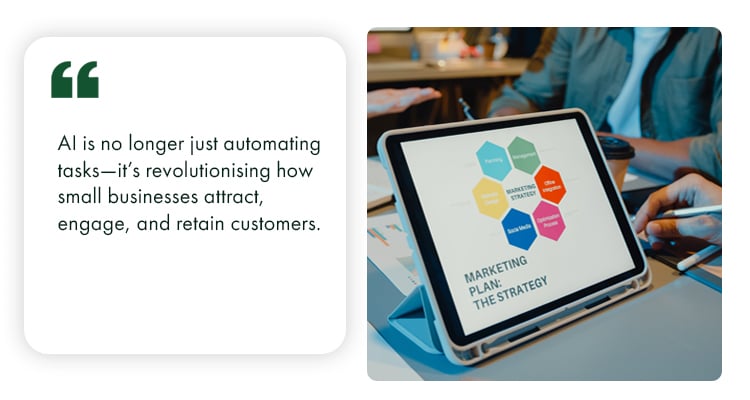
    AI is no longer just automating tasks—it’s revolutionising how small businesses attract, engage, and retain customers.

    With AI-powered tools, you can execute smarter, faster campaigns that rival the sophistication of enterprise-level strategies, without a massive marketing team or budget.

    AI helps businesses leverage digital channels more effectively, from social media and search engine marketing to content creation and customer engagement.

    By harnessing machine learning, natural language processing, and data analysis, you can make data-backed decisions, optimise campaigns in real time, and dramatically improve marketing ROI.

    Here’s how AI is transforming your marketing toolbox:

    AI for content generation and A/B testing

    Creating high-quality content consistently can be time-consuming, but AI tools make this easier by generating, optimising, and testing content based on what performs best with your audience:

    • Jasper and Copy.ai — Generate blog posts, ad copy, product descriptions, and social media captions using AI that understands your brand tone and objectives.

    • SurferSEO — Combines keyword strategy with AI-driven content creation for top-ranking SEO articles.

    • Unbounce Smart Traffic — Uses AI to automatically test and deliver the highest-converting landing page variant for each visitor.

    • Headline Studio (CoSchedule) — Analyses and improves your headlines using predictive engagement metrics.

    AI doesn’t replace your brand voice—it amplifies it by making content more relevant, faster to produce, and easier to refine through continuous testing.

    Keyword optimisation and trend monitoring

    Finding the right keywords at the right time can be a game-changer for traffic and visibility. AI tools now take the guesswork out of search optimisation and trend discovery through:

    • SEMrush and Ahrefs — Track keyword performance, discover new opportunities, and benchmark against competitors using real-time data.

    • Google Trends + AI Extensions — Identify what your audience is searching for today so you can respond quickly with relevant content or campaigns.

    • MarketMuse and Clearscope — Use AI to recommend content updates based on gaps in your current pages or articles.

    • BuzzSumo — Monitor content performance and viral trends across platforms so you can engage with timely topics before they peak.

    By integrating these insights into your content strategy, you can stay relevant, visible, and competitive in a fast-moving digital space.

    AI has deeply integrated with social and paid media platforms, helping businesses optimise ad spend, personalise messaging, and increase campaign performance without the guesswork:

    • Meta Ads (Facebook + Instagram) — Uses AI to automatically optimise content, targeting, and delivery for best performance.

    • Good Ads Smart Bidding — Adjusts bids in real time based on user behaviour, intent, and conversion probability.

    • Canva Magic Write and Adobe Firefly — Empower teams to design social assets with AI-assisted visuals and text generation.

    • Lately.ai — Turns long-form content like blogs or videos into dozens of social media posts tailored for each platform.

    • ChatGPT plugins and Zapier integrations — Automate social content generation, post scheduling, and performance reporting

    With these tools, small businesses can deploy high-impact marketing campaigns with precision, even with a much smaller team.

    5. Streamline Customer Support and Retention

    Small businesses can now offer customer support solutions without hiring large teams- thanks to AI.

    24/7 chatbots for FAQs and common issues

    Chatbots for customer service are now affordable, easy to deploy, and can handle high volumes of enquiries.

    They provide instant responses, boost satisfaction, and free human staff up for more complex cases.

    AI ticket triaging and customer satisfaction tracking

    AI can prioritise support tickets based on urgency and sentiment, making sure critical issues are addressed first.

    Sentiment analysis helps you gauge customer mood and improve service quality continuously.

    Multilingual support and sentiment analysis

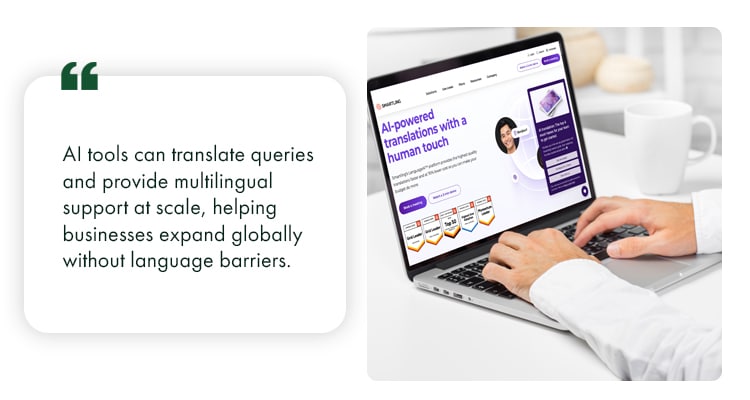
    AI tools can translate queries and provide multilingual support at scale, helping businesses expand globally without language barriers.

    A virtual assistant working with a laptop and AI application.

    How to Get Started with AI for Your Small Business

    Ready to begin your AI journey? Here’s how to start:

    • Assess Your Business Needs. Identify repetitive tasks, bottlenecks, or customer service gaps where AI could add value.

    • Explore Low-Cost or “Freemium” Tools. Many platforms offer free trials or entry-level plans. Test them on small projects before scaling with paid versions.

    • Partner with Local AI Consultants. Australian consultants understand local market needs and can help you choose the right solutions.

    • Invest in Staff Training. Tech-savviness is key. Provide basic AI literacy training so your team is ready to work alongside AI tools.

    FAQ: AI for Small Businesses in Australia

    Now, let’s go over the most common questions from business owners thinking about incorporating AI into their business processes.

    Is AI expensive for a small business?

    Not anymore. With cloud-based platforms and pay-as-you-go models, AI tools are accessible for almost any budget.

    Can I use AI without hiring a developer?

    Absolutely! Many AI tools are plug-and-play, designed for non-technical users with user-friendly dashboards.

    What are the risks of using AI tools?

    Common risks include relying too much on business process automation without oversight or using poor-quality tools that deliver subpar results. Always vet your platforms carefully.

    How do I measure ROI from AI investment?

    Track KPIs before and after implementation. For example, measure time saved, cost optimisation achieved, increased sales, or improved customer satisfaction.

    A virtual assistant busy composing AI prompts.

    AI Is Here to Level the Playing Field

    AI is no longer optional—it’s essential.

    The businesses that will thrive in the coming years are those that use AI to automate business tasks smartly and free up human talent to focus on what matters most.

    Don’t wait for competitors to outpace you. Start small—try a chatbot, test AI-driven content marketing, or automate one repetitive task.

    From there, scale smart and let AI help you achieve your business goals faster.

    The question isn’t whether you can afford to explore AI—it’s whether you can afford not to.

    • Want FREE AI Prompts for Different Areas of Your Business? Check out these 100 AI prompts
    • Curious About How to REDUCE Overhead Costs? Learn more here.
    • If you’re ready to experience the full advantages of working with a top global team, check out our 1,000 fully vetted and highly talented staff here.
  • Fighting AI Abuse and Deepfakes: Denmark Grants Citizens The Right to Copyright to Their Face, Body, and Voice

    Fighting AI Abuse and Deepfakes: Denmark Grants Citizens The Right to Copyright to Their Face, Body, and Voice

    Artificial intelligence is evolving rapidly. It can write essays, create images, and make videos – all you need are the right prompts.

    This development has drastically transformed how we work, create, and live. Some users are even using AI to recreate images, generate versions of their favorite characters, or rework official movies and stories for personal use. With many small businesses also using it to compete with large enterprises.

    However, this widespread use of AI-generated images has even led many creators to question the ethical and legal implications of creating content based on user data.

    Thus, many legal scholars emphasise the need for laws and regulations to keep up, especially with how easy it’s become to feed anyone’s face, body, or voice into image generation models without their consent – or even their knowledge.

    And until recently, no country has made much progress in legally addressing these issues.

    Here’s how, through the initiative of the Danish government, Denmark could very well be the first.

    Fighting Against Deepfakes and AI Abuse: A Legal First

    It’s hard to create and enforce laws on AI as it evolves so quickly.

    While laws take months or years to pass, technology can change in a matter of days or weeks.

    That’s why many countries struggle to protect their citizens’ privacy rights. But Denmark is determined to get the ball rolling regardless.

    Denmark AI News: Why Denmark’s Move is a Landmark in Digital Rights

    About a week ago, Denmark surprised the world with an unprecedented move to grant its citizens the copyright to their face, body, and voice.

    The proposed bill is the first in Europe to give citizens the legal right to ask platforms like Facebook, Instagram, and TikTok to take down fake digital versions of themselves online.

    If and when it comes to pass, this groundbreaking law:

    • Gives people control how their photos and voices are used (if at all);
    • Allows them to request takedowns or sue if their likeness is used without their knowledge or consent;
    • Provides a legal solution for AI-generated deepfakes; and
    • Sets a global example that could inspire other countries to follow.

    Ghibli style images

    Growing Global Scrutiny Towards AI-Generated Content

    The Ghibli-style images that went viral in early 2025 were certainly entertaining, but also raised serious concerns. As AI gets more advanced, it’s becoming harder to tell what’s real and what’s made by AI – blurring legal, ethical, and moral boundaries in the process.

    Some say AI-generated images are just tributes to one’s favorite artists, but many argue that generating such actually violate copyright laws.

    Thus, artists and creators like Hayao Miyazaki worry that AI can copy their style or use their work without permission, especially since no country in the world has yet to establish a legal infrastructure with clear guidelines for ethical use.

    How Does AI Use Your Voice Without Consent: Scarlett Johansson’s Case

    Even before AI image generation became mainstream, Hollywood star Scarlett Johansson already publicly condemned the serious threats posed by AI-generated ads. In 2023, she took legal action against an AI app for using her name and likeness in an ad without her permission.

    The ad made it look like she endorsed the product, even though she wasn’t involved at all. This case drew global attention to how easily AI can copy someone’s voice or appearance to create convincing fake videos or deepfakes.

    It also raises big questions for the public: How can we tell if what we see and hear online is real?

    And more importantly, how can we protect ourselves from featuring in fake, AI-generated content?


    [rcb_show_form]

    The Rise of AI Tools in Marketing and Media

    Creating captivating marketing and social media content used to take hours or days.

    Now, AI makes writing captions, designing layouts, and creating graphics much faster and easier. However, it also raises concerns about authenticity, ethics, and job security.

    AI tools are often used for:

    • Social Media – AI is widely used to make eye-catching posts, write engaging captions, and suggest the best times to post. It can also analyse trends and audience behavior to help brands stay relevant.
    • Advertising – AI can design personalised ads for specific groups and quickly create different versions to see what works best, saving time and money. It can also write ad copy, suggest keywords, and make visuals that fit a brand’s style.
    • Influencer Imagery – In many cases, many influencers and content creators use AI to improve their photos by adjusting lighting, smoothing skin, and creating a “perfect” version of themselves.

    Deepfakes, AI Voices, and the Ethical Gray Area

    Many people use AI to improve their photos.

    However, more and more users are also creating realistic videos or audio clips that look and sound like real people, even if those people never actually said or did those things.

    For example, AI-generated deepfakes can spread false information, damage reputations, be used to commit fraud, or feature in explicit content without the subject’s knowledge or consent. Politicians or celebrities can be falsely shown saying or doing things they never did, leading to public confusion and distrust.

    These situations create a big ethical gray area. Some say deepfakes are just harmless parodies or art, while others see them as serious threats to privacy, consent, and public trust.

    AI gets more advanced

    As AI gets more advanced, people are becoming more worried about their image, voice, and personal data being used without their permission.

    Since we often upload photos online and leave a digital footprint, many people feel uneasy knowing their faces, voices, or bodies could be used to train AI models.

    Aside from consent, AI-generated content also raises concerns about representation. For example, a deepfake might show a public figure making offensive comments about certain groups, making it all too easy to exacerbate the existing problem of fake news proliferating and affecting the average individual’s ability to make well-informed decisions that affect their lives and everyone else’s (e.g., in elections, etc).

    Who Are Most At Risk for AI Abuse?

    Improper AI use can affect anyone online, but some groups are more at risk than others. Let’s take a closer look.

    Public Figures: Celebrities, Politicians, Influencers

    AI tools can easily scrape images, videos, voice clips, and statements of public figures from the internet. This puts celebrities, politicians, and influencers at risk of:

    • Voice Cloning and Impersonation – AI can copy their voices to trick people, promote fake products, or spread false recordings.
    • Deepfake Videos – AI-generated videos can also show them saying or doing harmful, illegal, or explicit things, which can ruin their reputation and in some cases, erode public trust.
    • Image-Based Exploitation – Celebrities and influencers are at high risk of being targeted by AI tools that can be used to create explicit content using their image.

    Vulnerable Groups: Minors, Women, and Marginalised Communities

    Aside from public figures, the following are also at serious risk:

    • Minors – Children and teens spend more time online, making them easy targets for AI-generated deepfakes, identity theft, or online predators out to profit from using their likeness for nefarious purposes.
    • Women – Women are often targeted by AI tools that create fake nude photos or videos without their consent. These are then used for harassment, blackmail, or shared on adult sites without permission.
    • Marginalised Communities – Members of racial, ethnic, LGBTQ+, and other marginalised groups can also be targeted by AI-generated fake content or hate speech that spread harmful stereotypes.

    Everyday People: Social Media Users with Large Public Profiles

    Even regular people can be victims of AI abuse. Those with a strong online presence—like content creators, vloggers, or small business owners, are especially at risk of:

    • Catfishing and Identity Theft – AI can create fake profiles using someone’s photos or voice, which can lead to scams, catfishing, or damage to their reputation.
    • Business Scams – Small business owners and influencers might have their name or photo used to promote products or services without their consent or knowledge.
    • Cyberbullying – People with a public following are more likely to be targeted by AI-made memes, fake content, or messages meant to embarrass, provoke, or damage their reputation.

    AI abuse

    What Happens When AI Uses Your Face and Voice: Real-World Harm

    AI abuse may start online, but it can quickly lead to real-world consequences. It can even affect your mental health, relationships, and even your career.

    Here are some examples.

    Deepfake Pornography and Non-Consensual Imagery

    In recent years, female celebrities like Emma Watson, Scarlett Johansson, and Gal Gadot have been targeted by deepfake ads. Their faces were placed on fake explicit videos and shared on adult websites and social media.

    Left unaddressed, these manipulated and AI-generated images and videos may result in:

    • A loss of privacy, causing fear, anxiety, and a lasting sense of being violated;
    • Feeling exposed or watched, which can hurt self-esteem and mental health; and
    • Damage to your reputation, affecting your job and relationships.

    Voice Cloning for Fraud and Scam Calls

    In 2019, a scammer used AI to copy the voice of a German CEO and called the UK branch’s manager, asking him to urgently send a large amount of money. The money was sent, but by the time they found out it was a scam, the funds had already been moved across several countries.

    These scams are hard to spot because cloned voices can sound almost exactly like the real person, including their accent and tone. Worse, victims often lose money and may also feel stressed, embarrassed, and unable to trust others.

    AI-Powered Catfishing and Social Engineering

    Cybersecurity experts found fake LinkedIn profiles using AI-made photos to trick professionals and steal sensitive data. These fake accounts connected with real people and started friendly chats to gain trust.

    Once scammers gained trust, they asked for company info, sent dangerous links, or gathered data for bigger attacks like phishing. Victims could lose money, jobs, or private information. Many also end up grappling with serious trust issues moving forward, since the chats seem real and they don’t realize it’s a scam until it’s too late.

    Emotional, Professional, and Legal Fallout for Victims

    When someone uses your face, voice, or identity without permission, the harm goes beyond feeling embarrassed online. Some people may feel unsafe or like they’re being watched, especially if it keeps happening.

    Moreover, even if the content is fake, the damage it inflicts is all too real.

    Deepfakes or false posts can ruin someone’s reputation, affect job opportunities, or even cause them to lose their job. While victims may try to fight back, many countries still lack clear laws against AI abuse. And even where rules exist, taking legal action can be costly and slow, ultimately making it difficult for the victims to prevail and achieve justice.

    operational excellence

    Find the Role That’ll Help Protect & Support Your Operations.

    Hire a Remote Staff specialist to support operations while you take care of your business vision.

    Trusted by 3,000+ businesses to scale remotely since 2007.

    Denmark’s proposed legislation seeks to recognise a person’s face, voice, and body as their intellectual property, much like copyrighted music, photos, and written work.

    Here’s how they plan to do it.

    What the Law Covers and How It Works

    Once the law takes effect, a person’s likeness, how they look, sound, and move, will be treated like intellectual property. This means Danish people will be able to:

    • Protect Their Faces – No one can use their face in AI-generated images or videos without clear permission.
    • Protect Their Voices – Their voice cannot be cloned and used in calls, videos, or advertisements without consent.
    • Protect Their Body and Movements – Their body shape, gestures, and movements will also be protected by law if copied using motion capture or AI without their knowledge.

    So, if someone uses their likeness without permission, Danish citizens can take legal action, whether the offending party is an individual, a company, or an AI developer.

    Moreover, online platforms like social media or video apps may have to remove unauthorised content – or face penalties if they ignore takedown requests.

    How It Applies to AI Generators and Deepfake Tech

    Denmark’s proposed law will require AI developers and users to get clear permission before making any image, video, or audio that uses someone’s face, voice, or body.

    If a tool is made in a way that allows or encourages misuse, like creating fake images of real people without consent, it could face fines, restrictions, or even an outright ban in Denmark.

    Penalties and Enforcement—Who’s At Risk?

    The following can be held liable under Denmark’s face, voice, and body copyright law:

    • Individual Offenders – People who share deepfakes, use AI to copy someone’s voice for scams, or post edited photos or videos of others without permission;
    • AI Developers and Platform Owners – Tech companies that create, host, or operate AI tools can be held responsible if their tools are used to make harmful or unauthorised content, or if they don’t set up proper safety measures; or
    • Online Platforms and Social Media Sites – Video-sharing sites and social media apps could be penalised if they allow unauthorised content to spread or fail to remove harmful content fast; monitor for repeated abuse; or cooperate with authorities during investigations.

    Denmark's legislation is a big shift for companies

    What This Means for Businesses Using AI in Branding and Advertising

    Denmark’s move marks a big shift for companies that rely heavily on AI for marketing, branding, and advertising.

    While AI offers creative and cost-effective ways to make realistic avatars, voiceovers, and videos, Denmark’s new law sets clear legal boundaries, ones that countries like Australia may soon adopt as well.

    Cross-Border Implications for Australian Companies

    Australian businesses using AI-generated content for global marketing need to be careful, especially if their ads or materials target audiences in Denmark.

    This means you should be extra cautious when:

    • Making AI-generated ads, avatars, or videos targeting Danish audiences;
    • Using public photos, voices, or movement data without clear permission; or
    • Working with AI tools or vendors that lack safety features or proper licenses.

    Risks of Unlicensed AI Content Use (Even If AI-Made)

    Even if AI generates an image, video, or voice clip entirely from scratch, it can still break the law, especially if it closely looks or sounds like a real person.

    This is important to remember because:

    • Misusing Likeness Means Legal Trouble – If your AI-made ad uses a face or voice that resembles a real person, even by accident, you could be sued or fined;
    • No Excuse for “AI Did It” – Saying “AI made it” won’t protect you from legal responsibility; and
    • Global Reach, Global Risk – If your content reaches people in Denmark, you could still be held accountable under Danish law, even if your business is in Australia.

    Importance of Transparent Media Sourcing and Permissions

    With stricter laws like Denmark’s on the horizon, businesses now need to handle AI-generated content as carefully as traditional media.

    Thus, you have to:

    • Secure proper consent prior to generating content based on the likeness of real individuals;
    • Partner only with ethical AI vendors that have proper licenses and sourcing records in place;
    • Keep documents that prove you legally acquired and used all content; and
    • Set up internal checks to spot any unintentional likenesses across all collaterals before launching campaigns.

    Will More Countries Help Stop AI Abuse: Denmark’s Lead and Who Follows

    Denmark’s approach to AI image generation is pushing other countries to act, especially as AI-generated deepfakes, voice cloning, and other AI content are becoming increasingly more convincing as the real thing – and becoming increasingly involved in harmful and illegal activities.

    Overview of EU, US, and AU AI Regulatory Discussions

    The European Union (EU) has already passed the Artificial Intelligence Act, the world’s first regulatory framework on artificial intelligence. It mainly targets high-risk AI systems but also includes rules on transparency and consent, especially for AI-generated content.

    In contrast, the United States has no single federal law on AI misuse or likeness protection. However, some states like California, Illinois, and Texas have laws covering biometric data, deepfakes, and the right to publicity.

    AU government holding consultations

    Meanwhile, Australia is still in the early stages of AI regulation law but is already actively considering stronger rules. The AU government is holding consultations with tech companies and legal experts to develop clearer protections against digital impersonation and privacy violations.

    Growing Push for AI Accountability Worldwide

    As AI becomes more advanced and accessible, many countries are recognising the need to hold people and companies accountable.

    This development goes beyond privacy and digital identity protection.

    It’s also about rebuilding public trust in digital platforms and making sure innovation is used responsibly. If done right, businesses, developers, and platforms will no longer treat AI content as a legal grey area.

    The Role of Consumer Advocacy in Driving Change

    As more people become victims of deepfakes and unauthorised use of their identity, consumer advocacy groups play a key role in urging governments to act.

    They raise public awareness, calling for stronger laws. They also put pressure on lawmakers through petitions, reports, and media campaigns to push for better protections.

    How to Protect Your Business When Using AI

    Here are some ways to protect your business when using AI-generated content for marketing, branding, or communication.

    Drafting Internal Policies on AI Content Usage

    Clear internal policies help ensure consistency, accountability, and compliance across your team. Thus, they should:

    • State clearly when and how your team can use AI tools;
    • Set rules against generating images or videos using real people’s likenesses without their permission;
    • Always get written consent before using someone’s likeness;
    • Choose AI tools with strong safety and legal checks;
    • Assign someone to review AI content before it’s published;
    • Keep a record of where the AI content came from;
    • Inform your team about the risks of misusing AI; and
    • Have a plan in case someone complains or challenges your content.

    Ensure Licensing of Training Data and Outputs

    It’s important to make sure the AI tools you use are trained on properly licensed or public domain data. This helps you avoid inadvertently using content taken without permission.

    Furthermore, check the AI tool’s terms of service to confirm you’re allowed to use its output for commercial purposes. If you’re using AI-generated music, images, videos, or voiceovers in your brand materials, keep records to show you have the rights to use them.

    Here are some key best practices to ensure legal and ethical use of AI-generated content:

    • Always get permission if you’re using real photos or videos to train your AI;
    • Use release forms that explain how the content will be used, shared, and stored;
    • Give credit to original creators when needed and follow any rules for attribution;
    • Don’t claim AI-generated work is fully original if it’s based on existing material; and
    • Keep clear records of the AI tools, prompts, and any data you used.

    Legal experts

    Legal experts can help you check if you have sufficient consent, or if you might be violating personal likeness rights, when your AI tools use data that looks or sounds like real people.

    Moreover, whether you’re using third-party AI tools or working with vendors, your legal team should check the terms of service and contracts. This ensures you can legally use the outputs for commercial purposes without violating the copyright for human likeness or privacy laws.

    It’s also important to consult your lawyer if you receive takedown requests or legal complaints for using someone’s likeness or copyrighted material. They can help you resolve the issue and reduce your legal risk.

    Even with the promising progress in Denmark’s legal system, AI abuse remains difficult to police because of several factors. Let’s take a look.

    AI as a tool

    AI is evolving so quickly that existing laws can’t keep up, leaving people and businesses open to risks.

    Current laws on privacy, copyright, and data protection were enacted long before AI tools became capable of replicating human features and speech. As a result, there is still confusion about how these laws apply when AI is involved.

    Jurisdictional Challenges in a Borderless Digital Space

    There are also concerns about jurisdiction since a country’s laws usually only apply within its borders. But AI content can be made in one place, stored in another, and spread worldwide—making it hard to enforce any one country’s rules.

    The absence of global standards lets bad actors take advantage of legal gaps, especially in places with weak or no AI regulations.

    Defining “Ownership” of One’s Digital Self

    Many countries still don’t have clear laws on whether people legally own their digital identity.

    Without clear definitions, it’s hard to protect people’s rights or hold creators of AI-generated content accountable. That’s why Denmark’s move to define what can be copyrighted, like a person’s face, voice, or body, is a big step forward.

    While a global agreement on this issue is still a long way off, it’s not a bad place to start by any means.

    Balancing Innovation with Protection

    Lawmakers must carefully create flexible policies that protect people from AI abuse without holding back ethical innovation.

    This means governments, tech leaders, civil society, and global organizations must work together to create rules that keep up with technology while protecting human rights and digital dignity.

    Here are some frequently asked questions about AI image generation and copyright laws.

    Can I Use AI-Generated Faces for Ads Without Permission?

    Under Denmark’s proposed law, using AI-generated faces that resemble real people, even if not based on anyone specific, could lead to legal trouble.

    Hence, it’s safer to avoid realistic AI faces in ads unless you have the rights or use clearly fictional designs.

    Will Similar Laws Come To Pass in Australia?

    As of this writing, Australia does not currently recognise legal rights over a person’s likeness, but that could change soon.

    The AU government has already made it a crime to create or share non-consensual sexually explicit deepfakes. So, it’s likely the law could expand to cover AI-generated faces or likenesses used in ads.

    How Can I Check if An AI Image Violates Someone’s Rights?

    Catching AI abuse can be tricky, but asking these questions can help guide you:

    • Does the image look like a real person?
    • Was it made using real photos without permission?
    • Is it being used in a way that could mislead people?
    • Do local laws protect a person’s image or identity?

    If the answer to any of these questions is “yes,” it’s safer to use a different image. Moreover, when in doubt, avoid using it, especially in ads, or ask a legal expert for advice.

    What Happens if My Ad Uses a Synthetic Face That Resembles a Real Person?

    You could face legal trouble if your ad uses an AI-generated face that looks like a real person. This is even more so if your business operates or targets audiences in Denmark.

    So, when creating ads for a Danish audience, it’s best to avoid realistic AI images, especially if they’re meant to look like real Danish people. Otherwise, your business could face voice and image copyright issues.

    Should I Stop Using AI Tools Entirely?

    Not at all. AI can help you work faster, create content, and be more creative. Just remember to use it carefully and make sure you’re not:

    • Violating someone’s legal rights;
    • Using copyrighted or misleading images; or
    • Relying too much on AI without checking the output.

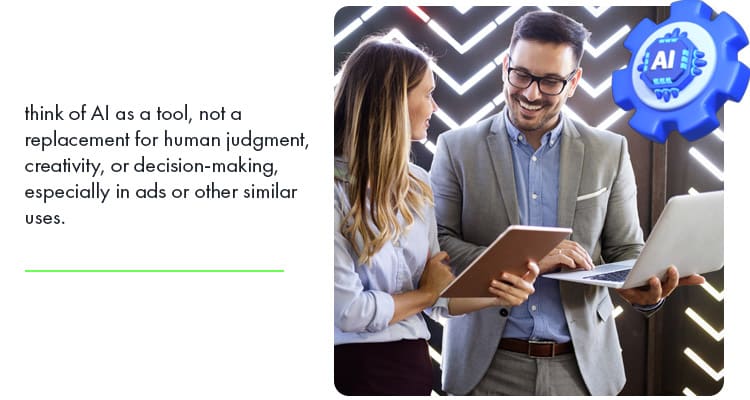
    In other words, think of AI as a tool. As such, it’s not a replacement for human judgment, creativity, or decision-making, especially in ads or other similar uses.

    Conclusion

    As AI tools improve, countries are updating their laws to keep up, just like Denmark. Other places, like Australia, may soon do the same.

    Australian businesses shouldn’t wait for lawsuits or penalties to create or implement rules for AI abuse. Instead, it’s best to stay informed, train your teams, and set internal guidelines to ensure your AI use meets both legal and ethical standards.

    Whether you’re creating ads, social media content, or product designs, always ensure your AI-generated content doesn’t use people’s faces, voices, or bodies without clear consent. Otherwise, careless or illegal use could lead to public backlash, loss of trust, or even legal trouble.

    After all, Denmark’s copyright law is just the beginning.

  • Top Free Invoicing Software for Australian Businesses (2025)

    Top Free Invoicing Software for Australian Businesses (2025)

    Australian businesses have access to several excellent free online invoicing software for small businesses in 2026. These solutions are designed for freelancers, startups, and established companies, offering features tailored to local compliance and business needs.

    Zeller logo, representing some of the best free invoicing software for Australian businesses.

    1. Zeller Invoices

    • Costs nothing to create and send unlimited invoices. Zeller allows you to generate professional invoices without any usage limits, making it perfect for small businesses that issue a high volume of invoices each month.
    • Mobile-first design for managing invoices on the go. The app is optimised for smartphones and tablets, enabling business owners and contractors to send invoices immediately after each job is completed, no matter where they are.
    • Compliant with Australian tax and GST requirements. Templates automatically include necessary GST fields and calculations, making sure every invoice you send meets local tax regulations.
    • No cost for basic invoicing; only pay a small fee if customers pay by card. You can use all core invoicing features for free. A transaction fee is applied, but only when customers pay with a credit card.
    • Suitable for freelancers, retailers, and service providers. Whether you’re providing bookkeeping services for small businesses or running a mobile retail operation, Zeller’s flexibility and simplicity would prove useful to many industries.

    ProfitBooks logo as one of the best free invoicing software in House.

    2. ProfitBooks

    • Intuitive interface designed for Australian businesses. The ProfitBooks dashboard is clean and intuitive, which means even users without an accounting background can navigate it with ease.
    • Create and send professional invoices quickly. You can generate polished, branded invoices in under a minute—a valuable feature for busy professionals juggling multiple client relationships.
    • Accept payments online (credit/debit cards, netbanking, e-wallets). Offering multiple payment channels improves your cash flow and gives customers more convenience at checkout.
    • Free plan available for small businesses and freelancers. Particularly useful for Xero bookkeepers for accountants and agencies who need a fast, lightweight billing solution for subcontracted work.

    One of the best free invoicing software for Australian businesses, represented by the Square logo.

    3. Square Invoices

    • Free for creating, sending, and managing invoices. All standard features, including reminders and status tracking, are included in the free plan—no trial period or strings attached.
    • Cloud-based with mobile access. Get instant updates on when an invoice is viewed, paid, or overdue, even while you’re managing virtual assessments or working remotely.
    • Integrates with Square’s POS and payment systems. Perfect for retail and hospitality businesses that already use Square terminals. All transactions sync automatically between sales and invoicing.

    Zoho logo, the brand is considered as among the best free invoicing software for Australian businesses.

    4. Zoho Invoice

    • Fully cloud-based and completely free. There are no surprise charges or limits on usage, even for advanced features like time tracking and expense logging.
    • Customisable templates that support email, WhatsApp, PDF, or iMessage delivery. Reach your clients through the channel they prefer, which improves communication and speeds up approvals and payments.
    • Real-time sync across devices. Your data is always up-to-date, whether you’re at your desktop, tablet, or phone—essential for business owners managing a team of personal assistants or freelancers.
    • GST-compliant with built-in automation features. Automates tax fields and calculations to reduce manual entry errors and maintain ATO compliance.
    • Part of a wider ecosystem. If your business grows, Zoho integrates easily with its other apps, such as Zoho Books, offering a seamless upgrade path for bookkeeping services for small businesses.

    The Invoicely logo, which represents some of the best free invoicing software for Australian businesses.

    5. Invoicely

    • Free invoicing tool with advanced features like recurring billing. You can automate recurring client payments, which is particularly helpful for subscription models or ongoing services like monthly virtual assessments.
    • Custom branding, tax/shipping discounts, and expense tracking. Personalise invoices with your company logo, offer discounts, and log associated expenses to keep finances in check.
    • Allows small business owners to manage reports and workflow in one place. View financial summaries, unpaid balances, and customer insights without separate tools or spreadsheets.
    • Scales well with growing businesses. Even though it’s free, Invoicely supports growth by offering upgrades for multi-user access and enhanced reporting, ideal for small teams or Xero bookkeepers for accountants managing several accounts.

    Among the best free invoicing software for Australian business, as shown by the Bildu logo.

    6. Billdu

    • Clean, fast invoice creation tailored for Australian businesses. A user-friendly layout helps you generate invoices within seconds, saving time during busy workdays.
    • Automatically calculates tax and supports multi-currency options. Whether you’re billing locally or internationally, it automatically factors in complex tax rules and currency conversion.
    • GST-ready and ATO compliant. Invoices come pre-formatted to meet Australian standards, reducing the risk of compliance errors.
    • Mobile app and desktop flexibility. You can start generating an invoice from your smartphone and finish it on your desktop computer, perfect for teams offering mobile bookkeeping services for small businesses.
    • Supports quick quotes and delivery notes. Ideal for professionals who need to send quotes ahead of invoices or attach delivery confirmations.

    Freeinvoice Builder representation, with the brand included in a few of the best invoicing software for Australian businesses.

    7. Freeinvoicebuilder.com

    • Australia-specific invoice templates for GST compliance. Templates are preloaded with ABN, GST, and invoice number fields—which you can all edit to suit your needs.
    • Built-in fields for mandatory invoice information and GST calculation. Takes care of line-by-line tax logic so you can bill with accuracy and confidence.
    • No registration required — generate invoices instantly. Great for freelancers, side hustlers, and personal assistants who need to bill quickly without creating an account.
    • Lightweight but effective. While it lacks some automation, this tool is excellent for one-off jobs or those just starting their business journey.

    Comparison Table: Key Features

    Software
    Free Plan
    GST/ATO Compliance
    Mobile App
    Online Payments
    Customization
    Invoice Limits
    Zeller Invoices
    Yes
    Yes
    Yes
    Yes
    Yes
    Unlimited
    ProfitBooks
    Yes
    Yes
    Yes
    Yes
    Yes
    Unlimited
    Square Invoices
    Yes
    Yes
    Yes
    Yes
    Yes
    Unlimited
    Zoho Invoice
    Yes
    Yes
    Yes
    Yes
    Yes
    Unlimited
    Invoicely
    Yes
    Yes
    Yes
    Yes
    Yes
    Unlimited (free tier)
    Billdu
    Yes
    Yes
    Yes
    Yes
    Yes
    Unlimited
    Freeinvoicebuilder
    Yes
    Yes
    Web only
    No
    Limited
    Unlimited

    Why Free Invoicing Software is Essential for Australian SMEs

    Running a small business in Australia comes with enough overhead costs.

    That’s why many SMEs, startups, and solo operators are turning to free invoice software to streamline their operations – without breaking the bank.

    Cost Efficiency for Small Businesses

    For businesses just starting out or operating on tight margins, even small monthly fees for software can add up. Free invoicing platforms help preserve cash flow without sacrificing professionalism or functionality.

    Built-in GST Compliance

    Invoicing software made for Australian users often includes automatic GST calculations, ABN fields, and ATO-compliant templates, which are crucial for avoiding costly tax errors.


    [rcb_show_form]

    Common Limitations of Free Invoicing Tools

    While free tools offer a great starting point, they come with trade-offs. Understanding these limitations helps you plan for upgrades as your business grows:

    • Limited support or customer service. Most free tiers don’t include live support or guaranteed response times.
    • May include branding on invoices. Some free tools place their logo on your invoices.
    • Payment fees still apply. Even when invoicing is free, platforms often charge transaction costs.

    When Should You Switch to Paid Invoicing Software?

    Consider switching when:

    • You need advanced features. Teams requiring project tracking or recurring billing often need premium tools.
    • You require integrations. As your tech stack grows, you’ll want tools that connect to your CRM or payroll.
    • You manage a team. Multi-user access is typically a paid feature.

    Related Read: Growing a business in Australia? Here’s Why You Need a Bookkeeper.

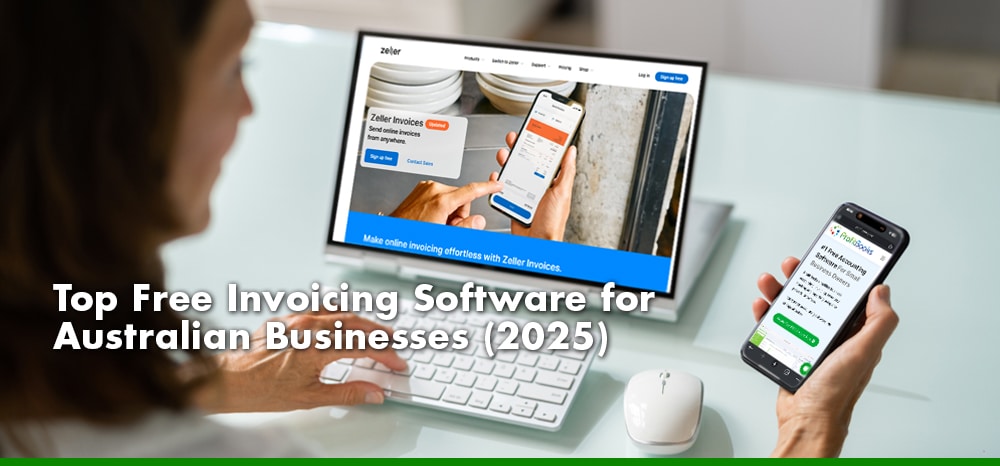
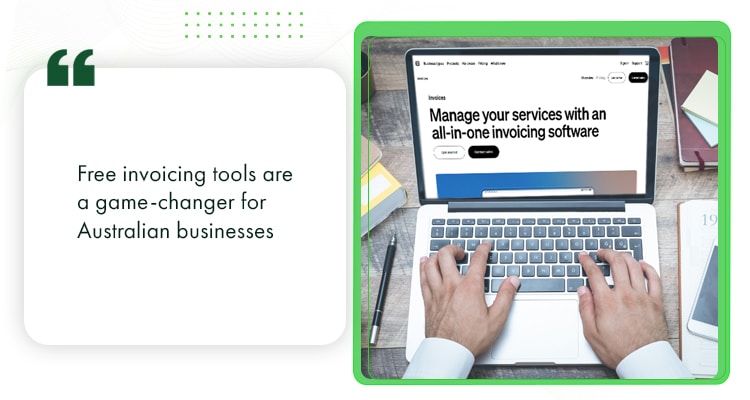
    A person using a laptop, showing on-screen text about invoicing software for Australian SMEs.

    Final Thoughts

    Free invoicing tools are a game-changer for Australian businesses, offering professional-grade features without the overhead.

    Ready for the upgrade, along with the specialist to help maintain your paid or free invoice apps? Learn how you can Calculate Outsouring Cost in Australia, and let’s find you the right software specialist. Call us or Request a Callback.

  • The Small Business Owner’s Guide to Work-Life Balance

    The Small Business Owner’s Guide to Work-Life Balance

    As a small business owner, you’ve likely worn every hat—manager, marketer, customer service rep, and late-night bookkeeper. But here’s something most entrepreneurs don’t realise: the success of your business is directly tied to your well-being.

    According to the New York Enterprise Report, 58% of business owners say they work more than 50 hours a week, and most of them experience stress and burnout symptoms.

    That’s not just exhausting—it’s unsustainable. Achieving a healthy work-life balance isn’t about working less—it’s about working smarter by building systems that support both your business goals and your personal well-being.

    That starts with better time management, clear boundaries, and reliable support. You can start by hiring a virtual assistant—a flexible, cost-effective solution that offers great time management and organisation of time-consuming tasks like scheduling.

    With the right help in place, achieving equilibrium becomes not just possible, but sustainable.

    Why Work-Life Balance Matters More Than Ever for Australian Entrepreneurs

    Running a small business in Australia can be freeing—but it also comes with a lot of pressure. Long hours, blurred boundaries, and the weight of accomplishing multiple roles can slowly affect your health, relationships, and clarity.

    A healthy work-life balance nowadays is essential. Without it, even the most passionate business owners risk burning out and losing the very drive that made their venture successful.

    In today’s business landscape, maintaining personal and professional balance is more critical than ever.

    When you look after yourself, your business tends to flourish. Here’s why:

    • Burnout is one of the top threats to sustainable business practices.
    • Poor work-life balance leads to lower productivity and disengagement.
    • Strong work-life boundaries boost creativity, clarity, and decision-making.
    • Well-being for entrepreneurs directly impacts business outcomes and longevity.

    Signs You’re Out of Balance (and What It’s Costing You)

    Sometimes, the signs of imbalance creep in slowly—until you’re too overwhelmed to function properly.

    Ignoring the signals not only affects your health but can also impact team morale, customer service, and overall performance.

    Recognising the red flags is the first step toward burnout prevention and better small business stress management.

    Here are some signs to watch for:

    • Constant exhaustion, even after a full night’s sleep.
    • Missing or delaying important business and personal commitments.
    • Neglecting relationships or hobbies outside of work.
    • Feeling irritable, unmotivated, or disconnected from your goals.
    • Difficulty concentrating, making decisions, or finding inspiration.

    Work-Life Balance Strategies that Actually Work

    If you want to achieve a healthy work-life balance, what you need are actionable strategies that help you regain control and create a better rhythm.

    The goal? Establishing equilibrium between ambition and rest, business and wellness.

    You don’t have to do everything alone either. A few smart shifts, supported by the right tools and people, can change everything.

    Set Business Hours – and Actually Stick to Them

    Define clear work hours and communicate them to your team and clients. This sets boundaries, reduces interruptions, and protects your personal time.

    It also helps you stay more focused and present during work hours.

    Use Tools to Automate Low-Value Tasks

    Automating repetitive tasks saves time and mental energy. Tools like automated invoicing or calendar reminders can free up space for higher-value work.

    This supports mindful productivity and reduces decision fatigue.

    Prioritise Self-Care and Block Personal Time Like You Do Meetings

    Your calendar shouldn’t only include deadlines—it should also include downtime. Treat rest, exercise, and personal commitments as non-negotiables.

    Health and business balance go hand in hand.

    Set Boundaries with Clients and Customers

    It’s okay to say no to after-hours calls or last-minute changes. Clear boundaries by helping clients respect your time and keeping relationships professional.

    Strong boundaries are a cornerstone of long-term work-life balance.

    Time to Delegate: How Virtual Assistants Can Help

    If your to-do list keeps growing even as you accomplish more things, it’s time to delegate.

    Handing off repetitive or time-consuming tasks doesn’t just lighten your load—it gives you space to focus on what really matters.

    Time to Delegate How Virtual Assistants Can HelpVirtual assistants can be a game-changer for your business if you want to regain control over your schedule. With the right VAs, you get more than just administrative support—you gain a trusted partner who helps you work smarter, not harder.

    Administrative Support that Saves You Hours

    From managing spreadsheets to document handling, a virtual assistant can take on the admin load that eats up time.

    This means fewer distractions and more energy for growing your business.

    Great Time Management and Organisation Skills

    Skilled VAs bring structure to your day, helping you prioritise and stay on track.

    Their availability to manage deadlines, calendars, and workflow supports smoother operations and more breathing room.

    Handling Scheduling, Emails, and Client Comms

    Need someone to handle scheduling, reply to emails, or coordinate with clients? A VA with excellent communication skills can manage it all, so you don’t have to be glued to your inbox 24/7.

    How to Choose the Right VA for Your Business

    Look for a virtual assistant who understands your industry, communicates clearly, and aligns with your values.

    Whether you need help with admin, communication, or planning, finding the right fit is key to building trust and long-term success.

    Productivity Tools and Apps That Help You Reclaim Time

    If you want to make better use of your time, smart tools can make a difference.

    The right digital apps support mindful productivity, streamline workflows, and help you get hours back every week.

    Whether you’re automating admin, managing projects, or setting boundaries with tech, these tools are essential for achieving equilibrium.

    Here are some productivity tools that support a healthy work-life balance and effective time management for business owners:

    • Trello/Asana. Visual project boards that make task tracking and time management easier.
    • Calendly. Simplifies client bookings and lets a virtual assistant help handle scheduling without endless email threads.
    • Xero. An Australian accounting platform that automates invoicing, payroll, and BAS (Business Activity Statement) reporting.
    • Zapier. Connects your apps to automate repetitive workflows like follow-ups or form submissions.
    • Notion. All-in-one hub for notes, SOPs, team wikis, and planning—great for small business documentation.
    • Slack. Keeps workplace communication quick and centralised, especially with hybrid or remote teams.
    • Headspace. Promotes mindfulness and focus for better mental health.

    Use these tools on their own or alongside a capable VA to clear your plate and make more room for what matters most.

    Success Stories: How Aussie Business Owners Rebalanced Their Lives

    A healthy work-life balance might feel like a dream—but plenty of Australian entrepreneurs are living proof that it’s achievable.

    Whether they’ve embraced sustainable business practices, delegated smarter, or purposely designed their routines, these success stories provide a blueprint for balancing business with wellness:

    FAQ: Managing Business and Life as an Aussie Entrepreneur

    Running a business in Australia comes with both freedom and pressure. Balancing productivity with personal time can feel impossible—but the key is to be proactive.

    Below are quick answers to help you navigate the realities of small business stress management and personal and professional balance.

    How can I tell if my work-life balance is genuinely off?

    If you constantly feel exhausted, disconnected from loved ones, or can’t remember the last time you relaxed without guilt—it’s time to reassess.

    These are clear signs that your health and business balance need attention.

    What are the most common reasons business owners burn out?

    Over-committing, lack of support, poor boundaries, and skipping rest are major causes.

    Many try to do everything alone and ignore the cost of chronic stress, leading to long-term issues with managing stress in business.

    How do I know if it’s time to hire a VA?

    If admin tasks are eating up your focus, you’re missing emails, or working late just to keep up, a good virtual assistant can lighten your load and give you room to grow (and rest).

    Build a Business That Doesn’t Burn You Out

    You didn’t start a business to feel trapped. Yet so many business owners live in survival mode—burning out while chasing success. That’s not sustainable, and it’s not the only way.

    A healthy work-life balance isn’t just about reducing hours—it’s about aligning your work with your values, energy, and vision.

    Build a Business That Doesn’t Burn You OutIt’s about building systems, setting boundaries, and asking for help when you need to. Whether it’s using automation, embracing work-life strategies, or hiring a VA with Remote Staff, the shift begins with a choice.


    And that’s to protect your personal time as fiercely as you protect your business.

    Challenge yourself today: What’s one task you can let go of, one hour you can reclaim, or one step you can take toward real balance? Your business will thrive once YOU do!

    • Want FREE AI Prompts for Different Areas of Your Business? Check out these 100 AI prompts.
    • Curious About How to REDUCE Overhead Costs? Learn more here.
    • If you’re ready to experience the full advantages of working with a top global team, check out our 1,000 fully vetted and highly talented staff here.

    [rcb_show_form]

  • Specialised Online Estimators in Australia: A Deep Dive with Wilson Petaluna

    Specialised Online Estimators in Australia: A Deep Dive with Wilson Petaluna

    Remote work was once limited to finance and IT jobs, but today, opportunities have expanded—even into the construction industry, which typically involves onsite work. Over the past decade, remote estimators have joined architects, civil engineers, and construction workers in building structures around the world.

    One of them is Filipino engineer Wilson Petaluna.

    Meet Wilson Petaluna: A Remote Estimator’s Journey

    Wilson Petaluna knows what it takes to be an estimator in Australia—while working remotely from the Philippines.

    Before becoming a remote estimator, Wilson earned a degree in civil engineering. Like many fresh graduates, he began as a project engineer, working on various building projects in the Philippines.

    He later moved to the United Arab Emirates (UAE), where he worked as a quantity surveyor, managing cost estimates involving different trades, such as:

    • Architectural
    • Structural
    • Electrical
    • Plumbing
    • Mechanical

    Eventually, he returned to the Philippines, but his work with international companies is far from over. He now specializes in roofing estimation for an Australian company, continuing to share his expertise from home. And he is not the only one.

    Like Wilson

    Like Wilson, thousands of Filipino professionals in the Philippines are delivering their world-class skills to clients worldwide, particularly in the field of remote estimation.

    What Does an Estimator Do?

    An online estimator acts as a financial forecaster, bringing blueprints and technical documents to life by providing accurate cost projections.

    Their key responsibilities include:

    • Project Analysis – Estimators check the project specifications which outline quality standards, installation methods, and specific products, allowing them to understand project requirements.
    • Research and Pricing – They research and gather quotes for materials, labor rates, equipment costs, and subcontractor bids. They also stay updated on market trends and price fluctuations.
    • Bid and Proposals – Estimators also compile all relevant information to create a comprehensive bid that outlines estimated costs, total project cost, and timelines.
    • Risk Assessment – They identify and assess potential risks that could impact project costs, such as material price increases, labor shortages, or unforeseen site conditions.
    • Procurement Support – In some cases, estimators can help the procurement team negotiate prices with suppliers and subcontractors.

    For instance, Wilson specialises in roofing estimation, providing initial costings based on the roof’s dimensions, slope, type, and features like skylights, vents, or chimneys.

    With 10 years of experience in the Philippines and abroad, he understands the labor needed for various roofing tasks. His engineering background also allows him to suggest cost-saving materials or methods without compromising their quality or results.

    Quantity Surveyor vs. Estimator vs. Cost Engineer: What’s the Difference?

    Wilson began his career as an engineer, then worked as a quantity surveyor, and now works as an estimator. While each role requires different skills, they also share some similarities. Let’s take a closer look:

    Estimator

    Estimators like Wilson focus on construction cost estimation for a specific trade, such as electrical, painting, or roofing. Because they specialise in one area, they can give a highly accurate assessment of the resources needed.

    Estimator

    Using project drawings and specifications, they calculate quantities and costs, especially during the pre-construction phase. Their work is key to the construction bidding process, as accurate and competitive estimates help contractors prepare proposals for clients.

    Once the bid is submitted and the project is awarded, they usually step back from daily construction activities, unless clarifications or assistance are needed.

    Quantity Surveyor

    Before becoming an online estimator for AU clients, Wilson worked as a quantity surveyor in the UAE, where he managed all aspects of a project, not just roofing.

    Unlike estimators who focus on pre-construction, quantity surveyors (QS) handle costs from the start of the project through to its completion, including:

    • Preparing initial cost estimates;
    • Managing budgets and expenses during construction;
    • Handling contract administration;
    • Assessing variations and changes in scope;
    • Ensuring value for money throughout the project; and
    • Preparing final accounts after project completion.

    Cost Engineer

    Meanwhile, cost engineers make sure the project stays within the approved budget. Their responsibilities include:

    • Tracking actual costs against the planned budget;
    • Analysing any deviations or variances; and
    • Monitoring labor costs, material expenses, and equipment use.

    Consequently, they keep detailed financial records throughout the project to track all costs, changes, and approvals.

    After the project ends, they assist with final cost conciliation, review the project’s financial performance, and identify areas to improve future projects.

    [aslcandidates id=’2000005′ subcat_id=’2000206′]

    Unique Features of Australian Online Estimation

    Unlike the UAE, which prefers quantity surveyors to handle all aspects, Australia prefers estimators to focus on one trade.

    In other words, an estimator has the option to specialize in roofing, concrete, carpentry, or other areas of construction. This singular focus allows them to:

    • Develop deeper expertise in their chosen trade;
    • Produce more accurate and detailed estimates;
    • Work more efficiently with trade-specific teams;
    • Stay updated on the latest materials, costs, and techniques in that area; and
    • Reduce errors by narrowing the scope of responsibility.

    Specialisation helps estimators follow the Australian building code and standards more closely. This matters because the rules are detailed, often vary by state, and can be very specific.

    Specialisation helps estimators

    Thus, online estimators must deeply understand the relevant codes to ensure all calculations and material choices comply. In other words, it’s not just about meeting legal requirements—it’s also about ensuring structural integrity, safety, and long-term durability.

    Key Differences in Estimation Between the Philippines and Australia

    As a Filipino estimator working for an Australian company, Wilson shared the following differences between estimators working in the Philippines and those for AU clients:

    • Philippines
      • Estimators in the Philippines are generalists who often manage several trades at once.
      • They also use different materials and methods, like hollow blocks, which are common in the Philippines.
      • Generalists have less specialisation because they need to handle many different trades.
    • Australia
      • They must follow strict Australian building codes and standards.
      • Australia requires estimators to be highly specialised, with one estimator typically assigned to each trade.
      • They are also very specific about materials and brands, so alignment with local standards is crucial.

    Like Wilson, many Filipino estimators start as generalists and later specialise in one trade. Most are civil engineering graduates, but some electrical and mechanical engineers can also occupy these roles, as long as they have:

    • The ability to read and interpret construction drawings;
    • Familiarity with estimation software;
    • Attention to detail and willingness to learn; and
    • Good communication and collaboration skills.

    Tools of the Trade: Essential Estimation Software

    Besides having the right skills, a good estimator also needs to use the right tools, such as estimation software and project management or tracking tools.

    Here are some examples:

    • PlanSwift – Online estimators use PlanSwift as their main tool for takeoffs and measuring quantities. Its easy-to-use, visual point-and-click interface lets estimators quickly measure lengths, areas, volumes, and counts directly from digital plans.
    • Bluebeam – Estimators who want more features use Bluebeam because it is stronger but more complex than PlanSwift. Besides takeoffs, it helps with managing documents, adding notes, and working together. It can also edit drawings, customize notes, and support real-time teamwork on construction files.
    • Cubit and Estimate One – Cubit is known for its “natural estimating” method, while EstimateOne mainly helps with tendering. So, use Cubit if you need to manage many price lists and cost codes. Use EstimateOne if you want to connect builders with subcontractors and suppliers and make sharing documents easier.
    • Workflow Max and Buildlogic – Modern estimation also needs project management tools like Workflow Max and Buildlogic.

    Workflow Max handles job management, quoting, and invoicing. Buildlogic offers a complete construction management system, with features for estimating, progress claims, contracts, and financial integration.

    The Remote Estimation Workflow

    It can be hard to imagine how Philippine-based estimators like Wilson manage to provide estimates for roofing projects all the way in Australia.

    Let’s dive deeper into how it works:

    • Receive Project Invitations – The estimator gets project invitations by email or from bidding websites like EstimateOne, iBuildnew, or other tender portals.
    • Download and Review Drawings – After getting the invitation, the estimator downloads the full set of project drawings, specifications, and other important architectural or engineering documents.
    • Use Estimation Software – Next, the estimator does the main part of remote estimation: measuring quantities accurately from digital drawings using special software.
    • Prepare and Submit Proposals – Once the takeoffs and calculations are complete, the estimator submits the final proposal to the client or manager. It includes all the key details like the scope of work, material quantities, labor costs, and the total bid price.
    • Coordinate with Suppliers – They also reach out to various suppliers to get competitive quotes and select quality materials that stay within or under budget.
    • Attend Meetings – Remote estimators also join regular meetings to clarify the scope, discuss complex details, review progress, and handle any unexpected issues.
    • Update Costings – Construction projects can change, sometimes needing revisions or addendums after the initial drawings. Estimators must make sure the final bid is accurate, up to date, and includes all changes to the project scope, materials, or timelines.

    Hiring Criteria for Estimators in Australia

    So, how do you find skilled estimators like Wilson? You can start by looking at the following:

    • Strong Technical Skills – They should know how to use digital tools like PlanSwift, Bluebeam, and Cubit. A good estimator can work with these programs to take accurate measurements and apply the right settings to calculate quantities quickly and correctly.
    • Ability to Read and Understand Construction Plans – Engineers like Wilson make good estimators because they understand architectural, structural, and MEP (mechanical, electrical, and plumbing) drawings. Without this basic knowledge, they won’t be able to make heads or tails of the software’s results.
    • Good Work Attitude – Soft skills like a positive attitude, willingness to learn, attention to detail, resilience, and a proactive mindset are also valuable. Estimators must be open to feedback and constructive criticism.
    • Relevant Experience – It’s best to hire professional estimators like Wilson, who have hands-on experience in an engineering firm or architectural practice. This kind of background helps them understand how materials and labour add up, resulting in more accurate and realistic bids.

    Experienced estimators with over 3 years of experience and knowledge of Australian brands, materials, and codes typically earn around PHP 50,000–60,000 per month.

    Challenges and Adaptations

    Transitioning from a generalist to a specialised estimator isn’t easy.

    However, like Wilson, many Filipino engineers and estimators have successfully moved from a broad understanding to detailed, expert knowledge of specific construction fields.

    Challenges and Adaptations

    Here’s how they adapt:

    • Learning Local Building Codes – They study Australian building standards, especially the National Construction Code (NCC). Besides that, generalists also learn about preferred materials and construction methods in Australia.

    For example, while hollow blocks are commonly used for building structural foundations in the Philippines, Australian homes often use brick veneer or lightweight cladding systems.

    • Resourcefulness in Sourcing Prices – Remote Australian projects don’t always provide a full list of suppliers, which can be challenging. This requires a more proactive and investigative approach.

    Estimators must browse supplier websites, understand regional price differences, research common trade discounts, and make direct inquiries to find current market rates for specific materials and components.

    Ultimately, successful estimators like Wilson are independent and open to learning. They can work on their own, manage their workload well, and proactively solve minor issues without needing constant supervision.

    Communication and Collaboration

    As mentioned, remote estimators often work independently once they receive all the necessary documents. However, they still coordinate with senior estimators, project managers, and suppliers to ensure everything runs smoothly.

    Direct interaction with clients or builders is also common, especially when estimators need to clarify requirements or submit proposals. While initial contact might go through a central point, many remote estimators communicate directly with their Australian clients.

    This helps them immediately clarify:

    • Project specifications;
    • Design preferences; or
    • Specific client expectations.

    Cultural and Industry Insights

    The Australian construction industry values specialisation – and estimators must be experts in their field and follow all relevant codes to meet high standards.

    That’s why many Australian construction firms hire Filipino professionals like Wilson. In addition to their technical skills and engineering experience, Filipino estimators are known for their adaptability and wide range of abilities.

    Even if they focus on one trade, they can still review other areas like architectural, structural, or MEP. More importantly, they should be open to learning, especially when dealing with new materials or standards.

    Just like Wilson’s Australian client, you can also find skilled remote workers to support your estimation needs, whether it’s for roofing, carpentry, concrete, steel fixing, cladding, or waterproofing.

    So, call us today or request a call back now and get access to our top-notch estimators – Wilson is just one of many skilled professionals who are on hand and ready to help!

    [rcb_show_form]

  • Why Storytelling Helps You Sell: How to Craft a Compelling Brand Narrative for Your SMB

    Why Storytelling Helps You Sell: How to Craft a Compelling Brand Narrative for Your SMB

    Never underestimate the power of a story.

    A powerful story can change opinions, influence actions, and provide inspiration. If you’re running a business, it can also shape how your target audience engages with your products and services. Thus, every brand should have and own their story.

    But how is this done? How can you craft a compelling narrative that helps you stand out from your competitors?

    In this article, we’ll explore the power of storytelling in business and show you how to craft your own story in a simple yet impactful way.

    Read on to know more.

    Why Storytelling Matters for SMBs

    Every small and medium-sized business (SMB) knows how difficult it is to stand out

    While having quality products or competitive prices is necessary, it’s not enough – you still need to create a deeper connection with your customers to ensure their loyalty to your brand.

    This is where storytelling comes in.

    A well-crafted story goes beyond just a logo, product, or service. It reveals the people behind the business. Since people are naturally drawn to stories, they tend to appreciate brands that are transparent and genuine.

    Storytelling creates a shared experience, making customers feel connected to your brand’s story and, eventually, turning them into passionate advocates.

    So, how can you create a great story for your brand?

    How Storytelling can 10x Your Brand

    Stories create connections and if you do it right, it creates long-lasting impressions. Take a look at Donald Miller, author, public speaker, and business owner known for his marketing company, StoryBrand.

    Donald Miller’s Storytelling Principles

    Miller supports the notion that the customer is the hero of the story, and your brand’s role is to guide them.

    He also believes every hero has a problem, and it’s your brand’s goal to help them overcome it by offering a clear, simple plan.

    Next, create a clear call to action (CTA) that leads customers toward their goal. Highlight the consequences of failure and the rewards of success to motivate your audience to act.

    More importantly, Miller emphasises that clear messaging is crucial, as confused customers don’t make purchases.

    Miller’s Way of Storytelling

    If you’re running an accounting firm, don’t just say you can do bookkeeping and accounting services.

    Instead, here’s how you can incorporate Miller’s StoryBrand framework in your marketing campaigns:

    “You’re a talented graphic designer, but taxes and bookkeeping aren’t your thing. That’s where [your company] comes in.

    We get the financial challenges creatives face and will handle the stress so you can focus on what you love – designing!

    Book your FREE consultation today, and let us help you achieve financial freedom.”

    This approach helps attract creatives who feel overwhelmed by taxes, expenses, and bills. It also positions you as an empathetic guide, ready and willing to help them overcome their challenges.

    When done right, telling stories with your customers as heroes will have 10x more impact than simply listing your product or service features.

    Social Media Influencers/Storytellers

    Storytelling has become even more powerful with social media.

    Brandon Stanton, creator of “Humans of New York,” shares photos and short interviews of everyday people. It started in New York City but now includes stories from around the world. His powerful storytelling led to best-selling books, a huge following, and income from book sales and sponsored content.

    Jimmy Donaldson, also known as MrBeast, is another great storyteller. His YouTube videos feature challenges and giveaways, but he also shares powerful stories, like building 100 water wells in Africa to give clean water to 500,000 people.

    His personal journey, his team’s energy, and the emotional pull of his giveaways keep viewers hooked. As of writing, he has 388 million subscribers on YouTube and 67.7 million followers on Instagram.

    Understanding the Elements of a Powerful Brand Story

    A powerful brand narrative should not be a chronological account of your business’ history.

    Thus, don’t make the mistake of listing dates, names, and numbers just to explain how you started. Instead, focus on understanding the key elements of a powerful brand story and use them to tell yours:

    1. The Hero (Your Customer) vs. The Guide (Your Brand)

    Make your customer the main character of your brand story. Imagine them as someone facing a challenge, seeking a solution, and striving for a better outcome.

    Next, position your brand as the guide. Offer the tools, knowledge, and support to help your customer (the hero) overcome their challenges. Your goal is to empower them, making them feel in control of their journey, with you as their guide.

    The Hero (Your Customer) vs. The Guide (Your Brand)

    As a guide, show your expertise and empathy. Demonstrate that you understand their struggles and are committed to their success. Most importantly, remember: You are not the hero – the customer is.

    The guide exists to serve the hero. Your brand is there to help your customers.

    2. Crafting a Relatable Problem and Presenting Your Business as the Solution

    Once you identify the characters, define the problem. Focus on the hero’s pain points, making them relatable and specific, so your target audience can see themselves in the story.

    For example, if you offer car rental services, highlight the challenges of traveling without comfortable transportation in a new place. Show how crowded buses or trains can be, and how inconvenient it is to navigate a city without access to a car.

    Then, show how your service can help them. Focus on the benefits your business provides, rather than just the features.

    Instead of focusing on the car’s mileage, specs, or turbo engine, show how it lets them travel to different places quickly, without the stress of rushing to catch the next train. Help them imagine exploring a new city at their own pace, visiting tourist attractions without worrying about train schedules.

    When you approach it this way, choosing your business feels like the natural outcome of the story.

    3. Using Emotion to Create a Deep Brand Connection

    People may forget a product name, but they’ll remember a story.

    Emotions like joy, hope, empathy, or even anger are powerful motivators. That’s why many brands use storytelling to make customers laugh, cry, or feel angry. When done right, these stories create memorable experiences, leaving a lasting impression of the brand.

    So, if you’re running a brand campaign, be intentional with your narrative. Share stories that are relatable and memorable for your audience. Use vivid language, imagery, and sound to create a sensory experience and emotional connection.

    While facts like names, dates, or events are easily forgotten, customers will remember how an ad, poster, or online post made them feel.

    For it to work, you need to do it right. Share genuine stories, like your brand’s humble beginnings, behind-the-scenes struggles, or employees’ success stories. The key is authenticity. Be real and honest—otherwise, a simple internet search could disprove your narrative.

    Defining Your Brand’s Core Narrative

    Your small business marketing should align with your brand’s core narrative. What do you want to achieve? What’s the driving force behind your stories?

    In other words, your brand’s core narrative is the foundation for all other stories. It defines who you are, what your brand stands for, and why it exists.

    Identifying Your Mission, Vision, and Values

    Every business needs to understand its purpose. That’s why it’s important to craft your mission statement—your why. It defines your purpose and guides what you do every day.

    It should be concise, clear, and actionable.

    Identifying Your Mission, Vision, and ValuesFor example, Canva, an Australian online design and visual communication platform, states its mission “to empower everyone in the world to design anything and publish anywhere.”

    Based on this premise, the company grew into a 49 billion AUD business with over 220 million monthly active users creating more than 30 billion designs across 190 countries.

    How to Make Your Brand Story Authentic and Memorable

    Customers are no longer passive when it comes to brand stories; they can easily spot fake or made-up narratives.

    Fortunately, there are ways to make sure your brand story feels authentic, genuine, and unforgettable. Here’s how:

    • Be True to Your Roots. Share your genuine beginnings – focus on the challenges you’ve overcome and the motivations behind your success.

      People connect with realness. Show the people behind your brand – share stories of your employees, customers, and community.
    • Craft a Clear Story. Stories trigger emotions like joy, hope, empathy, or nostalgia. Use these powerful feelings to shape your narrative.

      Also, structure your story with a clear beginning, middle, and end, and bring it to life with vivid language, imagery, and sensory details.
    • Know Your Audience. Understand your target audience’s values, needs, and aspirations.

      Ask customers for their feedback on your brand and use this insight to shape your narrative. Then, customise your stories to connect with them on a deeper level.
    • Focus on Your “Why”. Clearly define your mission and purpose.

      What is your business aiming to achieve? Why does your business exist beyond just making a profit? What impact do you want to have?

    Choosing the Right Platforms for Your Brand Story

    Once you have a compelling narrative, it’s time to choose the right platform. Here are a few options:

    1. Websites and Blogs

    Every company needs a website for authenticity and credibility. It serves as your brand’s home base, offering a central hub for your story. Through your website, you can provide detailed information and have full control over your brand’s narrative and messaging.

    Meanwhile, blog posts are essential for in-depth storytelling. You can write engaging stories paired with relevant images to attract more attention. When done right, long-form blog posts help establish credibility and build trust.

    For instance, you can also share customer success stories, behind-the-scenes glimpses, and thought leadership articles to further engage your audience and build a stronger connection.

    2. Social Media

    If you prefer short-form content, social media platforms are the way to go. Facebook, Instagram, and X (formerly Twitter), are perfect for bite-sized stories, enabling quick communication and relationship building.

    For example, you can share snippets of your brand story through images, videos, and posts. You can also offer your audience a glimpse into your daily operations or company culture.

    With the help of a social media virtual assistantWith the help of a social media virtual assistant or a virtual social media planner, some companies even let their audiences share their own stories and experiences with the brand through polls, quizzes, and contests. In fact, you can also host live Q&A sessions, product demonstrations, and behind-the-scenes tours.

    This strategy is effective because social networking sites reach a wide audience in a short amount of time. It also provides real-time updates when someone leaves a comment, interacts with your post, or shares your updates.

    3. Video Storytelling

    Customers now prefer short-form content, with 15- and 30-second videos dominating social media and becoming the top choice for advertising.

    Video storytelling is powerful because it taps into emotions more effectively than text or images. They are also highly shareable, with online users more likely to share them than other content types.

    Additionally, people tend to retain information better when it’s presented in video format, especially when simplifying concepts or showcasing product features, compared to just using text or images.

    More importantly, videos highlight the human side of your brand by sharing its origin, mission, and values. By featuring your staff, customers, or target audience, you create a relatable and memorable connection with viewers.

    The Role of a Social Media Virtual Assistant in Storytelling

    Creating brand stories is a journey that involves research, brainstorming, and experimentation. The good news is, you don’t have to do it alone.

    How a Social Media Virtual Assistant Helps Craft Brand Narratives

    Writing stories often requires the expertise of a remote content creator or writer.

    However, you also need a social media virtual assistant (VA) to develop a content calendar that aligns with the brand’s narrative.

    They can also help with:

    • Creating engaging micro-stories, captions, and visuals;
    • Adapting the brand’s story for different platforms;
    • Tracking metrics like engagement, reach, and followers;
    • Offering insights to optimise content;
    • Managing multiple accounts;
    • Staying updated on trends and algorithm changes; and
    • Scheduling posts.

    Tools and Techniques Used by Remote Content Creators

    To accomplish all of these tasks, a social media VA and a remote content creator use various tools to improve business storytelling techniques.

    For instance, here are some common apps and software used for content creation and design:

    • Graphic Design Tools
      • Canva
      • Adobe Creative Suite (Photoshop, Illustrator, InDesign)
      • Figma
    • Video Editing Apps and Software
      • CapCut
      • InShot
      • Adobe Premiere Pro
      • DaVinci Resolve
      • OBS Studio
      • Loom
    • Image and Video Resources
      • Unsplash
      • Pexels
      • Pixabay
      • Adobe Stock
      • Shutterstock
    • Audio Editing
      • Adobe Edition
      • Audacity

    Meanwhile, social media management and monitoring are easier with the help of:

    • Social Media Scheduling Tools
      • Hootsuite
      • Buffer
      • Later
    • Social Listening Tools
      • Sprout Social
      • Mention
    • Analytics and Reporting
      • Google Analytics
      • Facebook Insights
      • Twitter/X Analytics
      • Instagram Analytics

    Building an Online Community Around Your Brand Story

    Creating engaging stories is not enough; you also need to share them with the right audience. This is where an online community manager comes in.

    The Role of an Online Community Manager

    An online community manager is the main storyteller in your brand’s online community. They handle community building, content curation, engagement and moderation, and community advocacy.

    Here’s what they do:

    • Attract and identify your target audience;
    • Share engaging, relevant content;
    • Encourage user-generated content (UGC);
    • Respond to comments, messages, and questions;
    • Resolve conflicts and issues;
    • Identify brand advocates;
    • Gather community feedback and insights;
    • Track metrics like engagement and growth;
    • Monitor community trends; and
    • Organise online or offline events to connect the community.

    Creating Interactive Experiences Through Storytelling

    Interactive storytelling turns passive listeners into active participants. For example, you can create polls to gather insights or offer content that encourages participation.

    Creating Interactive Experiences Through Storytelling

    Some brands feature UGC on their websites or social media, encouraging customers to share their stories and experiences with the brand.

    Live Q&A sessions and webinars, on the other hand, allow your audience to interact with your team and ask questions. These sessions offer a chance to share behind-the-scenes insights and expert knowledge, highlighting your products or services and how they’re made.

    The Power of Data-Driven Storytelling

    To be effective, a brand narrative must be supported by data. Brands should focus on data-driven storytelling, creating stories that resonate with the target audience based on real experiences and preferences.

    Here’s how:

    Using Analytics to Measure Storytelling Success

    You can check the effectiveness of your storytelling by looking at social media engagement metrics such as likes, shares, comments, saves, reach, impressions, and follower growth.

    You can also track your website’s page views, bounce rate, time on page, scroll depth, and click-through rates. For videos, check metrics like views, watch time, completion rate, shares, and comments.

    Some brands even use sentiment analysis or social listening to monitor online conversations about their products or services. This helps identify the overall sentiment toward the brand and its stories.

    A/B Testing Different Storytelling Formats

    Also known as split testing or bucket testing, A/B testing compares two versions of content to see which one resonates more with viewers.

    Here are different ways to do it:

    • Headline Testing – Try different blog titles to see which one gets the most clicks and engagement.
    • Video vs. Text – Test whether your audience prefers video or text-based stories.
    • Visual Testing – Compare different images, videos, or graphics to see which one appeals most to your audience.
    • Story Length Testing – Try long-form and short-form stories to see which ones keep the audience engaged.
    • Call-to-Action (CTA) Testing – Test different CTAs to see which ones lead to the most conversions.
    • Platform Testing – Check which platforms work best for different types of stories.

    Common Storytelling Mistakes to Avoid

    Telling stories is easy, but writing the right one can be challenging. It’s not just about knowing what to say, but also what not to say.

    Common Storytelling Mistakes to Avoid

    Thus, here are some storytelling mistakes you should avoid:

    1. Overcomplicating Your Brand Message

    It can be tempting to include everything, like too much information or technical terms, to cover all the details. However, this can cause you to lose focus on the core message.

    A good storyteller, however, conveys simple yet powerful messages.

    Instead of using jargon or complex language, use simple words that everyone can understand. Focus on the most important part of your story and deliver one clear, concise message.

    Lastly, keep it short. The shorter (and simpler) the story, the easier it is to remember.

    2. Being Too Sales-Driven Instead of Story-Driven

    Small businesses can also fall into the trap of focusing on product features rather than building an emotional connection.

    While this approach is understandable, it can backfire, leading to a brand narrative that feels inauthentic and lacks a genuine human connection.

    Instead, focus on the hero. Remember, your customers are the heroes of your story, not your brand. As such, offer valuable content that educates, entertains, or inspires your audience.

    FAQs on Brand Storytelling for SMBs

    Here are some frequently asked questions (FAQs) about brand storytelling.

    1. What Makes a Brand Story Compelling?

    A good brand narrative feels authentic and human. It acknowledges challenges and vulnerabilities, making the audience feel understood and connected to the brand.

    It also taps into emotions like joy, hope, empathy, and nostalgia. Additionally, it features relatable characters and speaks directly to the audience’s desires, pain points, and aspirations.

    As a result, it creates a sense of belonging, making customers feel like they’re part of a community.

    2. How Often Should I Update My Brand Story?

    There’s no one-size-fits-all approach to how often you should share your brand story. The key is to keep it relevant to your brand’s evolution.

    How Often Should I Update My Brand Story

    You should also consider the following factors:

    • Significant business growth or expansion into new markets;
    • Changes in your target audience’s demographics;
    • Evolving social trends and cultural shifts;
    • Refinement of your brand’s mission, vision, or values; or
    • Emerging technologies.

    However, even when there are no significant changes, it’s a good idea to schedule regular reviews, either annually or bi-annually, to ensure your story remains relevant and relatable.

    3. What Are the Best Free Tools for Storytelling on Social Media?

    The following tools can help you create compelling stories for social media:

    • Canva – Canva offers an easy-to-use interface with a large library of templates, images, and fonts ideal for social media posts, memorable logo and visuals.
    • Unsplash – This platform offers high-quality, royalty-free stock photos for your posters and other graphic needs.
    • CapCut – CapCut is a powerful mobile video editing app that lets you edit videos, add effects, text, and music for free.

    Conclusion: The Future of SMB Storytelling

    In today’s competitive market, storytelling isn’t just a marketing strategy for SMBs; it’s also a way to connect with your audience and grow your following.

    The Future of SMB Storytelling

    So, how do you develop powerful narratives for your brand?

    1. Start with a captivating hook to draw attention.
    2. Focus on authentic storytelling – with your customers at the center.
    3. Create narratives that are relevant and relatable.
    4. Make your customers laugh, feel hope, and empathise with your brand’s story.

    If you do all of this right, the sales will follow.

    For more information on how to tell the right stories with the help of a social media virtual assistant, call us today or request a callback now.

  • How SMBs Can Go Green and Save Money

    How SMBs Can Go Green and Save Money

    Going green isn’t just good for the planet—it’s a smart move for Australian SMBs looking to save money through sustainability and stay competitive.

    With over 51% of Australian consumers preferring sustainable businesses, adopting eco-friendly practices like energy efficiency, green technology, and sustainable supply chain can boost both your reputation and your profits.

    Rising market expectations and policy pressures make this shift more urgent, but the transition is more accessible than ever.

    With the shift to work-from-home setups, SMBs can reduce fuel use and resource consumption—lightening their environmental impact. With support from Australian online business assistance and Australia VA teams, going green has never been more achievable.

    Keep reading to discover how to build a profitable and sustainable business with practical, cost-saving strategies.

    Why Sustainability Matters for Australian SMBs

    Sustainability is no longer just the domain of large corporations with deep pockets.

    For small and medium-sized businesses in Australia, embracing sustainable business practices is now a vital part for staying relevant and profitable.

    From shifting consumer values to growing environmental regulations, the green wave is reshaping how businesses operate -and how customers are wielding their purchasing power.

    More importantly, this shift is about building a smarter, more resilient business. Integrating green initiatives for SMBs and following a clear business sustainability strategy can help reduce costs, attract loyal customers, and future-proof operations.

    So, what’s driving this change? Let’s look at the pressures and expectations shaping sustainability for SMBs today.

    Environmental Regulations and Consumer Expectations

    Governments and consumers are making it clear—sustainability isn’t optional anymore.

    Australian SMBs are feeling the push towards new policies and the pull from a market that increasingly values eco-conscious initiatives.

    Key factors influencing this shift include:

    • Stricter environmental regulations requiring businesses to report on emissions and adopt sustainable practices.
    • Rising consumer demand for eco-friendly practices and sustainable supply chains.
    • Incentives and rebates for adopting green energy solutions and renewable energy for small business.
    • Sustainability expectations from investors, stakeholders, and business partners.

    Green Branding, Trust, and Competitive Advantage

    Businesses that lead with eco-conscious branding build stronger customer trust and stand out in crowded markets.

    Showcasing your commitment to sustainability—whether through green business certification or transparent practices—can turn one-time buyers into brand advocates.

    That’s a clear win for both your brand and the environment.

    Pros and Cons of Going Green for SMBs

    While the benefits are compelling, the green transition can come with challenges. Here’s what to expect

    Pros:

    • Lower long-term costs through energy efficiency for small businesses
    • Improved customer loyalty and brand perception
    • Access to green grants, rebates, and certifications
    • Alignment with market trends and government initiatives

    Cons:

    • Initial setup costs for green technology for SMBs
    • Time and effort to retrain staff and adjust operations
    • Possible supply chain shift or sourcing changes

    Practical Green Strategies SMBs Can Implement Today

    The path to sustainability doesn’t have to be overwhelming. With a few strategic changes, SMBs can make a meaningful impact—both environmentally and financially.

    These cost-saving sustainability tips are simple to apply and easy to scale as your business grows.

    Reduce Energy Usage in Office and Remote Setups

    Switching to LED lighting, energy-efficient appliances, and smart power management tools can significantly cut down electricity use.

    Reduce Energy Usage in Office and Remote Setups

    In remote work setups, supporting employees with energy-saving tips and tools pays off, too.

    This approach aligns with energy efficiency for small businesses and supports an environmentally friendly business model.

    Eco-Friendly Packaging and Products

    Switch to biodegradable, recycled, or reusable packaging wherever possible.

    Sourcing sustainable products helps minimise waste and promotes your commitment to sustainable business practices.

    It’s a smart move that resonates with eco-conscious customers.

    Go Paperless with Digital Tools

    Using cloud-based systems, e-signatures, and online collaboration tools helps you ditch the paper trail.

    Not only do they reduce carbon footprint, but they also streamline the operations of professionals working from home, like Australian virtual executive assistants.

    Going digital is better for business and better for the planet.

    How Green Practices Lead to Cost Savings

    It has been a common perception that going green is too expensive for a small business. Well, think again.

    When implemented wisely, green initiatives for SMBs often lead to significant cost reductions.

    From cutting down on energy use to improving operational workflows, sustainable actions can directly affect your bottom line.

    Businesses that adopt eco-friendly practices don’t just help the environment—they also unlock long-term savings, efficiency, and even tax perks.

    In a nutshell, the right business sustainability strategy can turn seemingly small improvements into powerful, cost-cutting transformations:

    Lower Utility and Resource Bills

    Using green energy solutions and improving energy efficiency for small businesses can slash electricity, water, and gas bills.

    Smart lighting, efficient heating systems, and waste reduction go a long way in minimising recurring costs. Every kilowatt saved is a dollar earned.

    Tax Incentives and Government Support

    Many local and federal programs in Australia offer rebates, subsidies, or tax deductions to businesses investing in renewable energy for small businesses or sustainable upgrades.

    These financial supports make green improvements more accessible. Staying informed about available incentives is thus a smart step toward maximising savings and in turn, revenues.

    Boosting Efficiency with Australian Virtual Executive Assistants

    Working with Australian virtual executive assistants streamlines operations and cuts overheads.

    These professionals help businesses operate leaner while contributing to eco-friendly practices. Here’s how they support a green shift:

    • Eliminate the need for in-house admin staff and reduce commuting emissions
    • Manage digital documentation to support paperless processes
    • Assist in coordinating green business certification applications
    • Source suppliers for sustainable supply chains and packaging
    • Help track eco metrics and integrate them into your business sustainability strategy

    How to Involve Employees and Stakeholders in the Green Transition

    Sustainability isn’t a one-person job—it thrives when the whole team is on board.

    For SMBs, involving employees and stakeholders in the green journey can strengthen culture, boost engagement, and amplify your environmental efforts.

    Encouraging collaboration around sustainable business practices guarantees your initiatives are more than just policies—they become part of everyday decision-making.

    Building a Culture of Sustainability

    Sustainability must be strongly implemented into your business culture to make green habits a lasting practice. Therefore, clear communication, shared goals, and leading by example are vital.

    Practical ways to cultivate this are:

    • Start green workplace challenges or eco-reward programs
    • Offer training on eco-friendly practices and energy-saving tips
    • Include sustainability goals in performance reviews
    • Encourage team input on green solutions or suppliers
    • Celebrate wins—big or small—publicly and consistently to make a statement and encourage others to join you in your crusade for a greener planet

    Remote Sustainability – A New Workplace Model

    Remote work models naturally support sustainability by lowering emissions, office energy use, and daily waste.

    When supported by Australian remote personal assistants, your business can reduce overheads and your carbon footprint. It’s a win for flexibility AND the planet.

    Measuring Impact and Promoting Your Green Brand

    Once your green initiatives for SMBs are in motion, the next big step is measuring and sharing your impact. Data doesn’t just help you fine-tune your approach, it also strengthens your credibility.

    Whether you’re aiming to reduce your carbon footprint, improve energy efficiency, or gain green business certification, presenting documented results reveals the sincerity of your commitment.

    Measuring Impact and Promoting Your Green Brand

    Your progress can be seen if you’ve lessened your electricity and water bills, or saved more from your usual paper consumption.

    Promoting this progress through smart branding builds trust and opens new market opportunities.

    And with help from Australian online business assistance providers like Remote Staff, measuring and marketing your green wins becomes a lot more manageable.

    Track Your Environmental Footprint

    Knowing your numbers is key to long-term impact. Measure energy use, waste output, and emissions to evaluate and improve your sustainability efforts.

    Here’s how to start:

    • Use free online tools or carbon footprint calculators
    • Track utility usage and compare every month
    • Conduct regular internal audits with support from administrative reports
    • Use project management software to log green initiatives and outcomes

    Marketing Your Sustainability Ethos

    Telling your green story sets you apart. Customers connect with businesses that show transparency and purpose, and your sustainability journey is a powerful part of that narrative.

    You can show your efforts by:

    • Sharing achievements through blogs, email newsletters, and social media
    • Displaying green business certification and eco-labels clearly
    • Highlighting the use of eco-friendly practices in product packaging and signage
    • Promoting employee involvement and community partnerships
    • Creating an “Impact” page on your website outlining your business sustainability strategy

    Collaboration with Australian Online Business Assistance Platforms

    Partnering with Australian online business assistance providers makes it easier to stay on track and scale your green progress.

    Tapping into remote support also frees up your resources and time for strategic planning, specifically through:

    • Hiring remote professionals to research and apply for grants or certifications
    • Delegating admin tasks to virtual assistants to streamline paperless workflows
    • Getting help from freelancers to source sustainable suppliers
    • Leveraging insights from Australian online administrative services to document and report progress

    FAQ: Green Business and SMB Profitability

    Making your business more sustainable can feel overwhelming at first—but with the right information and support, it quickly becomes a smart, profitable move.

    Below are answers to common questions small business owners have when exploring the green path.

    What are some quick, low-cost ways to start going green?

    Switch to LED lights, go paperless using cloud tools, reduce unnecessary printing, and unplug unused devices.

    Work with freelance professionals to digitise admin and cut waste. Encourage employees to embrace eco-friendly practices from day one.

    Are there any financial incentives or rebates available in Australia for SMBs going green?

    Yes, various government programs offer incentives for installing renewable energy for small businesses, upgrading to energy-efficient equipment, or applying for green business certification.

    Many states also offer rebates tailored for SMBs. Platforms offering online business assistance can help you identify and apply for these.

    How can I measure the environmental impact of my business?

    Start by tracking energy usage, water consumption, and waste output. Use online carbon calculators, or hire remote support to conduct simple audits.

    Document progress regularly as part of your business sustainability strategy.

    A Greener Path is a Smarter Path

    The future of business in Australia is green—and SMBs are perfectly positioned to lead the charge.

    Whether it’s cutting costs, earning customer trust, or making a real difference for the planet, the case for sustainability has never been stronger.

    A Greener Path is a Smarter Path

    With partnership from outsourcing companies like Remote Staff, you have the right support to take action—without exhausting your resources.

    It’s time to act! Start small, think big, and commit to building an environmentally friendly business that saves money while shaping a better future.

    • Want FREE AI Prompts for Different Areas of Your Business? Check out these 100 AI prompts.
    • Curious About How to REDUCE Overhead Costs? Learn more here.
    • If you’re ready to experience the full advantages of working with a top global team, check out our 1,000 fully vetted and highly talented staff here.
  • Minimising Waste and Improving Estimating in the Australian Building Industry

    Minimising Waste and Improving Estimating in the Australian Building Industry

    The Australian building industry generates more waste than any other commercial sector. It’s responsible for over 27 million tonnes of waste each year.

    Yet many project managers, builders, and estimators don’t realise that a large portion of this waste is preventable. Moreover, this waste stems from poor building project cost estimation, last-minute material changes, and inefficient project planning.

    Minimising construction waste in Australia is now a strategic advantage, not just a regulatory requirement. Accurate cost estimating helps reduce waste and protect profit margins, yet many builders still rely on outdated, error-prone methods.

    Read on to learn more about how to modernise your approach with smarter estimating practices, strategic outsourcing, and cutting costs while boosting sustainability.

    Minimising Construction Waste in Australia

    Waste in the construction sector is a bottom-line issue. Builders and project managers can take this as an opportunity to: reduce waste AND costs, improve margins, and enhance your business’s sustainability credentials.

    Why Waste Minimisation Matters

    Australia’s construction industry generates millions of tonnes of waste that end up in landfills.

    It contributes to higher disposal costs and missed opportunities to reclaim materials, not to mention the disastrous environmental impact.

    In addition, excessive waste increases project costs through over-ordering, poor material handling, and site inefficiencies.

    Key Strategies for Reducing Waste

    To reduce construction waste in Australia, builders and project teams can adopt practical, proven strategies:

    • Reduce, Reuse, Recycle: Apply the 3Rs by cutting down on unnecessary materials, reusing formwork and offcuts, and recycling when possible.
    • Modular Construction and Design for Disassembly: Prefabricated components lead to less site waste and easier disassembly at end-of-life.
    • Use Recycled Materials. Integrate reclaimed steel, concrete, and timber into designs to cut costs and improve environmental impact.

    On-Site Waste Management Practices

    On-Site Waste Management Practices

    Implementing structured practices on-site like the following can significantly reduce and support sustainable outcomes:

    • Creating Waste Management Plans: Identify and track all expected waste outputs from the start of the project.
    • Installing Sorting and Recycling Stations: Set up easy-access points for separating materials like concrete, timber, and steel.
    • Partnering with Local Construction Waste Recycling Facilities in Australia: Collaborate with recycling centres that accept your project materials and offer cost-effective disposal methods.

    Training and Regulatory Compliance

    A major factor in successful construction waste minimisation in Australia is the right education. Equip your teams with the proper training on waste management procedures and material handling.

    Stay updated with Australian Standards and local council regulations to avoid fines and boost your site’s sustainability performance.

    Benefits of Minimising Waste

    Prioritising waste reduction can yield substantial returns:

    • Lower landfill and haulage costs
    • Stronger compliance with environmental legislation
    • Positive branding through sustainable practices
    • Reduced material purchasing and overordering

    Understanding Construction Estimating Methods

    Accurate estimates are the backbone of successful building projects.

    In Australia, where market volatility, labour shortages, and regulatory compliance add layers of complexity, nailing down your numbers early on can mean the difference between profit and loss.

    Thus, reliable construction estimating methods in Australia are essential for better budgeting, resource allocation, and client trust.

    Types of Estimating Techniques

    Types of Estimating Techniques

    There are several tried and tested estimating methods used across the industry. Each one fits a different project type or phase:

    • Square Metre Estimating. This approach can provide a quick estimation for early-stage budgeting. However, it’s not precise for complex or customised builds.
    • Parametric Estimating. It uses data-driven variables like cost per unit (e.g., per door or bathroom). This method also helps predict costs using historical data and real-time pricing.
    • Assemblies/Elemental Estimating. A technique that breaks down builds into systems like walls, roofing, or electrical needs. It is also ideal for modular builds and comparisons between design options.
    • Detailed Quantity Takeoff. This method has two approaches. The manual approach is time-consuming, but still often used for smaller jobs, while the digital one produces accurate and efficient estimation with the assistance of software.

    Tools of the Trade

    Technology has transformed how builders approach cost estimation. Even small operations can benefit from:

    • Professional Estimating Software. Tools like Buidxact, CostX, or Cubit provide real-time cost updates, visual takeoffs, and historical data integration.
    • Spreadsheets and Custom Templates. For smaller or simpler jobs, tailored Excel templates can help manage scopes, track expenses, and reduce manual errors.

    Best Practices in Estimating

    To stay competitive and compliant, Australian builders can follow these proven strategies:

    • Keep Data Up-to-Date. Market rates for materials and labour shift constantly—outdated input leads to underquoted jobs.
    • Add Contingencies. Build in buffers (typically 5 to 15%) for price increases or unforeseen site issues.
    • Learn from History. Consult and review past projects for realistic timelines, waste expectations, and pricing nuances.

    Common Estimating Mistakes Made by Builders

    Even experienced builders can fall into traps that inflate costs or destroy margins. Recognising and addressing these pitfalls early can protect your bottom line.

    Scope and Cost Misjudgment

    Lack of a clear project scope is one of the biggest culprits behind budget overruns.

    When the scope shifts mid-project or isn’t properly defined from the outset, estimating tends to rely on guesswork.

    Unverified takeoffs or third-party quotes also lead to under- or over-ordering materials, driving waste and labour costs up.

    Regulatory and Overlooked Costs

    Ignoring soft costs and hidden fees can be expensive. These often include:

    • Permit application fees
    • Environmental compliance charges
    • Local council levies or zoning-related adjustments

    Market and Project Dynamics

    In a volatile construction market, sticking to outdated cost models is risky. Builders often:

    • Fail to factor in rising material and subcontractor costs
    • Underestimate variations in regional pricing
    • Over-rely on one-size-fits-all cost models

    Lack of Professional Expertise

    Engaging experienced estimators—or outsourcing construction estimating in Australia to experts—helps avoid:

    • Inaccurate quotes
    • Missed deadlines
    • Budget blowouts that damage client trust and/or diminish your bottom line

    Outsourcing Estimation: Save Time and Reduce Costs

    In an industry where time is money and margins are tight, outsourcing construction estimation has quickly become a smart strategy for Australian builders.

    Outsourcing Estimation

    With rising labour costs, fluctuating material prices, and increasing regulatory pressures, keeping estimation in-house can often stretch limited resources even further.

    That’s why more builders are exploring building cost estimation outsourcing as a practical way to improve accuracy, scale operations, and reduce building costs in Australia without compromising quality.

    The Case for Outsourcing

    When you outsource your estimating tasks, you’re not just delegating paperwork—you’re unlocking serious operational efficiency.

    Builders report saving up to 80% of their time and 70% in labour and software costs by partnering with offshore or specialist local estimating providers.

    You also gain access to advanced construction cost estimating methods in Australia—from detailed quantity takeoffs to digital modelling tools—without investing in training yourself or spending time and money to obtain expensive licenses.

    Strategic Benefits for Builders

    Here’s why smart builders are making the shift:

    • Minimising Errors. Tap into experienced estimators with proven track records and systems in place to double-check their accuracy.
    • Focus on Core Activities and Growing the Business. Free up time to win new contracts, monitor ongoing projects more effectively, and strengthen existing client relationships.
    • Lowering Overhead. Say goodbye to ongoing costs related to training, software subscriptions, and full-time staff management.

    Best Practices for Effective Outsourcing

    Outsourcing works best when it’s built on transparency and collaboration. To get the most from your outsourced construction estimation partner:

    • Align on Local Codes and Practices. Make sure your estimator understands regional building standards and the nuances of building project cost estimation in your area.
    • Use Collaborative Platforms. Leverage cloud-based tools like Procore, Buildertrend, or Cubit for real-time updates, file sharing, and version tracking.
    • Set Clear Expectations. Define scope, timelines, cost formats, and reporting protocols from day one to avoid confusion and rework.

    Competitive Edge and Business Growth

    In competitive environments, quick and accurate bids can mean the difference between winning and losing projects.

    With outsourcing construction estimating in Australia, you can submit more proposals with greater confidence and more credibility.

    Competitive Edge and Business Growth

    Over time, this builds a more resilient and scalable business model, allowing you to grow without constantly adding to your overhead.

    Outsourcing doesn’t just save you time on drawing up estimates. It positions your business for faster growth, fewer headaches, and sharper pricing strategies.

    From Margin Pressure to Profit Potential

    Today’s builders can’t afford to rely heavily on guesswork. If you’re serious about reducing construction waste and delivering better value to your clients—then it’s time to modernise your estimating approach.

    Whether it’s the construction waste minimisation Australia needs or navigating common estimating mistakes builders still make, the shift toward smarter systems and outsourcing construction estimating with the help of virtual assistants could be the lever your business needs to scale.

    Try to challenge yourself by auditing your current estimating practices. Then identify the gaps and explore what outsourcing these could unlock for your future.

    If you’re ready to save time, reduce building costs, and bid with greater precision—then it’s time to move forward to the next step!

    • Want FREE AI Prompts for Different Areas of Your Business? Check out these 100 AI prompts.
    • Curious About How to REDUCE Overhead Costs? Learn more here.
    • If you’re ready to experience the full advantages of working with a top global team, check out our 1,000 fully vetted and highly talented staff here.
  • Navigating the Gig Economy: Leveraging Freelancers for Small Business Growth

    Navigating the Gig Economy: Leveraging Freelancers for Small Business Growth

    Today’s rapidly evolving business landscape has witnessed the emergence of the gig economy. This transformative force redefined traditional employment models.

    The gig economy is characterised by short-term, flexible jobs often facilitated through digital platforms. It allows professionals to engage in freelance or contract work over full-time positions.

    Recent statistics reveal that freelancers now represent approximately 46.6% of the global workforce, with 1.57 billion people working independently out of 3.38 billion.

    That said, the significant shift is driven by technological advancements and a growing preference for flexible work arrangements.

    By embracing the gig economy, small business owners can leverage a diverse pool of independent contractors, digital nomads, and professionals seeking remote work opportunities.

    This approach aligns with the evolving dynamics of contract-based employment and self-employment trends.

    Keep reading to explore strategies for effectively integrating freelancers into your business model, the benefits, and the challenges of the gig economy.

    Running a Small Business in the Gig Economy Age

    The rise of the gig economy has reshaped how small businesses operate, providing on-demand workforce solutions that cater to modern business needs.

    Unlike traditional employment models, contract-based employment allows business owners to hire independent contractors and remote professionals.

    This shift towards skill-based hiring and workforce agility has given small businesses the ability to scale faster, optimise costs, and remain competitive in an evolving market.

    However, the gig economy presents unique challenges that business owners must be aware of.

    Challenges of Running a Small Business in Today’s Market

    With evolving market trends, economic uncertainties, and shifting employment preferences, you must explore obstacles that can impact growth and sustainability:

    • High Operating Costs: Traditional full-time employment models come with fixed payroll expenses, benefits, and overhead costs that can strain small business budgets.
    • Talent Acquisition Difficulties: Finding specialised skills through conventional hiring methods can be time-consuming and costly.
    • Market Uncertainty: Economic shifts, industry disruptions, and unexpected global events make long-term financial commitments risky.
    • Scaling Limitations: Expanding operations requires additional resources, which can be challenging for small businesses with limited budgets.
    • Administrative Burdens: Payroll management, compliance regulations, and legal responsibilities add complexity to business operations.

    Why More Business Owners Are Hiring Freelancers

    Why More Business Owners Are Hiring FreelancersTo stay competitive, more business owners are turning to freelancers and independent contractors because of:

    • Cost-Effective Workforce Solutions: You can hire freelancers or remote Filipino workers on a task-based or short-term contract basis, reducing long-term financial commitments.
    • Access to Niche Talent: Skill-based hiring allows small businesses to find highly qualified specialists without the need for full-time employment.
    • Flexible Hiring Models: On-demand workforce options enable companies to scale up or down based on project needs.
    • Global Workforce Availability: Hiring independent contractors and Filipino freelancers guarantees 24/7 productivity by leveraging different time zones.
    • Reduced Onboarding and Training Costs: Freelancers come pre-skilled and require minimal training, allowing businesses to save time and resources.

    How the Gig Economy Empowers Business Owners

    The gig economy offers small businesses the following advantages:

    • Workforce Agility: Hiring remote professionals gives businesses the ability to adapt quickly to changing demands.
    • Increased Productivity: Digital platforms make contract-based employment more efficient, allowing projects to be completed faster with fewer resources.
    • Scalable Business Growth: Small businesses can expand their operations without the constraints of traditional hiring.
    • Hybrid Work Models: A mix of full-time employees and freelancers provides the best of both worlds—stable operations with flexible workforce support.
    • Access to Digital Tools and Expertise: Many Filipino VA services and Philippines-based virtual help professionals specialise in digital marketing, admin support, IT, and customer service, making it easier for businesses to thrive.

    Benefits of Hiring Freelancers for Small Businesses

    Hiring freelancers provides cost-effective, flexible, and highly skilled workforce solutions that drive business success.

    Whether it’s short-term contracts or ongoing remote opportunities, freelancers allow small businesses to operate more efficiently without the constraints of full-time employment.

    Cost Efficiency Without Sacrificing Quality

    Freelancers offer high-quality services at competitive rates, making it easier for small businesses to optimise budgets while accessing specialised expertise.

    This is particularly beneficial when hiring Filipino freelancers as they provide top-tier services at cost-effective rates.

    Flexibility & Scalability

    Unlike traditional employees, gig workers can be hired on-demand, allowing businesses to scale up or down as needed.

    This workforce agility makes sure that companies only pay for work when it’s required, avoiding unnecessary expenses.

    Access to Global Talent & Round-the-Clock Productivity

    Hiring freelancers allows businesses to tap into a global talent pool and work with digital nomads and Filipino workers in different time zones.

    This means projects can be completed 24/7, improving turnaround times and efficiency.

    Faster Execution & Project Turnaround

    Freelancers are task-focused and deadline-driven, so you can expect quicker project completion without compromising quality.

    Many Filipino VA services and contract-based professionals specialise in fast and high-quality work, making them valuable assets for small businesses looking to grow.

    How to Find & Manage Freelancers Effectively

    As the gig economy grows, small businesses must develop effective strategies for hiring and managing freelancers to maximise productivity.

    Remember that finding the right team member requires careful selection, setting clear expectations, and effective communication.

    By leveraging on-demand workforce models, businesses can maintain workforce agility while accessing top talent from around the world.

    Where to Hire Freelancers for Different Business Needs

    One of the best ways to access remote work opportunities is by partnering with specialised outsourcing platforms that connect businesses with highly skilled professionals.

    While many entrepreneurs turn to marketplaces like Upwork, a more strategic approach is to work with established providers such as:

    • Remote Staff: Specialises in Filipino VA services, remote Filipino workers, and Philippines-based virtual help, offering screened, pre-qualified professionals for various industries.
    • Fiverr: Great for one-off projects and task-based work, but may require additional vetting and management.
    • OnlineJobs.ph: A direct job board for hiring Filipino freelancers, though it requires businesses to manage hiring and contracts independently.

    For small businesses seeking long-term freelancers, Remote Staff provides workforce solutions that go beyond traditional hiring platforms by handling payroll, compliance, and performance monitoring.

    Evaluating Candidates: What Business Owners Should Look For

    You need to hire professionals who would definitely help your business grow, and here are the things you should look for:

    • Relevant Work Experience. Check previous projects, industry expertise, and client reviews.
    • Skill-Based Hiring. Match freelancers’ skills to business needs, whether it’s digital marketing, admin support, IT, or creative work.
    • Communication Skills. Look for clear and professional communication, especially in remote settings.
    • Work Ethic & Reliability. Evaluate timeliness, responsiveness, and professionalism through trial tasks or test projects.
    • Adaptability & Workforce Agility. Make sure freelancers can adjust to business demands and deadlines.

    Setting Clear Expectations & Contracts

    To build a successful working relationship with freelancers, you have to establish clear guidelines from the very beginning.

    Setting Clear Expectations & ContractsDefining project scope, payment terms, and communication protocols helps prevent misunderstandings and keeps work aligned with the business goals.

    Best Tools for Collaboration & Productivity

    If you want to successfully manage your freelance team, you can utilise the following tools:

    • Asana/Trello. For task-based and project management tracking.
    • Slack/Microsoft Teams. For real-time messaging and communication.
    • Zoom/Google Meet. For video conferencing and team check-ins.
    • Time Doctor/Hubstaff. For time tracking and remote productivity monitoring.
    • Google Drive/Dropbox. For file sharing and collaborative work.

    Common Challenges & Solutions in Working with Freelancers

    While hiring freelancers offers cost-effective and flexible workforce solutions, businesses often face certain challenges:

    Communication & Work Alignment Issues

    Miscommunication can lead to missed deadlines, errors, or project delays.

    Setting up clear communication protocols, using real-time messaging tools, and holding regular check-ins help keep freelancers aligned with business objectives.

    Managing Time Zone Differences & Remote Work Schedules

    Working with freelancers such as remote Filipino workers means possible time zone challenges.

    Establishing flexible working hours, using time management tools, and aligning on overlapping availability help maintain workflow consistency.

    Quality Assurance & Performance Monitoring

    There are so many talented freelancers out there, but it’s best to go for the ones that provide quality work, which is best measured through:

    • Sample Work Provided Before Hiring. Helps verify skills and work quality before committing to a long-term contract.
    • Key Performance Indicators (KPIs). Track task completion rates, response times, and output quality.
    • Performance Reviews. Regular feedback helps freelancers improve and adapt to business needs.
    • Time-Tracking Tools. Measures accountability while maintaining fair work expectations.

    It is best to implement proactive management strategies that can help you optimise freelance collaboration and overcome these obstacles.

    Effectively managing freelancers can help increase work efficiency and reduce costs, making the gig economy a valuable asset for long-term growth.

    Technological advancements, particularly in AI and automation, are reshaping freelance work dynamics.

    Understanding these trends is essential for businesses aiming to thrive in this evolving landscape.

    How Freelancers Are Becoming a Core Part of Business Strategies

    Integrating freelancers into your core business operations helps you leverage the on-demand workforce for specialised tasks and projects.

    This approach enhances workforce agility, allowing businesses to adapt swiftly to market changes without the long-term commitments of traditional employment.

    By embracing hybrid work models, companies can efficiently scale resources up or down, optimising productivity and cost effectiveness.

    The Impact of AI & Automation on Freelance Work

    As AI and automation continue to evolve, they’re transforming how freelancers operate:

    • Task Automation. Routine tasks are increasingly handled by AI, enabling freelancers to focus on complex and creative projects.
    • New Opportunities. AI advancements create demand for freelancers skilled in AI integration, data analysis, and machine learning.
    • Collaboration Tools. AI-powered platforms enhance collaboration between freelancers and businesses, improving efficiency.
    • Ethical Considerations. Business owners must reinforce strong ethical AI use to avoid violations like plagiarism.

    Adapt to these advancements to stay competitive while being safe from potential risks.

    The Future of Remote Work & Small Business Hiring

    The trajectory of remote work suggests a sustained shift towards flexible work arrangements.

    Small businesses are expected to continue leveraging remote work opportunities, accessing a global talent pool that includes digital nomads and independent contractors.

    This shift promotes skill-based hiring and the utilisation of task-based contracts, aligning with the evolving preferences of the modern workforce.

    As technology advances, businesses that adapt to these trends are likely to experience enhanced innovation and competitiveness.

    FAQ Section

    Here are answers to some of the most common questions business owners have when integrating remote work opportunities into their operations.

    What Are the Best Ways to Ensure Freelancer Reliability?

    Hiring from reputable platforms like Remote Staff, conducting skill-based hiring assessments, and setting clear expectations from the start are key.

    Reviewing past work, client testimonials, and performance ratings also helps in selecting dependable freelancers.

    Establishing a structured communication plan, defined milestones, and performance tracking tools further enhances freelancer accountability.

    How Much Does It Cost to Hire a Freelancer?

    Freelancer rates vary based on expertise, industry, and geographic location. Hiring Filipino freelancers is often a cost-effective option.

    These professionals’ rates are generally lower than their Western counterparts without compromising the quality of their output.

    A Filipino virtual assistant can charge an hourly rate, while others work on task-based or project-based pricing, allowing businesses to maintain budget flexibility.

    What Tasks Can a Freelancer Handle for a Small Business?

    Freelancers can manage various business functions, including digital marketing, customer support, bookkeeping, content creation, web development, graphic design, and administrative support.

    Many Filipino VA services and Philippines-based virtual help professionals specialise in handling repetitive or time-consuming tasks, so business owners can focus on growing their business.

    Final Thoughts

    The gig economy is a game-changer for small businesses looking to scale efficiently.

    By leveraging freelancers, you can access a highly skilled, flexible workforce that delivers results.

    gig economy is a game-changerTo stay competitive, you must embrace workforce agility, adopt hybrid work models, and optimise hiring strategies for maximum growth.

    The future of work is evolving—will your business evolve with it?

    • Want FREE AI Prompts for Different Areas of Your Business? Check out these 100 AI prompts.
    • Curious About How to SAVE and Maximize on Taxes? Learn more here.
    • If you’re ready to experience the full advantages of working with a top global team, check out our 1,000 fully vetted and highly talented staff here.

    [rcb_show_form]