Blog

  • Best Mother’s Day Gift Ideas For Every Mom: Gifts For Working Moms, Single Moms, Mompreneurs, and More

    Best Mother’s Day Gift Ideas For Every Mom: Gifts For Working Moms, Single Moms, Mompreneurs, and More

    β€œHow does she do it?”

    You wonder, as mum flexes her superpowers, casually making your family’s life better every day… just by being.

    Yet for mothers, exhaustion can be every day, too:

    • 72% of women reported burnout in the past 12 months, according to Women’s Agenda’s 2024 Women’s Ambition Report.

    As Mother’s Day 2026 becomes the search and talk of every panic-scrolling child, adult, or otherwise, you’re asking:

    What are the best Mother’s Day gifts for mom?

    When no gift can truly suffice for all they do and are, what gift do you give stay at home work from home moms, mompreneurs, single moms, and working moms for a lifetime of love, tenderness, and sacrifice no one could ever repay?

    You’ve seen Tom Brady’s Mother’s Day Tribute. Now, it’s your turn.

    Whether you’re in Sydney, New York, or LA, this Mother’s Day gift guide 2026 (which also serves as a guide for last-minute gift ideas) for the mom in your life who deserves nothing less than the world.

    What are the best Mother’s Day gifts moms love? (What are the most popular Mother’s Day gifts to give mom this year?)

    Key Takeaway / Quick Answer

    The most popular Mothers Day gift ideas for every type of mom center on relaxation and self-care, including spa bookings, household help, and high-end beauty gadgets like LED masks or Dyson Airwraps. While luxurious sleepwear is a top trend for 2026, classic tokens such as flowers, chocolates, personalized photo frames, and watches remain perennial favorites.

    #1: Best Mother’s Day Gifts for Working Moms

    She Clocks Out of Work or Logs Out, Then Heads To Her Home Shift.

    What do working moms actually want for Mother’s Day? But the more pulse-pounding thought is: Are there gifts she’ll actually use?

    Mothers who work in offices or are work from home stay at home moms want something that won’t add to their tiredness. More than trinkets, they want relief. An hour, preferably more, when they get to spend time for themselves or enjoy a meal that someone else in the family made.

    Time, and taking something off her to-do list, are among the best Mother’s Day gifts for working mums.

    β€œ

    According to the Australian Bureau of Statistics, two-thirds of all primary carers in Australia are women.

    β€” Australian Bureau of Statistics
    Gender Breakdown of Primary Carers

    General research shows that the average working mum logs 98 hours per week across work and caregiving combined.

    It’s no wonder, nor is it a secret, that mums get tired. Still, they don’t stop being mothers. There’s no time off or clocking out. They fill the role with radiance and strength, and through the fatigue, 24/7, flat out.

    Give mum something to ease her exhaustion.

    List of gifts for working and work from home stay at home moms:

    • Meal delivery subscriptions (Menulog, Door Dash, Uber Eats); one less meal for her to cook, delivered especially for mum
    • Treat mum to a same-day spa or massage; she’d never book this for herself, but she’ll definitely use it if it’s scheduled
    • Sleep and recovery gift; mums almost always run on less sleep. A high-quality sleep mask or a massage pillow tells them you notice
    • Heartfelt video compilation from her kids, plus a day off; film the vid on your phone for that extra genuine touch
    • Audible subscription for a book she’s always wanted to buy but hasn’t (because she knows she won’t have time to read it)

    Next: For the mum who had an idea and ran boldly with it, with her spouse and kids at her side.

    Learn about Four Ways Outsourcing Can Help Working Moms Stay Sane

     

    Get Matched AI Recruiter

    #2: Mother’s Day Gift Ideas For Mompreneurs / Mumpreneurs

    She Built or Runs Something, While Raising a Family.

    The first years of motherhood have mums dedicated to raising their kids and supporting their working spouses. According to Mums & Co, half of Australian business mums are between 30 and 39, with one in three starting their business while on parental leave and one in 10 starting while pregnant.

    For many, becoming a mumpreneur begins when the kids are school-aged, so they get more time to devote to themselves.

    β€œ

    60% of moms feel overwhelmed juggling home and family care with career.

    β€” Cost of Care Report
    2026 Career and Family Balance Impact

    The other story says that nearly half of mothers in business created their own because working for someone else was no longer viable. The primary reason being inflexibility, according to the same business report.

    Just like the way many mumpreneurs attend to their households, there’s no customer care team, no HR department asking β€œHow can we help?” They are the company, and often, you and the rest of the family are her only support. Until her business idea kicks off and growth becomes the next obvious step.

    For a thoughtful Mother’s Day present, give back two things she hasn’t had enough of: time and headspace. Something that stokes her pleasantly unexpected, sneaky-good ideas is also ribbon-and-gift-wrap worthy.

    Mother’s Day gift ideas 2026 for mompreneurs / mumpreneurs:

    • Business audiobook, or better again, ask if she’d come across one but hasn’t bought it yet (suggest Hidden Potential, Value Whispering, and The Art of Spending Money; depending on where she is in her business)
    • Canva Pro subscription, or whichever creative platform she’s on, or wants to be on (get the pro plan)
    • A proper afternoon off, which means no checking notifications on her mobile, even if she’s technically logged off her laptop.
    • Arrange childcare, preferably with family or close friends, and let her take her pick of how to spend the day; no work tasks or home errands
    • Book a lunch at her favorite restaurant; if she wants to spend it with the family, make time for the date
    • Make a purchase from a small business she’s inspired by; she gets to indirectly support a fellow small business on the side, something she’ll always remember
    • Book a discovery call with a remote staffing provider; she’ll learn about roles to add to her team, so she can focus on what she really wants her business to be

    Top it off by sharing this blog as the icing on the cake: The AU Entrepreneurs Ultimate Guide to Hiring and Working With a Filipino Virtual Assistant.

    Now, for the mom whose job title isn’t on any chart or business card, the work of her hands, often unacknowledged but forever cherished.

    #3: Mother’s Day Gifts 2026: For Full-Time Moms

    She Runs the Whole Operation Full-Time, and Nobody Calls It a Job.

    The full-time, SAHM doesn’t have a job title other than β€œMom.” But if you added up everything she does in a week and placed a dollar amount on her hours, she’d be earning a six-figure salary. More, even.

    Insure.com puts it at AUDAUD$224,000 a year. Salary.com goes higher: AUD $285,000, based on 106 hours of work per week. Her roles include childcare, cooking, teaching, housekeeping, logistics, bookkeeping, and running the household budget. She’s also the household CFO.

    All of it, day-to-day, unpaid.

    β€œ

    Mothers work an average of 77 hours a week: 30 hours on household work, 27 hours on childcare. 20 hours are in paid work, if they work part-time.

    β€” Australian Institute of Family Studies
    Weekly Work and Care Hour Statistics

    For mums who don’t work part-time, the extra 20 hours are still put towards household tasks and childcare.

    Full-time mums don’t want gifts they have to look after. The best gift you can give them on Mother’s Day is one that’s completely theirs and doesn’t need to be shared or maintained.

    Mother’s Day gift ideas 2026 for full-time SAHMs:

    • Full day off; everyone else in the family handles the household chores and errands, like cooking, cleaning, child logistics, grocery shopping, sending and picking the younger kids to and from school, all of it
    • Following the above is breakfast in bed, and is always a favorite
    • Kindle Paperwhite or Audible subscription; she’s been meaning to read for months; it’s also quiet time during her otherwise busy, chaotic day-to-day
    • Grocery delivery subscription; one errand she doesn’t have to stress over
    • A framed family photo; pick the one she likes best, and have her decide where she wants to put it
    • Spa gift card, a hair treatment booking, or a shopping gift card, and gift vouchers are also great alternative

    Upcoming are the best presents for mum who holds the fort on their own, wishing she could be in several places at once if it were possible).

    #4: Popular Mother’s Day Gifts For Single Moms

    She Does It Alone, And Does It Again Tomorrow.

    Single mums are doing every role simultaneously. She’s the breadwinner, caregiver, household manager, and emotional anchor, without a significant other to share the weight of it all with her.

    But she does everything magnificently, because she can.

    β€œ

    Single-parent families make up 1 in 5 of all families with dependent children. Around 8 in 10 of those are headed by mothers.

    β€” ABS Labour Force Status of Families
    Single-Parent Family Demographics in Australia

    The data also shows that two in three single mothers are in paid employment, on top of their solo unpaid care responsibilities.

    Though the majority are employed, a large number of them worry about long-term financial circumstances. That worry is mainly tied to their children’s futures. (Council of Single Mothers and their Children)

    They may or may not need it, but a helpful gift is a welcome one.

    Mother’s Day gift ideas 2026 for single moms:

    • Grocery delivery subscription (Woolworths Everyday Delivery or Coles Plus); an errand she can cross out of her weeklies
    • Meal prep or delivery service (Marley Spoon, HelloFresh AU), or you can cook something yourself; a treat that’ll literally be off her plate for the day or so
    • Cleaning service booking; even one session will lighten her load
    • Full-day childcare covered, again, preferably with family and close friends; give her a Saturday, or a weekend, that’s hers
    • Heartfelt letter from her kids for a personalised gift; from you, if you’re one of them; help the kids write if they can’t on their own
    • An extra special gift card for something that belts out β€œpamper me-time”; it can be anything from a massage to lunch, or coffee with a book, whatever her vibe

    What does every kind of mom need most right now?

    Every mum, whether she’s doing double shifts in the office, doing full-time household care, nurturing a new venture while being with her family, or taking care of things solo, carries the load without complaint and without nearly enough support.

    One of the best ideas, the best presents to spoil mum has to do with this: she needs to know that the load doesn’t always have to be that heavy.

    The Perfect Mother’s Day Gift For Any Season (What Every Mom Is Running Low On)

    The Perfect Mother's Day Gifts For Stay At Home Mums and Full-Time Mums

    Burnout. It happens. But burnout doesn’t make mums any less of a β€œmother,” and it doesn’t mean they’re doing terribly. It just means they’re human, and they get tired. Physically and emotionally.

    If your mum is looking to command her own business, or is doing so but needs reliable support, find the right roles through Remote Staff. For over 18 years, we’ve been working with American and Australian business owners, pairing them with exceptional offshore professionals whom we vet for skill and experience.

    We know mothers do everything at home and at work; that’s why everything else, from screening candidates to hiring and onboarding, along with HR work and payroll, is on us. You can also let her choose if she wants to engage with the hire part-time or full-time.

    The point is: mothers deserve all the support they can get, and if you’re looking for the best kind of support, we’re here to help them carry the load.

    Bonus Read: Get ready for Payday Super 2026 Rules and the Modern Slavery Act Australia. Practical guides, especially if mum wants to spread her wings in the AU business sphere even more.

    FAQs

    When is Mother’s Day 2026?

    Mother’s Day is Sunday, May 10, 2026. In Australia, it’s always the second Sunday in May, which is the same date observed in New Zealand, Canada, and the United States.

    What is the most given gift on Mother’s Day? (Best Mother’s Day gift ideas for moms)

    Flowers, as they’re considered an ideal gift. 37% choose flowers as their favourite Mother’s Day gift, according to Roy Morgan / ARA 2025. Apart from flowers, time off from household chores and errands, pampering or me-time gift sets, and bookings for spa days and hair days, a luxury gift (for those who aren’t thinking of budget-friendly gifts and are willing to splurge), and personalised photos are on the list.

    How much money do work from home stay at home moms earn?

    Mothers work an average of 77 hours a week: 30 hours on household work, 27 hours on childcare, and 20 hours in paid work (if working part-time). Salary.com estimates the global market value of that unpaid role at $184,820 per year, just for basic chores. Either way, it’s a six-figure job that they do for free and out of love.

    What is a mumpreneur? (What does it mean to be a mompreneur?)

    A mumpreneur is a mother who runs her own business, most often while being her household’s primary caregiver.

    How can I make money as a work from home stay at home mom?

    You can work online. There are agencies that match work from home moms with business owners, and the roles are completely remote. If you’re thinking about starting a venture, consider offshoring roles, so your attention stays on growing your business. Asking about roles and rates from legitimate outsourcing agencies like Remote Staff is a good place to start.

    They Deserve All the Mother’s Day Gifts 2026 Can Offer, And Always

    The best thoughtful gift for moms is something that tells her you understand how hard she’s been holding the household together. The perfect gift that gives her time to herself: a day off to relax, reenergize, and breathe a little, or perhaps to just not do anything at all.

    It won’t hurt to shower her with flowers, chocolates, mementos, and luxurious items (if it’s in your budget). But let the message come through: she needs to be taken care of, too. And Mother’s Day is a meaningful way of expressing that to her.

    Let her feel seen. Make her feel celebrated. Because there’s no one else like Mom.

    If you think she’s ready for support when it comes to her passion projects and creative detours, go ahead andΒ Request a Callback today.
    Happy Mother’s Day to every mom around the world!

  • What Are The Payday Super 2026 Rules: Guide To Superannuation in Australia and Why Offshore Hiring Changes the Game

    What Are The Payday Super 2026 Rules: Guide To Superannuation in Australia and Why Offshore Hiring Changes the Game

    Payday Super 2026 is about to kick in, and Superannuation in Australia is ready to come down hard on every pay run.

    The Superannuation Guarantee (SG) rate has been set and bolted down at 12% since July 1, 2025. A rate that won’t be changing any time soon.

    From July 2026, the payment timing changes. At the moment, some things you need to think about regarding the mandatory minimum percentage AU employers must pay over salary are:

    Quarterly super payments are done.

    Not every worker on your payroll qualifies the same way.

    And if you’re hiring offshore, the rules are different.

    How different? Most Australian business owners aren’t sure.

    That’s what this article spells out, from the SG baseline employers are held to, to what changes when you have a team based outside Oz.

    What is Payday Super 2026? (what is the Payday Super law?)

    Key takeaway / Quick Answer

    Payday Super is the new timing rule that directs the Superannuation Guarantee. Where SG is the non-negotiable part of payroll that Australian employers are required to set aside for their employees’ retirement, with a rate currently locked at 12% of ordinary time earnings, super dictates that said payment should now be done on the same payroll date or schedule. Where Super used to be a quarterly payment, starting July 2026, Payday Super does away with the quarterlies altogether.

    What Is The Superannuation Guarantee Obligation and Payday Super Legislation?

    Superannuation Guarantee, or payroll compliance Australia 2026, is the minimum amount Australian employers are required by law to pay towards their employees’ super funds. It applies regardless of your business’s financial performance.

    The current rate is 12% of each eligible employee’s ordinary time earnings (OTE). This isn’t the same as overtime pay. Incentives or bonuses and extra remuneration are counted separately from the super rate.

    About Payday Super, it’s the clock that SG runs on, where employers now have to pay it at the same time as wages.

    Who qualifies for Australian superannuation:

    All employees aged 18 and over

    Regardless of how many hours they work or how much they earn. The old $450/month minimum threshold was scrapped in 2022; the SG rate means it no longer has a β€œfloor” or base rate requirement.

    Employees under 18

    If they work more than 30 hours in a single week.

    Contractors

    If you’re paying someone mainly for their labour (time, effort, skills), the Australian Taxation Office (ATO) treats them as employees: it’s mandatory that you pay their super. But hires from whom specific deliverables are required, they’re treated as independent contractors, and are ineligible for super.

    Note: Whether Australian SMEs need to consider super for contractors is one of the most common compliance traps for Australian SMEs.

    What is the formula to calculate Superannuation? (How to calculate Super?)

    Superannuation Formula
    Superannuation (SG) = Ordinary Time Earnings (OTE) Γ— 12%

    The maximum contributions base from 1 July 2026 is AUD $250,000 per year. That’s the ceiling. No additional amount to pay if employees earn over AUD $250,000 annually.

    One number worth running: A base salary of AUD $90,000 turns into AUD $100,800 when super is added. You’re not counting recruitment costs, onboarding, training, and the time it takes for a new hire to reach full or constant productivity. Don’t let job ads deceive you into thinking the posted salary figure for a hire is the honest, no-surprises pay.

    Any contractor paid mainly for their time or effort rather than a specific deliverable warrants a classification review before 1 July 2026. There’s no buffer and the window’s narrowing, so start now.


    [rcb_show_form]

    Did Payday Super Get Passed?

    Yes, it did. Payday Super officially became law in Australia after passing both houses of Parliament on November 4, 2025, and receiving Royal Assent two days later on November 6, 2025.

    Upcoming Payday Super Changes Effective 01 July 2026

    Prior to the changes, super was paid every quarter, and within 28 days of each quarter’s end. The new system? It doesn’t follow the confusing 4 times a year cycle, where you have to go back to your books and calculate everything from the start of the quarter to the end of the quarter every three months.

    What are the changes to Superannuation in 2026?

    With Payday Super 2026, the super must be paid every pay cycle. The only schedule you need to remember is the actual pay day for your own employees. Super must be paid at the same time as wages. Weekly, fortnightly, monthly, whatever your business’s payroll clock ticks to.

    When does Payday Super start?

    Payday Super officially starts on July 1, 2026. From then, payments need to reach the employee’s fund within 7 business days of payday.

    What happens if I miss Payday Super rules?

    You’ll owe the Super Guarantee Charge (SGC). But it gets worse. You’ll be fined: Calculated on total wages (not just ordinary time earnings), includes interest (currently 10% p.a.), plus an administration fee per employee, per quarter.

    You’ll also lose your tax reduction benefit. While normal super payments are tax-deductible, SGC payments are not. You may face penalties, which, according to the ATO, can be up to 200% of the SGC in serious cases, and an ongoing non-compliance increases scrutiny.

    Late payments for superannuation for small business Australia, or missing it, is serious business because it’s filed as a reporting issue. Since it’s viewed as more than a mere error or late payment, you have to lodge a Superannuation Guarantee Charge (SGC) statement with the ATO.

    Extra read: The Rise of Information Technology in Australia: Opportunities and Challenges

    Payday Super 2026 and What Do Employers Need To Do? + Payday Super Checklist for Employers

    Instead of setting payments aside quarterly, ATO payday super compliance leaves your account with each payroll run.

    The SBSCH Is Closed For Good

    June 30, 2026: The ATO’s Small Business Superannuation Clearing House shut permanently. It stopped accepting new users from October 2025 onward. If your business still runs through it, make the transition to becoming SuperStream-compliant now.

    The Calculation Base Is Changing

    Payday Super introduces qualifying earnings (QE) as the new basis for calculating contributions, in place of ordinary time earnings (OTE). QE is broader, covering more than wages, such as extra super contributions that aren’t part of your employees’ normal pay.

    Some businesses will be calculating super on a higher base than they were prior to July 2025.

    Here’s a simple way to think about it:

    OTE covers your employees’ base pay and regular working hours. QE casts a wider net, so the base you’re calculating super on is higher than it was before. If you’re unsure whether this affects your payroll setup, check with your payroll provider before July 1.

    The ATO Will Be Monitoring Super Payments

    Closely. This much, they made very clear. Every pay run you process is reported directly to the ATO the moment it goes through. They call it Single Touch Payroll reporting.

    The ATO operates a three-tier risk system under Payday Super: low risk for businesses that catch and fix errors quickly, medium for those that rectify within 28 days of quarter end, and high for outstanding obligations with no action taken. High risk means investigation.

    β€œ

    SMBs are looking at a 60% increase in administrative overhead and a potential AUD $124,000 cash flow impact on day one.

    β€” Ben Thompson
    CEO of Employment Hero

    The compliance window is much smaller than it used to be, and underpayments that previously went undetected until a quarterly audit surface immediately. The payment deadlines for super 2026, closing in.

    Payday Super Checklist

    Go over each item in this checklist to see what you still need done and make sure you’re compliant from end to end. See: Payday Super Checklist for Employers.


    What Are the Payday Super Deadlines? (Summary of Previous Quarterly Super to Payday Super):

    Feature
    Old System (Quarterly)
    Payday Super (From 1 July 2026)
    Payment frequency
    4 times a year
    Every pay run
    Payment deadline
    28 days after each quarter ends
    7 business days after payday
    Calculation base
    Ordinary Time Earnings (OTE)
    Qualifying Earnings (QE); broader scope
    ATO visibility
    End-of-quarter reporting
    Real-time, every pay run
    Clearing house
    SBSCH available
    SBSCH permanently closed
    Missed payment consequence
    SGC applies at end of quarter
    SGC applies immediately per pay run
    Tax deductibility
    SGC not deductible
    SGC still not deductible
    Compliance window
    Wider, quarterly buffer
    Much narrower, 7 business days

    Payment frequency and the Compliance window will hit AU SMEs hardest. Do a double-take on these as you plan around cash flow this 2026 and beyond.

    What To Do: Contact your payroll software provider today and confirm Payday Super and SuperStream 3.0 readiness before 1 July. If you’re on the SBSCH, migration has to happen now. No excuses.

    Super For Non-Australians: Do You Have To Pay Superannuation For Foreign Employees?

    That depends on a two-pronged question.

    Regarding Superannuation for remote contractors Australia works with: Are your employees foreigners who reside in Australia? Then yes. Nationality won’t matter. If they live Down Under and are in Temporary Resident status, then you pay their Super.

    If your foreign employees live abroad, offshore workers, virtual staff who reside and are from countries outside of Australia, the answer’s no. They’re not eligible for super, and it goes that you aren’t required to pay for their super either.

    But there’s a catch:

    The Contractor Classification Trap: If you engage an overseas worker under a contractor agreement but the arrangement looks like employment (fixed hours, direction and control, exclusivity), the FWC and ATO can automatically reclassify them as eligible for super.

    The exposure: full back-SG, SGC penalties, and potential ATO/FWC fines up to AUD $99,000 per individual (AUD $495,000 for corporations).

    When you hire offshore through a compliant structure, like an Employer of Record, Australian superannuation obligations don’t apply to those workers.

    Illustration: James runs a 12-person digital agency in Melbourne. He’s engaged five Filipino professionals for design and content work, paid as contractors. His payroll reflects this on paper. But three of them work fixed business hours, use James’ tools, report daily, and work for no other employer.

    By ATO and FWC standards, that might be considered as employment. James contacts his hiring agency. They help him restructure those three engagements under an Employer of Record, and the SG exposure is cleared.

    What’s The Economics Behind Outsourcing vs Local Talent?

    In the context of Superannuation, and in any other context, to be frank, these numbers give you a straightforward answer. Let’s let them do the work through this example :

    Local hire at AUD $90,000 base salary (example), year-one total cost breakdown:

    • Super (12%): $10,800
    • Recruitment fees (typically 15 to 20% of salary): $13,500–$18,000
    • Onboarding and ramp time (30 to 60 days reduced productivity): est. $7,000–$10,000
    • Year-one total: AUD $120,000–$135,000+

    Offshore professional through a compliant structure:

    • No SG obligation
    • No AU recruitment fees
    • No AU leave entitlements
    • Total cost is the salary + the provider’s management/EOR fee

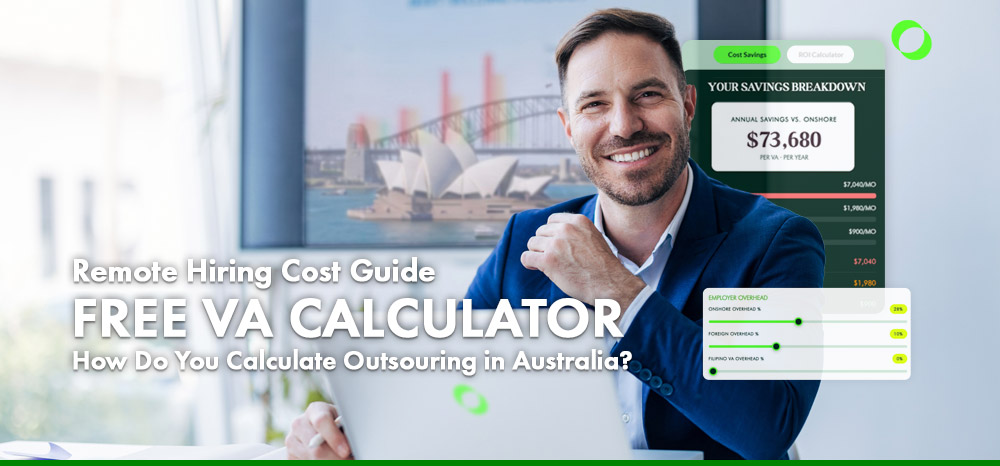
    The cost difference, being a reduction in quality, is a myth. The real, practical difference is a reflection of a different cost-of-living market. Learn How to Calculate Outsourcing Cost in Australia, and try calculating your numbers yourself through the Remote Staff FREE Outsourcing Calculator Tool:

    Interactive VA Calculator Tool
    (Click, scroll inside, move the toggles, or change the numbers)
    Can’t see the numbers? Use a desktop browser or scroll within the box for the best experience.

    What To Do: Before your next local hire, go over the Loaded Cost. Add 12% super, your estimated recruitment cost, extra remuneration, and the number of days of reduced productivity to the base salary. That total is what you’re signing up for annually.

    How Remote Staff Handles Superannuation So You Don’t Have To

    Australian SMEs have no cause to worry about super, especially when there’s a practical solution around it: offshoring or outsourcing specialists. Professionals whose roles can be fulfilled without having to be within the four walls of your office.

    Remote Staff Australia has been placing offshore professionals with Australian businesses for over 18 years. There’s no superannuation obligation here. Not when you partner with our candidates. We’ll also help you determine when an Employer of Record is the right fit, and take care of the rest.

    Payroll, onboarding, and HR tasks are ours to handle. We ensure that our workers are engaged and managed under compliant structures in their home country, and statutory entitlements are handled correctly under local law.

    Local role scarcity is becoming a real thing in each of Australia’s biggest regions. This is why SMEs are already thinking ahead, making up for the shortage and increase in demand through remote hiring.

    Find out about the ongoing job shortage in Oz: Queensland Construction Worker Shortage 2026, and see what opportunities you can get your hands on by staying ahead with remote hiring.

    FAQs

    What is the superannuation guarantee rate in Australia in 2026? (why is Payday Super good?)

    The Superannuation Guarantee rate 2026 is 12% of an employee’s ordinary time earnings. This has been mandatory since July 1, 2025. Under Payday Super, the SG must now be paid on each payday, instead of the previous quarterly arrangement. The maximum contributions base is AUD $250,000 per year from 1 July 2026.

    Do I have to pay super for casual employees?

    Yes. Since 2022, the $450/month minimum earnings threshold no longer applies. Casual employees, just like full-time or part-time staff, receive super calculated on their ordinary time earnings, including casual loading.

    What happens if I don’t pay super? (What happens if I don’t pay super on time under Payday Super?)

    Late payments trigger the non-tax-deductible Super Guarantee Charge (SGC). The ATO operates a three-tier risk system under Payday Super: businesses that identify and correct shortfalls quickly are treated as low risk. High-risk classification will be subjected to an ATO investigation. Repeated non-compliance can result in penalties, interest, and a β€œdirector’s” personal liability.

    Do I owe superannuation for overseas contractors I hire from Australia? (Does superannuation apply to overseas workers?)

    If they’re based in Australia, yes, super applies. That includes temporary visa holders working here and Australian residents your business has sent overseas temporarily. If they live and work offshore, super generally doesn’t apply. The catch is misclassification: if the arrangement looks like employment, the ATO can reclassify it, and the SG obligation follows. An Employer of Record structure removes that risk.

    Does Payday Super affect my business if I hire offshore?

    No, it does not. Payday Super applies only to employees subject to Australia’s Superannuation Guarantee. Offshore professionals engaged through a compliant EOR structure are covered by their home country’s statutory schemes. This means Australian super obligations don’t apply.

    Learn about how farm owners and managers are creating a second income stream with Agrivoltaics Hubs, Solar Panel Recycling Australia, and Solar Farm Lease Australia.

    The Transition To Payday Super 2026 Can’t Wait

    The quarterly buffer’s gone. What’s left is a seven-day window and no room for a late super payment. You should either have already set it up for this upcoming payroll, or you’re about to do so if you haven’t.

    But for your remote staff, the angle flips. Offshore professionals engaged through a compliant structure aren’t subject to Australia’s Superannuation Guarantee. The keyword being: β€œcompliant.” If the ATO sees fixed hours and daily direction, they’ll treat that arrangement as employment regardless of what the contract says. An Employer of Record is the solution to that.

    Super’s not supposed to be crippling. Don’t let it stop you from growing your team. Let Remote Staff find the right specialists for you, without adding to your local staff’s headcount, and without burdening you with Superannuation obligations.

    Call us today or Request a Callback.

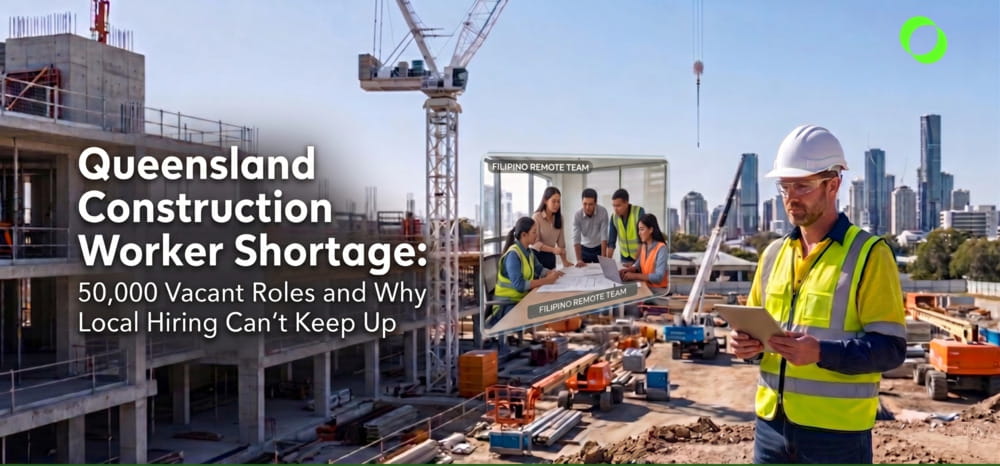
  • Queensland Construction Worker Shortage: 50,000 Vacant Roles and Why Local Hiring Can’t Keep Up

    Queensland Construction Worker Shortage: 50,000 Vacant Roles and Why Local Hiring Can’t Keep Up

    Queensland is 50,000 workers short as of early 2026.

    When the third most populous state in Australia, home to a population of 5.5 million, is unable to fill the Queensland construction worker shortage, the problem becomes less a statistic and more a matter of urgency.

    It’s not just construction workers either.

    Key roles like Estimators, CAD Designers and Technicians, BIM Modellers, Accounts and Payroll Specialists, and Administrative Support are in the mix, too, among many others.

    At the current pace of things, local talent pools won’t be able to meet the demand deluge, the Queensland Auditor-General’s Major Projects 2025 report confirms.

    The work is waiting. But the workers are nowhere to be found.

    So what does a Queensland construction business do when the local talent pool is wearing thinner by the day, and can’t keep up with the work that’s running on a tight, years-long deadline?

    Why is there a construction worker shortage in Queensland?

    Key Takeaway / Quick Answer

    Queensland is facing a massive construction worker shortage because four major pillars, housing, transport infrastructure, the net-zero energy transition, and Brisbane 2032 Olympics preparations, are all competing for the same limited local talent pool simultaneously. As project commissioning continues while supply remains stagnant, this deficit will compound annually, making traditional local hiring increasingly unsustainable.

    Behind the Construction Worker Shortage Queensland Is Facing Today (Why 2026-27 is the Forecasted Peak)

    The peak construction labor shortage Queensland is up against in 2026-27 comes from Construction Skills Queensland, or CSQ, an industry-funded body representing Queensland’s construction sector. They’re responsible for workforce planning and training investment, they make recommendations, and identify gaps throughout the sector and in construction occupations.

    Their flagship workforce research report, Horizon 2032, is a decade-long outlook for Queensland’s construction workforce that ties to the Brisbane 2032 Olympics timeline.

    That pipeline? It’s been said to grow from AU$53 billion in 2024-25 to AU$77 billion in 2026-27, and at the moment, beyond capacity.

    According to the Construction Skills Queensland’s (CSQ) findings:

    Queensland is heading for a peak shortage of 50,000 construction workers in 2026-27. The average shortfall is 18,200 workers per year, over the next eight years.

    Four concurrent demand drivers pulling from the same workforce pool simultaneously:

    • Housing construction targets
    • Transport infrastructure (Cross River Rail, Gold Coast Light Rail, Sunshine Coast Rail)
    • Net-zero energy transition
    • Brisbane 2032 Olympic venues


    [rcb_show_form]

    Is the Main Cause of Queensland Skilled Worker Shortage the Brisbane 2032 Olympics?

    No. Not entirely. TheΒ Brisbane Olympics construction demand is a driver, and one of the larger ones at that. But it’s not the major factor spinning the demand-supply propulsion out of order. The trade shortage Queensland issue had been plaguing the state and the continent at large since the post-pandemic construction boom of 2021 to 2022.

    The sudden surge in residential building, infrastructure investment, and materials costs rubbed against an already reduced workforce, with skilled migration slipping from behind it and forcing a hiring block.

    Facts about the construction worker shortage Queensland is dealing with at present:

    • Queensland accounts for a disproportionate share, given its pipeline density, weighed against the national context
    • Infrastructure Australia’s 2025 Market Capacity Report projects the national shortfall will reach 300,000 workers by mid-2027, up from 141,000 currently
    • 11 of 17 Brisbane 2032 venues were still in business case processes (as of mid-2025)
    • Queensland Government capital spend is AU$116.8 billion across four years in infrastructure, transport, housing, and public works

    What To Do: The shortage isn’t constrained to construction work alone. If you’re in the construction industry, do an audit of your operations and manpower. Identify every role that’s either vacant or understaffed.

    For any role that’s platform-based or doesn’t require physical site presence, offshore hiring is the immediate and viable answer right now.

    Use our FREE Outsourcing Calculator Tool and see the numbers for yourself, and read about How to Calculate Outsourcing Cost for Australian SMEs.

    Ready to Audit?

    Free ROI Calculator

    Compare local hire costs vs. Filipino VA rates in under 60 seconds.

    OUTSOURCING CALCULATOR TOOL

    QLD Construction Jobs Project Bottleneck: Are Estimators High In Demand In Australia?

    Yes, estimators, among others, are in high demand. There are three shortage categories named by the QAO (Queensland Audit Office) report: Engineering, project management, and trade roles. Estimators are perched right in between the first two.

    The lack of estimators in the industry can be particularly damaging because choke points mushroom before anyone sets foot on site. Estimators are responsible for reviewing plans and specs. They calculate qualities like materials, labour, and time, and price everything out from suppliers to equipment to wages. They build a cost estimate or bid.

    It boils down to this: no estimators equals no tender. No pricing, no bid.

    And this will compound, with the direction going nowhere else but upstream. Damage will only multiply from this one source of delay.

    Important details about the estimator shortage:

    • Queensland estimator listings as of April 2026 show open roles stacking up disproportionately against applicants
    • Australia’s job boards consistently list civil engineering professionals, including quantity surveyors, among the most in-demand occupations nationally
    • Surveyors Australia warns that the sector is about to hit a workforce shortfall of over 2,000 professionals per year by 2029

    Headcount isn’t the predicament here. There’s an overwhelming scarcity of senior estimators with platform experience in tools like Buildsoft, Cubit, or CoConstruct. The local pool is there, but is largely composed of junior or mid-level workers.

    Illustration: A Queensland subcontractor is missing a tender submission window because their company’s sole estimator resigned months ago. The replacement search is past the deadline, and they still can’t find a local candidate who can fulfil the role for the Queensland infrastructure workforce shortage.

    Not Just A Construction Workforce Gap Australia’s Staring Down, Not Just An Estimator Shortage

    The pre-site bottleneck isn’t the only leak in the building industry labor shortage QLD pipeline. Here are other roles that need filing, and why these, like Estimators, are best hired offshore.

    Quantity Surveyors

    Cost planning, contract administration, and financial reporting across the project lifecycle; in acute shortage.

    Drafters and CAD Technicians

    Produce construction drawings, shop drawings, and as-builts in AutoCAD, Revit, or ArchiCAD. Filipino drafters with AU construction project experience are among the most established offshore roles in the market.

    BIM Modellers

    Build information modelling for complex infrastructure and commercial projects. Where AU builders are increasingly adopting BIM-mandated procurement processes, demand for this role is rising.

    Project Administrators and Document Controllers

    RFI management, submittal tracking, contract documentation, and compliance registers. Their responsibilities do not need to be done on a site manager’s desk. The high-volume, process-driven work is system-based and is ideally offshored.

    Scheduling Coordinators

    Primavera P6 or MS Project-based programme management and progress reporting. This role is required in government-funded Queensland projects.

    Accounts and Payroll Specialists for Construction

    Progress claim processing, subcontractor payment schedules, and retention tracking. Construction-specific finance roles with AU compliance knowledge are easily available in global talent pools.

    Related Read: Stay updated about the Modern Slavery Act Australia strictly adheres to, and how you can stay compliant in supply chains and more.


    What’s the Biggest Killer in Construction? (Roles, Shortage, Remote Solutions)

    Role category
    Specific roles
    Shortage peak
    Remote-staffable?
    Engineers, Architects & Scientists
    Civil engineers, structural engineers, building designers
    Late 2026; 126,000 nationally
    Partially; Design, documentation, modelling
    Project Management Professionals
    Project managers, estimators, quantity surveyors, schedulers, procurement managers
    Mid-2027; 59,000 nationally
    Fully remote-compatible
    Trades Workers & Labourers
    Carpenters, electricians, plumbers, concreters, labourers
    Mid-2027; 126,000 nationally
    Site-based only
    Drafters & BIM Modellers
    CAD technicians, BIM modellers, documentation specialists
    Ongoing through 2028–29
    Fully remote-compatible
    Document Controllers & Project Admins
    RFI managers, contract administrators, compliance coordinators
    Ongoing through 2028–29
    Fully remote-compatible
    Finance & Accounts
    Progress claim processors, payroll, accounts receivable
    Ongoing through 2028–29
    Fully remote-compatible

    Sources: Infrastructure Australia 2025 Market Capacity Report; CSQ Horizon 2032; Queensland Audit Office Major Projects 2025

    What To Do: Go over this list and add roles you need apart from the ones mentioned. If more than two are vacant, or whoever’s fulfilling those roles is overloaded, now’s the time to launch your hiring roadmap.

    QLD Construction Work Hours

    On-site: Monday to Saturday, 6:30 am to 6:30 pm (noise regulation hours; shift hours will vary depending on contract and employer)

    Off-site / Remote / Offshore :Β 

    7:00 am – 3:00 pm AEST

    8:00 am – 4:00 pm AEST

    9:00 am – 5:00 pm AEST

    Normal office-style schedules aligned to Australian business operations.

    Why Is It So Hard to Find Construction Workers in Australia Right Now?

    Construction projects will continue to get commissioned year after year, and the work won’t stop. Every year the “construction jobs demand Queensland 2026″ goes unaddressed, it rolls over and adds to the next year’s deficit. The longer it goes unmet, the harder it becomes for theΒ construction workforce in Australia to meet work demand.

    As construction ramps up from 2027, it will compete with every other active project from then on.

    Note:

    Infrastructure Australia identifies that most shortage occupations require “a mix of general, technical, and specialised skills, which take time to develop.

    Negative impacts as direct results of the worker scarcity:

    • Some Queensland construction sites, averaging only 2.5 productive days per week, are bracing for productivity loss, which compounds the workforce shortage
    • Labour scarcity is inflating project costs; construction cost growth in Brisbane is forecasted at 5% in 2026 (RLB), with regional Queensland at up to 6%
    • 63% of firms cite labour cost as a substantial threat to project delivery
    • 59% of firms cite labour and skills shortages (Infrastructure Australia industry survey)

    Apart from these, there’s the competition issue. Smaller construction businesses and SMEs won’t be able to match the pay rates or guaranteed work volumes of larger, major contractors. Let alone government-backed projects bidding for the same scarce talent.

    Local-only hiring is out of the equation, and the data proves so. Local training also takes years, while interstate recruitment has its constraints because every other Australian state is facing its own shortage.

    Related Read: Don’t miss out on the current rules and changes about Payday Super 2026Β and stay compliant as you grow your team during this skills shortage, and beyond.

    The Roles Are Being Filled, But Not The Way Most Think

    For every role that runs inside a platform and produces a measurable output, remote hiring is a direct and immediate answer to the shortage. Such roles don’t require a physical presence, and these include estimators, quantity surveyors, drafters, project administrators, accountants and bookkeepers, administrative roles, BIM modellers, and schedulers.

    All are platform-based by nature.

    Filipino remote professionals working in this industry typically hold degrees in civil or structural engineering, quantity surveying, construction management, or architecture. Most bring several years of hands-on experience, such as direct work on AU residential, commercial, and civil projects.

    Remote Staff Australia has been placing remote professionals with Australian construction businesses for 18 years. On cost: the local hire equivalent for most of these roles carries a base salary of AU$80,000 to AU$120,000 before Superannuation, leave entitlements, and more.

    A comparable remote professional represents a materially lower total spend, not because the capability is different, but because the cost of living in their market is.

    Related Read: Wondering what Australian business owners are asking about What Is a Marketing Automation Specialist and The Best No Code App Development Platforms for Australian Businesses? Quick reads so you don’t miss out.

    FAQs

    Can a remote estimator handle AU construction software like Buildsoft or Cubit?

    Yes. Filipino construction professionals working in the offshore market frequently have hands-on experience with AU-standard estimating platforms, including Buildsoft, Cubit, Bluebeam, and CoConstruct. Screen for demonstrated project output, not just platform name recognition on a resume.

    Is the estimator shortage in Queensland expected to ease anytime soon?

    Not within the current infrastructure cycle. CSQ projects the average shortfall persisting across the next eight years, with the peak hitting in 2026-27. The Brisbane 2032 construction ramp-up from 2027 adds further pressure to the shortage of builders Queensland is facing.

    What’s the difference between a remote estimator and a quantity surveyor?

    A remote estimator focuses primarily on pricing, takeoffs, and bid preparation. A quantity surveyor covers a broader scope, including cost planning, contract administration, and financial reporting across a project’s lifecycle. Both roles are in acute shortage in Queensland.

    How quickly can a remote estimator be operational?

    With clean software access and a documented tender process, most remote estimators contribute within two to three weeks. Businesses that hand over a brief, platform login, and one completed example tender consistently report better ramp-up times.

    Related Read: Learn about other in-demand roles and find out how Marketing Automation Specialists and the No Code Developer are reshaping operations in AU SMBs.

    Demand Won’t Ease Up, Neither Will Local Supply Catch Up Quickly

    The point is that hiring remotely is the remedy. There’s no other way around it, unless you’re willing to gamble on a local search that drags on for months to years.

    You settle for a candidate who doesn’t have the expertise you’re looking for, and all the while, projects are halted. Everything, from tenders delayed to understaffed bid teams, brings costs in from different sides, layer upon layer.

    The numbers may look like they’re just part of another statistic. But if you’re a serious business owner, you know that they represent a moment that can change how you build and grow your team, and how far ahead of the market you end up.

    The remote estimator model is already working for AU construction businesses. The talent is vetted and available.

    The decision is whether to move now or after the next worker shortage. Request a Callback to discuss your estimating requirements today.

  • Best No Code App Development Platforms for Australian Businesses: Unbiased Tips + Owner Guide

    Best No Code App Development Platforms for Australian Businesses: Unbiased Tips + Owner Guide

    Ready to crack those fingers and scour through the list of the best no code app development platforms? The ones Australian businesses are lunging toward, this not-so-new tech phenomenon that keeps quietly reshaping how small teams build software?

    Maybe you’re already running one. Or two. A few, even. Maybe you’ve just started reading up on them, warming up to the idea, wondering how far “no code” can actually go in 2026.

    There’s a pattern showing up across AU businesses this year, and subscriptions, active, tools are live. And yet the builds don’t ship. Workflows stay manual. Platforms quietly gather dust in the background while the monthly invoice keeps landing.

    The question isn’t whether the best no code tools work. They do. The question is whether the ones you’re paying for are the right category for what you’re actually trying to build. Most businesses find out they’re not, long after the free trial ended.

    Here’s a breakdown of the 11 best platforms worth your money in 2026, grouped by what they help you build. The tool is half the job, though. Someone still has to run it. More on that as you read on.
    For the HEADER:

    What is a no code platform?

    Key Takeaway / Quick Answer

    A no-code platform is a software development environment that allows you to build functional websites, mobile apps, databases, and automations without writing traditional programming code. Instead of manual line-by-line coding, users design software through visual drag-and-drop components, pre-built templates, and conversational AI prompts (a.k.a. “vibe coding”). These platforms translate human intent and plain-language instructions into production-grade systems complete with backend logic and data storage. While accessible to non-technical users, they are powerful tools heavily used by specialists to rapidly ship software, prototypes, and internal business workflows.

    What Are No Code App Development Platforms? (Not the List, The Definition)

    What such platforms do for you: no code app development platforms let you build software, from apps, websites, internal tools, to automations, with “no code.” No writing code at all levels, the way a software developer does. No-code development or vibe coding is cut from a different cloth, since it’s intent-driven and prompt-based.

    The no-code developer identifies what language to use in crafting the right instructions, essentially to “tell” AI how to behave, how to generate the expected output.

    πŸ’‘

    Did You Know?

    2026 marks the year when the terms “no-code development” and “vibe coding” became one and the same, the latter being newer of the two. But because most, if not all, no code platforms now are AI-integrated, they now fit the “vibe coding” description.

    Scenario: In traditional development, the developer writes the entire line-by-line code that builds the software. The non code developer writes, not code, but the promptβ€”the instructions AI needs for it to start building.

    It’s in plain language, the vibe coder dialoguing with the AI tool. But it’s nowhere like how you type prompts in ChatGPT. This process requires technical knowledge and is skill-specific.

    After all, what’s being built is a moving, breathing app, website, or workflow that’s very much production-grade software. It runs with backend logic, user authentication, data storage, and integrations. All of these are to hold together with zero breakdowns, or as little as what’s acceptable, after launch.

    β€œ

    70% of new business applications will use low-code or no-code technologies by 2025 (up from 25% in 2020). Pairing your business operations and workflows with the right no code developer AUSMEs, a space Remote Staff can help fill.

    β€” No-Code Market Trends
    Global Technology Adoption Forecast

    The Platform Category Blind Spot

    Having the right vibe coding tools is where square one is. They don’t immediately work well the moment they’re switched on. The “platform category blind spot” is the mistake of picking a tool before identifying which category of problem you’re solving.

    Avoidable, when you identify what you need, and work with the ideal no code consultant.

    11 Best No Code App Development Platforms (What Are Examples of the Best No Code Platforms?)

    Enough setup. These 11 no code software below are grouped into five categories based on what software type they produce: what job they do. Use the categories to understand the general purpose, and skip straight to the 11 named platforms for the details.

    AI-Powered App Builders

    This one’s considered the newest in the growing sphere of no-code platforms. They generate full applications and build the full app. Through natural language prompts, the developer writes what they want (again, in a way the AI will understand).

    As in a conversation, the AI, if the language is understood, builds what’s being asked, and the build is polished and tweaked until the outcome is as the developer originally prompted.

    #1. Lovable

    Here’s an AI-first full-stack builder. It creates complete, ready-to-use apps you can “take with you” via exportable code. Normally, or at least for many no-code platforms, whatever’s built is locked within the platforms themselves.

    With builders like Lovable, you have the option to take what’s built out (the actual programming files created by AI), so that, should you decide to use a different platform, the next developer can continue the work.

    There’s a trade-off with this level of independence, of course. Complicated builds need to be overseen, ideally by a specialist who understands the output.

    Best for: SaaS prototypes and MVPs where you want code you can take with you. Starting cost (AUD): Free tier, paid plans from ~$30/month.

    #2. Bolt.new

    Browser-based, Bolt.new is fast, to put it simply and easily. It’s prompt-to-app, so you “describe” the tool that needs to be built.

    prompt-to-app, and fast. You describe the tool, it builds it, and you iterate or adjust it right there, same window. The benefit of speed is accompanied by a limitation, and it’s that for it to be production-ready, careful, meticulous validation is more than a must.

    Best for: Quick internal tools and functional prototypes you can ship in hours.

    Starting cost (AUD): Free tier, paid plans from ~$30/month.

    What To Do: If speed is your main goal at the moment, for a build that’s more on the less complex, less precise side, choose AI-first builders. Before it goes live, have the developer fully validate the output.


    [rcb_show_form]

    Visual App Builders

    This is considered one of the established categories, having been around since the early 2010s. Visual configurations are the main build operation through drag-and-drop canvas editors. Think of it like how you drag and drop elements in a slide on PowerPoint.

    It’s a go-to for many AU SMEs whose core businesses revolve around consumer-facing products.

    #3. Bubble

    Bubble is this category’s most flexible web app builder. It’s found across the pond of Australian commerce, from marketplaces to SaaS products, widely adopted throughout the spectrum.

    It handles more demanding setups. Apps that follow and work on different rules for different types of users, and custom data setup tailored to your workflow. It’s also great for processes that go through a series of steps.

    This is a specialised role, definitely best placed under the oversight of a specialist, and nowhere near self-building.

    Best for: Complex web apps with custom logic and databases.

    Starting cost (AUD): From ~$49/month.

    #4. Adalo

    Adalo goes onto iPhones and Android phones; directly to Google Play and the App Store. This mobile-first tool is for those whose products need to be found in an app store instead of a browser. Less powerful than Bubble when it comes to complex logic, but simpler when the project is a mobile app.

    Best for: Mobile-first apps where App Store and Play Store distribution matters.

    Starting cost (AUD): From ~$60/month.

    #5. FlutterFlow

    FlutterFlow uses Google’s open-source framework, Flutter, as its engine underneath. The build is visual, but it makes exporting clean Flutter code possible, so your app isn’t confined to the same platform.

    This is the most technical within its category.

    Best for: Cross-platform apps where you want the option to take the code with you.

    Starting cost (AUD): From ~$45/month.

    #6. Glide

    Clunky, unorganised spreadsheets can be transformed into polished apps through platforms like Glide. You link it to your Airtable or Google Sheets. It does the job in minutes, building you a straightforward, usable interface.

    The limitation is in customisation, especially in comparison to platforms like Bubble. However, for internal tools, it’s a reliable choice.

    Best for: Internal tools built on Google Sheets or Airtable data.

    Starting cost (AUD): Free tier, paid plans from ~$40/month.

    Understand How to Calculate Outsourcing Cost in Australia in this article. Then calculate using your own numbers and compare the results using our Free Outsourcing Calculator Tool below (click and type):

    Interactive Outsourcing Calculator Tool
    (Click, scroll inside, move the toggles, or change the numbers)
    Can’t see the numbers? Use a desktop browser or scroll within the box for the best experience.

    #7. Softr

    Softr is the customer-facing side of Airtable. The frontend layer. For data that’s already inside Airtable, it gives it a professional website-style interface. Speed? Fast. It’s strong suit? Membership sites, customer portals, and internal directories.

    There’s no catch. Just the obvious that Airtable should first be underneath.

    Best for: Customer portals and membership sites where your data’s already within Airtable.

    Starting cost (AUD): Free tier, paid plans from ~$75/month.

    What To Do: Visual app builders are the recommended category for customer-facing products with a polished UI. The way to choose is by starting with where your data’s currently stored.

    Website and CMS Platforms

    From a marketing site to a content-heavy one, you’re looking at the dominant option. Even for a blog. If you want less reliance on an on-call developer, this is it. Your team can make updates themselves in these platforms.

    #8. Webflow

    Webflow lets you build a beautifully designed website with a proper system for managing your content behind it. It gives you full design control, hence, the note about not being constantly dependent on an expert to execute changes.

    Weekly copy and content updates become easier here. There’s a learning curve that might take non-designers by surprise at first, but the hand-off and learning curve afterwards is manageable. Outputs appear highly professional.

    Best for: Marketing sites, blogs, and content-heavy sites your team can update without a developer.

    Starting cost (AUD): From ~$30/month.

    Operational Excellence

    What Is a No Code Platform? Find the Right No Code Developer / Vibe Coder, First.

    Hire a Remote Staff specialist to build the systems that work while you sleep.

    Trusted by 3,000+ businesses to scale remotely since 2007.

    Data and Internal Tools Platforms

    Problems in fragmented spreadsheets? Endlessly messy records? These are the storage behind the apps you build. Field teams stop working off paper with data and internal tools platforms that are built to consolidate and organise scattered data and sheets.

    #9. Airtable

    Airtable is a no-code database that gives the appearance and feel of a spreadsheet. It operates as the foundation of most of the tools in this list: Glide, Softr, and Zapier. It takes care of simple workflows, team collaboration, and reporting all on its own.

    Best for: The backend and data layer underneath most other tools on this list.

    Starting cost (AUD): Free tier, paid plans from ~$15/user/month.

    #10. Clappia

    Mining, construction, logistics, and agriculture businesses use Clappia, having been purposely built specifically for field operations, with available options for AU data residency: your data is stored on Australian servers.

    It digitises everything, from inspections to field team coordination. Your team can work offline through the mobile app, an important feature for remote Australian environments.

    Best for: AU businesses running distributed field teams in mining, construction, logistics, or agriculture.

    Starting cost (AUD): From ~$12/user/month.

    What To Do: If your problem is disconnected data or field teams on paper, don’t jump to any frontend builder just yet. Start here.

    Workflow Automation Platforms

    These don’t build apps. They connect the apps you already have, so your team don’t have to manually copy data while looking at one tool to the next.

    #11. Zapier

    The most widely used automation platform, not just in Australia, but in the U.S. and other parts of the globe, Zapier connects SaaS tools by the thousand, through trigger-action logic.

    Make (formerly Integromat) is accepted as the stronger alternative for multi-step workflows with conditional branching. n8n is another option. In case Zapier becomes too heavy on business cost, and when data residency or high-volume automation becomes the main concern, it’s a self-hostable platform worth considering.

    Best for: Connecting the SaaS apps you already use.

    Starting cost (AUD): Free tier, paid plans from ~$30/month.

    What To Do: Before building anything new, check whether automation between your existing tools is the solution, since in many cases, it usually is.

    Businesses deep in the Microsoft 365 or Google Workspace ecosystem are better paired with Microsoft Power Apps and Google AppSheet. Both are ecosystem-dependent rather than general-purpose picks, which is why they’re not listed above.

    Free app builders? You can try them out, too. Some features might be limited, but they’re a good place to start.

    How Much Do No Code App Development Platforms Cost in Australia? (No code App Builder Cost)

    Category
    Recommended Platforms
    Best For
    Starting Cost (AUD)
    AI-Powered Builders
    Lovable, Bolt.new
    MVPs, rapid prototypes
    Free / from ~$30/mo
    Visual App Builders
    Bubble, Adalo, FlutterFlow, Glide, Softr
    Customer-facing and internal apps
    From ~$40–75/mo
    Website / CMS
    Webflow
    Marketing sites, CMS content
    From ~$30/mo
    Data / Internal Tools
    Airtable, Clappia
    Databases, backends, field ops
    From ~$12–15/mo
    Workflow Automation
    Zapier (+ Make, n8n)
    Connecting existing apps
    Free / from ~$30/mo

    The Australian Compliance Layer (Yes, This Matters)

    No code app development platforms move a lot of business activity into one place. Customer forms. Booking systems. Internal dashboards. Automated emails and SMS flows. Payment collection. Team records. Connecting tools, storing information, and handling customer data across multiple systems are done under the hood.

    What is the Australian Privacy Act 1988?

    The Australian Privacy Act 1988 becomes relevant the moment personal information enters the workflow. Names, phone numbers, email addresses, payment details, staff records, customer enquiries. Australian businesses remain responsible for how that information is collected, stored, accessed, and transferred, including when the platforms underneath operate outside Australia.

    It’s one of the reasons experienced no-code developers matter beyond simply knowing how to use the tool itself.

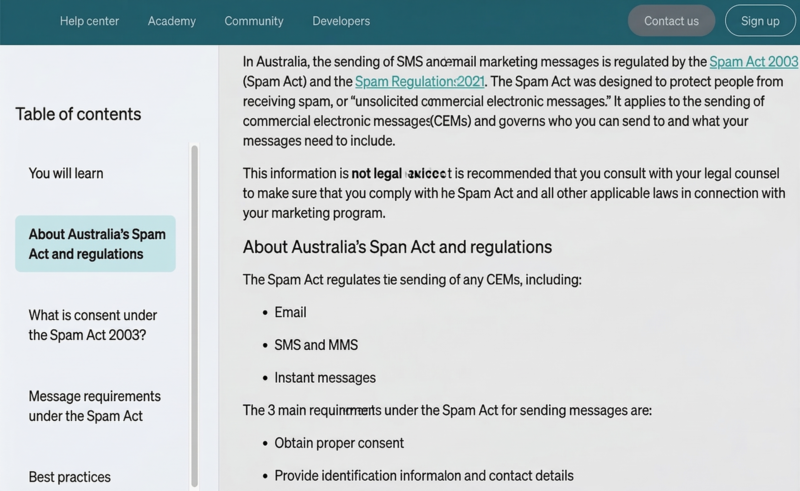
    What is the Spam Act 2003?

    The same goes for the Spam Act 2003. Automated follow-ups, newsletters, promotional emails, SMS reminders, onboarding sequences, abandoned-cart flows. These are standard inclusions across modern no-code builds because they reduce manual admin work across teams. But commercial messaging still requires consent handling and unsubscribe functionality properly configured into the workflow.

    The automation doesn’t remove the business responsibility attached to it. Take note.

    The platform is the way towards the deliverable, and that’s the configured system inside it. Something many AU SMEs misunderstand, and the reason why no-code subscription keeps getting renewed when build’s don’t hit the mark, if they even work at all.

    You need a no-code developer along with the no code development platforms. They craft the prompts that direct the AI tools to build data models. They know what the AI responds to, to integrate the APIs and maintain the system as your business continues to grow or change.

    There’s also an Australian compliance layer that cannot be overemphasised, nor ignored. Builds that go through customer data or sends commercial messages should comply with the Spam Act 2003 and the Privacy Act 1988.

    The vibe coder knows how to build these mandatory requirements into the workflows, so your business steers clear of penalties.

    Related Read: When it comes to marketing automation Australia is advancing towards, learn about What Is a Marketing Automation Specialist first.

    ℹ️

    While no-code development and vibe coding are technically distinct approaches, the lines have blurred significantly in 2026 as every major no-code platform has integrated AI. For practical purposes, the two terms are used interchangeably across the industry and throughout this guide.

    The Support AU Businesses Need To Match the Right No Code Platform With

    With Remote Staff, every no-code developer in the candidate pool is screened for actual workflows, actual integrations. Our team ensures specialists know how to build production systems meant to work inside businesses.

    Remote Staff has spent 18 years placing technical professionals with Australian businesses. Your project, your business needs dictate the engagement model, from project-based and part-time to full-time. Even the administrative side of it, payroll, and onboarding stays off your plate and on ours.

    As you strategise around hiring remotely, here’s The Foreign Employer’s Guide to Payroll Taxes in the Philippines.

    FAQs

    What is a no code app development platform? (What is a no-code app builder?)

    A no code app development platform lets you build functional software through visual interfaces and drag-and-drop components. All without writing code. These platforms replace traditional programming with configuration and templates. In 2026, AI-powered generation from natural language prompts.

    Are no code development platforms suitable for small businesses in Australia? (Are no code platforms good?)

    Yes. Most AU SMEs use them for internal tools, MVPs, customer portals, and workflow automation successfully. High-concurrency apps serving thousands of simultaneous users, or highly regulated builds in finance or healthcare are the exception, as these are better build through traditional development.

    What is the difference between low-code and no-code platforms? (What is meant by no code platforms)

    No code platforms require zero programming. They’re built for non-technical business users. Low code platforms allow some customisation through code, which is useful when developers want faster delivery, without stretching the timeline to that of complete traditional coding.

    What is the difference between low-code and no coding?

    Low-code still involves coding at certain stages. Low code reduces how much manual programming developers need to write, but for custom logic, technical work remains part of the process. That includes integrations, or advanced functionality. No-code removes direct coding almost entirely, relying instead on visual builders, drag-and-drop systems, prompts, and prebuilt workflows.

    The simpler way to look at it: low-code helps developers build faster. No-code helps non-developers build without traditional code writing. In practice, many Australian businesses end up using a mix of both, depending on how complex the software needs to become.

    Can a no code platform replace a traditional software developer?

    For most AU SME use cases, that answer is yes. No for high-concurrency, mission-critical, or ownership-sensitive builds, no, because of the “Platform Prisoner” risk. What gets built inside a no-code platform usually can’t be exported elsewhere, an important detail when your business strategy or the vendor’s workflow changes.

    Stay compliant in all areas of your business with the Modern Slavery Act Australia and Payday Super 2026 Rules.

    The Best No Code Tools Aren’t The Only Solution

    Not on their own. Picking a no code app development platform is merely a part of the long game. Knowing which category fits your problem, and having the right person execute inside it, answers the problem.

    The research you’ve done about no-code already puts you ahead of most businesses that are still unable to use the tools they have because they don’t have the specialist.

    The platform is the easy part. The execution is the product.

    When you’re ready to match the right platform with the right specialist, and call us today or Request a Callback.

    Thinking of what role to start with, alongside Vibe Coders? Project Managers, Online Business Managers, and Chief of Staff positions are catching AU SMBs’ eyes. Go ahead and check our other offshore roles and take your pick.

    Trending, In-Demand Roles in Australia now
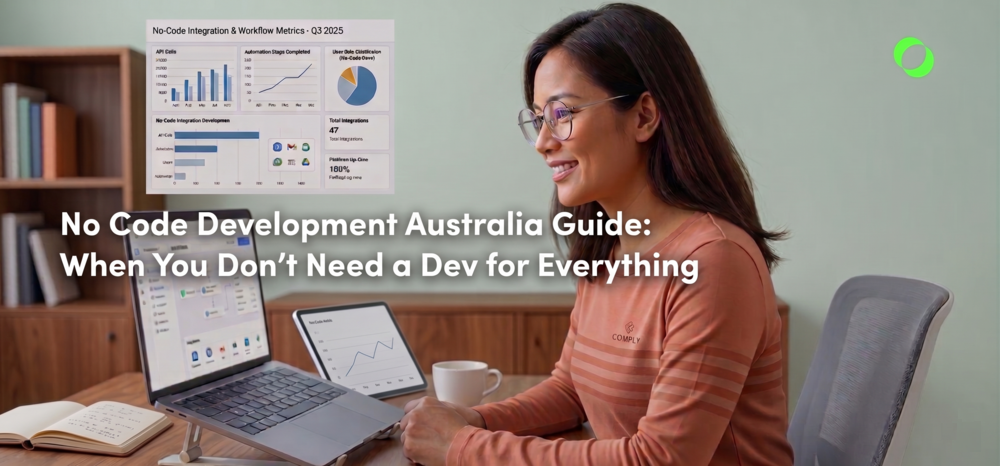
  • No Code Development Australia Guide: When You Don’t Need a Dev for Everything

    No Code Development Australia Guide: When You Don’t Need a Dev for Everything

    It’s real, and it’s a race Australian SMEs are only now catching up to:

    The rising demand for no-code development.

    You buy the tools and subscribe to the platforms. You tell your team to make like a developer and try building inside them.

    “No code,” so no writing code, right? How complicated can it be?

    It’s true that no-code development, or “vibe coding,” as it now goes by, does not require programming. But it isn’t so simple that anybody can watch a tutorial and build like it’s nobody’s business.

    This is intent-driven visual building. Instead of writing code, you work with visual interfaces, drag-and-drop tools, and pre-built logic that set the gears of your platform in motion.

    This is a specialisation. It requires a specialist.

    As you look deeper into no code development, understand the following: What does no-code development cover? What can it build? And why does your business need it?

    What is no code development?

    Quick Answer

    No-code development is the practice of building apps, automations, portals, and workflows using visual platforms and AI prompting, without writing traditional code. It encompasses everything from internal operational tools and client-facing portals to e-commerce automations and workflow systems that remove manual, repetitive work from your team. The practice now overlaps with vibe coding, where a specialist directs AI to generate the build.

    No Code Development Guide: What is No Code or Vibe Coding?

    No-code development is the process of building apps, automations, tools, and workflows with no traditional programming. It uses visual programming tools and drag and drop app builders, so that the no-code developer essentially “tells” the platform what to generate.

    The developer or “builder” handles the logic or instructions, while the platform carries them out.

    Today, “no-code development” and “vibe coding” are used interchangeably.

    While the former originally referred to building without code and the latter meant building without thinking in code through AI-prompting, they now largely overlap in practice.

    Although the main draw is that the approach requires “no code,” it isn’t always zero code. In limited cases, when you build apps without coding, a no-code developer can get behind what’s built and lightly modify the code.

    πŸ’‘

    Did You Know?

    “No code” and “vibe code” were once recognised as related, but varied methods. As of 2025, the two have become synonymous, with “vibe coding” being the newer jargon, made popular by the creator of the phrase itself: AI researcher, engineer, founding member of OpenAI, and former Director of AI at Tesla, Andrej Karpathy.

    Low Code vs No Code (How Is No Code Different From Low Code?)

    In low-coding, coding is expected, especially for complex use cases, much less than its line-by-line counterpart. In no-code, coding is not part of the model, and is optional (i.e. conditional rules that go beyond what the no code website builders supports, unusual data structures).

    To understand the distinction better:

    No code = visual building with generally zero programming (with occasional coding in advanced customisation, and more complex setups)

    Low code = also visual building, but with more programming involved than no-code, and less than traditional coding

    What No-Code Development Isn’t

    No-code development is not a self-managing development model. It’s not just for simple tasks, though highly complex systems requiring custom backend logic or full source code ownership still belong with traditional developers.

    It’s not a developer shortcut.

    Yes, it’s a faster, simpler way of building, but a different route altogether.

    Illustration: Kai has been running his 20-person logistics company in Perth for almost five years. His operations team tracks driver assignments, job statuses, and delivery confirmations using two Google Sheets, updated by four people daily. A recipe for lost jobs and duplicate information.

    A traditional developer quoted AUD$55,000 to build a dispatch system within a five-month timeframe. A no-code developer presented a lower quote and a more conservative build schedule. Kai went with the latter.

    The vibe coder built an Airtable operations hub in four weeks. Driver assignments update in real time, and job status changes trigger automatic notifications. Overlaps and misaligned information, gone.

    [rcb_show_form]


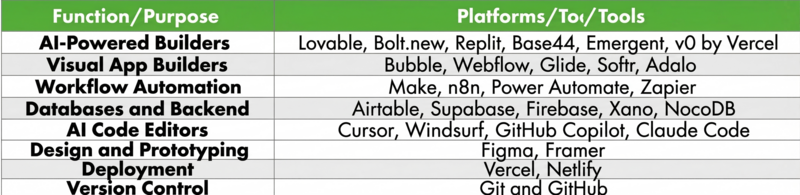
    Best No Code Tools: What Vibe Coders Work With

    Here is a quick reference across the most common no code platforms and their primary use cases.

    Platform
    Category
    Best For
    Airtable
    Database and Internal Tools
    Operational databases, job trackers, asset registers
    Glide
    Internal Tools
    Mobile-first internal apps built from spreadsheet data
    Softr
    Internal Tools and Portals
    Client portals and internal dashboards
    Bubble
    Web Application Builder
    Custom web apps, booking systems, client portals
    Lovable
    AI App Builder
    Rapid web app prototyping via AI prompting
    Bolt.new
    AI App Builder
    Fast MVP and portal builds through AI prompting
    Webflow
    Website and CMS
    Marketing websites your team manages without IT
    Klaviyo
    E-Commerce Automation
    Post-purchase flows, abandoned cart, loyalty triggers
    Make
    Workflow Automation
    Multi-step trigger-action automations between platforms
    n8n
    Workflow Automation
    Self-hosted automation for teams that want full data control
    Zapier
    Workflow Automation
    Connecting apps and automating simple repeated tasks
    HubSpot
    CRM and Marketing
    AI features, lead scoring, workflow automation
    Salesforce
    CRM and Enterprise
    AI-powered features, pipeline automation, data management
    Cursor
    AI Code Editor
    Reviewing and lightly editing AI-generated code outputs
    Supabase
    Database and Backend
    Structured data storage for more complex no-code builds
    Firebase
    Database and Backend
    Real-time databases for apps built on Bubble or Glide
    Xano
    Backend and API
    No-code backend for web apps requiring more complex data logic

    A Note for AU Businesses: A no-code developer does not need to be experienced in all no code automation tools on this list. Hire for the platforms your business is already on or is moving toward.

    What Can You Build With No Code Development?

    What Can You Build With No Code Development?

    Most AU business owners underestimate the scope. This is not a tool for building simple contact forms or basic landing pages. What can vibe coding do for your business? Here is what actually gets built.

    #1. Internal Tools and Operational Databases

    Your team is tracking important details in a shared spreadsheet that multiple people edit. Much like in the earlier illustration about Kai, records conflict, overlap, and disappear by accident.

    A no code developer builds a purpose-focused system inside Airtable, Glide, or Softr that replaces it. From job trackers, asset registers, project status boards, to staff onboarding checklists, it becomes the one source of accurate data your whole team works from.

    What To Do: Name one or two internal processes your team currently tracks in a spreadsheet. That’s where you start.

    #2. Workflow Automation

    When customers fill out a form, does someone manually copy the information onto another system? Any other similar manual processes that take place within your team week after week?

    With a vibe coder, trigger-action logic that removes that laborious relay is built. When a form is submitted, your CRM updates. When a job is marked complete, your client is sent a notification. Next steps kick in automatically inside Make, n8n, or Zapier.

    Practical Note: Workflows handling personal customer data need to be held to the letter of the Privacy Act 1988. An expert vibe coder will know to plan for this at the outset.

    What To Do: Write down every task your team repeats more than three times a week that involves moving data from one place to another. Each task is a candidate for automation.

    #3. Client-Facing Portals and Web Applications

    Bubble, Lovable, or Bolt.new house client-facing systems like booking systems, brief submission portals, shared project trackers, and approval workflows. These give clients direct access without routing everything through email.

    The Spam Act 2003 applies even when it’s the portal, not a human being, who sends automated messages to clients. The same requirements are mandatory for properly acquiring consent, clear sender identification, and providing an option to unsubscribe, all of which should be built in beforehand.

    Illustration: Rachel runs her architecture firm from Sydney. With 12 people currently on her team, and new project briefs coming in via email, four members are assigned to copy the details into a shared folder. When information is missing, they talk to each other and manually trace what went wrong.

    This back-and-forth means projects are delayed for days before work can begin.

    A no code developer built a Bubble client portal in six weeks. Clients submit briefs directly, upload files, and track project milestones themselves. The email chain for new projects is now a thing of the past.

    #4. Websites Your Marketing Team Can Update Themselves

    The no code developer builds the capability in Webflow: your marketing team publishes pages, updates content, and makes changes on their own. Having IT or an external agency on call is done away with.

    What To Do: If your team sends requests to change something on your website frequently, or within the last 30 days, this is the fix that solves the dependency loop permanently.

    #5. E-Commerce and Post-Purchase Flows

    For AU direct-to-consumer (DTC) and Shopify-native brands, abandoned cart sequences, post-purchase follow-ups, loyalty triggers, and predictive segments are where recoverable revenue lies dormant if not acted upon.

    Klaviyo handles most of this, but it needs the person who’s built inside it to configure the flows correctly.

    #6. AI Features Already Inside Your Existing AI No Code Platforms

    HubSpot, Salesforce, and Klaviyo include AI-powered features for lead scoring, content personalisation, and send-time optimisation. Most AU SMEs have never switched them on.

    A no-code developer gets inside the platform and activates what is already there, without additional software spend or a traditional developer involved.

    Vibe Coding vs. Traditional Software Development: Where Each One Belongs

    Both have their place. This table helps you tell which one your situation actually calls for.

    Your Situation
    Right Approach
    Building an internal tool, portal, or MVP
    No code development
    Automating manual business processes
    No code development
    CMS-driven website your marketing team controls
    No code development
    Complex system with custom backend logic
    Traditional development
    IP-sensitive software you plan to sell or list for acquisition
    Traditional development
    Build where you need “full” source code ownership (i.e. custom products with unique logic or features)
    Traditional development

    By 2026, more than 75% of new enterprise applications are expected to include no-code or low-code components.

    What To Do: Before you accept the next developer quote, ask yourself and your team: Does this need to be custom-coded, or does it just need to work? If you need it to work, then vibe coding should be your direction.

    Ready to Audit?

    Free Cost Savings & ROI Calculator

    Compare local hire costs vs. Filipino VA rates in under 60 seconds. Type in your numbers and click.

    OPEN Interactive OUTSOURCING CALCULATOR

    Platform Ownership and the Set-Up-and-Forget Problem

    Platform ownership and initial set-up are ground zero. From there to where your platform should be today is a distance only a vibe coder can cover.

    Australia’s Documented Digital Skills Challenge

    There’s an increasing demand for technical talent and services, and a shortage that’s climbing alongside it. You’ll find that no-code development is one of the specialisations Australian businesses are gearing up for over the next decade, and the qualified local pool is lagging behind demand.

    What To Do: You already know that nothing’s been touched in your platform since it’s been set up. Audit your monthly tools and check which ones haven’t been revisited. This list is the no-code development backlog that requires specialised attention.

    Operational Excellence

    Build Faster Without Code.

    But don’t do it on your own. Hire a Remote Staff specialist to build the systems that work while you sleep.

    Trusted by 3,000+ businesses to scale remotely since 2007.

    You Need No-Code Development, We Have The No-Code Developer

    The market is becoming tighter and more competitive in the chase for no code developers. Even more so locally, where there is a growing supply-demand strain between specialists and the tools they work with. It’s why AU businesses are setting their sights on hiring offshore.

    You don’t have to force your way through that race. At Remote Staff, we take on the responsibility to do the search ourselves and qualify candidates within their market locations.

    We screen them for build experience, platform familiarity, and working knowledge of AU compliance.

    Full-time or otherwise, it’s your call. Through us, you’re getting the same-quality developer as you would locally, but at a more accessible price point, because of talent based in markets with a lower cost of living.

    FAQs

    Is no-code development only for simple projects?

    No. Modern no-code platforms support multi-step workflows that cover most of what an AU SME actually needs built: CRM integrations, client portals, and e-commerce automations. Large-scale systems requiring custom backend logic or full source code ownership are a cut above simple. For the majority of business tools, no-code development is sufficient.

    Can my existing team handle no-code development, or do I need a no-code developer?

    A team member can use no-code tools for basic personal tasks. But building a production-ready portal or a client-facing application is a scope that requires a developer. This developer will have built these systems in a live business environment before.

    What is the difference between a no-code developer and a team member who knows Zapier?

    Knowing Zapier is a tool skill. A no-code developer combines platform expertise and, in many cases, AI prompt fluency to build systems that hold up in a production environment. Someone who knows Zapier connects two apps. The developer builds the system your business runs on.

    How long does a no-code development project take compared to traditional development?

    Traditional software development in Australia typically runs three to twelve months. A no-code developer working on a defined scope delivers working prototypes in days, where production-ready builds take about four to ten weeks.

    Do no-code developers in Australia need to understand local compliance requirements?

    Yes. No-code developers working with Australian clients or business owners should know about the Spam Act 2003 and the Privacy Act 1988. This is mandatory.

    The Race Towards No Code Has Begun. Are You In?

    Before vibe coding, you needed separate tools for every workflow, and a developer on call. But “on-call” usually meant waiting months for an update, a fix, or a new build to get done.

    This is what we mean by no-code development or vibe coding changing the way businesses operate from within. With a vibe coder at the helm using intent-driven prompts, you get faster results at a cost that makes sense.

    A form that routes submissions automatically. A dashboard that your team logs into and can be updated without a developer. A portal your clients use. A sequence that fires emails based on customer response. No line-by-line code writing needed.

    Building is more accessible now than ever before. Don’t be a bystander in the race and join it: Call us and find your no code developer through Remote Staff today.

    ℹ️

    While no-code development and vibe coding are technically distinct approaches, the lines have blurred significantly in 2026 as every major no-code platform has integrated AI. For practical purposes, the two terms are used interchangeably across the industry and throughout this guide.

    Trending, In-Demand Roles in Australia now
  • Outsourcing Cost Australia: Interactive Calculator & Offshore Staffing Rates

    Outsourcing Cost Australia: Interactive Calculator & Offshore Staffing Rates

    Planning to hire offshore talent, but unclear salary averages online are blurring your way forward?

    You want to find out if outsourcing transition costs, from hiring locally to hiring remotely, is worth the price before taking the plunge. You want to know hourly rates per specialisation so you can compare one hiring agency’s numbers with the next.

    But when online averages and outsourcing pricing models aren’t providing you with practical insight and many offshore hiring agencies are asking for some sort of commitment before they give you answers, how do you calculate outsourcing costs in Australia?

    With the Remote Staff VA Calculator.

    You read that right, it’s FREE, and it’s easy to use.

    No extra steps or paying up front required. Just let the calculator do the maths for you.

    Before you work your way through the numbers, learn about what you’re actually measuring (see Calculator Tool below).

    Before Calculating Cost for Outsourcing Services: Which Tasks Aren’t “Free”

    The concept behind this is known as the “silent salary.” It explains how your time as a business owner has its own price. So does the time you waste by spending it on things that have little business value.

    Here’s a simple formula that reframes it:

    owner’s Monthly SALARY FORMULA
    Business Owner’s Monthy Salary = (Your Hourly Rate) Γ— (Hours per Week on Low-Value Tasks) Γ— 4 (ave. no. of weeks per month, rounded off from 4.33)

    Every hour you spend on admin responsibilities or self-training for specialised roles is an hour you’re not billing, selling, or growing. At AUD $120 an hour, 15 hours a week adds up to AUD $7,200 a month in time that went to the wrong work.

    It’s spending that doesn’t come back to you as revenue.

    What To Do: List down your daily tasks that have nothing to do with how you manage your business. This will set the tone as you calculate the cost of offshore hiring.

    AU Remote Staffing Cost Calculator

    Don’t want manual calculations and formulas? Type your own numbers and click the buttons in our Free Calculator below.

    Interactive Calculator(Click, scroll inside, move the toggles, or change the numbers)
    Can’t see the numbers? Use a desktop browser or scroll within the box for the best experience.

    The Hidden Loaded Costs of In-House Australian Hiring (Super, Taxes, & Overhead)

    The True Cost of Outsourcing in Australia

    The Loaded Cost Gap or the Loaded Cost “Trap” describes why hiring locally isn’t bound by the confines of a base salary. You’re adding payroll tax, which varies by state. You’ve got annual and personal leave entitlements, all mandatory according to the National Employment Standards.

    That’s just the visible tip of the staffing cost iceberg. Onboarding time is 4-6 weeks’ worth of non-productivity. Software licenses, equipment, and desk or office space are other layers buried in the ice.

    What Is the Superannuation Guarantee for 2026?

    Key Takeaway / Quick Answer

    Effective July 2025, governed at the federal level by the Australian government, the Superannuation Guarantee (SG) requires Australian employers to pay 12% of an employee’s ordinary earnings (up from 11.5% previously) on top of base salary.

    This new addition to mandatory payroll costs means base salary is compounded with:

    • Leave entitlements

    • Insurance

    • Onboarding downtime

    • Infrastructure costs

    And you’re not even computing according to specialist expertise and experience level yet.

    What To Do: Regarding in-house vs outsourcing costs, outsourcing will show you friendlier overalls. When comparing outsourcing options, look at the all-in rate. Some agencies quote a base salary. Others still include add-ons like leave entitlements. That’s no reason to pause. The all-in, no hidden outsourcing costs figure, and the total cost of ownership outsourcing reveal, come in well below what a local hire costs you. Ask upfront which total you’re looking at.

    Worth Noting: The silent salary shows what your time costs, and the loaded cost trap shows what a local hire costs.

    Extra Read: Here’s what’s going on in Australia’s Agrivoltaics Hubs a.k.a. Agrisolar Hubs, as well as in Solar Panel Recycling, and catch the business opportunity that awaits those who get in first.

    [rcb_show_form]

    4-Step Formula to Calculate Your Total Outsourcing ROI

    The four-step formula for calculating outsourcing costs in under 20 minutes:

    #1. Work Out Your Own Effective Hourly Rate

    What is your time worth? Not asking philosophically. There’s a dollar equivalence to this.

    Before you add up outsourcing costs, you need this one number first. It’s effectively what your hourly rate is as a business owner, and it’s what makes every other calculation in this process tailored to you.

    Set Your Baseline Rate: Calculate Your Time

    Business Owner’s HOURLY RATE CALCULATION FORMULA
    Hourly Rate = Annual Business Income Γ· Working Hours Per Year (Baseline uses 2,080 hours based on standard 52 weeks at 40 hours per week)

    Here’s an example:

    AUD $197,600 Γ· 2,080 hours = AUD $95 hourly rate = (Your) Effective Hourly Rate

    So how much does your time actually cost? If your business brings in AUD $197,600 a year, the answer is AUD $95. That’s the real dollar amount on paper. Use it to put a tangible figure on your daily and hourly tasks.

    This is what business owners often brush aside. They don’t account for the dollar amount of each hour they spend on what should be delegated to someone else.

    What To Do: Take a look at last year’s revenue figure and divide it by 2,080. Write that number down and hold on to it; you’ll need it for every step that follows.

    #2. Audit the Hours You’re Spending on the “Wrong Work”

    Track one week of tasks. Try last week’s (rough log). In a sheet, create two columns: column one for tasks that require specific expertise and column two for ones that don’t. For the latter, this includes inbox management, calendar scheduling, data entry, tutorials or skills learning (for specialisation or skills upgrading), and basic research.

    Name the total hours in column two as your “delegation inventory.” Defined simply, these are hours spent on things you shouldn’t be doing yourself, or doing at all.

    If you’re only now deciding to build a team, that’s all the more reason for you to hire remotely.

    Moment of Realisation

    β€œMany AU SME owners see 10 to 20 hours per week under the delegation inventory column (column two).”

    ● ● ●

    Illustration: Rachel runs an 8-person accounting firm. She and her team work directly from the main Brisbane office. She spends somewhere around 12 hours a week checking inboxes, chasing outstanding invoices, and going over call logs.

    Her effective hourly rate (from Step 1) is AUD $95.

    MONTHLY TIME-VALUE formula
    12 hours Γ— AUD $95/hr (example) Γ— 4 weeks = AUD $4,560 / month (Opportunity cost in owner time value performing tasks a VA could handle)

    Rachel pays her VA AUD $1,200 a month. Her monthly savings before factoring in any extra revenue from freed-up time = AUD $3,360.

    #3. Calculate the True Cost of the Outsourced Role (Cost-Benefit Analysis Outsourcing Data)

    This is where the comparison happens. Let’s take a standard local admin hire as the reference for this table’s computation.

    Another add-on, since you’re looking into remote hiring, here’s something about The Foreign Employer’s Guide to Payroll Taxes in the Philippines.

    Local Admin Hire Average Salary (AUD): SAMPLE ROLE & COST

    Local AU Admin Hire
    Costs & Details
    Base Salary
    AUD $70,000
    Superannuation (12%)
    AUD $8,400
    Annual & Personal Leave
    Included under NES
    Payroll Tax
    Varies by state
    Equipment & Software
    Your Cost
    Onboarding Downtime
    4–6 weeks
    Estimated Year-One Total (Base + Add-Ons)
    AUD $90,000–$100,000

    View Our Roles and Rates

    Outsourcing changes every element in this table. There’s technically no superannuation obligation outside Australia. The exact add-ons depend on the agency and the engagement structure, but the point is: your hire’s location pulls the total cost down.

    You’re paying for the same-quality hire. The difference is that they’re in a different part of the globe, where the cost of living is less than where you are.

    For Australian businesses hiring through Remote Staff, that total comes in at a fraction of what a local hire costs in year one alone.

    What To Do: Go back to your delegation inventory under #2. Consider hiring part-time if you’ve got 10–15 hours of weekly tasks to hand over. Full-time if it’s more than that.

    #4. Run the ROI Check: Outsourcing Financial Analysis

    The ROI check tells you whether hiring an offshore worker makes financial sense for where your business is right now. Using Rachel’s numbers as an example, here’s the formula:

    NET MONTHLY GAIN FORMULA
    (Your Hourly Rate Γ— Hours Delegated/Week Γ— 4) βˆ’ VA Monthly Cost = Net Monthly Gain (AUD $95 [example] Γ— 12 hours Γ— 4 weeks) βˆ’ AUD $1,200 = AUD $3,360 net monthly gain

    Give it 2 to 3 months. AU businesses typically begin to notice the payoff within 60 to 90 days, when simple, repetitive tasks are clearly outlined from the beginning.

    90-day Timeline Caveat: Expect a wider time for complex tasks without SOPs, since they take longer to hand over.

    Illustration: Tom has been running his business in Melbourne for over a year. He sells homeware direct-to-consumer (DTC). A part of his week is consumed in going over customer service emails, following up on suppliers, tracking orders, and answering order queries.

    After hiring a part-time VA through Remote Staff at $AUD 800 per month, he’s able to free 15 hours from his weekly schedule, and allots those to wholesale partnerships. Within 90 days, he’s locked in two new wholesale accounts, each worth $3,200 monthly in additional revenue.

    Tom’s ROI isn’t merely time saved, but revenue created because of it.

    What To Do: Review your numbers using the formula above. More preferably, use the Remote Staff FREE Outsourcing Calculator to generate your personalised estimate in less time.

    Ready to Audit?

    FREE Interactive Outsourcing Calculator

    Compare local hire costs vs. Filipino VA rates in under 60 seconds.

    Outsourcing CALCULATOR tool

    Taking The Pressure Of The Hiring Process Off Your Shoulders

    Maybe you’re still warming up to the idea of outsourcing or offshore hiring. Maybe you want to add more remote workers to your growing team. Whatever your hiring need, and whether you’re thinking about full-time, part-time, or project-based roles, Remote Staff is here for you.

    Let us answer your questions about “How to charge for outsourcing services.” We’ve been placing remote professionals with Australian businesses for 18+ years. We’re confident and experienced in how we handle placement, as we screen candidates for hands-on experience for every specialisation, industry, and business size.

    Your future hire isn’t tied to Australia’s Superannuation Guarantee. Equivalent add-ons vary by country and agency. But the fact remains that market location is your advantage regardless.

    Extra read: Learn about the Modern Slavery Act Australia and Payday Super 2026 guidelines, so you stay compliant in every part of your business.

    FAQs About Calculating Outsourcing Salary in Australia

    What is the formula for calculating actual cost? (How much do companies save by outsourcing?)

    Use two formulas, starting with your offshore hire’s base rate plus applicable agency fees. Place that side by side to the same role, at a local cost: base salary, superannuation at 12%, leave entitlements, payroll tax, equipment, and onboarding downtime. You should be looking at a local as well as a remote Actual Cost. Subtract one from the other, and the total is your Cost Advantage.

    Actual Cost = Base Rate + Agency Fees
    Cost Advantage = Local Hire Total βˆ’ Actual Outsourcing Cost

    How much does outsourcing payroll cost in Australia?

    Add the base rate to any agency or management fees, then subtract what you’d otherwise pay for a local hire. Do two separate calculations: one where leave, payroll tax, and onboarding costs are included, and one with only the base salary. The net figure of either one is almost always lower than a local hire, often significantly so.

    What’s the difference between outsourcing cost and outsourcing value?

    Cost is the dollar amount you pay the remote worker. Value is the time you get back from outsourcing, and what you can now do with it, like focusing on work that brings in revenue.

    How many hours per week do I need before outsourcing makes financial sense?

    Aim for at least five to eight hours of clearly defined, repeatable tasks per week before hiring. This is the practical threshold. Above ten hours, and the maths will tell you that it makes more than financial sense.

    How long before I see ROI from a virtual assistant in Australia?

    Most AU businesses with clear task documentation and an active workload witness measurable ROI within 60 to 90 days. Businesses starting without documented processes need a full quarter or more. Things move faster when your tasks are clearly laid out before your remote hire begins.

    Bonus Read: Labour Day Australia 2026 is coming— here’s its history, and how the different dates confuse SMBs, and cause problems in the workplace!

    You’ve Calculated the True Cost Of Hiring Remotely. Pursue The Hire.

    There’s no such thing as “free” when it comes to offloading yourself from tasks that should be done by someone else. But the numbers are much more agreeable when you choose to hire remotely than locally.

    As a business owner, your hours should be earmarked to responsibilities that directly affect your business, like making decisions, bringing in revenue, partnering with other businesses, and winning clients.

    No more hours spent on tasks that have nothing to do with managing your business. No more confusion on direct and indirect outsourcing costs. You need offshore specialists who are already excellent at doing those things, so you can put your time and effort into working on your business goals instead.

    The calculation is simple. The outsourcing savings calculator? Even simpler to use.

    Whether you want to hire a virtual assistant Australia trusts, work with Estimators, Back-Office Administrators, Marketing Assistants, or any role you need, get the numbers right and hire offshore through Remote Staff, or Request a Callback.

    What’s trending in today’s marketplace
  • Marketing Automation Specialist Salary in Australia: What Salary Websites Won’t Tell You

    Marketing Automation Specialist Salary in Australia: What Salary Websites Won’t Tell You

    Three different salary websites, three completely different numbers.

    AU$65K on one, AU$98K on another, AU$146K on a third.

    That’s what you get after doing your research about “marketing automation specialist salary.”

    Actual numbers are buried in estimates, and no explanation for the differences.

    It’s because the title covers several different specialisations, each with its own experience requirements, platform demands, and salary range. Most salary websites don’t make that distinction.

    Here’s what the numbers actually mean, and what Australian businesses are paying once the full cost of this hire is on the table.

    What are the average marketing automation specialist salaries in Australia?

    Key Takeaway / Quick Answer

    The average marketing automation specialist salary in Australia is typically between AU$85,045 and AU$98,000. For practical budgeting, use AU$90,000 to AU$100,000 as a realistic mid-level baseline, then adjust based on specific platform expertise, location, and superannuation structures.

    Marketing Automation Specialist Salary 2026: Why the Numbers You’re Finding Don’t Reflect Your Actual Hire

    Three things drive the salary range and marketing automation specialist salary trends you’re seeing, and none of them is visible on salary websites.

    Different role definitions under the same title

    Glassdoor AU reports an average of AU$98,000 for this role. PayScale AU reports AU$85,045. The AU$13,000 gap between them reflects the different levels of expertise, seniority, company size, and industry. Both figures are real, but neither is necessarily yours.

    Superannuation included or excluded

    Many advertised salaries in Australia are quoted as base only. Others include computations for the mandatory retirement savings system (superannuation). But it’s not clear which ones do or don’t.

    Since 1 July 2025, the Superannuation Guarantee rate has risen to 12% of ordinary time earnings. That means a AU$98,000 base hire costs AU$109,760 before a single on-cost is added on.

    When you’re comparing salary data across platforms, you’re often comparing figures that aren’t structured the same way.

    Platform complexity and scope aren’t captured

    A specialist managing HubSpot for an 8-person business will have a different skillset than one who was in a 200-person operation, running Salesforce Marketing Cloud with complex, automated follow-up sequences.

    Both roles carry the same title, but one commands AU$120,000+.

    Illustration: Marcus runs a B2B professional services firm in North Sydney. He searches salary data online, settles on AU$90,000 as a midpoint, and posts the role.

    Every candidate with three to five years of platform experience declines or doesn’t apply. The ones who do apply can execute campaigns, but have never built a workflow from scratch.

    He’s priced for a coordinator when he needs a specialist.

    What To Do: Define the role before you research the salary. Specify the platform you’re currently on, what the work entails, whether seniority is a factor, and whether you’re quoting base or base plus super.


    [rcb_show_form]

    Numbers By Experience Level: What Is the Marketing Automation Specialist Salary in Australia?

    When it comes to marketing automation salary by experience level, seniority is the first and most significant variable. Here’s what each tier actually delivers, and what it costs.

    A businessowner thinking about marketing automation specialist salary in Australia.

    #1. Junior Specialist (0–2 Years): AU$70,000–AU$90,000

    At an entry level marketing automation specialist salary, a hire comes in with platform familiarity and works within a process someone else has already set up. They can handle:

    • Basic workflow setup and email campaign scheduling
    • List hygiene and contact management
    • Standard A/B tests on subject lines and send times
    • Reporting on pre-built dashboards

    This specialist does not design systems from scratch or troubleshoot CRM integrations.

    According to PayScale AU, the average total compensation for a marketing automation specialist with one to four years of experience is AU$76,290.

    Brightbox Consulting, an Australian digital marketing recruiter, places junior roles between AU$70,000 and AU$90,000 based on 2024–2025 placement data.

    What To Do: This tier is for you if your automation strategy is already documented and your platform is configured. If you’re starting from scratch, a junior specialist might not be the best fit.

    #2. Mid-Level Specialist (2–5 Years): AU$90,000–AU$120,000

    This is the hire that runs the platform independently. A mid-level specialist works across:

    • Multi-step nurture workflow builds and optimisation
    • CRM integration and data sync maintenance
    • Contact database segmentation and lifecycle management
    • Campaign performance reporting and attribution

    They know how to troubleshoot what breaks and when to escalate what falls outside their scope.

    According to Glassdoor AU, the typical range at AU$84,000 to AU$121,000 (25th to 75th percentile), with a reported average of AU$98,000. Jora AU, which pulls directly from SEEK job ad disclosures, reports AU$97,500 as the current average for advertised roles.

    This is the most common hire for Australian SMBs, and this tier often sees ROI the fastest.

    What To Do: For most growing AU businesses without an existing automation programme, this is the starting point. The specialist works independently, and the cost is still manageable before the senior premium applies.

    #3. Senior Specialist (5+ Years): AU$120,000–AU$145,000+

    For senior marketing automation specialist salary, the expert moves from the day-to-day maintenance to designing the entire system. They decide how leads get scored, how contacts move through your funnel, handle platform migrations, and report to marketing leadership on what’s driving revenue.

    Brightbox Consulting places senior roles between AU$120,000 and AU$145,000. It’s consistent with Glassdoor AU’s 90th percentile figure of AU$146,880. Contract and day-rate specialists at this level typically charge AU$600 to AU$1,100 per day. The numbers may differ for marketing automation manager salary.

    What To Do: If your automation programme is still being built, hold off. A senior specialist is a mismatch when you’re only laying the foundation.

    Marketing Automation Specialist Salary Range Summary Table:

    Marketing automation specialist salary comparison table.

    Numbers Per Tier: What Makes Automation Specialist Salaries Different?

    These four factors determine where a specific hire lands within their band.

    #1. Platform Specialisation

    HubSpot is the most widely used platform at the SMB level in Australia. The qualified pool for Salesforce Marketing Cloud and Marketo is significantly smaller and attracts higher salaries accordingly. Enterprise platform depth drives mid-level salaries well above AU$100,000.

    And that’s just for mid-level specialists.

    The AU digital marketing software market reflects the same pressure: marketing automation recorded a 14.80% Compound Annual Growth Rate (CAGR) between 2025 and 2030. Platform-specific talent is becoming more scarce, yet demand is growing fast.

    What To Do: The platform you’re using is the first qualifier when hiring. If HubSpot is your stack, no need to screen for specialists who’ve worked mostly on Marketo.

    #2. Location

    Sydney and Melbourne consistently sit 10–15% above the national salary average for marketing roles. Brisbane and other capital cities are more moderate.

    Remote roles follow the same experience-based marketing automation specialist pay range, but at lower rates generally because of the difference in cost of living.

    What To Do: If you’re in a high-cost metro and hiring on-site, factor a location adjustment. Consider hiring remotely and offshore.

    Use our FREE VA Calculator and check the numbers yourself:

    Interactive Outsourcing Calculator Tool(Click, scroll inside, move the toggles, or change the numbers)
    Can’t see the numbers? Use a desktop browser or scroll within the box for the best experience.

    Get more tips: How to Calculate Outsourcing Cost

    #3. The True Cost Gap

    When hiring locally, on-costs turn a AU$98,000 hire into a AU$132,300 one. The 25–35% on top of marketing automation specialist compensation base salary includes:

    • Superannuation at 12% (effective 1 July 2025): +AU$11,760
    • Payroll tax (varies by state, 4.85%–6.85% above threshold)
    • Workers’ compensation and leave entitlements

    All up, before recruitment fees.

    Illustration: Sophie runs a SaaS company in Melbourne. She budgets AU$97,000 for a mid-level automation specialist. She’s surprised when her accountant projects the first-year total at AU$127,000.

    What To Do: Multiply your base salary figure by 1.25 to 1.35 to estimate the actual first-year employment cost. That’s the budget to build around.

    #4. Certifications

    Certifications carry a different weight depending on which one you’re looking at:

    • Marketo Certified Expert – associated with a 12–20% salary premium above uncertified professionals at the same experience level
    • Salesforce Marketing Cloud Consultant – similar premium range
    • HubSpot certifications – widely held, useful as a baseline signal

    28% of Australian businesses cite talent shortages as a top growth barrier, with advanced martech skills being the scarcest in the job market. Regarding marketing automation specialist salary Australia typically follows, certified candidates with live deployment experience pull toward the upper end of their band.

    What To Do: Ask candidates to walk you through a workflow they’ve built, and look at conversations only as a cue for probing further. Experience and work done are the credentials worth noting.

    Operational Excellence

    Unsure Where to Start?

    Hire a Remote Staff specialist to support operations while you take care of your business vision.

    Trusted by 3,000+ businesses to scale remotely since 2007.

    When the Budget Maths Points Toward a Different Hiring Model

    The marketing automation consultant salary range is practical and real. But the engagement model is a separate decision. For many AU businesses, it changes the maths more than most expect.

    Your Scope Doesn’t Justify a Full-Time Commitment

    If what you need is a defined platform build, such as an initial workflow setup, a CRM integration, or a one-time migration, a full-time salary commitment won’t serve you well.

    What To Do: Match the engagement model to what you’re building. Project-based for a defined scope. Part-time for ongoing maintenance. Full-time only when automation is the core of your growth engine.

    The Local Talent Pool Is Thin for Your Platform

    The advanced martech talent shortage is documented across the AU market. Businesses without access to specialist candidates on their specific platform often wait months to fill the role.

    Opening the search to remote talent addresses both at once.

    What To Do: Don’t confine your hiring to a postcode. Remote automation work is entirely platform-based. Where a specialist logs in from has no bearing on what they build.

    How Remote Staff Helps AU Businesses Make This Hire Work

    The hard part for most AU businesses is absorbing the full cost of hiring locally.

    That’s why Remote Staff works with Australian businesses to source marketing automation specialists who’ve built real systems inside real platforms. The screening process focuses on what they’ve actually built: workflows, CRM integrations, reporting setups, and lead scoring logic that run in a live business environment.

    The engagement structure fits where your programme is right now. If you need someone full-time to own automation end-to-end, that’s available. If the scope is still being defined and a part-time arrangement makes more financial sense, that works. So do project-based engagements for a defined build.

    The cost difference comes down to geography: the same hands-on experience and platform depth, at a total spend that doesn’t carry AU employment on-costs on top of it.

    Payroll administration, onboarding, and HR support are handled on your behalf, so the time and overhead that usually comes with a new hire stays off your plate.

    FAQs

    Does the AU marketing automation specialist salary include superannuation?

    Not always. This is where the budget miscalculation usually happens. Since 1 July 2025, Australia’s Superannuation Guarantee rate is 12%. If your employment contract is structured as base plus super, a AU$98,000 salary becomes AU$109,760 before other on-costs. Always confirm which structure the advertised figure reflects before committing to a budget.

    Should I hire a full-time marketing automation specialist?

    It depends on what you’re building. For a defined platform setup, CRM integration, or one-time migration, a project-based engagement at AU$600–AU$1,100 per day is often more cost-effective than a full-time salary. For ongoing campaign management, database maintenance, and programme optimisation, full-time makes more sense.

    What are the benefits of offshore hiring for marketing automation specialists?

    Yes. Marketing automation work is entirely platform-based. Specialists build inside tools and systems that don’t require physical presence. Remote hiring is how most AU businesses are successfully accessing this skill set.

    Benchmark Your Budget Based on Your Programme Needs

    The confusion around the average marketing automation specialist salary in Australia comes from how every platform averages the title instead of the role.

    National averages won’t get you there. Your budget should be built around your platform, your seniority requirement, your engagement model, and the true employment cost. This includes superannuation and on-costs.

    Once you know what you’re hiring for, the number becomes a practical planning tool.

    The right budget is the one built around your actual hire.

    When you’re ready to hire marketing automation specialists, call us today or Request a Callback.

  • Email Marketing Automation Specialist: The Hire Collecting $$$ Your Platform Has Been Ignoring

    Email Marketing Automation Specialist: The Hire Collecting $$$ Your Platform Has Been Ignoring

    Email platform? Check. List of contacts and potential leads? Check. You green-light the sequences, and campaigns go out on schedule.

    But it’s been months. There’s still no movement in open rates. After the first email, sometimes even more than just one, leads suddenly go quiet. Nobody can answer why that is, or why sequences are set up the way they are.

    Many businesses miss out on billions in potential revenue because a huge portion of their marketing emails never pay off, thanks to deliverability issues, low opens, and poor strategy. Even though email can be extremely profitable when it’s done well.

    Only around 83–86% of marketing emails actually land in the inbox:

    About 1 in 6 gets blocked by spam filters or bounces; businesses are paying to send messages that can never convert.

    Most Australian SMBs are paying for email platforms that are only being used at a fraction of their capability. They have the tools, but not the person who makes them work the way they’re designed to.

    An email marketing automation specialist.

    What does the role involve? What specific signals tell you it’s time to hire one?

    Learn about why you need this specialist, what the hire costs in Australia, and how to make the hire without the full weight of local employment overhead.

    What is an email marketing automation specialist?

    Quick Answer

    An email marketing automation specialist builds and manages the automated systems inside your email marketing platform. They configure the rules that determine what your platform does after a contact takes an action, from filling in a form to making a purchase. For Australian businesses, the role also covers compliance with the Spam Act 2003 and Privacy Act 1988. The result is a marketing system that runs, responds, and improves without your team having to manage it manually.

    What Is an Email Marketing Automation Specialist?

    An email marketing automation specialist builds and manages the automations within your email marketing platform. They create the rules and configure them so that your platform “knows” what to do next after a trigger or an action.

    This could be anything from filling in a form, clicking a button or a link, making a purchase, or disappearing when they’re inches away to a close.

    A specialist is not the same as a digital marketer. A digital marketer works within the sphere of scheduling campaigns and writing and creating content. This role is also not a developer or an IT expert.

    An email marketing automation consultant sets up the technical side of your email platform. That way, your marketing strategy fires away, the right way, without any manual push, every single day. Or according to the timetable you set.

    Illustration: Rachel owns and runs an 11-person B2B software company in Brisbane. She hired a marketing coordinator to manage HubSpot. Twelve months later, the coordinator is sending newsletters and updating contact records singlehandedly. But that’s how her team had been doing things even before this hire.

    She knows that the workflows are inside the platform. It’s just that none of them has been evaluated. At this point, she’s paying HubSpot AU$1,200 monthly for what’s operating as an overpriced email writing tool.

    What Rachel needs is a specialist who can build the system her coordinator was never trained to create.

    [rcb_show_form]

    What Does an Email Marketing Automation Specialist Actually Do?

    At the core of this role is email, and everything else that relates to how you use it as a tool. A tool that, ultimately, meaningfully reaches out to the right audience, strengthens your brand’s relationship with them, and turns that into returns.

    Does it have to do with sending emails?

    Is it that you need email marketing automation tips or email automation best practices?

    Yes. But that’s only a small part of it.

    Building Automated Email Campaigns and Sequences

    Most marketing teams work a fixed calendar, and nothing more. An email automation specialist puts together sequences that respond to contact behaviour. This allows the messaging to be tailored to where the contact is in the customer journey automation.

    If a lead turns silent for two weeks, the platform sends the appropriate re-engagement email. A customer completes a purchase? They’re moved into a retention flow, an email series that keeps them coming back.

    All of these are done automatically: nobody in your team has to hit send.

    Lead Nurturing and Drip Email Campaigns

    Assuming that first contact immediately opens a door that leads to a purchase is a mistake many sales teams make. So is assuming anything at all about a lead. That’s where the specialist makes a difference. They create drip campaigns where the messaging mirrors the buying process stage.

    The goal shifts away from blindly sending sequences to every contact, at random, to sending emails to targeted, qualified leads.

    Audience Segmentation and Personalized Email Automation

    Research proves that rolling out the same email to everyone on your list produces lacklustre results.

    Actually, it’s worse than that.

    Besides poor (zero, in some cases) open rates, doing this breaks the link to cold leads that could have been potentially warmed up with the right strategy.

    The specialist segments the database by: behaviour, industry, lifecycle stage, or purchase history. They transform campaigns so that it’s about the message, and it speaks to each group specifically.

    No more contacts receiving messages that have nothing to do with their situation, what they’re looking for, or what they’re not looking for. Sequences are made relevant to them. General formulas written for every average customer, many of whom probably have nothing to do with what your business offers, are done away with.

    A/B Testing and Campaign Optimisation

    A specialist isn’t afraid to run structured tests for subject lines, send times, calls to action, email length, and more. They examine the data and act decisively.

    Over time, you’ll notice open rates steadily improving, and click-throughs going up. Sequences that have long been abandoned are given a revamp to match current performance data.

    Compliance Under Australia’s Spam Act 2003

    This is mandatory for Australian businesses. It’s also where many are exposed, and frequently, unintentionally.

    The Spam Act 2003 requires that commercial electronic messages sent to or from Australia must have the following:

    • Recipient consent
    • Accurate sender identification
    • A working unsubscribe option processed within five business days

    The Privacy Act 1988 adds obligations around data collection, storage, and use.

    The Australian Communications and Media Authority (ACMA) enforces these rules and has been escalating enforcement significantly. In 2025, Tabcorp received a AU$4 million penalty, Betfair paid AU$871,660, and PointsBet was fined AU$500,800.

    What does this have to do with SMEs?

    It’s a reminder that compliance oversight exists at every business size and type.

    What To Do: Confirm your specialist fully understands both the Spam Act 2003 and the Privacy Act 1988. Ask them how they handle unsubscribe processing and consent documentation within their workflows. If they can answer clearly, you have your hire.

    Operational Excellence

    Unsure Where to Start?

    Check What Role You Need.

    Hire a Remote Staff specialist to build the systems that work while you sleep.

    Trusted by 3,000+ businesses to scale remotely since 2007.

    Four Signs Your Australian Business Needs This Hire

    When you recognise two or three of these in your business, it’s enough reason to start the search.

    #1. The Frozen Sequence: Workflows Built Once Are Never Revisited

    Your automation platform has workflows running. Some were set up so long ago that nobody remembers when. Nobody has gone over them since. You don’t know if any of it still makes sense with where your business is today.

    Do they match your current sales process or your current database? How about your contact list?

    What To Do: Log into your platform and pull a list of every active workflow. Check when each was last modified. Modification dates that are from a year ago or further mean the logic is outdated. Keeping things business-as-usual without updating will affect your engagement rates.

    #2. The Manual Follow-Up Loop: Sales Still Chasing Leads by Hand

    Your sales team is sending follow-up emails manually. When the person who’s supposed to send the emails is caught up with other projects, leads are left on their own. For days. For weeks.

    There are no behavioural trigger emails in place to automatically follow up on someone who submits a form.

    What To Do: What does your CRM say about your average lead response time? Two to four hours is a warning. If it’s consistent, then it’s a problem.

    #3. The Compliance Blind Spot: No One Is Accountable For Your Spam Act Obligations

    Have you tested your unsubscribe links recently? What’s your process for opt-outs within five business days like? And your database, have you removed those who were initially added without consent?

    Answers to these questions are a barometer for compliance.

    What To Do: Run a basic compliance check on your last four to five campaigns. Check on the following: a working unsubscribe link, sender identification, and consent from every contact. If any one of these is missing, address it immediately.

    Stop any scheduled campaign until this is resolved.

    #4. The Invisible Inbox: Unclear Performance Even If Emails Are Going Out

    Campaigns are going out according to schedule, but no one in the team knows which sequences are doing well and which aren’t. Nobody can tell you which contacts fell off the radar, or what email activity is attracting leads. The platform is generating reports nobody seems to be reading, let alone acting on.

    What To Do: Do a performance summary. Let your team give you a report on open rates, click-through rates, unsubscribe rates, and what those emails led to in terms of actual business. The report should encompass data over the last 90 days.

    If it takes more than a day to produce, or if the data isn’t there, that’s all you need to know.

    Email Marketing Automation Tools in Australia: What a Specialist Should Use

    Your first qualifier when hiring email automation specialists is platform knowledge. Here’s how the AU market breaks it down:

    • HubSpot is the most widely used platform at the AU SMB level. Candidates should have experience with email workflow automation branching, contact lifecycle email marketing, and reporting dashboards.
    • Klaviyo leads in Australia’s direct-to-consumer and Shopify-native market. It’s built around purchase behaviour data.
    • ActiveCampaign is a strong option for SMBs with email-first automation needs. It’s more accessible than HubSpot at the entry level and ideal for businesses new to building their automation foundation.
    • Salesforce Marketing Cloud is standard for larger AU businesses running complex, multi-channel campaigns. Specialists with SFMC experience are rarer, so expect them to command higher salaries.
    • Zapier and Make are integration tools rather than email platforms. A specialist who knows how to use them can connect your email platform to your CRM email automation and other tools; you’ll no longer need to involve a developer each time.

    What To Do: Confirm which platform your business is currently on and whether a migration is planned. Screen candidates from there.

    What to Look for When Hiring Email Marketing Automation Specialists in Australia

    The difference between a capable candidate and the right one for your business isn’t limited to building. They should understand why a workflow is built a certain way.

    Technical Skills to Assess

    These are the specific skills worth checking for:

      • Experience building multi-step automated workflows
      • CRM integration
      • Data management across different platforms
      • Audience segmentation, email segmentation strategy, and lifecycle stage mapping
      • Basic HTML and CSS for email template customisation
      • A/B testing methodology
    • Performance reporting
    • Knowledge of the Spam Act 2003 and Privacy Act 1988

    Soft Skills To Screen For

    The specialist will be working across teams. They should be able to explain technical decisions to your content team, your sales team, and often your developers or IT specialists.

    They need to translate what they encounter in plain language, properly documenting it, so the data and email automation tools can be maintained by other members.

    Clear communication and organisation matter here because the specialist jumps to and from multiple parts of your business at once. They also need to be consistent with their work, regardless of team or staff changes.

    Three Screening Questions Worth Asking

    1. Walk me through a workflow you built from scratch. What was the business problem behind it, and what did the results look like?
    2. How do you handle unsubscribe processing across multiple platforms to stay compliant with the Spam Act 2003?
    3. How do you decide what should be automated versus what should stay as a manual process?

    What To Do: Although certifications carry their own importance, they’re not a major screening factor. Instead, use them to ask more questions about the candidate’s platform knowledge.

    What Does an Email Marketing Automation Specialist Cost in Australia?

    Salary ranges for this role in 2024–2025 are based on data from Glassdoor AU, PayScale AU, and Brightbox Consulting:

    These are base salary figures only. From 1 July 2025, Australia’s Superannuation Guarantee rate is 12%. A AU$95,000 base hire becomes AU$106,400 before payroll tax, workers’ compensation, recruitment fees, and onboarding time are factored in.

    A realistic total first-year cost for a mid-level local hire sits between AU$125,000 and AU$140,000.

    For most AU SMBs, that total cost changes the conversation about where to source the hire from.

    Experience Level
    Experience in Years
    Base Salary Range (AUD)
    Junior
    0-2 years
    $70,000 – $90,000
    Mid-level
    2-5 years
    $90,000 – $120,000
    Senior
    5+ years
    $120,000 – $145,000+

    How Remote Staff Helps You Make This Hire Work

    Finding the right email marketing automation expert takes time. It also takes knowing what to look for. That’s the part Remote Staff has been doing for Australian businesses for over 18 years.

    Our screening process looks at what candidates have built and delivered in real business environments. They’ve set up workflows and managed integrations. They’ve kept workflows running while helping businesses stay compliant.

    Maybe you want a hire who’ll work with your team as a member, full-time. If you’re still figuring out the scope, a part-time arrangement works. If you need a specific build done and handed over, a project-based engagement is an option, too. The structure adjusts to your business.

    On the cost side, the difference between hiring locally and hiring through Remote Staff comes down to the location of our candidates. The price reflects a different job market, but you’re accessing the same level of experience.

    Payroll, onboarding, and HR are handled on the Remote Staff side. That part of the process doesn’t land on your desk.

    FAQs

    What does an email marketing automation specialist do in Australia?

    They build and manage the automated systems inside your email marketing platform. That includes trigger-based email sequences, lead nurturing emails and workflows, audience segmentation, A/B testing, CRM integration, performance reporting, and compliance with the Spam Act 2003 and Privacy Act 1988. This expert sees to it that your platform runs as it was designed to.

    Does my specialist need to know the Spam Act 2003?

    Yes. This is non-negotiable for any AU business. ACMA enforcement has escalated significantly, with multiple companies receiving penalties in the millions in 2025 alone; a reflection of how ACMA enforcement has escalated significantly. A specialist who does not understand the Spam Act 2003 and Privacy Act 1988 is a compliance risk. Be sure to confirm this knowledge before you hire.

    What platforms should an AU email automation specialist know?

    HubSpot for most AU SMBs. Klaviyo for direct-to-consumer and Shopify-native businesses. ActiveCampaign for email-first SMB operations. Salesforce Marketing Cloud for enterprise. The candidate you hire should have demonstrated depth in the specific platform your business is currently using or migrating toward.

    Is hiring a remote email marketing automation specialist cost-effective for AU businesses?

    Yes. A mid-level local hire at AU$95,000 base reaches AU$125,000 to AU$140,000 in total first-year cost once super, payroll tax, and onboarding are included. Remote specialists through Remote Staff deliver the same technical capability at a lower total cost due to candidate location and cost of living.

    The Email Platform Runs While The Email Marketing Automation Specialist Makes It Work

    You feel like emails should be the least of your worries in your company. It’s both a medium and a channel you and your team should already have a pretty good handle on by now. But despite efforts in creating out-of-the-ordinary campaigns and email content, nothing’s changed. Not even after you subscribed to the tool.

    Most Australian SMBs have the software. What many don’t have is the “who.” The person who configures it correctly.

    The specialist grows your business. The platform is just the tool they use to do it.

    If you’re ready, the next step is straightforward:

    Want to learn more about the role of a marketing automation specialist? Or planning to hire the right email marketing automation specialist? Call us or request a callback.

  • What Is a Marketing Automation Specialist? The Role Australian SMEs Are Finally Taking Seriously

    What Is a Marketing Automation Specialist? The Role Australian SMEs Are Finally Taking Seriously

    Australia’s digital marketing software market was valued at AUD 2.22 billion in 2024 and is projected to reach AUD 6.25 billion by 2034.

    What’s driving that race upward for Australian SMEs?

    Marketing automation. It’s growing fast at 14.80% Compound Annual Growth Rate (CAGR).

    The questions many business owners are asking:

    “What is a marketing automation specialist?”

    “Do I need one?”

    You already have the platform, whether it’s HubSpot, ActiveCampaign, or Klaviyo. Your subscriptions are paid up. Your team has been using the tools. The platform is running.

    But nothing inside it has actually been set up.

    That’s where a specialist fits in.

    This article explains what the role is, what they do day-to-day, which type your business needs, and what it costs to bring one on in your team.

    What is a marketing automation specialist?

    Key Takeaway / Quick Answer

    A marketing automation specialist sets up and manages the automated systems inside your marketing platform. They handle email sequences, lead scoring, CRM integration, audience segmentation, and compliance workflows, so your team doesn’t have to do these tasks manually. In Australia, this includes building workflows that meet Spam Act 2003 requirements.

    What Is the Role of a Marketing Automation Specialist? The Plain-English Answer

    The marketing automation specialist Australia definition: This person puts together the technical logic inside your marketing platform. By doing so, the platform carries out campaigns, follows up with leads, organises, sorts, and tracks people in your database. All on its own. As a result, your team will no longer have to do any of these by hand.

    This specialist is NOT a developer. Nor are they a digital marketer who takes care of writing content and posting on social media. They’re also NOT an IT person.

    A marketing automation expert connects the dots between these two:

    Your strategy decides what you want to do, while your platform is the tool that does it.

    They’re the “system owner” of your marketing stack. You bought the platform, and they make it work.

    Illustration: Mia runs an 18-person B2B consulting firm in North Sydney. After 18 months, they outgrew Mailchimp and migrated to HubSpot. Her marketing coordinator handles social media posts, blog content, and the monthly newsletter. But nobody in her team has ever built a workflow. Nobody’s tried setting up lead scoring or connecting HubSpot to the sales CRM.

    Contacts come in through the website form. That’s it. The sales team follows up manually, sometimes days later. Sometimes not at all. At this point, and without a specialist to hook up its features, HubSpot is costing her AU$1,100 a month and is functioning merely as an email tool.

    Digging Into the Role Details: Marketing Automation Specialist Job Description

    The responsibilities under a marketing automation specialist role Australia hires for vary depending on your business size, platforms in use, and industry or niche. That being said, these are the core tasks that marketing automation consultants typically cover:

    #1. Building and managing automated email campaigns

    Screenshot for what is a marketing automation specialist in automated email workflows.


    #2. Designing workflows that respond to customer behaviour (clicks, purchases, sign-ups); called trigger-based workflows

    A screenshot for what is a marketing automation specialist when designing workflows.


    #3. Audience segmentation for targeted, personalised messaging

    Audience segmentation through what is a marketing automation specialist.


    #4. Setting up and maintaining lead scoring and lead nurturing automation

    What does a marketing automation specialist do in setting up lead scoring.


    5. Integrating the automation platform with your Customer Relationship Management software (CRM)

    What does a marketing automation specialist do in CRM integration.


    #6. Running A/B tests on emails, subject lines, and landing pages

    What does a marketing automation specialist do in running email a/b tests.


    #7. Mapping customer stages from first touch to conversion, and building drip campaigns that match each stage

    What does a marketing automation specialist do in mapping customer stages.


    #8. Monitoring campaign performance and pulling reports

    What does a marketing automation specialist do in monitoring campaign performance.


    #9. Building compliance into workflows

    What does a marketing automation specialist do in AU compliance.


    #10. Troubleshooting technical issues with automated workflows or platforms

    What does a marketing automation specialist do in troubleshooting issues.


    Does Marketing Automation Really Work?

    It’s reasonable to ask whether the specialist and the technology are worth investing in.

    So, does it?

    Yes, it works.

    The data tells us that the average return is $5.44 for every $1 spent on marketing automation. AU businesses aren’t waiting long to see it, with 76% reporting a positive ROI within the first year.

    In Australia, B2B businesses using automation report an average ROI of 300%, with adoption jumping from 52% in 2024 to 68% in 2026.

    The clearest proof point is in lead generation. Businesses using automation generate up to 80% more leads, and conversion rates run at 77% higher than those still relying on manual setups.

    Takeaway: There’s evidence that the technology works. It works best only when a specialist is operating it day by day.

    Marketing Automation Tools: What Do Specialists Use in Australia?

    The platforms your business uses define the type of specialist you should work with. These are the tool categories employed in AU businesses today:

    Enterprise Platforms

    Salesforce Marketing Cloud, Adobe Marketo Engage, and Oracle Eloqua are standard at the enterprise level. Large AU companies are headed towards more complex lifecycle-based marketing.

    Something To Know: Commonwealth Bank expanded its Salesforce Marketing Cloud deployment in February 2025.

    These platforms handle complex multi-touch campaigns, advanced lead scoring models, and deep CRM sync.

    Your potential hire should know how to build complex campaign structures, set up rules that automatically sort and filter contacts, and track which marketing activities are driving revenue.

    Mid-Market and SMB Platforms

    HubSpot opened a Sydney data centre in February 2025. This allowed Australian businesses to keep customer data onshore. At present, HubSpot Marketing Hub and ActiveCampaign dominate the AU SMB market.

    Candidates should understand HubSpot’s workflow branching and reporting dashboards.

    E-Commerce Platforms

    Klaviyo is taking the lead in Australia’s large Direct-to-Consumer (DTC) and Shopify-native market. They reported that:

    80% of Australian marketers plan to increase their automation budgets.

    The platform drives revenue for DTC brands through abandoned cart flows, post-purchase sequences, and predictive segments.

    No-Code and Integration Tools

    Even in non-technical roles, familiarity with Zapier, Make (Integromat), and n8n is a plus, particularly for teams connecting SaaS tools and automating internal processes.

    n8n suits teams that want automation running on their own servers. Teams that don’t want a third-party cloud.

    CRM and Data Platforms

    External platforms are “outside” your marketing tools. Working knowledge of them tells you that the candidate understands how the data flows throughout your organisation. Take note of hands-on experience or familiarity with Salesforce CRM, HubSpot CRM, Zoho, and Customer Data Platforms (CDPs) like Segment.

    More Australian businesses (from SMEs to large corporations) are focusing on owning and managing their customer data directly.

    CDP experience is becoming increasingly valuable.

    Marketing Automation Tools Comparison Table:


    Tools in understanding what does a marketing automation specialist do.


    The ideal marketing automation consultant doesn’t need to be a master of all tiers. They simply need to be experts in one, as skill transfer to the other tools is generally easy: how quickly they do so depends on how similar the platforms are and the individual’s technical depth.

    [rcb_show_form]

    What Skills Are Needed For Marketing Automation?

    These are the technical and soft marketing automation skills required when looking for a candidate:

    Technical skills

    A capable specialist is versed in both technical fluency and practical application. On the technical side, look for:

    • Proficiency with AU-relevant marketing automation platforms (see above)
    • CRM integration and data management
    • Basic HTML/CSS for email template customisation
    • Workflow logic and customer journey mapping
    • Data analysis and reporting
    • Understanding of lead scoring and funnel stages

    Note: Any specialist managing contact data and sending commercial messages on behalf of an AU business needs working knowledge of both the Spam Act 2003 and The Privacy Act 1988.

    Soft skills

    To strong candidates, campaign metrics are one thing. They should be able to read data and connect it to business outcomes. They document what they build and catch errors before they pile up.

    A specialist runs multiple workflows, platforms, and campaigns at once. This means working with and across teams. This means explaining technical results in plain language to sales and leadership teams. In certain contexts, project management is part of the job, too.

    What to Look for When Hiring a Marketing Automation Specialist in Australia

    The misconception is that platform “familiarity” is the standard. Or that a marketing automation specialist certification Australia finds popular is a factor. But what makes the ideal candidate stand out from the rest is an understanding of business logic: why a workflow is built the way it is and what business outcome it’s supposed to improve.

    They also need a working knowledge of AU compliance obligations that apply to campaigns they execute.

    Screening questions for your evaluation:

    • Platform match: Do they have proven, hands-on experience with the specific platform your business runs on or is migrating toward?
    • AU compliance: Have they read through and understood the Spam Act 2003 requirements? How have they incorporated them into their previous workflows?
    • CRM fluency: Do they understand how your marketing platform and CRM connect, and how to keep data accurate across both?
    • Analytical thinking: Can they look at campaign performance and tell you what to change and why?
    • Cross-team communication: Can they translate workflow logic into plain language for the teams they’ll be working with?
    • Proven output: Ask about workflows they’ve built and improvements in lead conversion after they took over past automation projects.

    Look for a specialist who has built, tested, and maintained live systems in business environments.

    Operational Excellence

    Manual Marketing Workflows Not Working?
    Start Automating.

    Hire a Remote Staff specialist to build the systems that work while you focus on other business matters

    Trusted by 3,000+ businesses to scale remotely since 2007.

    Who Does a Marketing Automation Specialist Work With?

    The role cuts across nearly every function that affects lead movement and campaign performance.

    Day to day, a specialist works with content writers and designers on campaign assets, and the sales team on when to pass a lead to sales and how leads get scored and ranked. They work with analytics or data teams on attribution and reporting, alongside IT or developers for custom technical work on platform integrations.

    How Much Do Marketing Automation Specialists Make in Australia?

    Just as relevant as understanding the role: How much does marketing automation cost, and how much should you spend on a marketing automation strategist?

    2024-2025 data from Glassdoor AU, PayScale AU, and Brightbox Consulting tells us that the most common hire for AU SMBs, mid-level specialists, earns between AU$90,000 and AU$120,000 in base salary.

    Marketing Automation Salary Australia: Comparison Table:


    Marketing Automation Specialist Salary Table


    Where a hire lands within that band comes down to:

    • The platform or platforms they specialise in
    • Their depth of CRM and analytics experience
    • The industry your business operates in

    Expect specialists with advanced skills in AI-driven marketing automation campaign management and CRM integration to attract higher pay.

    Salesforce Marketing Cloud and Marketo specialists command a premium in Australia, especially because the qualified local talent pool for these platforms is limited.

    Is Marketing Automation Right for Australian Small Businesses?

    Is your team manually sending follow-up emails and copying campaign sequences by hand? Missing follow-ups and, in turn, losing leads along the customer journey?

    A businesswoman going over documents about marketing automations specialists.

    The bigger your marketing operation gets, the harder it is to keep everything running without automated systems and a marketing automation specialist to build and maintain them.

    The AU market says it all: marketing automation is the fastest-growing segment in Australia’s digital marketing software landscape. Australian SMEs account for 58.2% of the country’s digital marketing software spend.

    The tools are there, and business owners have bought in.

    The missing link?

    A specialist.

    You’re already convinced the technology is worth it. You just haven’t been able to tap into what it can really do. A qualified specialist does that. They need to build the systems, maintain them, and make sure every campaign, workflow, and lead handoff is performing as intended.

    Types of Marketing Automation Specialist: What Does Your Business Need?

    Hiring the right specialist is the key to getting the actual results your business needs from the tools you’re already paying for.

    How to do it hinges on what problem you’re trying to solve and which platforms your business runs on. Answer these, and you narrow down the types of specialists to the one you need. Briefly put, the main types of specialists are:

    • The email marketing automation specialist who builds and optimises your sequences
    • The lead nurturing automation specialist and customer journey automation specialists who look at customer behaviour and data, and engage where they are in the funnel
    • The CRM marketing automation specialist who manages your pipeline and contact data
    • The e-commerce specialist who works with purchase behaviour and platforms like Klaviyo
    • The AI specialist who activates the smart features already sitting inside your existing tools
    • The compliance-aware specialist who builds Spam Act 2003 and Privacy Act 1988 requirements into every workflow
    • The senior specialist brought in to take over or rebuild an existing programme

    For a full breakdown of each type, what they do, and which one fits your business, read our complete guide: Marketing Automation Specialists for Australian SMEs.

    Since each type solves a different problem, know which one you need before you start looking.

    [rcb_show_form]

    Finding Your Automation Specialist Without the Full-Time AU Overhead

    Remote Staff has spent 18 years placing technical marketing professionals with Australian businesses. Our goal remains the same: to assess every candidate for demonstrated platform experience.

    We take care of the screening, and when you’re ready to hire, the onboarding, HR support, and payroll, too. We tailor the engagement model to where you’re at, whether that’s full-time or part-time.

    All of the responsibilities on the administrative side sit on our shoulders, because they shouldn’t have to be on yours.

    Australian SMEs are shifting from hiring locally to hiring offshore because they get the same experience, with a cost difference that’s meaningfully lower.

    How?

    A lower cost of living in our talent markets.

    FAQs

    What does a marketing automation specialist do in Australia?

    They build and manage the automated workflows inside your marketing platform. These include email sequences, lead scoring, CRM integration, audience segmentation, and compliance-built workflows under the Spam Act 2003. The goal is a marketing system that runs without constant manual input from your team.

    Can my existing marketing team handle automation, or do I need a dedicated specialist?

    It depends on what your team was hired to do. Most digital marketers focus on content, channels, and creative. But for technical workflow configuration and CRM integration, a dedicated automation specialist is the practical answer.

    How much does a marketing automation specialist cost in Australia?

    Mid-level specialists (two to five years of experience) earn AU$90,000 to AU$120,000 in base salary. Superannuation is at 12%, along with other employment on-costs. The first-year figure sits between AU$120,000 and AU$140,000 for a local hire. Remote engagement through Remote Staff brings this cost down significantly.

    What platforms do marketing automation specialists use in Australia?

    HubSpot for most AU SMBs, Klaviyo for DTC and e-commerce, Salesforce Marketing Cloud and Marketo for enterprise, and Zapier or Make for integration work between platforms.

    Focus On the Platforms and the Problems, Then Choose Your Specialist

    Australian SMEs have been buying marketing automation platforms over the past five years. The trajectory will see even higher numbers over the next decade, yet most have not invested in the person who uses them correctly.

    Marketing automation specialists are the variable most AU businesses gloss over.

    Match your business to the right specialist. Call us today or Request a Callback.

    Trending Topics for Australian SMEs
  • No Code Developer a.k.a Vibe Coder: Better Software for Less

    No Code Developer a.k.a Vibe Coder: Better Software for Less

    Your software developer quoted you $65,000 and six months. A no-code developer quoted less and had something working in seven weeks.

    That’s a variance, and it’s repeatable.

    No-code platforms, like Bubble, Lovable, Bolt.new, and Webflow, were built to cut development time and cost. But they don’t run themselves.

    Someone has to get inside them and drive the AI-assisted, prompt-driven development process: describing what needs to be built, and iterating until it works once it’s put to the test in a real business setting.

    Who is that person?

    A no code developer.

    In 2025, the industry started calling them “vibe coders.” Either way, same job.

    What they deliver spans no code web development, and no code automation, but way more: websites, apps, client portals, internal tools, dashboards, and workflows that do what they’re purposed to without manual input. Built in weeks, not quarters, at a cost that doesn’t need a business case the size of a software contract for validation.

    This guide covers what the role does day to day, which platforms they work across, what they cost in Australia, and which industries are already ahead on this hire.

    What is a no code developer?

    Key Takeaway / Quick Answer

    A no-code developer builds web applications, workflow automations, internal tools, business process automations, and client-facing digital products using AI-powered platforms, drag-and-drop app builders, and visual editors instead of traditional programming. They direct the build through prompts and platform logic, connect databases and third-party services, validate what the AI produces, and hand over something the business can actually use, typically in weeks rather than months.

    What Is No Code: What Does It Mean To Be A No-Code Developer?

    A no code developer or a “vibe coder” is someone who builds fully functional web applications, internal tools, automation workflows, and digital products. They do this using AI-powered platforms and visual development environments, without traditional programming as the foundation of the work.

    It’s a new way of building, shifting from writing code line by line (traditional development) to directing or “telling” AI tools and visual platforms what to do.

    The vibe coder prompts the AI, and the AI generates the output. The vibe coder re-prompts it, the cycle repeating until the intent is met.

    β€œ

    The no-code developer as a professional job title emerged around 2012, when platforms like Bubble and Webflow created demand for the role. The term itself has evolved significantly, so that in 2026, it has become loosely interchangeable with “vibe coder.”

    The process is conversational: app-building without coding. Vibe coders describe what they want built, much like a manager explaining a task to a very fast, very efficient superhuman. They connect what’s built to databases and third-party services, making sure it holds up against the demands of real business conditions.

    Illustration: Priya established her 12-person e-commerce business at the heart of Sydney. After some back and forth with her team about buying Bubble, she finally did. She tried prompting her way through the build, but to no avail, or to mediocre results.

    The development agency gave her a $AUD48,000 quote. After four months, the prompts produced something, but nothing her team could really use.

    She hires a vibe coder, and within weeks, her clients are tracking orders and submitting requests on their own.

    What Does a No-Code Developer Do? (What Is An Example of No-Code Development)

    More gets built by this non-traditional developer than most business owners anticipate. Here are some of their responsibilities.

    A business owner who's been helped by a no code developer or vibe coder.

    Building Web Applications, Dashboards, and Internal Tools

    Using AI app builders like Lovable, Bolt.new, and Replit, or visual app builders like Bubble, Softr, and Glide, a vibe coder builds the digital products your business runs on. These include client-facing portals, booking systems, dashboards, and internal tools your team uses daily.

    Turning Product Requirements Into Working Prototypes

    A vibe coder takes your product requirements and user stories and translates them into working prototypes using natural language prompts and visual editors. Once done, your team can immediately use what’s built upon handover.

    Automating Business Workflows

    Vibe coders connect your existing tools and build the trigger-based processes that put an end to manual work through Make, n8n, or Power Automate. They describe the logic. The AI builds the automation. They check that it works. End-to-end.

    After the integrations are built, everything takes care of itself.


    [rcb_show_form]

    Integrating Third-Party APIs, Databases, and Services

    Databases like Supabase, Firebase, and xano, payment gateways, CRMs, and any third-party service your business relies on are linked to the build. The vibe coder maps the steps that determine what happens when data is transferred between them, without writing the full backend code.

    Iterating on UI/UX Based on User Feedback

    After the first version goes live, the no code development professional refines it. They use no-code development tools like Cursor and v0 by Vercel, adjust interfaces, and improve flows. User feedback serves as the basis for what the initial build got right or not. The vibe coder responds to what users are doing inside the product accordingly.

    Since the build is in a platform that’s visual, changes are implemented quickly. No rebuilding from the ground up.

    Reviewing and Validating AI-Generated Outputs

    This is where the vibe coder’s expertise and judgment hold the center. Before anything goes live, the vibe coder evaluates what the AI produces for functional accuracy (if it behaves as designed), data integrity, and security risks.

    β€œ

    Studies show that 40-45% of AI-generated code contains security vulnerabilities.

    β€” Cybersecurity Research
    Code Quality & Risk Analysis

    Maintaining and Documenting the Build

    A vibe coder leaves your team with full visibility of what was built and how it works. They document what they build, the structure, the logic behind how things work, and how your team can maintain it themselves.

    Collaborating Across Teams

    Vibe coders clearly and plainly communicate the work done. They work alongside designers, engineers, and project managers to size up projects and translate what the business needs into what’s buildable on the platforms.

    What Are No-Code Tools List: Vibe Coding Platforms

    The platform choice usually comes before the hire. If your business is already on Airtable, look for someone who knows Airtable. The same applies across every category above.

    Vibe coders work across several platform categories depending on the build.

    Vibe Coding or No-Code Software Development Tools and Functions:


    Vibe coding or no code development software table.


    A vibe coder won’t cover every category, so hire according to the platforms your business is using.

    Types of No-Code Developers (Vibe Coders By Specialisation)

    The industry doesn’t follow a fixed taxonomy around the categories within this role. Vibe coders tend to specialise according to no-code development platform and use case.

    These are the most common specialisations AU businesses hire for:

    #1. No Code Automation Specialist

    Platforms They Use: Make, n8n, Power Automate

    This specialist spells out the automation logic in plain language and directs the tools to execute it. Trigger-action moments become automatic. A customer submits a form, and your CRM updates. You receive a notification for a product query, and the sender is sent a follow-up email.

    For many SMEs in Australia, this is the fastest hire-to-result timeline of any no-code specialisation.

    What To Do: Pick any tool your team uses daily and identify how many times a week someone manually copies data from it to another. More than five times means this hire should be on your team asap.

    #2. No Code Web Application Developer

    Platforms They Use: Lovable, Bolt.new, Bubble, Adalo

    In no-code app development, the developer builds client portals, booking systems, and SaaS MVPs using AI-powered builders and visual development environments. They detail product requirements using natural language prompts and visual editors in order to create working prototypes, completing the work that traditionally takes weeks to months.

    Data from 2025 and 2026 consistently reveal that developers complete tasks 25-55% faster with AI assistance.

    In Australia, it usually takes 3 to 12 months to build a fully functional one. A no-code web developer delivers a working, maintainable version in four to 10 weeks, at a friendlier cost.

    What To Do: Get a quote from a no-code web developer. The quote will be significantly different from what a software developer gives you.

    Illustration: Tom has a B2B consulting firm in Melbourne, and needs a portal where clients can submit briefs. His team would be tracking project status and approving deliverables on it.

    The developer’s quote was $AUD65,000, and a six-month timetable. The no-code web application developer’s quote was lower, and built a working Bubble portal in seven weeks.

    ℹ️

    While no-code development and vibe coding are technically distinct approaches, the lines have blurred significantly in 2026 as every major no-code platform has integrated AI. For practical purposes, the two terms are used interchangeably across the industry and throughout this guide.

    #3. No Code Website and CMS Developer

    Platforms They Use: Webflow

    For building design-precise, CMS-driven websites, a no-code website and CMS developer is the one to call in. This person directs the platform’s visual tools so your marketing team can update and publish content, and make changes on their own after launch.

    What To Do: Website update requests in backlogs are tasks your marketing team could’ve handled themselves without involving a developer. A vibe coder-configured Webflow site gives them that ability.

    #4. No Code Data and Internal Tools Specialist

    Platforms: Airtable, Supabase, Firebase, Xano, NocoDB

    No-code data and internal tools experts transform fragmented spreadsheets and systems into structured databases. They build the system and set up what each team sees inside it. They make sure the information stays current through automatic updates.

    This is a relevant hire for AU companies in the construction, logistics, professional services, and healthcare industries, because their operations are typically divided by function, across multiple disconnected spreadsheets.

    What To Do: Stop relying on a manual spreadsheet and avoid the risk of not knowing what to do next if items on it are deleted.

    Illustration: Daniel owns a freight logistics company. With a large main office in Brisbane, his dispatch team tracks jobs that are buried in three separate Google Sheets. Records are often duplicated, making real-time updating a problem. Jobs fall through during shift changes.

    A vibe coder prompts an Airtable build that consolidates all three sheets. They describe the job assignment logic in plain language and test that it works. It should be able to auto-assign jobs based on driver availability and send SMS notifications at status changes.

    No more lost jobs.

    #5. AI-First Developer

    Platforms: Cursor, Windsurf, GitHub Copilot, Claude Code

    An AI-first developer’s primary concern is the quality of what the AI produces. It’s the most technically specific specialisation within the vibe coder role, as they’re focused on output validation and security review.

    They update the interface as users engage with the platform.

    What To Do: If your business is building on Lovable, Bolt.new, or Replit, this expert does the final check before the build’s rolled out for real users.

    πŸ’‘

    Did You Know?

    The term “vibe coder” was coined by AI researcher Andrej Karpathy in February 2025 and named Collins Dictionary’s Word of the Year for 2025.

    Where Do Vibe Coders Work? Industries That Hire This Role

    The demand for vibe coders is spreading across industries, business sizes, and use cases in Australia. Here’s where the hire is growing.

    Vibe Coders Across Industries:

    Table showing role of no code developers in different industries.


    When You Might Not Need a Vibe Coder

    There are two situations where a different approach, or a different hire, makes sense:

    You’re Building For Very Large Scale

    The key benefits of no-code development are accessibility and speed. If your platform is faced with thousands of users simultaneously at any given time, traditional development is the better option. And the specialist to do it is a software developer.

    You Want Full Independence From Any Single Platform

    What gets built in a no-code platform stays inside it. Businesses where technology has a stake in business valuation (e.g. businesses prepped for merging) will match up more ideally with a software developer, so your business owns the code.

    Operational Excellence

    Build Faster Without Code.

    But don’t do it on your own, without the right support or the right expertise. Hire a Remote Staff specialist to build the systems that work while you sleep.

    Trusted by 3,000+ businesses to scale remotely since 2007.

    No Code Developer Skills & Qualifications (What Skills Do You Need For No-Code Developers When Hiring)

    Let’s take a look at what separates a capable vibe coder from someone who merely knows how to give prompts to AI like ChatGPT or Gemini:

    Experience

    At least 1-4 years building products with no-code or low-code platforms, with a demonstrated portfolio of shipped apps or tools.

    Technical Skills

    • Proficiency in at least two AI app-building platforms, evidenced through live builds
    • Data modelling – how they structure information, tables, relationships, and queries across records
    • REST API and JSON familiarity – understanding how your tools pass data to each other
    • Basic HTML, CSS, and JavaScript – enough to review and lightly edit AI-generated code
    • An eye for what users see and interact with, particularly in Bubble, Webflow, and AI-generated interfaces from Lovable or Bolt.new
    • Version control basics – familiarity with Git and platform-native version history tools

    AI and Automation Skills

    • AI prompt fluency – crafting clear, specific, iterative prompts that guide AI tools toward production-quality outputs
    • Automation fluency – experience designing multi-step workflows with conditional logic and error handling
    • Product thinking – the ability to figure out what should be built first and what can wait, and when buying is the better option than building

    Soft Skills

    Beyond the technical side, a capable vibe coder communicates clearly across teams and manages stakeholder expectations. They work even without a perfect brief to get started. They keep up with fast-moving platforms and can adapt to changes along the way.

    AU Compliance Awareness

    Any vibe coder managing automations that handle customer data or send commercial messages needs working knowledge of the Spam Act 2003 and The Privacy Act 1988.

    What To Do: Ask every candidate to show you a live build. The ones worth putting through the hiring process can explain exactly why they built it the way they did.

    No-Code Developer Salary: How Much Does a No-Code Developer Earn in Australia?

    You’re asking, “How much should I pay for a no code developer?” Available salary data below are from online job platform averages, and here’s what the numbers say as of 2025 to 2026:

    Vibe Coder Salary Range:

    Vibe coder or no code developer salary comparison table.

    When you consider the Loaded Cost, you’re adding payroll tax obligations in higher-threshold states, workers’ compensation, and leave entitlement to the base salaries in the table above. This 25 to 35% on top of the premium includes the 12% Superannuation (stay up-to-date with Payday Super 2026 Rules and beyond).

    Local Vs Remote Hiring

    The salary range of this role is strapped to a heavy price tag. This is why AU businesses are choosing to hire remotely. Understandably, businesses are setting their sights on the practical with regard to overall spend. Let alone a new hire.

    Hiring remotely lightens that load, while bringing you talent that’s no different from what you’d come across locally.

    Calculate the cost using your own numbers with our Outsourcing Calculator Tool (click, scroll, and type your actual numbers):

    Interactive Outsourcing CalculatorΒ (Click, scroll inside, move the toggles, and change the numbers)
    Can’t see the numbers? Use a desktop browser or scroll within the box for the best experience.

    How Remote Staff Helps AU Businesses Find the Right No-Code Developer

    Many are learning that in Australia, the demand for no-code developers is increasing. However, the local talent pool hasn’t kept pace.

    As a business owner, you shouldn’t carry the weight of the hiring process. Our team has been pairing Australian businesses with technical professionals across industries and business sizes for 18 years.

    With Remote Staff, every no code developer in your candidate list has gone through a vetting process. They’ve done the work, with project histories supporting their applications.

    Geography is what makes the cost workable. And despite the difference in location, there’s a cultural adaptability that allows for naturally cohesive working relationships between our specialists and business owners.

    The paperwork, onboarding, and HR side of the hire? We’ve got them covered. Hiring full-time, part-time, or per-project is completely up to you.

    Learn How to Calculate Outsourcing Cost in Australia and stay compliant in all parts of your business through the Modern Slavery Act Australia.

    FAQs

    Is no-code development a real profession, or is it a workaround for businesses that can’t afford a developer?

    It’s a real, skilled profession, and vibe coding is its most current form or name. It works in a different sphere than traditional development, involving AI-powered building and visual platforms like Lovable, Bolt.new, Bubble, and Webflow to set up the systems and automations where traditional programming isn’t required.

    What is the no-code developer definition, and what’s the difference between a no-code developer and a team member who “knows Make”?

    A team member who uses Make has learned a tool for specific tasks. A vibe coder crafts AI prompts that produce production-quality outputs and builds the rules that allow features to run automatically.

    Can a no-code developer replace a traditional software developer for my AU business? (Will no-code replace developers?)

    For most AU SMEs, a no-code developer covers the majority of digital build requirements at a lower cost and faster timelines. Highly complex systems are still meant for large-scale operations and require traditional development.

    How long does it take to see results after hiring a no code developer?

    With AI-powered builders, prototypes can be live within days, whereas production-ready builds with proper data architecture and security review take four to ten weeks, or more.

    No Code Doesn’t Mean No Developer

    Most AU SMEs aren’t suffering from a lack of AI-powered development software. They have the platforms. What they’re missing is the person who knows how to direct the AI within.

    Every platform you’ve purchased has been waiting for this person. So have you and your team.

    We’re here to help you find the right vibe coder, so that searching for your hire doesn’t become another project in your timeline.

    Call us today or Request a Callback, and let the AI in your tools meet the person who knows how to direct it.

    Trending, In-Demand Roles in Australia now